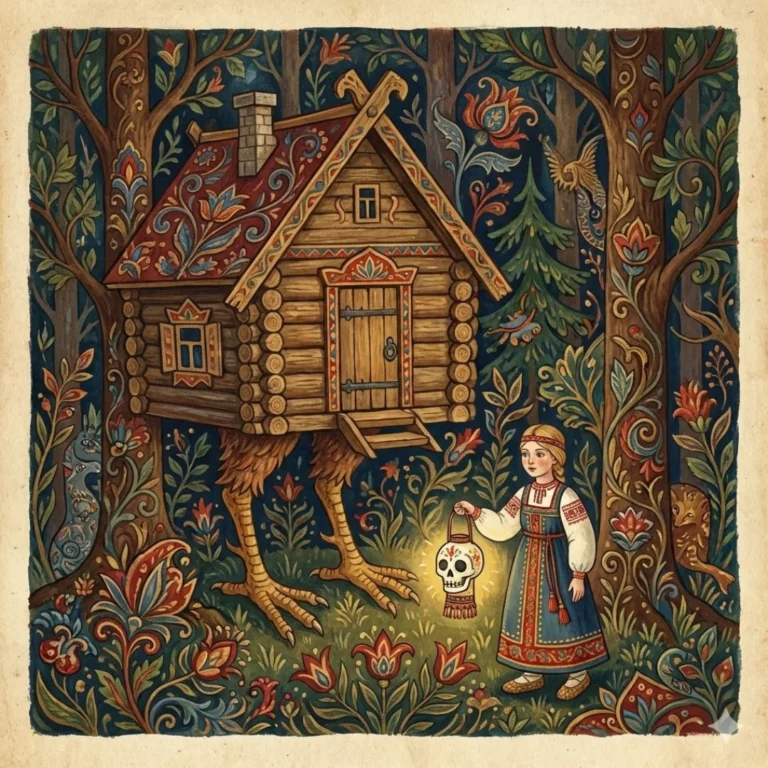
Prince Ivan captures a Firebird’s feather but must quest for the whole bird. With a wise wolf’s help, he learns that greed leads to mistakes, but loyalty and love can overcome betrayal and bring redemption.
In a kingdom where winter winds whispered ancient secrets, there lived a Tsar who treasured three things above all others: his three sons, his magnificent garden, and within that garden, a single tree that bore golden apples. These were no ordinary apples—they shimmered like captured sunlight and granted wisdom and youth to any who ate them.
But each night, something magical and terrible would visit the garden. The Tsar’s guards spoke in hushed voices of a creature made of living fire, whose feathers blazed with all the colors of sunrise, whose eyes sparkled like crystals holding starlight. The Firebird, they called it, and each night it would steal one precious apple.
The Tsar’s heart grew heavy with worry. “My sons,” he said, his voice trembling with both hope and sadness, “I am growing old, and these apples are my greatest treasure. Will you help your father catch this magnificent thief?”
The two eldest sons, proud and confident, agreed at once. But when they took their turns to guard the tree, the soft hooting of owls lulled them to sleep, and the Firebird came and went like a dream they could not remember.
Then came the turn of Ivan, the youngest prince—Ivan Tsarevich, who was often overlooked because he asked questions no one else thought to ask and noticed small, beautiful things his brothers ignored. On his night of watching, Ivan did not sit by the fire with the guards. Instead, he climbed into the apple tree itself, pressing his cheek against the cool bark, feeling the tree’s ancient heartbeat.
At midnight, the garden filled with golden light so bright it seemed the sun had forgotten to set. Ivan opened his eyes and gasped. Descending from the sky was a bird unlike anything he had ever imagined—her feathers blazed with crimson and gold and orange flames that did not burn, her wings sang a melody that made his heart ache with longing for something he could not name.
The Firebird landed on the highest branch and reached for an apple with her graceful beak. Ivan, moving as quietly as falling snow, stretched out his hand and grasped her tail feathers. The Firebird shrieked—a sound both terrible and beautiful—and tore herself free. But Ivan held fast to one single feather that burned in his palm with a light that never dimmed.
“I have it, Father!” Ivan cried, running to the palace, the feather blazing like a torch in the darkness.
The Tsar looked at the feather, and though his eyes filled with wonder, his heart grew heavier still. “My son,” he said quietly, “if you have captured a feather, you must capture the whole bird. For I am old, and I want to see her beauty once more before I die.”
Though the task seemed impossible, Ivan loved his father too much to refuse. He saddled his horse and rode into the deep forest where pine trees grew so tall they seemed to hold up the sky.
He had ridden for three days when a gray wolf, massive and ancient, stepped onto the path. Ivan’s horse reared in terror and ran. The wolf caught it easily and, with one terrible bite, killed the frightened creature.
Ivan drew his sword, grief and anger burning in his chest. But the wolf spoke in a voice like winter wind through bare branches. “I am sorry, young prince. Your horse was not meant to carry you where you must go. I have taken his life, and so I owe you mine. Climb onto my back, and I will take you to the Firebird.”
Something in the wolf’s ancient eyes made Ivan sheathe his sword. He climbed onto the wolf’s back, and they ran faster than any horse could gallop, faster than eagles fly, until they reached a kingdom of golden towers.
“The Firebird lives in a golden cage in that tower,” the wolf said, his yellow eyes serious and sad. “Take the bird, Ivan. But whatever you do, do not touch the cage. Beauty can be a trap for the greedy.”
Ivan crept into the tower at midnight. There, in a cage of pure gold that sang when moonlight touched it, sat the Firebird. Her feathers were dimmed in captivity, her crystal eyes dulled with sorrow.
Ivan’s heart broke at the sight. He opened the cage door gently. “You are meant to fly free,” he whispered.
But as he reached for the bird, his fingers brushed the golden cage. Oh, how it gleamed! How perfect its craftsmanship! Surely his father would want to see such beauty. His hand closed around it.
Instantly, bells rang throughout the palace. Guards seized Ivan and dragged him before a stern king who looked at him with disappointment rather than anger.
“You are a thief,” the king said, and the word hurt worse than any blow. “But you are young, and young people make mistakes. Bring me the Horse with the Golden Mane from the kingdom beyond the mountains, and I will give you both the bird and the cage.”
The gray wolf was waiting outside, shaking his head. “I warned you, Ivan. Greed makes thieves of us all. But come—I will help you still.”
They traveled to another kingdom where a magnificent horse with a mane of spun gold stood in a silver stable. “Take the horse,” the wolf said. “But do not touch the golden bridle.”
But again, the beauty of the bridle dazzled Ivan’s eyes. He reached for it, and again bells rang, and again he was caught.
This king was older and wiser and sadder. “Young man,” he said, “you have a good heart, but you cannot resist taking what is not yours. Bring me Princess Elena the Beautiful from the castle beyond the edge of the world, and the horse is yours.”
Ivan wept then, and his tears were bitter. “I am not a thief,” he told the wolf. “I only wanted to make my father happy. But each time, I see something beautiful, and I cannot help myself.”
“That,” said the wolf gently, “is because you have not yet learned the difference between possessing beauty and appreciating it. Come. We will find this princess.”
When they found Princess Elena, walking in a garden of white roses, Ivan saw true beauty for the first time. Not the beauty of golden things, but the beauty of kindness in someone’s smile, of wisdom in someone’s eyes, of joy in someone’s laughter. They spoke together for hours, and without meaning to, they fell in love.
“I was sent to take you as a prisoner,” Ivan confessed, unable to lie to her.
“Then I will go with you freely,” Elena said, “for I see you are learning something important.”
The wolf smiled—the first time Ivan had seen him do so. He transformed himself to look like Elena and let the sad king take him away. Then, when the princess and Ivan had escaped far enough, the wolf broke free and transformed again to steal the golden horse. And again, to steal the Firebird.
Ivan returned home with all three treasures, his heart both full and empty. He had succeeded, but he had learned a painful lesson about himself.
But as they neared his home, his two jealous brothers attacked him, stole everything, and left him dying by the roadside.
The wolf found him three days later, barely breathing. With tears in his ancient eyes, the wolf traveled to a spring where healing water flowed from the earth itself. He brought the water back and placed drops on Ivan’s wounds, then on Ivan’s lips.
Ivan opened his eyes. “You could have left me,” he whispered.
“I could have,” the wolf agreed. “But you learned to love something more than gold. That made you worth saving.”
Ivan returned home, not with anger but with truth. He told his father everything—his greed, his mistakes, his brother’s betrayal. The Tsar wept and embraced his youngest son.
“The Firebird is beautiful,” the Tsar said, opening her cage. “But she belongs to the sky.” He released her, and she soared upward, filling the night with flame and song.
Ivan married Princess Elena, and they ruled with wisdom and kindness. The golden horse lived free in the meadows. And sometimes, on clear nights, Ivan would see a light like living fire dancing across the stars, and his heart would fill with joy—not because he possessed it, but because such beauty existed in the world.
And the gray wolf? Some say he still runs through the forest, helping young princes and princesses learn the difference between loving beauty and owning it. For that, as Ivan learned, is the most important lesson of all.
Test Your Understanding
1What made the golden apples in the Tsar’s garden so special?
2Why did the gray wolf help Ivan on his journey?
3What mistake did Ivan keep making during his quest?
4How was Princess Elena different from the other treasures Ivan sought?
5What did the Tsar do with the Firebird at the end of the story?
Frequently Asked Questions
What is the moral lesson of The Firebird and Ivan Tsarevich?
What age is this story appropriate for?
How long does it take to read The Firebird and Ivan Tsarevich?
What culture does this story come from?
Can I use this story for teaching?
Frequently Asked Questions
What is the story of the Firebird and Ivan Tsarevich about?
The Firebird and Ivan Tsarevich is a classic Russian fairy tale about a young prince who must capture a magical Firebird that steals golden apples from his father’s garden. With the help of a wise wolf, Ivan goes on a quest that teaches him lessons about greed, loyalty, love, and redemption.
What is the Firebird in Russian folklore?
The Firebird is a legendary magical creature from Russian folklore whose feathers glow with the colors of sunrise and eyes sparkle like crystals. It is both beautiful and mysterious, often appearing as a thief in royal gardens. The Firebird symbolizes both temptation and wonder in traditional Slavic fairy tales.
What moral lesson does the Firebird and Ivan Tsarevich teach children?
The story teaches that greed leads to poor decisions and unnecessary hardship. It also shows that staying loyal and acting with love can help overcome betrayal and bring redemption. Ivan’s journey reminds readers that wisdom often comes from listening to trusted guides rather than giving in to temptation.
📚 Recommended Books
Handpicked for readers like you
As an Amazon Associate, we earn from qualifying purchases. These recommendations are personalized based on this story's themes and your reading history.
Who is the wise wolf in the Ivan Tsarevich story?
The wise wolf is a magical companion who helps Prince Ivan on his quest to capture the Firebird. Acting as a guide and protector, the wolf offers crucial advice that Ivan must follow carefully. The wolf represents wisdom and loyalty, helping Ivan navigate the consequences of his mistakes throughout the journey.
Is the Firebird story suitable for young children?
Yes, the Firebird and Ivan Tsarevich is suitable for children of most ages. While it contains themes of betrayal and consequence, the story ultimately delivers a positive message about love, loyalty, and redemption. Its vivid magical imagery and adventure make it engaging and entertaining for kids while sharing meaningful life lessons.