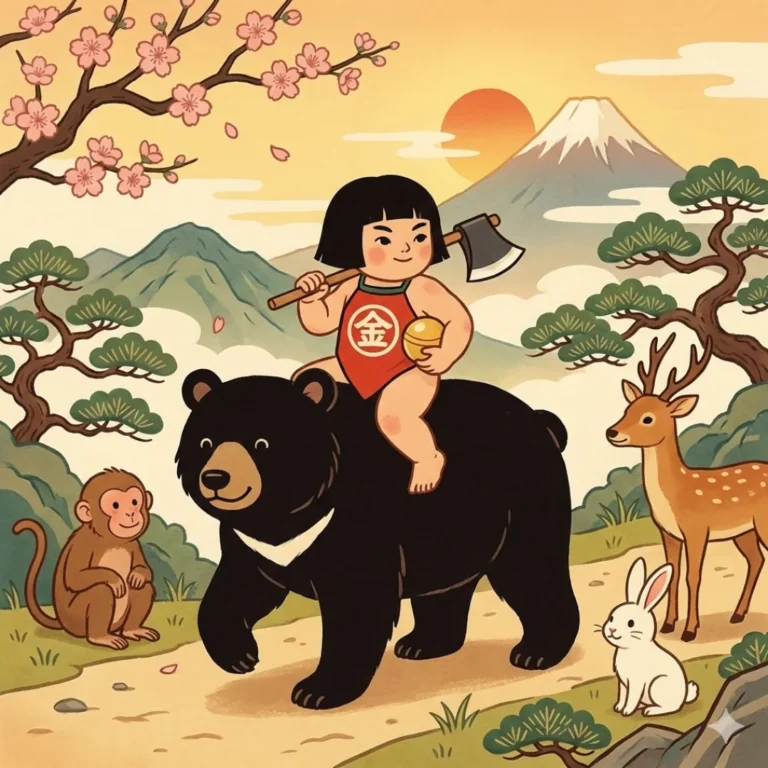
‘The Adventures Of Kintaro, The G…’ is an educational moral story perfect for bedtime reading with children ages 6-12.
High in the misty Ashigara Mountains, where pine trees whispered ancient secrets, a young boy wrestled with a bear. But this was no ordinary wrestling match, and Kintaro was no ordinary boy. “Yoisho! Yoisho!” grunted the massive brown bear as she tried to push the eight-year-old off the grassy platform. Her thick fur rippled with effort, but Kintaro’s feet remained planted firmly, his golden skin glowing in the dappled sunlight. “Nice try, Bear-san!” Kintaro laughed joyfully, his dark eyes sparkling with delight. With a gentle push, he sent the bear tumbling onto the soft moss. She looked up at him in amazed wonder. “You grow stronger every day!” she rumbled, both proud and astonished. “How can a human child be so powerful?” Kintaro helped his furry friend to her feet, his heart swelling with happiness and love for his loyal companions. “Mother says I was born under a special star!” Around them, a deer with magnificent antlers, a red-backed monkey named Red-back, and a long-eared hare named Long-ears clapped and cheered excitedly. These were Kintaro’s only friends in the lonely forests where he lived with his cherished mother, hidden from the world. “My turn!” chittered Red-back eagerly, bouncing with excitement. “All right!” said the deer, stepping forward as umpire. He raised a crimson maple leaf high. “Ready? Begin!” The monkey and Long-ears faced each other, and when the deer dropped his leaf, they rushed together crying “Yoisho, yoisho!” “Red-back! Stand your ground!” called the deer encouragingly. “Long-ears! Be strong!” grunted the bear. The hare gave the monkey a tremendous push, sending him flying off the platform. The poor monkey sat up rubbing his aching back, his face twisted with pain. “Oh, oh! How my back hurts!” Kintaro laughed kindly and pulled out a rice dumpling from his lunch box. “Here’s your prize, Long-ears! You earned it well!” But the monkey felt wounded and disappointed. “I wasn’t fairly beaten! Let us wrestle again!” This time, the cunning monkey grabbed Long-ears by one long ear. The hare yelped in startled surprise, and the monkey flipped him onto his back. Now the monkey received a rice dumpling, which made him so happy and delighted he forgot all about his sore back. After the matches, Kintaro led his friends through the forest. The sweet smell of cedar filled the air. Soon they came to a wide river, its surface dancing with white foam. “How will we cross?” asked Long-ears, his ears drooping with worry and fear. “Wait a moment. I will make a good bridge for you all!” Kintaro approached the tallest tree at the water’s edge. Wrapping his small arms around its rough bark, he pulled with all his might. Once. Twice. Three times! MERI, MERI! CRACK! The enormous tree groaned, its roots tearing from the earth. It toppled forward, falling perfectly across the stream. “There! What do you think of my bridge?” The animals stared in grateful astonishment. “How marvelous you are!” High on a rocky outcrop stood a man dressed as a woodcutter, his face creased with shocked amazement. “This is no ordinary child,” he whispered, filled with wonder. The woodcutter followed them anxiously. Kintaro returned to the small cottage in the pine-woods. “O, Kimbo!” his mother Yama-uba said with a bright, loving smile when he arrived home safely. “How late you are! Where have you been?” “I took my four friends for a wrestling match. We had wonderful fun!” “Who is the strongest of all?” his mother asked, eyes twinkling with pride and joy. “I am the strongest! There was no need for me to wrestle.” Suddenly a voice called: “Next time, take this old man with you!” The woodcutter entered. Kintaro and Yama-uba jumped in frightened surprise, hearts racing with alarm. “Who are you?” demanded Kintaro protectively, though fear fluttered in his chest. “Let us see who has the strongest arm!” The stranger extended his right arm. Kintaro never backed down from a challenge. They grasped hands and wrestled, arm against arm. Kintaro pushed with all his might, face flushed, sweat beading. The stranger’s arm trembled but didn’t bend. For long minutes they strained, perfectly matched. Finally the old man stepped back, impressed and amazed. “A draw! You are indeed very strong! I saw you at the river when you pulled up that large tree. I followed you home.” He bowed respectfully to Yama-uba. “Honored mother, have you thought of taking your child to the Capital to teach him the way of the samurai?” Yama-uba’s eyes filled with sorrowful tears, hands trembling with emotion. “You are kind to take interest. But he is wild and uneducated. I hid him away because of his great strength. I have hoped and wished to see my boy wear two swords, but we have no influential friend at the Capital.” “You need not trouble yourself! I am no woodcutter—I am General Sadamitsu, vassal of the powerful Lord Minamoto-no-Raiko. He ordered me to search for boys of remarkable strength to train as brave soldiers. I have found your son. If you truly wish him to be a samurai, I will present him to Lord Raiko.” Yama-uba’s heart filled with overwhelming joy mixed with profound grief and sorrow. This was the one precious wish of her life—seeing Kintaro a samurai before she died. But losing her beloved son made her chest ache with heartbreaking pain. “I will entrust my son to you,” she whispered sadly, voice breaking. Kintaro’s heart leaped with thrilled excitement. “Oh, joy! Joy! I shall be a samurai!” But seeing his mother’s tears, his joy mixed with deep sadness and love. The general decided to leave at once. Though Yama-uba’s heart felt like breaking, she hid her grief with a strong, brave face, as they say in Japan. “Kimbo,” she said tenderly, cupping his face, voice thick with emotion, “mind and be a good boy. Make me proud.” “I promise, Mother!” Kintaro said fiercely and lovingly, throwing his arms around her, breathing in the familiar comforting scent of pine smoke and sweet rice. “I will never forget you. As soon as I wear two swords, I will build you a beautiful house and take care of you!” All the faithful animals came to see him off—the bear, the deer, Red-back, and Long-ears. “Mr. Kintaro, we wish you good health on your travels,” they said, voices sad but proud. They climbed a tree and watched him grow smaller until he was lost to sight. The bear wiped away a tear with her paw, feeling both proud and sorrowful. Years passed. Kintaro trained harder than ever under Lord Raiko’s wise guidance, learning the way of the sword, the code of honor, and the arts of war. He was determined to make his mother proud. When he earned the right to wear two swords, Lord Raiko named him chief of the Four Braves—the most elite warriors in the land. Kintaro’s heart swelled with grateful pride. Not long after, terrible and frightening news reached the capital: a monstrous cannibal creature had taken residence in the mountains, devouring travelers. People were stricken with terror and fear. Lord Raiko summoned Kintaro. “This is your test. Defeat this monster and prove yourself a true hero.” Kintaro rode into the mountains bravely, heart steady though he felt some fear. When he found the monster’s cave—a dark mouth reeking of sulfur—he took a deep, calming breath. Drawing his sword, which sang as it left its sheath, he charged inside courageously. The battle was fierce and terrifying. The monster was hideous and powerful, but Kintaro’s speed and strength, honed by years of wrestling bears and pulling down trees, served him well. With one clean, decisive strike, he defeated the monster, cutting off its great head and ending its reign of terror. When he returned carrying proof of his victory, the people cheered and wept with joyful relief, throwing flowers at his feet. Kintaro had become the greatest hero in Japan. Great was the power and honor and wealth that came to him. But he never forgot his cherished promise. The first thing he did was build a comfortable, beautiful home with a garden of chrysanthemums and a view of distant mountains. Then, heart racing with excited anticipation and love, he traveled back to the Ashigara Mountains, to the small cottage where his beloved mother still waited hopefully. “Mother!” he called, and Yama-uba rushed out, face shining with overjoyed, grateful tears. “My son! You remembered!” She could barely speak through happy sobs. “I will always remember,” said Kintaro tenderly, now a grown man but still the same devoted boy who had played with bears. His eyes were wet with tears of love and happiness. “Come with me to the capital.
Frequently Asked Questions
What is the moral lesson of The Adventures Of Kintaro, The G…?
What age is this story appropriate for?
How long does it take to read The Adventures Of Kintaro, The G…?
What culture does this story come from?
Can I use this story for teaching?
Frequently Asked Questions
Who is Kintaro and what is his story about?
Kintaro is a legendary Japanese folk hero known for his extraordinary strength. In this children’s story, he is a young boy living in the Ashigara Mountains who befriends forest animals and embarks on adventures. The tale explores themes of kindness, courage, and friendship, making it a wonderful moral story for kids ages 6 to 12.
What age group is The Adventures of Kintaro suitable for?
The Adventures of Kintaro is designed for children ages 6 to 12. It works especially well as a bedtime story, combining exciting action with meaningful moral lessons. The language is engaging and accessible, making it easy for parents to read aloud or for older children to enjoy independently.
What moral lessons does the Kintaro story teach children?
The Kintaro story teaches children the value of kindness, loyalty, and using your strengths to help others rather than harm them. Through Kintaro’s friendships with forest animals and his adventures, kids learn about empathy, bravery, and the importance of treating every living creature with respect and love.
📚 Recommended Books
Handpicked for readers like you
As an Amazon Associate, we earn from qualifying purchases. These recommendations are personalized based on this story's themes and your reading history.
Is Kintaro based on a real Japanese legend?
Yes, Kintaro is rooted in Japanese folklore and is one of the country’s most beloved folk heroes. Traditionally depicted as a golden-skinned boy of superhuman strength raised in the mountains, he eventually becomes a loyal samurai warrior. This story reimagines his childhood adventures in a child-friendly, educational format.
What makes The Adventures of Kintaro a good bedtime story for kids?
The Adventures of Kintaro combines vivid storytelling, lovable animal characters, and gentle moral lessons — perfect ingredients for a bedtime story. The mountain setting feels magical yet calming, and Kintaro’s warmhearted personality gives children a positive role model to dream about, encouraging both imagination and good values before sleep.