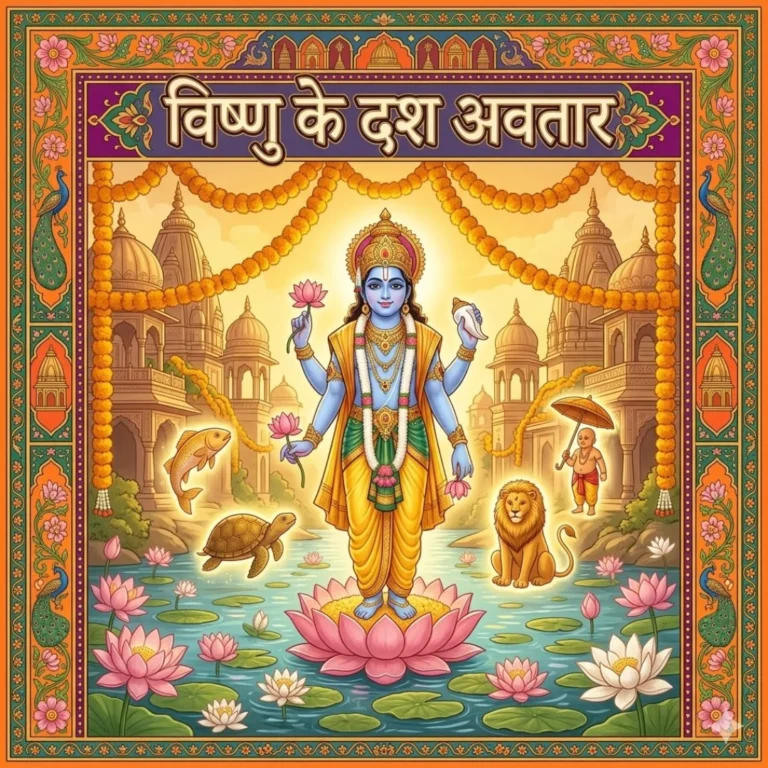
‘The Guardian Who Wears Many Forms’ is an educational moral story perfect for bedtime reading with children ages 6-12.
The Guardian Who Wears Many Forms
In the beginning, when the cosmos was young and stars were still learning to shine, three great deities maintained the balance of all existence. Brahma the Creator dreamed new worlds into being with each breath. Shiva the Destroyer danced the old ones into stardust with his cosmic dance. And between them stood Vishnu the Preserver, whose task was the hardest of all—to protect the good, maintain dharma, and ensure that the universe neither spiraled into chaos nor froze into lifeless order.
Young Priya sat cross-legged on her grandmother’s veranda, where jasmine vines curled around weathered wooden posts and filled the cooling evening air with sweetness so thick you could almost taste it. The old boards creaked comfortably beneath them. Somewhere in the garden, crickets had begun their twilight song.
“Nani,” she asked, watching her grandmother’s gnarled fingers sort rice in a wide brass plate that caught the lamplight, “why do people say Lord Vishnu has so many forms? Isn’t he just one god?”
Grandmother smiled, the wrinkles around her eyes deepening with joy. She lifted a handful of rice grains and let them fall back into the plate with a soft, pattering sound. “Ah, that’s a wonderful question, my clever child. Let me tell you about the Dashavatara—the ten times Vishnu came to Earth wearing different forms, like an actor changing costumes for different plays. But each costume was perfect for what needed to be done.”
“Tell me! Please!” Priya scooted closer, the wooden floor warm beneath her, her eyes bright with anticipation.
“Long, long ago,” Grandmother began, her voice taking on the rhythm of ancient storytelling that her mother and grandmother had used before her, “during the great flood that nearly destroyed all knowledge, darkness covered the world like a heavy blanket. Rain fell for years without stopping—water rising, rising, swallowing temples and mountains alike. Can you imagine? Rain hitting the water so hard it sounded like a thousand drums.”
“How scary!” Priya whispered.
“Yes. And worse—a demon named Hayagriva had stolen the sacred Vedas, the holy books of wisdom that held all knowledge. Without them, humans would forget everything—how to pray, how to live righteously, how to tell right from wrong, even their own names.”
“That’s terrible!” Priya gasped, her hand flying to her mouth.
“It was. So the sage Manu, standing in his boat as water lapped at his feet, prayed desperately: ‘Lord Vishnu, help us! Knowledge itself is drowning!’ And do you know what happened?”
Priya shook her head, entranced, leaning forward so much she almost toppled.
“In the churning flood waters, dark and cold and angry, appeared a tiny golden fish—Matsya. It gleamed like a piece of the sun that had fallen into the ocean. And it spoke with a voice like temple bells ringing across water: ‘I am small now, but I will grow. Tie your boat to my fin, and trust me.’”
“A talking fish!” Priya’s eyes were wide as full moons.
“Manu did as the fish instructed, his hands shaking as he tied the rope. And Matsya grew—first as big as a whale, then as big as a mountain, then larger than imagination itself! The fish pulled Manu’s boat through the raging flood, its golden scales flashing beneath the waves. It dove deep into the dark waters where no light reached, defeated the demon in the crushing depths, and returned the Vedas safe and dry, not a single page damaged.”
“A fish saved all knowledge?” Priya breathed.
“A fish that was Vishnu in disguise,” Grandmother corrected gently. “You see, he chose the form the moment needed—what better to navigate a flood than a fish? That’s the wisdom of it, child. The solution matched the problem perfectly.”
She continued, her hands never stopping their patient sorting, the brass plate singing softly. “The next time, the gods and demons were churning the cosmic ocean, trying to extract the nectar of immortality. They used Mount Mandara as a churning stick, wrapped with the great serpent Vasuki as a rope. Back and forth, back and forth they pulled, the mountain spinning. But oh! The mountain began to sink into the ocean floor! The whole effort—which could bring great blessings to the world—was about to fail.”
“What did Lord Vishnu do?”
“He became Kurma, a giant tortoise bigger than islands, and dove beneath the churning ocean with a splash that created tidal waves. On his hard shell, harder than diamonds, he held up the entire mountain! Can you imagine? For thousands of years, he stayed there, perfectly still, the ocean churning above him, his shell bearing the weight of a mountain and all the gods and demons pulling on it, while they churned and churned. At last the nectar emerged, glowing like liquid starlight, along with the moon that lights our nights, and the divine cow Kamadhenu, and many other treasures.”
Priya tried to imagine a tortoise big enough to hold a mountain. Her face scrunched up with the effort. Her grandmother laughed, a sound like wind chimes, and patted her hand.
“But perhaps the greatest challenge,” Grandmother’s voice grew serious, “came during the time of the demon Hiranyakashipu. This demon was so powerful, he’d done such severe penance that the gods granted him a special boon—he couldn’t be killed by man or beast, inside or outside, during day or night, on earth or in sky, by any weapon forged by gods or men.”
“Then how could anyone stop him?” Priya’s voice trembled.
“That’s exactly what the tyrant thought! He grew so arrogant, so swollen with power, that he declared himself the only god. His voice boomed through his palace: ‘I am the supreme lord! No one may worship Vishnu!’ He forbade anyone to pray to any deity but himself. But his own son, little Prahlada, who was only as old as you, loved Vishnu with all his pure heart and refused to stop praying.”
“His own father was mean to him?” Priya looked shocked, her hand clutching her grandmother’s arm.
“Terribly mean. Hiranyakashipu tried everything to make Prahlada stop worshipping Vishnu—threw him off cliffs into jagged rocks below, put him in with wild elephants whose tusks were sharp as spears, even tried to poison his food with venom that could kill a hundred men. But each time, Prahlada survived, protected by his unshakable faith. His father’s hatred grew hotter than forge fires.”
“That’s so unfair!”
“Yes. Finally, furious beyond reason, the demon demanded: ‘If your precious Vishnu is everywhere as you claim, is he in this pillar?’ And he struck the palace pillar with his iron mace—CRASH! The sound echoed through the palace like thunder.”
Grandmother paused dramatically, her eyes gleaming. Priya leaned forward so far she was practically in her grandmother’s lap. “What happened? What happened?”
“The pillar exploded! Marble and gold flew everywhere! And out stepped Narasimha—half man, half lion, neither one nor the other! His mane was golden fire that crackled and sparked, his claws sharp and curved as diamond sickles, his eyes blazed like twin suns, and his roar shook the very stars in their celestial courses!”
Priya shivered with delicious fear.
“He grabbed the demon at twilight—neither day nor night, when the sun kissed the horizon. He held him on the threshold of the palace—neither inside nor outside, where the door meets the world. He placed him across his lap—neither earth nor sky, suspended in between. And he used his claws—no weapon at all, just what he was born with—to defeat the tyrant once and for all. Every single part of the boon was kept perfectly, yet justice was still done!”
“Because Vishnu found a way around the rules!” Priya clapped her hands, the sound sharp in the jasmine-scented evening.
“Exactly. He’s always finding the way, always solving the puzzle.” Grandmother smiled proudly, her gold nose ring glinting. “And you know what’s interesting? Sometimes, the form he chose wasn’t fierce at all. Sometimes wisdom works better than strength. Once, there was a king named Bali who had conquered all three worlds—heaven, earth, and the underworld—through his righteousness and power. He was actually a good king, generous and just, but his power had grown so great it threatened the cosmic balance. The gods worried in their celestial halls.”
“What could Vishnu do? You can’t punish someone for being good and successful!”
“Indeed! That’s why this avatar teaches us something special. Vishnu came as Vamana, a tiny dwarf Brahmin boy, barely as tall as your knee, with a gentle face and innocent eyes. During Bali’s great ritual, when the king was granting wishes to holy men, this small boy approached the mighty king and asked in a soft, humble voice: ‘Great king, you who are so generous, I ask only for as much land as I can cover in three small steps.’”
“That’s not much at all!” Priya said.
“That’s exactly what King Bali thought! He laughed warmly—not a mean laugh, but a kind one—and agreed immediately. ‘Of course, little one! Take your three steps!’ But the moment Bali poured water on the boy’s hands to seal the promise, the dwarf began to grow. He grew and grew and grew until he was taller than mountains, taller than clouds, taller than the sky itself! His first step covered the entire Earth—forests, oceans, deserts, cities—all in one stride. His second step covered all the heavens where the gods dwell. And for the third step, there was nowhere left to step but on King Bali’s head—gently but firmly pushing him down to rule the underworld.”
“That seems mean, Nani!” Priya protested. “He was a good king!”
“Ah, but here’s the beautiful part, child. King Bali wasn’t angry. He understood what Vishnu was teaching him. He bowed his head willingly and said, ‘Lord, I recognize you. Thank you for this lesson.’ You see, Vishnu had taught him that no matter how great our power or goodness, we must remain humble. Even our virtues can become pride if we’re not careful. And Bali accepted his new kingdom with grace, learning the lesson perfectly. Vishnu was so pleased that he blessed Bali, promising that one day he would return to greater glory—but only after he’d truly mastered humility.”
The evening sky had turned from gold to purple to deep indigo while they talked. Priya noticed her grandmother had finished sorting the rice, the brass plate shining in the lamplight like a small moon.
“Did Vishnu only come in ancient times, Nani?” Priya asked quietly, a hint of sadness in her voice.
“No, child. The beautiful thing is he kept coming when the world needed him. He came again as Prince Rama of Ayodhya, who walked barefoot from his palace to exile in the forest without a single complaint, though he could have been king. Who fought the ten-headed demon king Ravana to rescue his beloved wife Sita. Who ruled with such perfect justice that even today, thousands of years later, people still say ‘Ram Rajya’ when they dream of a kingdom where everyone is happy and treated fairly.”
“I know that story!” Priya said excitedly, bouncing slightly. “We celebrated Diwali for when Rama returned home! We lit all those diyas with the ghee that smelled so good!”
“Yes! The lights welcomed him home.” Grandmother’s face glowed with the memory. “And Vishnu came yet again as Krishna—oh, Krishna! What can I say about Krishna that songs haven’t already sung?” Her voice became tender. “As a baby, he defeated demons with his tiny dimpled hands. As a boy, he played tricks on the milkmaids and stole butter from the highest shelves—but with such a mischievous smile that no one could stay angry! He danced with the gopis under the full moon, and played his flute so sweetly that even the Yamuna River stopped flowing to listen, the water hanging silent in its banks.”
“Really? The river stopped?”
“That’s what the stories say. And as a young man, on the battlefield of Kurukshetra, he spoke the Bhagavad Gita to the warrior Arjuna—truths so profound that scholars still study them today, finding new meanings. He showed that the divine could be joyful, playful, wise, and fierce all at once. That God could be your friend, your teacher, your child, your beloved.”
“How many times has Vishnu come?” Priya asked, trying to count on her fingers.
“Ten major avatars in all, though some wise people say there are countless minor ones—little interventions we never even notice. We’ve talked about Matsya the golden fish, Kurma the mountain-bearing tortoise, and Varaha the mighty boar who rescued Earth when a demon dragged her into the cosmic ocean. We talked about Narasimha the fierce man-lion, Vamana the dwarf who became a giant, and before Rama there was Parashurama the warrior sage who fought for justice. Then Rama the perfect king, and Krishna the divine teacher.”
“That’s only eight, Nani!”
“The ninth,” Grandmother said softly, her voice respectful, “was Buddha, the enlightened one who sat beneath the bodhi tree and taught compassion to all beings, who showed that truth wears many robes and speaks many languages. Some say he taught that even suffering has purpose, and that kindness is the greatest strength.”
“And the tenth?” Priya whispered, almost afraid to ask.
“Ah, Kalki hasn’t come yet.” Grandmother’s voice carried both hope and mystery. “When the world falls into its darkest age—when dharma is almost completely forgotten, when evil seems to have won, when good people hide in fear and cruelty walks openly in daylight—then Vishnu will come one last time, riding a white horse with a mane like silver fire, carrying a blazing sword that shines like the sun, to end the dark age and begin the world anew, fresh and clean as the first day.”
They sat in comfortable silence, watching fireflies blink like fallen stars in the darkening garden. The jasmine scent grew stronger in the cooling air. A night bird called softly from the mango tree.
Finally, Priya said slowly, working it through, “Nani, I understand now. Vishnu isn’t changing who he is—he’s just wearing the right form for what needs to be done. Like you wear your best silk sari for temple and simple cotton for working in the garden. The same Nani, different clothes.”
Grandmother’s face lit up with such joy that she looked young again. She hugged Priya tight. “Exactly right, my brilliant girl! The actor is always the same, but the role changes to fit the play. What matters isn’t the form—fish or tortoise, dwarf or giant, man or lion. What matters is always the purpose: protecting dharma, defeating evil, saving the good, restoring balance.”
“So if evil comes in our time,” Priya said, her voice growing stronger with understanding, “Vishnu would come in a form that works for our time? Maybe not a fish or a lion, but whatever is needed?”
“That’s the promise,” Grandmother nodded firmly. “Whenever dharma declines, whenever evil rises, whenever good people need protection—the Guardian appears in whatever form is needed. Sometimes fierce as Narasimha, sometimes gentle as Krishna’s flute. Sometimes huge as the cosmic Vamana, sometimes tiny as baby Rama. Sometimes obvious, bursting from pillars in glory, sometimes disguised so well we don’t recognize him until later. But always there, always watching, always protecting.”
Priya thought about this, her young mind working through the implications. “Then we don’t have to be afraid of problems that seem too big to solve?”
“No, dear child. No, we don’t.” Grandmother’s voice was firm and warm as sunlight. “Because the Lord who could become a fish to swim the flood, a tortoise to bear a mountain’s weight, a lion to defeat an invincible demon, a dwarf to humble a king—that same Lord sees our troubles too. And just as he found the perfect form for every other age, he’ll find the perfect way to help us in ours. The universe is not indifferent. It has a Guardian.”
“What should we do while we wait for help?” Priya asked practically.
Grandmother pulled Priya close, the jasmine scent wrapping around them both like a blessing. “We do our dharma, child. We try to be good, honest, kind—not because we’ll be rewarded, but because it’s right. We protect what’s just and speak against what’s wrong, even when it’s hard. We remember that we’re not alone in this task—the universe itself bends toward justice, because the Preserver is always preserving, always watching, always ready to step in when the moment is exactly right.”
“In whatever form is needed,” Priya whispered, wonder in her voice.
“In whatever form is needed,” Grandmother agreed, her hand warm on Priya’s head.
Above them, stars wheeled in their ancient dance, the same stars that had watched Vishnu become a fish, a tortoise, a lion, a dwarf, a king. Somewhere in the cosmic ocean, perhaps Vishnu rested on the great serpent Shesha, watching over all the worlds with eyes that never truly sleep. Or perhaps he walked among people right now, in some ordinary form no one recognized, doing small kindnesses that prevented disasters no one would ever know had been coming.
The point wasn’t to know which form he wore. The point was to trust that protection was woven into the very fabric of existence—sometimes obvious as a lion bursting from a pillar with a roar that shook the stars, sometimes subtle as a kind word at the perfect moment, or a thought that changed everything.
“Come, child,” Grandmother said, standing with the brass plate of perfectly sorted rice. “Let’s cook dinner. Even talking about gods and avatars, we must still do our human work—that’s our small dharma, the one we were born to protect.”
Priya helped her grandmother to the kitchen, her bare feet padding softly on the worn wooden floor, her mind full of golden fish and mountain-bearing tortoises, fierce lions and humble dwarves. She carried with her the comforting knowledge that the universe had a Guardian who wore many forms but never forgot his purpose: to preserve the good, protect the just, and ensure that in the great cosmic story of existence, love and righteousness would always, always find a way to win.
Even if that way looked like a fish.
Even if it took a thousand years.
Even if it seemed impossible.
The Guardian would find a way. He always had. He always would.
That was the promise written in the stars.
Frequently Asked Questions
What is the moral lesson of The Guardian Who Wears Many Forms?
What age is this story appropriate for?
How long does it take to read The Guardian Who Wears Many Forms?
What culture does this story come from?
Can I use this story for teaching?
Frequently Asked Questions
What is ‘The Guardian Who Wears Many Forms’ about?
It’s an educational moral story about Lord Vishnu and his many avatars, told through a grandmother-granddaughter conversation. Set in a cozy evening on a veranda, the story uses Hindu mythology to teach children about dharma, protection, and how goodness can take many forms. It’s ideal for kids aged 6 to 12.
Why does Lord Vishnu have so many forms or avatars?
According to Hindu mythology, Lord Vishnu takes on different forms — called avatars — to protect the good, restore dharma, and maintain balance in the universe. Each form is suited to the specific challenge or evil of its era. This story explores that concept in a child-friendly, engaging way through storytelling.
Is ‘The Guardian Who Wears Many Forms’ a good bedtime story for kids?
Yes, absolutely. It’s written specifically as a bedtime moral story for children ages 6 to 12. The gentle, descriptive setting and warm grandmother-granddaughter dynamic create a calm, soothing tone perfect for winding down at night while also sparking curiosity about mythology and values.
📚 Recommended Books
Handpicked for readers like you
As an Amazon Associate, we earn from qualifying purchases. These recommendations are personalized based on this story's themes and your reading history.
What moral or lesson does this story teach children?
The story teaches children about dharma — the idea of living rightly and protecting what is good. Through the mythology of Lord Vishnu, kids learn that goodness can adapt and show up in many forms, and that preserving balance and kindness in the world is one of life’s most important responsibilities.
Who are the three main deities mentioned in this Hindu mythology story?
The story introduces the Hindu trinity: Brahma the Creator, who dreams new worlds into existence; Shiva the Destroyer, who dissolves the old through his cosmic dance; and Lord Vishnu the Preserver, whose role is to protect the good and maintain dharma — the central focus of ‘The Guardian Who Wears Many Forms.’