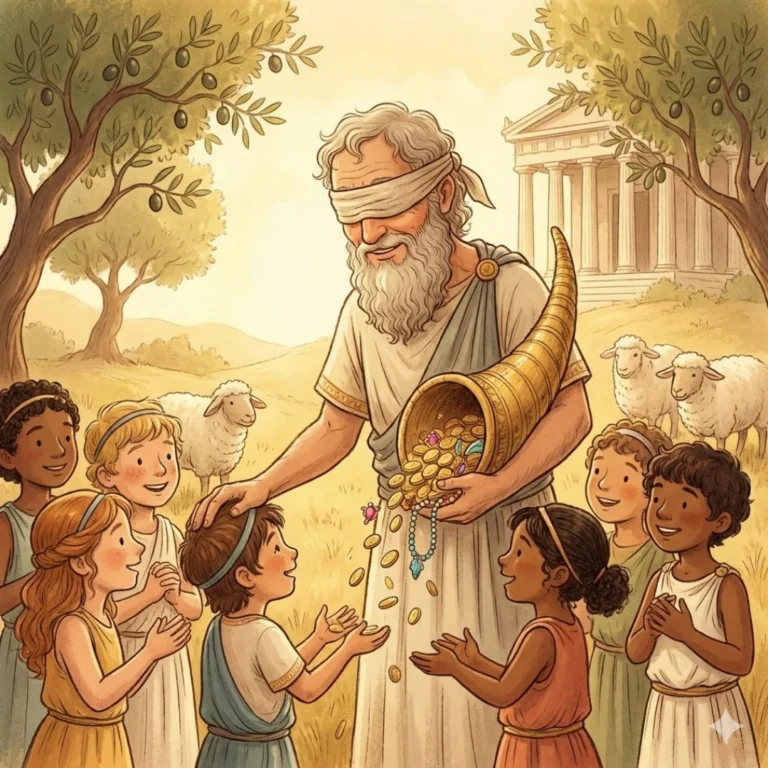
Share this engaging bedtime story with kids ages 6-12 to teach valuable life lessons.
In the golden fields of ancient Greece, where wheat swayed in gentle breezes that smelled of honey and earth, and olive trees dotted the sun-baked hillsides, the goddess Demeter walked among her beloved crops. Her hands, warm from the midday sun, touched each stalk of grain with care. She was the goddess of the harvest, and all growing things flourished under her watchful gaze.
One day, Demeter met a kind mortal farmer named Iasion. His fields weren’t the largest, and his stone cottage wasn’t the grandest, but his heart was generous and his laughter rang out like music across the dusty valleys.
“Lady Demeter,” Iasion said, bowing respectfully when he recognized the goddess in his field, his rough hands still clutching his wooden plow. “What brings you to my humble farm?”
“I come where love for the earth grows strong,” Demeter replied, her voice warm as summer rain pattering on thirsty soil. “You care for your crops as I do. That makes you special, Iasion.”
Over time, Demeter and Iasion became close friends, and eventually, they had a son. But this wasn’t an ordinary child. From the moment he was born, baby Plutus glowed with a strange, golden light that filled the room like lamplight reflecting off polished bronze. When he cried, the sound echoed like coins clinking together in a leather purse. When he laughed, the air shimmered as if filled with precious gems catching sunlight.
“He’ll be the god of wealth,” Demeter announced, holding her infant son close, feeling his unusual warmth against her chest. “All the riches of the earth—gold, silver, jewels hidden deep below—shall answer to him.”
But as Plutus grew, Demeter noticed something troubling. Her son couldn’t see. His eyes, though bright as polished gold coins, were blind.
“Mother, why can’t I see the world like others do?” young Plutus asked one evening, reaching out his hands to feel the cool grass beneath him, his fingers exploring each blade.
Demeter sighed, running her fingers through his golden hair, which felt like silk threads. “It’s part of who you are, my son. You’ll understand when you’re older.”
As Plutus grew into a young god, he developed other unusual traits. His legs were weak and twisted, making him walk with a pronounced limp. Each step took effort, and he moved slowly, leaning heavily on a wooden staff carved from an ancient olive tree, its surface worn smooth from use.
“Why do I walk so slowly, Mother?” Plutus asked, struggling to keep up as Demeter walked through the fields, his breathing labored.
“Because wealth should come slowly,” Demeter explained gently, slowing her pace. “Good things take time to grow, just like my wheat takes seasons to ripen. Quick riches rarely last, my dear.”
But there was more. From Plutus’s shoulders sprouted magnificent golden wings that sparkled in the sunlight like a thousand tiny mirrors. They rustled softly with each breath he took, feathers gleaming. They were beautiful but seemed almost mocking given his difficulty walking.
“If I have wings, why can’t I fly whenever I wish?” Plutus wondered aloud, touching the soft feathers, which felt like warm silk beneath his fingertips.
“Because wealth leaves quickly,” Demeter said sadly, her voice heavy with ancient wisdom. “When riches depart, they fly away faster than you can imagine. People work years to gain wealth, but it can vanish in a moment—stolen, lost, or spent.”
When Plutus came of age, Zeus himself assigned him his divine duty. “You will distribute wealth among mortals,” the king of gods declared, his voice booming like thunder across Mount Olympus. “Go forth and bestow gold, silver, and riches where they’re needed.”
Plutus nodded eagerly and set off on his mission. But because he was blind, he couldn’t see who truly deserved wealth and who didn’t. He stumbled through the mortal world, his weak legs making progress painfully slow, and gave his gifts to whoever happened to be nearby when he finally arrived.
One day, Plutus came limping slowly into a bustling town, his staff tapping against the cobblestones. The first person he encountered was a lazy merchant who spent his days cheating customers and hoarding money in hidden chests.
“Who’s there?” Plutus called out, unable to see, only hearing footsteps approaching.
“I’m just a poor, hardworking merchant,” the man lied smoothly, his voice dripping with false humility. “I’ve struggled all my life and barely have bread to eat.”
“Then take this!” Plutus said cheerfully, and suddenly the merchant’s pockets overflowed with gold coins that clinked heavily, spilling onto the street. But before the merchant could even thank him, Plutus’s wings unfurled with a whoosh of air, and he flew away in a rush of golden feathers, leaving the undeserving man rich beyond measure.
The next town Plutus visited took him weeks to reach, limping step by painful limping step along dusty roads. By the time he arrived, exhausted and footsore, he encountered a kind widow who spent her days caring for orphaned children, giving them warm bread even when she had barely enough flour for herself.
“Who approaches?” the widow asked kindly, seeing the young god struggling up her stone path, his face flushed with effort.
“I am Plutus. I bring wealth,” he said tiredly, leaning heavily on his staff.
“Oh, how wonderful!” the widow exclaimed, her worn face lighting up with hope. “I could use help feeding these hungry children.”
But just then, a goat bleated nearby, the sudden sound startling Plutus. His wings sprang open reflexively with a loud snap, and before he could give the widow anything, he found himself flying away into the bright sky, the wind rushing past his ears.
“Wait! Come back!” the widow called desperately, but Plutus was already gone, carried off by his own uncontrollable wings, growing smaller and smaller in the distance.
This happened again and again. Plutus would limp slowly to one place, spending days or weeks traveling, his feet developing blisters, then give wealth to whoever he met first—often people who didn’t deserve it—before his wings would carry him quickly away, frequently before he could help those who truly needed his gifts.
One evening, Plutus returned to his mother, frustrated and sad, tears streaming down his golden cheeks. “Mother, I’m terrible at my job! I can’t see who deserves wealth. I give riches to greedy people while kind people get nothing. What should I do?”
Demeter hugged her son close, smelling the dust of his travels in his hair. “My dear Plutus, you teach mortals an important lesson, even if you don’t realize it.”
“What lesson?” Plutus asked, confused, wiping his eyes.
“You show them that wealth isn’t fair,” Demeter explained softly, her voice gentle as a breeze through barley. “It doesn’t always go to the most deserving. It comes slowly but leaves quickly. It’s often foolish in who it chooses. That’s why mortals must learn not to judge others by riches alone.”
“But that seems wrong!” Plutus protested, his voice rising.
“Perhaps,” Demeter agreed, stroking his hair. “But it teaches people to value things wealth can’t buy—kindness, love, friendship, honest work. When people see wealth going to unworthy individuals, they learn that being rich doesn’t make someone good. And when good people remain poor, others are inspired to help them.”
Plutus thought about this for a long moment, listening to the evening crickets chirping in the fields. “So my blindness serves a purpose?”
“Everything about you serves a purpose,” Demeter assured him, squeezing his hand warmly. “Your slow arrival reminds people that good things take time. Your quick departure reminds them not to take wealth for granted. Your blindness reminds them that money doesn’t recognize worth. You’re not failing at your job, my son. You’re doing exactly what you were meant to do.”
Plutus made his home deep in the earth’s bowels, in vast caves filled with gleaming gold that reflected torchlight, sparkling silver that chimed when touched, and precious gems of every color imaginable—ruby red, emerald green, sapphire blue. The underground halls echoed with the steady drip of water over ancient treasure, and the smell of rich, damp earth filled every shadowy chamber.
Because Plutus dwelt so deep underground, near the realm where precious metals and gems are born from the earth itself, mortals sometimes confused him with Aïdes, the lord of the underworld. Both gods lived in the darkness below, both were associated with what lies hidden beneath the surface. But while Aïdes ruled over departed souls, Plutus commanded the material riches buried in stone and soil.
There, surrounded by all the wealth in the world, Plutus waited. When it was time, he would limp slowly upward through winding tunnels to bring riches to the surface, then fly quickly away again on his golden wings.
Over time, mortals came to understand Plutus’s strange nature. They learned to work hard, knowing wealth would come slowly if it came at all. They learned to save carefully, knowing riches could fly away in an instant like startled birds. And most importantly, they learned to measure a person’s worth not by gold in their pockets but by kindness in their hearts and honesty in their dealings.
“Mother was right,” Plutus would often say to himself in his underground palace, running his hands over smooth coins and rough gemstones, feeling their weight and texture. “I may be blind, lame, and foolish, but I teach the world what truly matters. And that’s worth more than all the gold I carry.”
And so Plutus continues his work to this day, distributing wealth blindly and unequally, arriving slowly on aching legs but departing swiftly on golden wings, reminding everyone who seeks riches that true treasure isn’t found in golden coins but in good character, honest work, and the love of family and friends.
Frequently Asked Questions
What is the moral lesson of The Blind God of Wealth: Plutus’…?
What age is this story appropriate for?
How long does it take to read The Blind God of Wealth: Plutus’…?
What culture does this story come from?
Can I use this story for teaching?
Frequently Asked Questions
Who is Plutus, the blind god of wealth, in Greek mythology?
Plutus is the Greek god of wealth and abundance, said to be the son of Demeter and the mortal farmer Iasion. According to myth, Zeus made Plutus blind so he would distribute wealth randomly rather than only to good or deserving people, which is why riches don’t always go to the most virtuous.
What life lessons does the story of Plutus teach kids?
The story of Plutus teaches children that wealth isn’t always fair or deserved, that generosity and hard work matter more than riches, and that true happiness comes from the heart rather than material possessions. It’s a great bedtime story for kids ages 6-12 to spark conversations about money and values.
Who are Demeter and Iasion in this Greek mythology story for kids?
Demeter is the Greek goddess of the harvest who nurtures all growing things. Iasion is a kind-hearted mortal farmer she meets in her fields. Though his farm is small, his generosity and love for the earth capture Demeter’s heart, and together they become the parents of Plutus, the god of wealth.
📚 Recommended Books
Handpicked for readers like you
As an Amazon Associate, we earn from qualifying purchases. These recommendations are personalized based on this story's themes and your reading history.
Is this story of the blind god of wealth appropriate for young children?
Yes, this story is designed for kids ages 6 to 12. It uses gentle, imaginative language set in ancient Greece to make mythology accessible and engaging. The moral themes around wealth, fairness, and kindness are presented in a way that’s easy for young readers or listeners to understand and discuss.
Why is Plutus depicted as blind in Greek mythology?
Zeus blinded Plutus deliberately so he couldn’t see who truly deserved wealth. This mythological detail explains why riches sometimes go to selfish or undeserving people rather than the kind and hardworking. It’s an ancient way of addressing the age-old question of why life doesn’t always seem fair.