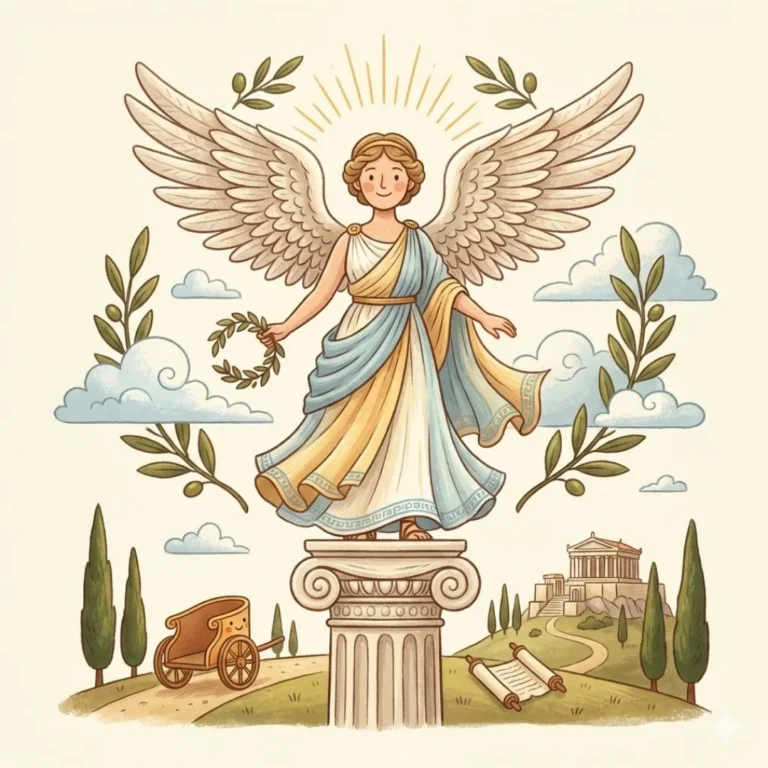
This moral story for children ages 6-12 combines entertainment with important values.
High above the mortal world, where clouds drift like sheep across an endless blue pasture and the air tastes thin and crisp, there lived a goddess whose very name meant triumph. Nike, daughter of the mighty Titan Pallas and the river nymph Styx, was born with magnificent white wings that could carry her faster than any eagle, swifter than any wind.
From the moment Nike could fly, feeling the rush of air beneath her feathers, she understood her purpose. Whenever someone worked hard, trained diligently, or faced challenges with courage/” title=”More stories about courage”>courage, Nike would soar down from the heavens to crown their efforts with success.
“Mother,” young Nike asked one day as she stood beside the dark waters of the River Styx in the underworld, “why do I have these wings when you don’t?”
Styx, whose name mortals spoke in hushed tones when making solemn oaths, smiled at her daughter. The river behind her flowed black as midnight, its waters cold and reflecting starlight from far above like scattered diamonds. The smell of ancient stone and underground springs filled the air. “Your wings are a gift, my dear. You must be swift to reach those who need victory most. You can’t walk slowly like your father or flow steadily like me. You must fly.”
Nike’s father, the Titan Pallas, nodded his great head, his beard rustling like wind through pine trees. His voice rumbled like boulders rolling down a mountainside. “Victory must come quickly to those who’ve earned it, before doubt creeps into their hearts. That’s why you were given those beautiful wings.”
As Nike grew, she became known across Mount Olympus for her grace and beauty. She wore flowing robes of pure white silk, fastened elegantly on her right shoulder with a golden clasp that gleamed in the sunlight, allowing the fabric to drape across her form like morning mist over a valley. Her clothing rustled softly with each movement. In her left hand, she carried a crown woven from fresh laurel leaves that smelled of mountain slopes and never wilted. In her right hand, she held a palm branch, its fronds rustling with each movement like whispered congratulations.
One day, Zeus himself, the king of all gods, summoned Nike to his throne room. Thunder echoed through the marble halls as she approached, her sandaled feet barely touching the polished floor, which was cool and smooth beneath her toes.
“Nike,” Zeus said, his voice powerful yet warm, making the very air vibrate, “I’ve watched you bring victory to worthy mortals. Your judgment is fair, your speed unmatched. I would like you to stand beside me.”
“It would be my honor, great Zeus,” Nike replied, bowing her head respectfully, feeling her wings fold gracefully against her back.
From that day forward, Nike stood at Zeus’s side during important moments, sometimes perched delicately on a golden ball held in his outstretched palm, life-sized despite the impossible balance. When Zeus needed to reward someone for their achievements, Nike would fly down to deliver the crown of victory.
The goddess Athene, wise and skilled in both warfare and crafts, also requested Nike’s companionship. “Nike,” Athene said, her gray eyes thoughtful and sharp as polished steel, “battles aren’t won by strength alone. Strategy, preparation, and perseverance/” title=”More stories about perseverance”>perseverance matter just as much. Will you help me recognize true victory?”
“I will,” Nike promised, and she began to divide her time between Zeus and Athene, learning from both.
One morning, Nike soared down to watch a young athlete named Alexios training for the Olympic Games. The sun had barely risen, casting long purple shadows across the training grounds, but already sweat dripped down his face, glistening like tiny jewels as he ran lap after lap around the dusty track. The smell of dried grass and earth filled the warm air.
“Why do you train so early?” Nike asked, landing beside him on silent wings. She appeared to him as a kind stranger in white robes that seemed to glow in the dawn light.
Alexios stopped, breathing hard, his chest heaving. “Because I’m not the fastest runner,” he admitted, his voice tired but determined. “Others have longer legs, stronger muscles. But I can work harder. I can practice more.”
Nike smiled, impressed by his honesty. The morning breeze ruffled her wings gently. “Keep training,” she encouraged warmly. “Victory favors those who persevere.”
Days turned to weeks. Nike visited Alexios each morning, sometimes visible, sometimes invisible, watching his progress. She saw him stumble and fall, scraping his knees on rough stone that left red marks. She saw him get back up, dust coating his hands. She saw him run in rain that soaked him to the skin and in scorching heat that burned his shoulders red. She saw him never give up.
Finally, the day of the great race arrived. Athletes from across Greece gathered, their bodies strong and ready, muscles gleaming with olive oil. The crowd buzzed with excitement, their voices rising like bees in a hive. Alexios looked small compared to some competitors, but his eyes burned with determination, bright as coals.
“Nike,” Zeus called from Olympus, his voice reaching her even from the heights, “who do you think will win?”
Nike watched the runners take their positions, saw their tense muscles, heard their controlled breathing. “The one who has earned it most,” she replied.
The race began with a loud trumpet blast that echoed off surrounding hills. Runners shot forward like arrows released from bows, their feet pounding against packed earth. Alexios stayed in the middle of the pack, not leading but not falling behind either. His breathing was steady, his pace measured. Nike flew above, invisible to mortal eyes, her wings beating silently as she watched carefully.
As they rounded the final turn, raising clouds of dust that made spectators cough, the leader began to tire. His early burst of speed had exhausted him. Another runner tried to pass but stumbled on loose pebbles that scattered beneath his feet. Alexios, who had conserved his energy through months of disciplined training, found his strength. His legs pumped faster. His arms swung with perfect rhythm.
“Now!” Nike whispered to herself, and she dove toward Alexios like a shooting star, wind whistling through her feathers. She didn’t touch him—that would be cheating—but her presence filled him with confidence. He could feel victory within reach, could taste it like honey on his tongue.
Alexios surged forward and crossed the finish line first, collapsing to his knees in exhausted triumph, gasping for air that burned his lungs.
Nike descended gently, visible now to all who watched. Her white wings spread wide, catching the golden sunlight and glowing like polished marble. She placed the laurel crown upon Alexios’s sweaty head and handed him the palm branch, its leaves cool against his hot palms.
“You’ve won because you never stopped trying,” Nike announced, her voice clear as a bell ringing across the stadium. “This victory is truly yours.”
The crowd erupted in cheers that washed over them like ocean waves. Alexios looked up at Nike with tears of joy streaming down his dusty cheeks, cutting clean paths through the dirt. “Thank you,” he whispered hoarsely.
“Don’t thank me,” Nike said gently, her voice warm with affection. “Thank yourself. I only acknowledge what you accomplished through your own effort.”
Over the centuries, Nike brought victory to countless mortals. She crowned warriors who defended their homes bravely, their armor clinking as they knelt. She honored craftspeople who perfected their skills, their hands rough but skilled. She celebrated scholars who never stopped learning, their eyes bright with knowledge. And she always, always rewarded those who persevered through difficulty.
The people of Athens loved Nike so much that they built a magnificent temple for her on the Acropolis, the highest point in their city. The temple’s marble columns gleamed white against the blue sky, smooth and cool to the touch, visible for miles. Citizens would climb the steep steps, their sandals slapping against worn stone, to offer prayers and thanks for victories great and small.
“Thank you, Nike, for helping my crops grow despite the drought,” a farmer would say, his voice rough from working under the hot sun.
“Thank you, Nike, for giving me strength to keep trying when learning seemed impossible,” a young student would whisper, clutching a wax tablet.
Nike heard every prayer, though she appeared to very few. But she felt joy knowing that people understood her message: victory isn’t about being the biggest, strongest, or smartest. It’s about working hard, never giving up, and doing your very best.
Sometimes Nike would visit the temple at night, walking silently among the offerings left by grateful mortals, her bare feet silent on the cold marble floor. She would touch a child’s crude drawing of her with wings spread wide, the papyrus soft beneath her fingertips. She would read letters from soldiers thanking her for helping them protect their families, their words carefully scratched into clay tablets. She would smell the sweet incense burned in her honor, its spicy-sweet scent filling the still air.
“This is why I was given wings,” Nike would say to herself, her heart full, “to remind everyone that victory is possible, no matter how difficult the challenge seems.”
In one corner of her temple, Nike kept a special task. Using a sharp bronze stylus that scraped against metal with a satisfying scratch, she would inscribe important victories on polished shields that reflected lamplight. Not just battle victories, but personal ones too: a child learning to read, a widow rebuilding her life, an elderly man forgiving an old enemy. Nike recorded them all, because she knew that every victory, large or small, deserved recognition.
When the Romans encountered Greek culture, they fell in love with Nike and gave her a new name: Victoria. They built sanctuaries for her in Rome, especially on the Capitoline Hill where marble temples gleamed white in the Italian sunshine. After great military successes, generals would commission beautiful statues of Victoria and place them in temples, thanking her for guiding their armies.
The Emperor Augustus himself, after winning the great Battle of Actium, erected the most magnificent statue of Victoria ever created. It stood tall and proud, carved from creamy marble, her wings spread wide, her face serene, reminding everyone that victory comes to those who fight wisely and bravely.
Every year on the twelfth day of April, festivals were held in Nike’s honor. People wore laurel crowns that smelled fresh and green, carried palm branches that rustled in spring breezes, and told stories of victories they’d achieved or witnessed. Athletes competed while crowds cheered, scholars debated while listeners nodded, and artists displayed their best work while admirers gasped. It was a day to celebrate not just winning, but the hard work and dedication that made winning possible.
To this day, Nike’s temple still stands on the Acropolis in Athens, weathered but beautiful, its columns reaching toward the sky. Birds nest in its corners, their songs echoing off ancient stone, and tourists from around the world climb the ancient steps, worn smooth by countless feet, to see where the goddess of victory was once honored.
And though mortals can no longer see her with their eyes, Nike still watches over the world. Whenever someone perseveres through difficulty, whenever someone achieves something through dedication and hard work, whenever someone refuses to give up despite setbacks, Nike is there.
She hovers on silent wings, invisible but present, ready to place an invisible laurel crown on deserving heads. Because victory, true victory, never goes out of style. It’s as important today as it was thousands of years ago when a beautiful winged goddess first taught the world that success belongs to those who earn it through persistence, courage, and unwavering determination.
Frequently Asked Questions
What is the moral lesson of Nike: The Winged Goddess of Victory?
What age is this story appropriate for?
How long does it take to read Nike: The Winged Goddess of Victory?
What culture does this story come from?
Can I use this story for teaching?
Frequently Asked Questions
Who is Nike the Winged Goddess of Victory in Greek mythology?
Nike is the Greek goddess of victory, daughter of the Titan Pallas and the river nymph Styx. She is famous for her magnificent white wings that allowed her to fly faster than any eagle. Nike would descend from the heavens to reward those who showed hard work, courage, and determination.
What age group is the Nike Winged Goddess of Victory story suitable for?
This story is designed for children ages 6 to 12. It combines entertaining Greek mythology with important moral values, making it an ideal read for early and middle-grade readers who enjoy adventure stories with meaningful life lessons about perseverance and courage.
What moral lesson does the Nike goddess story teach children?
The story teaches children that success comes to those who work hard, train diligently, and face challenges with courage. Nike rewards genuine effort rather than luck, encouraging young readers to persist through difficulties and understand that victory is earned through dedication and a brave spirit.
📚 Recommended Books
Handpicked for readers like you
As an Amazon Associate, we earn from qualifying purchases. These recommendations are personalized based on this story's themes and your reading history.
Why does Nike have wings in Greek mythology?
In Greek mythology, Nike’s wings symbolise her ability to swiftly reach anyone in need of victory. According to the story, her mother Styx explains the wings are a gift so Nike can quickly fly to those who deserve success. Her speed ensures that hard work and courage never go unrewarded.
Who are Nike’s parents in Greek mythology?
Nike’s parents are the Titan Pallas, a powerful figure associated with warfare and strength, and Styx, the famous river nymph of the underworld whose name mortals invoked when making solemn oaths. This powerful parentage reflects Nike’s significant role as the goddess of victory in ancient Greek mythology.