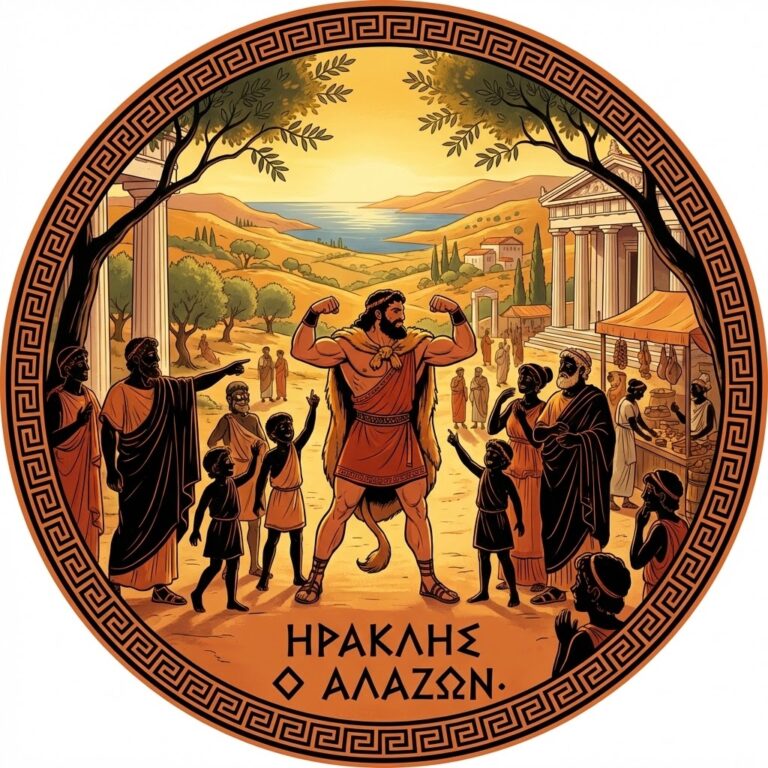
In the golden age of heroes, when the gods still walked among mortals and monsters lurked at the edges of maps, there lived a young man named Alexios in the prosperous city of Argos.
Alexios was not an ordinary young man. His father was said to be none other than great Zeus himself, king of Olympus, who had visited his mother in a shower of golden light. Whether this was true or merely a story his mother told, no one could say for certain—but what everyone COULD say was that Alexios possessed strength beyond any mortal.
By the time he was ten, he could lift a full-grown ox over his head. By twelve, he had wrestled a wild boar to the ground with his bare hands. By fifteen, he had driven a band of giants from the mountain passes above Argos, protecting the city from invasion.
The people of Argos loved him. They showered him with praise, composed songs about his deeds, and hung garlands around his neck wherever he walked. And slowly, without Alexios quite noticing, something began to change inside him.
“I am Alexios, son of Zeus!” he would announce to anyone who would listen—and many who would not. “I am the strongest hero in all of Greece! No monster can stand against me! No challenge is too great!”
His mother, a wise woman named Alcmene, watched this with worried eyes. “My son,” she said to him one evening, as the sunset painted the sky in shades of rose and gold, “the gods do not look kindly upon boasting. Pride comes before a fall—this is what the old stories teach us.”
But Alexios only laughed. “Mother, the gods GAVE me this strength! Why should they not want me to celebrate it? I have earned my glory through my deeds!”
“A truly great man does not need to proclaim his greatness,” Alcmene replied softly. “It speaks for itself.”
But Alexios was young, and the young do not always hear wisdom when it is offered to them.
One morning, a messenger arrived from Delphi, the sacred site where Apollo’s priestess spoke prophecies from the depths of the earth. The Pythia, the Oracle herself, had summoned Alexios to her temple.
Alexios strode into the sanctuary with all the confidence of a young man who has never truly failed. The temple was filled with smoke from sacred laurel leaves, and the air was heavy with mystery. On her three-legged stool above the chasm in the earth, the Pythia sat swaying, her eyes rolled back to show only white.
“Great Oracle!” Alexios called out, his voice echoing off the marble columns. “I am Alexios, son of Zeus, the strongest hero in Greece! Surely you have summoned me for some magnificent quest worthy of my abilities!”
The Pythia’s voice, when she spoke, seemed to come from everywhere and nowhere at once.
“Young hero, son of sky,
Your strength lifts you so high.
But pride, unchecked, will be your fall—
The tallest tree catches the lightning’s call.
Seek the lesson that strength cannot teach:
The wisdom that lies beyond your reach.”
Alexios frowned. “I don’t understand. What lesson? I have already defeated giants and monsters. What more must I prove?”
The Pythia’s attendant, an elderly priest named Philos, stepped forward. His face was grave. “The Oracle speaks of hubris, young hero. Excessive pride that challenges the gods themselves. You must learn humility/” title=”More stories about humility”>humility, or you will face a reckoning.”
“Humility?” Alexios scoffed. “What use is humility to a hero? Should I pretend to be weak? Should I hide my gifts under a basket?”
The priest shook his head sadly. “There is a difference between acknowledging your gifts and being consumed by them. The humble man knows his strengths but also his limitations. He uses his power in service of others, not in service of his own glory.”
But Alexios was already striding out of the temple. “Riddles and warnings!” he muttered. “I have monsters to defeat and glory to win! I have no time for lessons about being LESS than what I am!”
From her smoking throne, the Pythia whispered one final word that followed him out into the sunlight: “Remember…”
Word soon reached Alexios that a terrible creature had been terrorizing the farming villages near Mount Parnassus—a lion of monstrous size, with a hide so tough that no spear could pierce it, and claws that could tear through bronze armor like parchment.
“At last!” Alexios declared. “A challenge worthy of my strength! I shall destroy this beast and add its conquest to my legend!”
But instead of going directly to face the lion, Alexios decided first to visit every village along the way, announcing his intention to save them all. He expected—and received—feasts in his honor, songs sung to his glory, and young men following him like disciples.
“Watch me closely!” he told them. “You will witness the greatest hero of our age defeat this monster single-handedly! Tell your children and your children’s children what you see today!”
By the time Alexios finally reached the lion’s territory, a small crowd of admirers trailed behind him, keeping at what they hoped was a safe distance.
The lion emerged from its cave with a roar that shook leaves from the trees. It was indeed massive—larger than any lion that had ever lived, with eyes that burned like embers and a mane of tangled golden fur. Its muscles rippled beneath that impenetrable hide as it crouched, ready to spring.
Alexios faced it without fear. His strength was the strength of the gods, was it not? He had never met a foe he could not overcome.
The battle was terrible and long. Alexios struck the lion with his fists, each blow carrying the force of a thunderbolt—but the beast’s hide turned even those mighty punches aside. The lion’s claws raked his shoulders, drawing blood that shocked him with its reality. He had never been wounded before.
For the first time in his life, Alexios felt something he had never experienced: doubt.
But the watchers were there, his admirers, the people who had come to see his glory. He could not fail in front of them. He could NOT.
With a desperate cry, Alexios hurled himself upon the lion, wrapping his arms around its massive neck. If he could not pierce its hide, he would strangle it instead. The lion thrashed and twisted, its claws tearing at his back, but Alexios held on with all the strength his divine heritage had given him.
At last, the great beast shuddered and fell still.
Alexios rose from the lion’s body, blood streaming from a dozen wounds, and raised his fists to the sky. “Victory!” he roared. “I am Alexios, greatest of heroes! Nothing can stand against me!”
But among the watching crowd, an old woman shook her head and said quietly to her grandson: “He thanks himself, but not the gods. He celebrates his glory, but not the good he has done. This does not end well.”
In the weeks that followed, Alexios wore the lion’s impenetrable hide as a cloak, its head serving as a hood, its paws tied across his chest. He strode through the countryside like a god among mortals, and wherever he went, he demanded recognition, tribute, and praise.
“Do you not know who I am?” he would cry if anyone failed to bow. “I am Alexios, slayer of the Parnassian Lion! I wear its hide as proof of my unmatched strength!”
He began to neglect the duties of a hero. When farmers came asking for help against bandits, he waved them away, saying such small matters were beneath him. When a mother begged him to rescue her daughter from a river cave, he laughed and said she should find a lesser hero for lesser tasks.
“I am meant for great deeds,” he proclaimed. “For monsters and miracles, not for the small troubles of ordinary people!”
And high on Mount Olympus, the gods watched and frowned.
It was Athena, goddess of wisdom, who finally spoke. “Father Zeus,” she said, “this boy is YOUR son. Will you not teach him?”
Zeus, who had been silently observing, nodded his great head. “He has been given every warning and ignored them all. But you are right, daughter. A lesson must be taught—not in cruelty, but in love. Sometimes we must lose everything to understand what truly matters.”
“What will you do?”
“I will take his strength,” Zeus said simply. “For a time. Long enough for him to learn what he should have understood all along.”
Alexios awoke one morning feeling strange. His body, which had always thrummed with divine power, felt… ordinary. Heavy. Weak.
He tried to lift his lion-skin cloak and found that he could barely raise it from the ground.
Panic seized him. “What is this? What has happened to me?”
He staggered outside, where he found the old priest Philos from Delphi waiting for him, as if he had known to come.
“Your father, Zeus, has withdrawn his gift,” Philos said gently. “Your divine strength is gone. You are now as other men—no stronger than a common farmer, no mightier than a shepherd boy.”
“No!” Alexios clutched at his arms, his chest, as if he could find the missing power hidden somewhere in his body. “This cannot be! I am a HERO! I am the greatest—”
“You WERE strong,” Philos interrupted. “Now you must discover what else you are. What remains when strength is gone? What makes a hero when the power fails?” He paused. “This is the lesson the Oracle spoke of. The lesson strength could not teach you.”
Alexios sank to his knees, tears streaming down his face. “But… but who am I, if not the strongest? What good am I to anyone?”
“That,” said Philos, not unkindly, “is exactly what you must discover.”
The months that followed were the hardest of Alexios’s life.
Without his strength, he could not hunt monsters. Without his glory, the crowds who had followed him melted away. Even his lion-skin cloak was too heavy for him to wear, so he bundled it up and left it in a corner, a reminder of what he had lost.
He was forced to find work as a common laborer, carrying water and stacking stones. Tasks that once would have taken him moments now left him exhausted by midday. His muscles ached, his back bent with effort, and he understood for the first time what ordinary people endured every day of their lives.
One afternoon, as he rested by a well, an old farmer sat down beside him.
“You look troubled, young man,” the farmer said.
Alexios almost laughed bitterly. “You have no idea, grandfather. I used to be… someone. Now I am nothing.”
The farmer was quiet for a moment. “I heard stories about you, you know. About Alexios the hero.”
Alexios winced. “Then you know what I have lost.”
“What I remember,” the farmer said slowly, “is that when my son went to ask for your help against the bandits who burned our barn, you turned him away. You said our troubles were too small for you.”
Shame flooded through Alexios like cold water. He remembered that day. He remembered the young man’s desperate face, and how he had laughed and walked away.
“I… I’m sorry,” he whispered. “I was wrong.”
The farmer studied him for a long moment. “The strange thing is, after you refused, a traveling merchant helped us instead. He was an old man with a bad leg, and he couldn’t fight the bandits himself. But he organized the village, taught us how to set traps and work together. We drove the bandits off ourselves.” He smiled. “Sometimes the greatest help isn’t doing something FOR people—it’s helping them find the strength to do it themselves.”
Alexios thought about this for a long time.
Slowly, over months and seasons, Alexios began to change.
He learned to LISTEN—really listen—to the people around him. He discovered that everyone carried burdens, not just physical ones but burdens of the heart and spirit. He found that a kind word, a patient ear, or a willing hand could sometimes accomplish more than all his former strength combined.
He helped the village women carry water—not because he was strong enough to lift great quantities, but because he was willing to make many trips. He sat with the elderly and heard their stories, learning wisdom from lives longer and more experienced than his own. He played with children, learning to be gentle and patient.
When a young boy scraped his knee and began to cry, Alexios did not tell him to be brave or stop weeping. Instead, he knelt beside the boy and said, “That looks like it hurts. Tell me about it.” And the boy, feeling heard and understood, found that his pain eased.
“You have changed,” the old priest Philos said one day, appearing again as if from nowhere. “I see it in your eyes.”
“I understand now,” Alexios said quietly. “My strength was never really mine. It was a gift, and I treated it as if I had earned it, as if it made me better than others. But we are all gifted in different ways. The farmer has gifts I will never possess. The healer, the teacher, the mother—each has abilities I lack. My strength made me unusual, but it did not make me superior.”
“And what have you learned about being a hero?”
Alexios thought carefully. “A hero is not someone who does great deeds for glory. A hero is someone who uses whatever gifts they have in service of others—even if those gifts are small, even if no one sings songs about it afterward.” He paused. “The traveling merchant who helped the farmer’s village was more of a hero than I ever was, because he acted out of kindness, not pride.”
Philos smiled. “Your father will be pleased.”
That very night, as Alexios slept beneath the stars, he dreamed of Mount Olympus. In the dream, he stood before a great throne of clouds and lightning, and upon it sat Zeus himself, king of the gods.
“My son,” Zeus said, his voice both thunder and gentle rain. “You have learned what I hoped you would learn.”
“Father,” Alexios said, bowing his head—not in subservience, but in genuine respect. “I understand now why you took my strength. I was not ready for it. I used it to elevate myself rather than to help others.”
“And now?”
“Now I know that strength is a tool, not an identity. Whether you return it to me or not, I will try to be a true hero—one who serves rather than one who boasts.”
Zeus smiled, and the smile was like sunrise breaking over mountains. “Your strength was never truly gone, my son. I merely… hid it from you for a time, so you could see what lay beneath. It is yours again—but I trust you will use it more wisely now.”
Alexios woke to find his body thrumming once more with divine power. He stood and stretched, feeling strength flow through him like a river through its banks. But this time, instead of immediately seeking out monsters to conquer, he walked into the village and asked a simple question:
“Is there anything I can do to help?”
The rest of Alexios’s life was full of great deeds, but they were different from his early adventures. He still fought monsters when monsters threatened the innocent, but he fought them quietly, without demanding praise. He still performed feats of incredible strength, but he used that strength to build as much as to destroy—raising bridges, clearing fields, lifting stones that would have taken ordinary workers days to move.
When people thanked him, he would say only, “I am glad I could help. But the real heroes are you, who work every day to feed your families and care for each other.”
He never again turned away anyone who asked for help, no matter how small the task seemed. He learned that helping a child find a lost lamb was as important as slaying a monster—perhaps more important, because it taught the child that help would come when needed, that the world was not as frightening as it sometimes seemed.
And when young warriors came to him, boasting of their strength and seeking to learn from the great hero, Alexios would tell them this story—his own story—and ask them a question:
“What kind of hero do you want to be? One who is remembered for his power, or one who is remembered for his kindness? In the end, monuments crumble and songs are forgotten, but the good we do lives on in the hearts of those we helped.”
Many years later, when Alexios finally departed for the Elysian Fields, the people did not remember him as “the strongest hero in Greece.” They remembered him as “Alexios the Gentle,” the hero who had time for everyone, who used his great gifts in humble service of the small and the weak and the forgotten.
And that, in the end, was the greatest glory of all.
This tale from ancient Greece teaches us that *true greatness lies not in our abilities but in how we use them. Alexios was born with divine strength, but that strength became a curse when he used it for his own glory rather than in service of others. Only when he lost his power and learned humility did he become a true hero.
The story also illustrates the Greek concept of hubris—the dangerous pride that makes us think we are better than others, or even equal to the gods. The ancient Greeks believed that hubris always led to nemesis (downfall), because the universe itself seems to humble those who become too proud.
Most importantly, the tale shows us that everyone has gifts worth giving. When Alexios lost his strength, he discovered that kindness, patience, and willingness to listen were also valuable gifts—perhaps more valuable than any feat of might. We do not need to be strong or talented or famous to be heroes; we only need to use whatever we have in service of others.
Central to Greek moral thinking was the concept of hubris (excessive pride) and its inevitable consequence, nemesis (divine retribution). The Greeks observed that those who became too proud inevitably fell. This was not merely punishment but a restoration of cosmic balance.
The Oracle at Delphi was the most important religious institution in ancient Greece. The Pythia, priestess of Apollo, delivered prophecies while in a trance state. The famous inscriptions at Delphi included “Know Thyself” and “Nothing in Excess”—both relevant to this story’s themes.
The Greek virtue of sophrosyne (moderation, temperance, wisdom) was the opposite of hubris. A person with sophrosyne knew their place in the cosmic order, respected the gods, and avoided excess of any kind.
Many Greek heroes were said to be children of gods and mortals. This divine heritage gave them extraordinary abilities but also subjected them to the attention—and sometimes the correction—of the gods.
This story follows the pattern of the hero’s journey found in many Greek myths: a hero of great ability must undergo trials and transformation before achieving true heroism.
Mythological Sources:
The story draws on the traditions surrounding Heracles (Hercules) and other Greek heroes, as preserved in:
– Hesiod’s Theogony and Works and Days (8th century BCE) – On the nature of gods and mortal virtue
– Homer’s Iliad and Odyssey (8th century BCE) – Examples of heroic hubris and its consequences
– Pindar’s Odes (5th century BCE) – Celebrations of heroic achievement balanced with humility
– Greek tragedy (Aeschylus, Sophocles, Euripides) – Dramatizations of hubris leading to downfall
Story Elements from Greek Tradition:
1. Divine parentage – Zeus fathering heroes with mortal women (cf. Heracles, Perseus)
2. The Oracle’s warning – Prophecies often warned against pride (cf. Oedipus)
3. The invulnerable lion – Directly references the Nemean Lion of Heracles’s labors
4. Temporary loss of divine favor – Gods testing mortals (cf. Odysseus’s journey)
5. Transformation through suffering – Central theme of Greek tragedy
6. Service to others as true heroism – Greek philosophical tradition
Historical Context: The ancient Greeks were deeply concerned with questions of virtue, excellence (arete), and the proper conduct of life. Their myths often served as moral teaching tools, illustrating the consequences of various behaviors and the nature of true heroism.
The Problem of Pride: While self-confidence is valuable, the Greeks understood that excessive pride (hubris) leads to blindness about one’s own limitations. This remains relevant today, when social media and celebrity culture can encourage boasting and self-promotion.
Discussion Starters:
1. Have you ever known someone who bragged too much about their abilities? How did it make you feel about them?
2. Is it wrong to be proud of your accomplishments? What’s the difference between healthy pride and hubris?
3. Can you think of quiet heroes in your life—people who help others without seeking recognition?
4. If you suddenly lost something you were really good at, what would be left? What else makes you valuable?
1. Why do you think Alexios’s mother warned him about his pride, but he didn’t listen? (Explores why we often ignore good advice, especially when we’re young)
2. The Oracle’s riddle mentioned “the wisdom that lies beyond your reach.” What wisdom could strength never teach Alexios? (Discusses the limitations of any single ability)
3. When Alexios lost his strength, he asked “Who am I, if not the strongest?” How would YOU answer that question for yourself? (Encourages self-reflection beyond achievements)
4. The traveling merchant who helped the farmers couldn’t fight the bandits himself, but he helped the village save itself. Why might this be better than if a strong hero had simply defeated the bandits? (Explores empowerment vs. dependence)
5. At the end, Alexios was remembered as “the Gentle” rather than “the Strongest.” Which would you rather be remembered as, and why? (Values clarification)
6. Do you think Zeus was right to take away his son’s strength? Was this loving or cruel? (Debates about discipline, natural consequences, and tough love)
– Hubris: Excessive pride or arrogance that leads to downfall; a major theme in Greek tragedy
– Nemesis: Divine retribution or the goddess of revenge; the inevitable consequence of hubris
– Sophrosyne: Greek virtue of moderation, self-control, and wisdom about one’s limitations
– Arete: Excellence or virtue; the quality of being the best version of oneself
– Pythia: The priestess at Delphi who delivered Apollo’s prophecies
– Oracle: A person through whom divine wisdom is communicated, or the place where this occurs
– Elysian Fields: The Greek paradise where heroes went after death
– [Hubris in Greek Mythology](https://www.greekmythology.com/Myths/Hubris/hubris.html) – Concept and examples
– [The Oracle at Delphi](https://www.britannica.com/topic/oracle-religion) – Historical and religious context
– [Heracles/Hercules Mythology](https://www.theoi.com/Heros/Herakles.html) – Source traditions
– [Greek Concepts of Virtue](https://plato.stanford.edu/entries/ethics-virtue/) – Philosophical context
This story draws on authentic Greek mythological traditions and philosophical concepts to explore the timeless lesson that true heroism lies not in strength or glory, but in humble service to others. The themes of hubris and its consequences, central to Greek tragedy and moral teaching, remain profoundly relevant for young readers learning to navigate their own gifts and limitations.*
Test Your Understanding
1What was Theodoros’ attitude like after his victories against the Titans?
Frequently Asked Questions
What is the moral lesson of A Greek hero learns the value of humility?
What age is this story appropriate for?
How long does it take to read A Greek hero learns the value of humility?
What culture does this story come from?
Can I use this story for teaching?
Frequently Asked Questions
What is the story of the Greek hero who learns humility about?
It follows Alexios, a young hero from Argos with godlike strength, who lets fame and praise turn him arrogant. The story traces his journey from boastful pride to genuine humility, showing how even the mightiest heroes can fall when they stop respecting their own limits and the people around them.
What lesson does a Greek hero learning humility teach kids?
The story teaches children that true strength isn’t just physical power — it also means staying humble, listening to others, and recognising your own flaws. Alexios starts believing his own hype, and that pride becomes his greatest weakness, showing young readers that arrogance can undermine even exceptional talent.
Who is Alexios in this Greek mythology story?
Alexios is a fictional young hero from the city of Argos, said to be the son of Zeus. By age fifteen he has already performed incredible feats, but constant praise slowly makes him boastful and reckless — setting up the central conflict of the story.
📚 Recommended Books
Handpicked for readers like you
As an Amazon Associate, we earn from qualifying purchases. These recommendations are personalized based on this story's themes and your reading history.
Is this Greek hero story suitable for children?
Yes, absolutely. The story is written in an accessible, engaging style aimed at younger readers, using classic Greek mythology as a backdrop to deliver a timeless moral lesson. It features adventure, relatable emotions, and age-appropriate challenges without graphic violence.
How does Greek mythology teach the value of humility?
Greek myths frequently show heroes destroyed by hubris — excessive pride that offends the gods and blinds heroes to their own limits. Stories like Alexios’s use that tradition to illustrate how humility protects you, keeps relationships strong, and ultimately makes a hero more effective than arrogance ever could.