This moral story for children ages 6-12 combines entertainment with important values.
Chapter One: The Sacred Grove
In the time before time was counted as we count it now, when the hills of Wales were covered in ancient forests and the stars seemed close enough to touch, there lived a Druid named Taliesin.
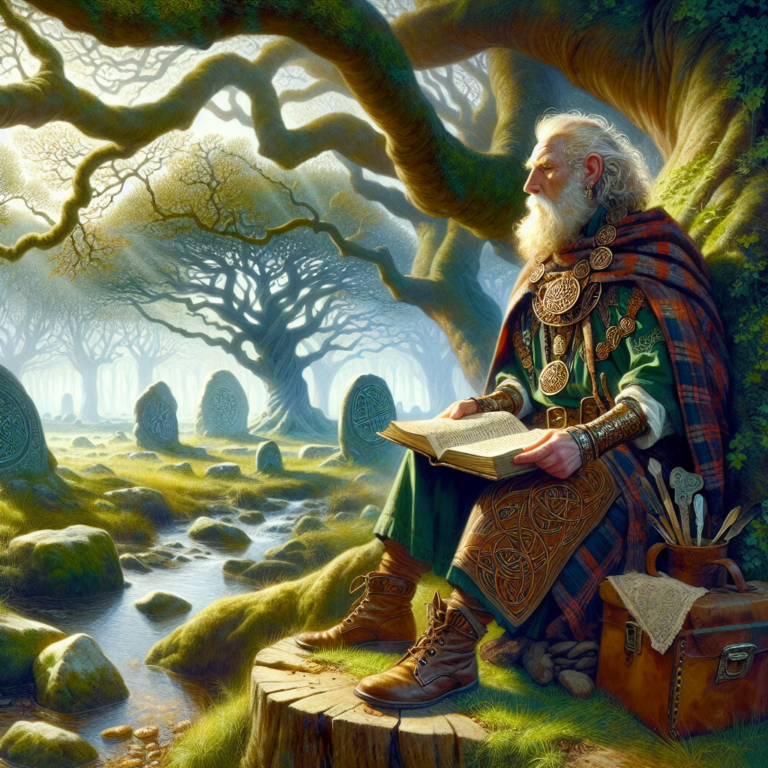
Taliesin was old, some said impossibly old. His beard was white as mountain snow, and his eyes were the deep green of forest pools. He had been chief among the Druids for longer than anyone could remember, keeper of the sacred wisdom that had been passed down from generation to generation since the world was young.
One autumn morning, as mist curled through the sacred grove of oaks, a young girl came seeking Taliesin. Her name was Branwen, and she was twelve years old, with hair as red as rowan berries and a mind as quick as a sparrow.
“Great Druid,” Branwen said, kneeling at the edge of the grove, “I have walked three days to find you. They say you are the wisest person in all of Wales. Will you teach me?”
Taliesin studied her with his ancient eyes. “Why do you seek wisdom, child?”
“Because my village is suffering,” Branwen said. “The crops have failed for three years. The animals sicken. The people have forgotten how to live in harmony with the land. My grandmother says we have angered the spirits of the earth. If there is wisdom that can help my people, I must learn it.”
Taliesin smiled, and his smile was like sunlight breaking through clouds. “That is a good reason, young one. Come, enter the grove. Your training begins.”
Chapter Two: The First Lesson – The Memory of Trees
Branwen followed the old Druid into the heart of the sacred grove. The oak trees here were enormous, their trunks wider than houses, their branches reaching toward the sky like arms raised in prayer. Mistletoe hung from their boughs, its white berries gleaming in the filtered light.
“Tell me, child,” Taliesin said, placing his weathered hand against the bark of the largest oak, “how old do you think this tree is?”
Branwen studied the tree. “A hundred years? Two hundred?”
“This tree was ancient when your grandmother’s grandmother’s grandmother was born. It was here when the Romans came, and it was here when they left. It will be here long after you and I are dust.” Taliesin’s voice was soft, reverent. “This is the first lesson: the trees remember what humans forget.”
He led her around the tree, pointing to marks in the bark, to the patterns of its growth. “See here, where the bark is rough and twisted? That was a terrible winter, long ago, when the rivers froze solid and many people died. And here, where the growth is thick and healthy? That was a year of plenty, when the rains came at the right time and the sun shone with gentle warmth.”
Branwen touched the bark, feeling its rough texture under her fingers. “The tree is like a book?”
“Better than a book,” Taliesin said. “Books can lie. Books can be changed. But the tree simply grows, and its growth tells only truth. This is why we Druids hold our ceremonies in oak groves: the trees are our witnesses, our record-keepers, our connection to the long memory of the land.”
Chapter Three: The Second Lesson – The Language of Water
The next morning, Taliesin led Branwen to a spring that bubbled up from between moss-covered rocks. The water was so clear she could see every pebble at the bottom, and it sang as it flowed, a gentle, endless music.
“Drink,” Taliesin instructed.
Branwen cupped her hands and drank. The water was cold and sweet, with a taste unlike any water she had ever known.
“This spring has flowed from the heart of the mountain for ten thousand years,” Taliesin said. “The water you just drank fell as rain on this mountain when mammoths still walked the earth. It seeped down through rock and soil, filtered and purified, until it emerged here, as pure as starlight.”
He sat beside the spring, and Branwen sat with him.
“Water is sacred to us because water connects everything,” he continued. “The water in this spring will flow to the river, which will flow to the sea, which will rise as mist and fall again as rain, perhaps on your village, perhaps on a distant mountain. Nothing is truly separate. Everything is connected.”
“Is that why my village is suffering?” Branwen asked. “Because we’ve forgotten that we’re connected to the land?”
Taliesin nodded slowly. “Your people have begun to take without giving back. They have cleared forests without planting new trees. They have hunted animals without respect for the spirits of those animals. They have polluted the streams and neglected the old offerings to the earth.”
“What can I do to fix it?”
“You cannot fix it alone. But you can remember the old ways and teach them to others. Come, let us continue.”
Chapter Four: The Third Lesson – The Wisdom of Ancestors
Deep in the grove stood a circle of standing stones, ancient monoliths that had been there since before even Taliesin could remember. Some said they had been raised by giants. Others said they had grown from the earth itself.
“This is where we honor the ancestors,” Taliesin said, leading Branwen into the circle. “Not just our own ancestors, but all those who came before, who learned, who struggled, who passed their knowledge on.”
He sat in the center of the circle, and Branwen sat across from him.
“Close your eyes,” he instructed. “Listen.”
Branwen closed her eyes. At first, she heard only the wind in the trees and the distant call of a crow. But as she listened more deeply, she began to hear something else, a murmuring, like many voices speaking at once, too soft to make out individual words.
“What are those voices?” she whispered.
“They are the echoes of all who have sat in this circle before,” Taliesin said. “Druids, bards, kings, and common folk, all seeking wisdom, all leaving a little piece of themselves behind. When we listen to our ancestors, we learn from their triumphs and their mistakes. We do not have to discover everything anew. We can build upon what they have already learned.”
Branwen opened her eyes. “But how do I know which ancestors to listen to? What if some of them were wrong?”
Taliesin laughed, and his laugh was warm and kind. “You are asking the right questions! Yes, the ancestors were sometimes wrong. They made terrible mistakes. But even their mistakes teach us, if we are willing to learn. The key is not to follow blindly, but to think carefully, to question, and to always ask: ‘Does this bring harmony? Does this respect the balance of all things?’”
Chapter Five: The Fourth Lesson – The Power of Words
As the days grew shorter and the leaves turned gold and red, Taliesin began to teach Branwen about the power of words.
“We Druids do not write our most sacred knowledge in books,” he explained. “We memorize it. We recite it. We sing it. For there is power in the spoken word that the written word cannot match.”
He taught her the old poems, the songs that held the history of their people, the hymns that honored the gods, the stories that explained how the world came to be.
“When you speak these words aloud,” Taliesin said, “you are not merely reciting. You are calling upon the power that created them. You are connecting yourself to every person who has ever spoken them, back through the generations to the very first Druid who shaped them from the raw stuff of language.”
Branwen memorized poem after poem. She learned the Three Illuminations of Truth, the Nine Waves of Manannan, the Twenty-one Qualities of a Good Ruler. Her mind, which she had thought was small, turned out to be vast, capable of holding more than she had ever imagined.
“Words shape the world,” Taliesin told her. “When you name something, you give it power. When you bless, you bring forth good. When you curse, you bring forth harm. This is why Druids are careful with their speech. Every word is a seed, and every seed grows.”
Chapter Six: The Fifth Lesson – The Balance
On the night of the winter solstice, the longest night of the year, Taliesin led Branwen to the top of the highest hill, where they could see the stars wheeling overhead and the dark land stretching away in all directions.
“You have learned much,” Taliesin said. “But there is one final lesson, the most important of all.”
Branwen waited, shivering in the cold wind.
“The world is in balance,” Taliesin said. “Day and night. Summer and winter. Life and death. Growth and decay. None of these is good or bad by itself. All are necessary. When humans try to have only day without night, only growth without rest, only taking without giving, the balance is disrupted, and suffering follows.”
“Like in my village,” Branwen said quietly.
“Like in your village. Your people tried to take more than the land could give. They forgot that they were part of the balance, not masters of it. Now the land is trying to restore itself, and it may take years before harmony returns.”
Branwen looked out at the dark land. “Can I help restore it?”
“You already are. By learning these lessons, by carrying this wisdom, by teaching others, you are doing your part. You cannot force the balance to return. But you can live in a way that supports it. You can remind others that they are not separate from the earth, but part of it.”
The first light of dawn began to touch the eastern sky.
“The solstice passes,” Taliesin said. “From this day, the light returns. The darkness has reached its peak and must now give way. This is the promise of the balance: no matter how dark the night, the dawn will come.”
Chapter Seven: The Return
When spring came, Branwen returned to her village. She was different now, older in spirit if not in years, and the villagers gathered to hear what she had learned.
She did not preach or command. Instead, she told stories. She sang the old songs. She showed them how to honor the spirits of the land, how to take only what they needed, how to give back what they could.
It took time, years and years, but slowly, the village began to heal. The crops grew stronger. The animals recovered. The streams ran clear again.
And Branwen became a Druid in her own right, teaching the next generation, passing on what Taliesin had given her, keeping the chain of wisdom unbroken.
The Red Book of Hergest, in which these stories were written down many centuries later, still exists today. It sits in a library at Oxford, its pages carefully preserved. But the wisdom it contains does not live in the pages. It lives in everyone who reads the stories, understands the lessons, and passes them on.
Moral Lessons
- We are not separate from nature but part of it, and our wellbeing depends on living in balance and harmony with the natural world. Wisdom is not owned but passed on, growing richer with each generation that receives and shares it.
Test Your Understanding
1Who kept the ancient book of tales known as the Red Book of Hergest?
Frequently Asked Questions
What is the moral lesson of The Wise Druid’s Enchanting Quest for the sacred wisdom of Wales?
What age is this story appropriate for?
How long does it take to read The Wise Druid’s Enchanting Quest for the Sacred Wisdom of Wales?
What culture does this story come from?
Can I use this story for teaching?
Frequently Asked Questions
What age group is The Wise Druid’s Enchanting Quest for the Sacred Wisdom of Wales suitable for?
This story is written for children ages 6 to 12. It combines entertaining fantasy storytelling set in ancient Wales with important moral values, making it a great read-aloud choice for parents or an independent read for older kids in that age range.
What is the Sacred Wisdom of Wales story about?
The story follows Taliesin, an ancient Druid, and Branwen, a twelve-year-old girl who travels three days to seek his teaching. It explores themes of wisdom, perseverance, and the value of knowledge through a magical adventure set in the ancient forests of Wales.
What moral lessons does this Welsh druid story teach children?
The story teaches children values like determination, humility, and the importance of seeking knowledge. Branwen’s three-day journey to find the wise druid shows that wisdom is worth pursuing, and the Druid’s questioning encourages children to think about why learning and understanding truly matter.
📚 Recommended Books
Handpicked for readers like you
As an Amazon Associate, we earn from qualifying purchases. These recommendations are personalized based on this story's themes and your reading history.
Is this story based on real Welsh mythology or folklore?
The story draws inspiration from Welsh mythology, using the legendary bard Taliesin and the name Branwen, both rooted in Welsh legend. While it is a fictional moral tale rather than a retelling of a specific myth, it is richly flavoured with authentic Celtic and Druidic tradition.
How long does it take to read this druid wisdom story to a child?
Based on the chapter structure and typical story length for the 6–12 age group, you can expect a reading time of around 10 to 20 minutes. It works well as a bedtime story or classroom read-aloud, with natural chapter breaks that make it easy to pause and discuss the values being explored.