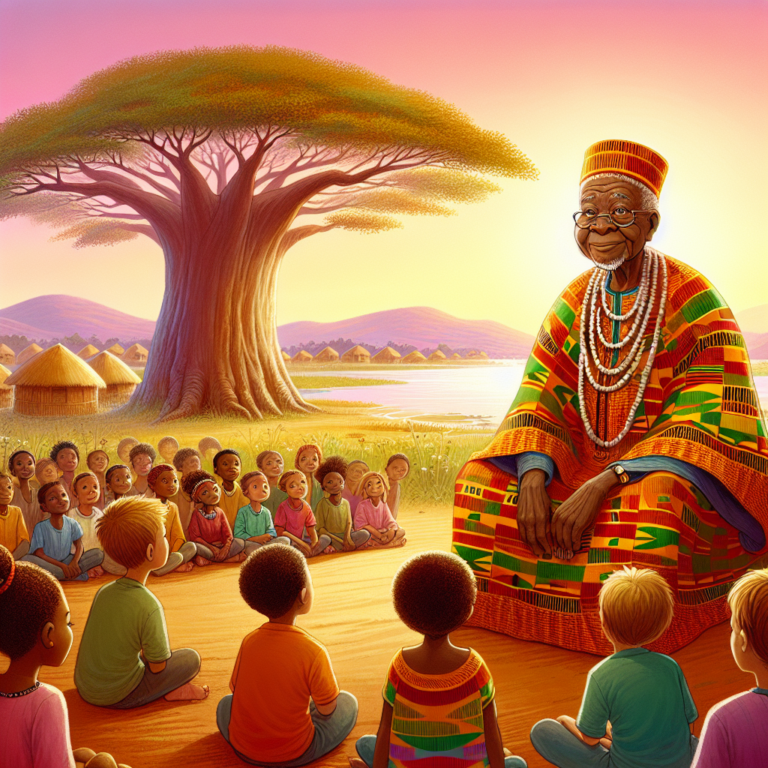
Share this engaging bedtime story with kids ages 6-12 to teach valuable life lessons.
## Chapter One: The Boy Who Wanted Everything Now
In the golden lands of Africa, where the sun rises like a great orange blessing each morning and sets like a farewell gift each evening, there lived a boy named Uzoma.
Uzoma was special – everyone said so. He was stronger than boys twice his age. He could run faster than the wind that sweeps across the savanna. He learned his lessons quicker than any child the village teachers had ever known. By the time he was twelve summers old, he could solve problems that made grown men scratch their heads in confusion.
But Uzoma had a problem that all his gifts could not solve.
He was impatient.
Not the ordinary impatience that makes children squirm when they have to wait for dinner or fidget during long ceremonies. Uzoma’s impatience went deeper than that. He looked at the village elders – the grey-bearded men and women who were consulted for every important decision – and he thought: “Why should I have to wait so many years to be like them? I am already smarter than most of them. Why can’t I have their wisdom/” title=”More stories about wisdom”>wisdom NOW?”
He would sit in the village meetings, watching the elders speak. Their words were slow and measured, carrying the weight of years. When they gave advice, people listened and nodded. When they resolved disputes, both sides went away satisfied.
“I could do that,” Uzoma would think. “If only people would listen to me the way they listen to them.”
But they didn’t listen to him. He was just a boy. And no matter how quick his mind or strong his body, he was treated like a boy.
And this made Uzoma burn with frustration.
## Chapter Two: The Elder Named Jabari
The wisest person in Uzoma’s village was an elder named Jabari.
Jabari was so old that no one could say for certain how many years he had walked the earth. His hair was white as the clouds. His face was a map of wrinkles, each line telling a story. His back was bent from carrying the weight of decades. But his eyes – ah, his eyes were like stars, bright and deep and full of secrets.
When Jabari spoke, even the other elders fell silent. His words were like seeds that, once planted in your mind, would grow into understanding. He never raised his voice, yet somehow everyone heard him. He never argued, yet somehow he always convinced.
The young people of the village were a little afraid of him. Not because he was cruel – he was the kindest person in the village – but because when he looked at you, you felt like he could see straight into your soul.
Uzoma was not afraid of Jabari. But he was fascinated by him.
“Jabari,” he asked one day, approaching the old man who sat in the shade of the great fig tree, “how did you become so wise?”
Jabari smiled slowly. “By living, young Uzoma. By making mistakes and learning from them. By listening more than speaking. By watching the world and letting it teach me.”
“But that takes so long!” Uzoma said. “Isn’t there a faster way?”
Jabari’s smile faded a little. “Why are you in such a hurry, child?”
“Because I want to be wise NOW. I want people to listen to me NOW. I don’t want to wait fifty years to become what you are.”
Jabari was quiet for a long moment. Then he said, “Be careful what you wish for, young one. The fastest path is not always the best path. A fruit that ripens too quickly often rots before it can be eaten.”
But Uzoma wasn’t listening. In his mind, he was already planning how to find a way to become wise without having to wait.
## Chapter Three: The Desperate Request
Weeks passed, and Uzoma’s impatience only grew. He tried everything he could think of to make the adults take him seriously. He offered clever solutions to village problems. He quoted the sayings of the ancestors. He tried to speak in the slow, measured way that the elders spoke.
But still they patted him on the head and said, “What a bright boy! He will be a great man someday.”
Someday. Someday. Always someday, never today.
Finally, Uzoma’s frustration reached its breaking point. He went to Jabari again, but this time his voice was not curious – it was desperate.
“Jabari,” he said, falling to his knees before the old man, “I beg you. I know you have powers that others do not possess. I have heard the stories – how you have healed the sick when all hope was lost, how you have seen the future in your dreams. Please, use your power to help me. Make me old. Make me wise. I cannot bear to wait any longer.”
Jabari looked at the boy kneeling before him, and his ancient eyes filled with sadness.
“Uzoma,” he said gently, “what you ask would be a terrible gift. Youth is precious. To throw it away would be a tragedy.”
“But I don’t want youth!” Uzoma cried. “I want wisdom! I want respect! I want people to listen to me!”
“And you think those things come only with age?”
“Yes! That’s what everyone says! ‘Listen to your elders. Respect your elders. Learn from your elders.’ Well, I’m tired of always being the one who has to listen! I want to be the one who is listened to!”
Jabari was silent for a very long time. The sun moved across the sky. Birds called to each other in the trees. Life went on around them while the old man and the young boy sat frozen in their strange conversation.
Finally, Jabari spoke.
“Very well, Uzoma. If you truly want this – if you are absolutely certain – I will grant your wish. But remember: you asked for this. And once it is done, you cannot take it back.”
## Chapter Four: The Ancient Blessing
Jabari closed his eyes and began to chant in a language older than the village, older than the trees, older than the hills themselves. His voice rose and fell like the wind, and the air around them seemed to shimmer and pulse.
Uzoma felt strange. His skin tingled. His bones ached. His heart beat faster, then slower, then in a rhythm he had never felt before.
The chanting stopped.
Uzoma opened his eyes – and gasped.
His hands, which had been young and smooth, were now gnarled and spotted with age. His legs, which had been strong and quick, felt weak and stiff. His back, which had been straight as a spear, was now bent and aching.
He reached up and touched his face. The skin was loose and wrinkled. He touched his head. His hair was thin and white.
“What – what have you done?” he whispered, his voice cracking and trembling.
“I have given you what you asked for,” Jabari said quietly. “You are now as old as I am. You have lived through all the years between your youth and this moment – your body remembers them, even if your mind does not. The villagers will see you as an elder. They will listen to you, as you wanted.”
“But – but -“
“Go,” Jabari said. “Go and see if wisdom is everything you hoped it would be.”
## Chapter Five: The Elder Uzoma
Uzoma stumbled out into the village, still reeling from what had happened.
The first person he saw was a young woman carrying a water jug. She looked at him and smiled respectfully. “Good morning, Mzee,” she said, using the term of respect for elders.
She didn’t recognize him. Why would she? He looked nothing like the young boy who had run through the village just yesterday.
He walked further. Children playing in the dirt stopped their games to bow their heads as he passed. Men working on their huts nodded to him with respect. Women paused in their grinding to greet him politely.
For a moment, Uzoma felt triumphant. This was what he had wanted! Respect! Attention! Acknowledgment!
But then he saw a group of young people his own age – or what had been his own age yesterday. They were laughing together, chasing each other through the village, their bodies full of energy and joy.
And Uzoma couldn’t join them.
His legs wouldn’t carry him fast enough. His lungs couldn’t take in enough air. His heart couldn’t keep up with the running and playing that had been so effortless just hours ago.
He was old now. And he realized, with a cold shock, that he had given up something precious without even understanding its value.
## Chapter Six: What Wisdom Costs
Days passed, and Uzoma discovered more and more what he had lost.


Yes, people listened to him now. When he spoke at village meetings, they fell silent and paid attention. But the words that came out of his mouth were the same words he would have spoken as a boy – and somehow, they didn’t sound as wise as he had expected.
He knew facts. He knew information. He knew history and philosophy and the sayings of the ancestors. But knowing was not the same as understanding. When people came to him with their problems, he found he didn’t have the answers they were looking for.
“What should I do about my son who won’t listen to me?” a mother asked him.
Uzoma opened his mouth – and realized he had nothing useful to say. He had never been a parent. He had never struggled with a rebellious child. He had the body of an old man, but not the experiences that would have taught him how to advise this worried mother.
“How do I know if I should marry this woman?” a young man asked.
Again, Uzoma was speechless. He had never been in love. He had never navigated the complicated waters of a relationship. He had never known the joy and heartache of choosing a life partner.
And worst of all, he found he no longer had the energy to learn these things. His old body was tired. His old joints ached. His old eyes grew weary long before the day was done.
He had wanted to skip the journey of life and arrive directly at the destination. But he was discovering that the destination without the journey was empty and meaningless.
## Chapter Seven: The Long Night
One night, Uzoma sat alone under the stars, his aged body wrapped in a blanket against the chill.
He thought about everything he had missed by rushing to become old.
He would never fall in love for the first time, feeling his heart race when he saw her smile.
He would never hold his firstborn child, marveling at the tiny fingers and perfect toes.
He would never make mistakes and learn from them, growing stronger with each failure and triumph.
He would never dance at festivals with energy that lasted until dawn.
He would never race his friends across the savanna, the wind in his hair and laughter in his throat.
All of that was gone. Skipped over. Lost forever.
And what had he gained in return? People listened to him – but he had nothing worth saying. People respected him – but he had done nothing to earn that respect. He had the appearance of wisdom without its substance.
Tears rolled down his wrinkled cheeks. For the first time in his life, Uzoma truly understood what he had thrown away.
## Chapter Eight: The Return to Jabari
The next morning, Uzoma went back to Jabari. But this time, he did not approach the old man with pride or frustration. He approached with humility and shame.
“Jabari,” he said, his voice barely above a whisper, “I was a fool.”
Jabari, who had been expecting this visit, nodded slowly. “Tell me what you have learned, Uzoma.”
“I thought wisdom was about knowing things. But it’s not, is it? It’s about having lived things. It’s about the experiences that shape you, the mistakes that teach you, the joys and sorrows that deepen you.
“I wanted to skip to the end of the book, but I’ve discovered that the end of a book means nothing without the chapters that came before.
“I am old now, but I am not wise. I have the appearance of an elder, but inside I am still a child – a child trapped in a body that can no longer do the things children do.”
Jabari listened to all of this, his old eyes glistening.
“Is there anything else?” he asked.
Uzoma took a deep breath. “Yes. I understand now why you were sad when I asked for this. Not because you didn’t want to help me, but because you knew what I was throwing away. You tried to warn me, but I wouldn’t listen.
“I wish – I wish I could take it back. I wish I could have my youth again, even if it meant waiting decades for the wisdom I was so impatient to have. But I know that’s not possible. You said the spell couldn’t be undone.”
Jabari smiled – a real smile, full and warm.
“I said it couldn’t be taken back,” he said. “But that was a test, Uzoma, to see if you were willing to live with the consequences of your choices. The truth is… I never truly made you old. I created an illusion – a vision of what your life would be like if you got your wish. You have been living in a kind of waking dream for these past weeks.”
## Chapter Nine: The Awakening
Uzoma stared at Jabari in shock. “A dream? But it felt so real!”
“The best lessons often do,” Jabari said. He reached out and touched Uzoma’s forehead.
Suddenly, the world seemed to shimmer and shift. The wrinkled hands Uzoma had been staring at became smooth and young again. The aches in his joints vanished. The fog in his mind cleared.
He was a boy again.
Uzoma looked at his hands, flexed his fingers, felt the strength and energy flowing through his young body. He had never been so grateful for anything in his entire life.
“This is the real magic,” Jabari said. “Not the power to make you old, but the power to make you appreciate what you have. Most young people must wait until they actually are old to understand what youth is worth. I have given you that understanding now, while you still have time to use it.”
Uzoma fell to his knees and wept – but these were tears of joy, not sorrow.
“Thank you,” he said. “Thank you for not giving me what I asked for. Thank you for giving me what I needed.”
## Chapter Ten: The New Uzoma
From that day forward, Uzoma was a different person.
He was still intelligent. He was still eager to learn. But he was no longer impatient. He understood now that each day of youth was a gift to be savored, not a burden to be rushed through.
He still sat at the village meetings, listening to the elders speak. But now he listened with appreciation rather than frustration. “Someday,” he thought, “I will have lived enough to speak as they do. But there is no hurry. I have time.”
He played with his friends again, running and laughing and feeling the joy of being young and alive. He noticed the beauty of the sunrise, the taste of fresh fruit, the sound of birds singing in the morning. Things he had been too impatient to notice before now seemed miraculous.
Years passed, as years do. Uzoma grew up in the natural way, gathering experiences like a farmer gathers grain. He fell in love. He married. He had children. He made mistakes and learned from them. He faced sorrows that deepened him and joys that enriched him.
And slowly, slowly, he became wise.
Not the false wisdom of someone who had skipped to the end of the story, but real wisdom – earned wisdom – the wisdom of someone who had lived fully through every chapter of life.
## Chapter Eleven: The Circle Completes
Many, many years later, when Uzoma was truly old – his hair white, his face wrinkled, his back bent – he became one of the village elders. When he spoke, people listened. When he gave advice, it came from decades of experience.
One day, a young boy approached him. The boy’s eyes were bright with intelligence, and his voice was full of impatience.
“Mzee Uzoma,” the boy said, “why must I wait so long to be wise? Why can’t I have the respect and knowledge of an elder now?”
Uzoma smiled, remembering himself at that age. He remembered Jabari, who had passed to the ancestors many years ago. And he knew exactly what to say.
“Come, sit with me,” he said. “Let me tell you a story. A story about a boy who was so impatient that he wished away his youth – and learned, almost too late, what a terrible mistake that was.”
And as the sun began to set over the African plains, painting the sky in shades of gold and red, Uzoma shared the story of his journey to the wisdom of the elders.
Because that is how wisdom truly passes from generation to generation. Not through magic spells or shortcuts, but through stories, through patience, through the eternal cycle of elders teaching the young, who grow up to become elders themselves and teach the next generation.
This is the way it has always been. This is the way it will always be.
And this is the way it should be.
Moral Lessons
- Wisdom cannot be rushed or shortcut – it comes only through living, experiencing, making mistakes, and learning from them. Every stage of life has its own gifts, and trying to skip ahead means missing the irreplaceable experiences that shape who we are. Patience and respect for the natural order of life bring deeper understanding than any quick path to knowledge.
Test Your Understanding
1Who was Jabari?
Frequently Asked Questions
What is the moral lesson of Uzoma’s Journey to the Wisdom of the Elders?
What age is this story appropriate for?
How long does it take to read Uzoma’s Journey to the Wisdom of the Elders?
What culture does this story come from?
Can I use this story for teaching?
Frequently Asked Questions
What is Uzoma’s Journey to the Wisdom of the Elders about?
It’s a bedtime story set in Africa about a gifted but impatient boy named Uzoma who wants to gain the wisdom of the elders without waiting to earn it. The story teaches kids ages 6-12 valuable life lessons about patience, humility, and the true meaning of wisdom.
What age group is this wisdom story best suited for?
Uzoma’s Journey to the Wisdom of the Elders is written for children ages 6 to 12. It works wonderfully as a bedtime story, with themes and language accessible to younger kids while still offering meaningful lessons that resonate with older children.
What life lesson does Uzoma’s story teach children?
The story teaches that wisdom cannot be rushed or shortcut, even for the most talented and intelligent children. Uzoma learns that true wisdom comes from experience, patience, and listening to those who have lived longer — lessons that no amount of natural ability can replace.
📚 Recommended Books
Handpicked for readers like you
As an Amazon Associate, we earn from qualifying purchases. These recommendations are personalized based on this story's themes and your reading history.
Where is Uzoma’s Journey to the Wisdom of the Elders set?
The story is set in the golden lands of Africa, drawing on rich African cultural traditions including village elders, the savanna landscape, and communal decision-making. This setting gives the wisdom story a warm, vivid backdrop while celebrating African heritage and storytelling.
Why is Uzoma impatient in the story?
Uzoma is exceptionally gifted — stronger, faster, and smarter than most kids his age — so he struggles to understand why he must wait years to earn the wisdom the village elders possess. His impatience isn’t ordinary; it comes from genuinely believing his talents should fast-track him to wisdom.