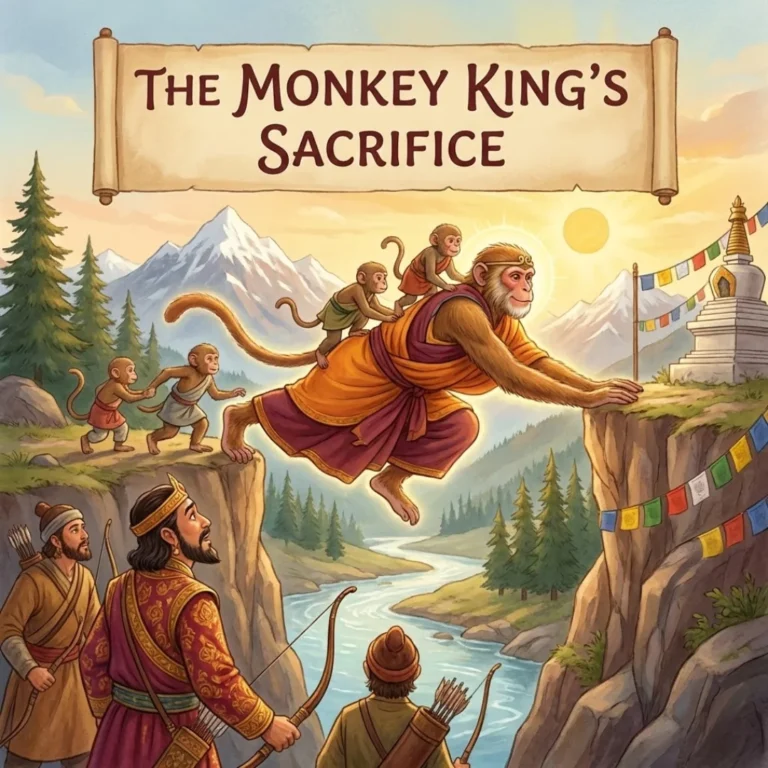
High in the mountains where clouds brushed the treetops like gentle hands, a troop of monkeys lived among the ancient fig trees. Their leader was no ordinary monkey. He was strong and wise, with silver fur that caught the morning light like dewdrops on spider silk.
The other monkeys called him Raja, which means king. But Raja never acted like he was better than anyone else. When food was scarce, he ate last. When danger came, he stood first. When baby monkeys played too roughly, he settled their arguments with patience, not anger.
“Why do you always put yourself last?” asked a young monkey named Kavi one day.
Raja smiled, his dark eyes twinkling. “A tree doesn’t grow from the top down, little one. The roots support everything above. That’s what leaders do.”
One morning, the peaceful forest changed. Hunters arrived, spreading their nets between the trees like spider webs made of rope. The monkeys scattered in all directions, chattering in fear.
“To the cliff!” Raja called out. “Follow me!”
The troop raced through the branches, leaping from tree to tree. Behind them, they could hear the hunters’ shouts and the swish of nets cutting through the air. Raja led them higher and higher up the mountain until they reached the edge of a great chasm.
It was a terrible sight. Below them, rocks tumbled down into darkness. Across the gap, about thirty feet away, the forest continued on the other side of the mountain, safe and green and free.
But there was no way across.
The baby monkeys whimpered. The young ones looked at each other with wide, frightened eyes. Even the bravest adults felt their hearts sink.
“We’re trapped,” someone whispered.
Behind them, they heard the hunters getting closer, crashing through the undergrowth.
Raja looked at his troop, his family, all the monkeys who depended on him. He saw old Grandmother Tara, who had taught him to find the sweetest figs. He saw Kavi, who asked so many questions. He saw mothers holding their babies close.
Then he looked up at a strong branch that hung out over the chasm. His mind worked quickly, calculating distances, thinking through possibilities.
“Listen carefully,” Raja said, his voice calm and clear. “There’s a vine on that tree across the gap. I’m going to jump to that branch above us, then swing across and grab the vine. I’ll tie it here, and you can all climb across to safety.”
Before anyone could argue, Raja leaped. He caught the branch with ease, his strong arms pulling him up. Then he swung out, reaching, stretching, his fingers just brushing the vine on the other side.
But it was too short.
No matter how far he stretched, the vine wouldn’t reach the tree on their side. The gap was too wide.
Raja hung there for a moment, thinking. The hunters were so close now. He could hear their voices clearly.
Then he did something no one expected.
He took one end of the vine and tied it around his waist. Then he swung back across the chasm, landing on the branch above his troop. He tied the other end of the vine to this branch, pulling it as tight as he could.
But the vine was still too short to make a proper bridge. It hung in the middle of the gap, useless.
Unless…
Without a word, Raja positioned himself in the middle of the vine, gripping it with his hands and feet. He stretched his body out as far as it would go, making himself into a living bridge.
“Cross now!” he commanded. “Walk on my back! Quickly!”
“But Raja—” Kavi started to protest.
“NOW!” Raja’s voice was firm. “I can hold you all, but you must go quickly.”
One by one, the monkeys crossed. They stepped carefully onto Raja’s back and walked across him like he was a rope bridge. His body trembled with the strain. His muscles screamed. But he held firm.
Grandmother Tara crossed, tears streaming down her old face. The young monkeys crossed, helping the babies. Kavi was one of the last.
“Thank you,” Kavi whispered as he stepped onto Raja’s back.
“Be brave,” Raja whispered back. “Be kind. That’s all that matters.”
As the last monkey reached safety, Raja’s strength finally gave out. The vine began to slip. His back, which had held the weight of dozens of monkeys, could hold no more.
But everyone was safe.
As Raja fell toward the rocks below, a strange thing happened. A traveler on horseback came around the bend, looking up just in time to see the last monkey cross to safety on the back of their king.
This traveler was King Dasaratha, ruler of the lands below the mountain. He had come hunting, but now he watched in amazement as Raja fell.
“Catch him!” the king shouted to his men. “Save that monkey!”
The king’s servants rushed forward with nets—not to trap, but to save. They caught Raja just before he hit the ground.
King Dasaratha knelt beside the injured monkey. Raja’s breathing was shallow, his back broken from the weight he had carried.
“Why?” the king asked softly. “Why did you sacrifice yourself?”
Raja’s eyes focused on the king’s face. When he spoke, his voice was weak but clear.
“What else is a leader for?” Raja said. “They were my responsibility. My family. If I couldn’t keep them safe, what was the point of being strong? What was the point of being wise? A crown means nothing if you’re not willing to give everything for those you lead.”
The king felt tears on his cheeks. In all his years of ruling, surrounded by advisors and generals and priests, he had never heard such simple, pure wisdom.
Raja took one more breath and closed his eyes, a peaceful smile on his face.
King Dasaratha returned to his palace a changed man. He sent word to all his hunters: the forest where the monkeys lived was now protected forever. No hunting, no trapping, no harm.
And every day for the rest of his life, before making any decision as king, he asked himself a simple question: “Am I putting my people first, or myself?”
High in the mountains, the monkeys still tell the story of Raja. They teach their children that strength isn’t about being the biggest or the loudest. True strength is knowing when to bend, when to sacrifice, and when to become the bridge that others need.
And if you listen very carefully on quiet mornings, when the clouds brush the treetops and the world is still, you might hear the monkeys singing Raja’s name, remembering the king who taught them what love really means.
Frequently Asked Questions
What is the moral lesson of The Monkey King’s Sacrifice?
What age is this story appropriate for?
How long does it take to read The Monkey King’s Sacrifice?
What culture does this story come from?
Can I use this story for teaching?
Frequently Asked Questions
What is The Monkey King’s Sacrifice story about?
The Monkey King’s Sacrifice is a moral story about Raja, a wise and selfless monkey leader who always puts his troop’s safety before his own. When hunters threaten his family, Raja makes a courageous decision to protect them, teaching children powerful lessons about true leadership and self-giving love.
What moral lesson does The Monkey King’s Sacrifice teach kids?
The Monkey King’s Sacrifice teaches children that real leadership means serving others, not seeking power. Raja shows that a great leader eats last, faces danger first, and is willing to sacrifice personal comfort for the good of the group. It’s a story about courage, selflessness, and responsibility.
Is The Monkey King’s Sacrifice suitable for young children?
Yes, this story is written in warm, accessible language perfect for children aged 4 to 10. The characters are relatable, the action is engaging, and the moral is clearly woven into the narrative. Parents and teachers can use it to start meaningful conversations about kindness and looking after others.
📚 Recommended Books
Handpicked for readers like you
As an Amazon Associate, we earn from qualifying purchases. These recommendations are personalized based on this story's themes and your reading history.
Who is Raja in The Monkey King’s Sacrifice?
Raja is the silver-furred leader of a troop of monkeys living in ancient mountain fig trees. Unlike typical rulers, he never acts superior — he eats last when food is scarce, faces danger first, and leads with patience and wisdom. His name means ‘king,’ but his true greatness comes from his humility.
What happens when hunters arrive in The Monkey King’s Sacrifice?
When hunters spread nets through the forest, Raja immediately takes charge, calling his troop to flee toward the cliffs. Rather than saving himself, he guides his frightened monkeys to safety, demonstrating the self-sacrificing bravery that defines his leadership throughout the story.