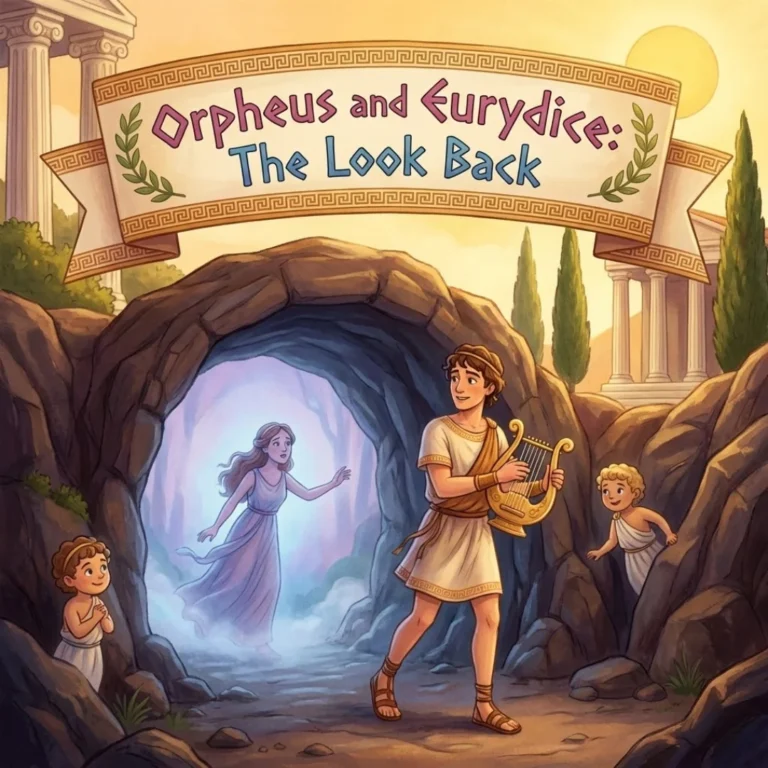
In the golden days when gods still walked among mortals, there lived a musician named Orpheus whose songs could make the very stones weep. His lyre sang with such sweetness that rivers would pause in their flowing to listen, wild beasts would creep close to hear, and ancient trees would bend their branches low as if bowing to a king.
But all the music in the world meant nothing to Orpheus without Eurydice, his beloved wife. Her laughter was brighter than his finest melody, her smile warmer than the summer sun. Together they wandered through meadows thick with flowers, and Orpheus would play while Eurydice danced, and it seemed as if joy itself had taken human form.
Then, on a day like any other, tragedy struck swift as a viper. Eurydice was gathering wildflowers in a sun-dappled grove when a serpent, hidden in the tall grass, bit her ankle. The poison worked faster than any doctor could come, and before the sun had set, Eurydice’s spirit slipped away to the shadowy realm of the dead.
Orpheus wept until his tears made rivers, and his songs turned so sorrowful that all of Greece mourned with him. Birds fell silent in the trees. The wind carried his grief across the land. But no amount of weeping could bring Eurydice back.
Then a terrible determination seized Orpheus’s heart. If Eurydice would not return to him, he would go to her. He would do what no living mortal had ever done—he would descend into the underworld itself and demand her return.
Down, down, down Orpheus went, through caves that grew darker with each step, past rivers that flowed backward and stones that whispered warnings. The path to the land of the dead was not meant for living feet, but Orpheus walked it anyway, his lyre clutched tight against his chest.
At last he came to the throne room of Hades, lord of the underworld, where shadows pooled like spilled ink and the air itself seemed to hold its breath. Beside Hades sat Persephone, queen of this dark realm, her face as pale and beautiful as moonlight.
The fearsome three-headed dog Cerberus growled, but when Orpheus began to play, even that monster’s snarls turned to whimpers. His music filled the vast darkness with light and warmth. He sang of love that conquers death, of memories sweeter than honey, of the unbearable ache of loss.
Tears—actual tears—rolled down Hades’ stone-hard cheeks. Persephone wept openly. Throughout the underworld, the tormented souls paused in their endless punishments to listen. Even the Furies, those terrible spirits of vengeance, felt their hearts soften.
“Enough,” Hades finally said, his voice rough with emotion. “No mortal has ever moved me so. I will grant your wish, Orpheus. Eurydice may follow you back to the world of the living.”
Orpheus’s heart leaped with such joy he thought it might burst.
But Hades raised one warning hand. “There is one condition. You must lead her out, and you must not look back at her—not once—until you both stand again in the sunlight. If you turn to see her before then, she will be lost to you forever. Do you understand?”
“I understand,” Orpheus promised, though his voice trembled. “I won’t look back. I swear it.”
And so the journey back began. Orpheus walked the winding path upward through the darkness, and behind him—he could not see but he desperately hoped—came Eurydice. He heard no footsteps, for the dead make no sound. He felt no breath upon his neck, for the dead do not breathe. But he trusted. He had to trust.
Up he climbed, through the whispering caves, past the backward-flowing rivers, toward the distant pinprick of light that marked the entrance to the living world. His hands shook. His heart hammered against his ribs. Was she really there? Had Hades kept his word? What if this was all a cruel trick?
Doubt crept into his mind like a cold fog. What if he was climbing alone? What if Eurydice wasn’t following at all? Just one quick glance would tell him. Just one tiny look to make sure she was safe behind him.
The light grew brighter. He was almost there, almost to the surface, almost to safety. Just a few more steps and they would both stand in the sunshine again.
But the doubt grew louder than his trust. What if she had stumbled? What if she needed help? What if, what if, what if…
At the very threshold between darkness and light, with the sun’s warm rays already touching his face, Orpheus turned around.
And there she was—Eurydice, her hand reaching toward him, her lips forming his name, her eyes full of love and sorrow. For one precious heartbeat, he saw her. She was real. She had been following him all along.
Then, like smoke caught by the wind, she began to fade.
“Orpheus,” she whispered, and it sounded like goodbye.
He lunged forward to catch her, but his hands grasped only air. Eurydice dissolved into shadow and was pulled back down into the depths, back to the realm of the dead, lost to him forever because he could not trust what he could not see.
Orpheus stood at the cave’s mouth, one foot in sunlight and one in shadow, and screamed his anguish to the uncaring sky. He had been so close. She had been right there. And his own doubt had destroyed everything.
They say he never sang again after that day, at least not the joyful songs of before. They say he wandered the earth alone, a lesson written in the language of grief: that trust is the bridge between love and doubt, and when we break that trust—even for just one moment—we may lose what matters most forever.
Some things, once looked back upon, can never be reclaimed. Some chances come only once. And sometimes, the hardest thing in the world is to keep walking forward and trust that love follows where we cannot see.
Frequently Asked Questions
What is the moral lesson of Orpheus and Eurydice: The Look Back?
What age is this story appropriate for?
How long does it take to read Orpheus and Eurydice: The Look Back?
What culture does this story come from?
Can I use this story for teaching?
Frequently Asked Questions
What is the story of Orpheus and Eurydice about?
The story of Orpheus and Eurydice is a Greek myth about a gifted musician, Orpheus, whose beloved wife Eurydice dies from a snake bite. Driven by love, Orpheus journeys into the underworld to bring her back. The tale explores themes of love, loss, trust, and the consequences of doubt.
Why did Orpheus look back at Eurydice?
In the myth, Orpheus was allowed to lead Eurydice out of the underworld on one condition — he must not look back at her until they reached the living world. Despite the warning, Orpheus looked back, likely out of love, doubt, or fear that she wasn’t truly there, and in doing so, lost her forever.
What is the moral lesson of Orpheus and Eurydice?
The story of Orpheus and Eurydice teaches that trust and self-control are essential, even when driven by deep love. It also shows that impatience and doubt can cost us what we cherish most. Sometimes, following the rules — even the hardest ones — is the only way to achieve what we truly want.
📚 Recommended Books
Handpicked for readers like you
As an Amazon Associate, we earn from qualifying purchases. These recommendations are personalized based on this story's themes and your reading history.
How did Eurydice die in the myth?
Eurydice died after being bitten by a serpent hidden in the tall grass while she was gathering wildflowers. The venom acted quickly, and she passed away before help could arrive, sending her spirit to the underworld and plunging Orpheus into deep grief.
Is the Orpheus and Eurydice story appropriate for kids?
Yes, the Orpheus and Eurydice story can be shared with children in an age-appropriate retelling. It introduces themes of love, loss, perseverance, and following instructions even when it’s hard. Parents may want to guide younger children through the sadder elements, using the story as a gentle introduction to handling emotions and consequences.