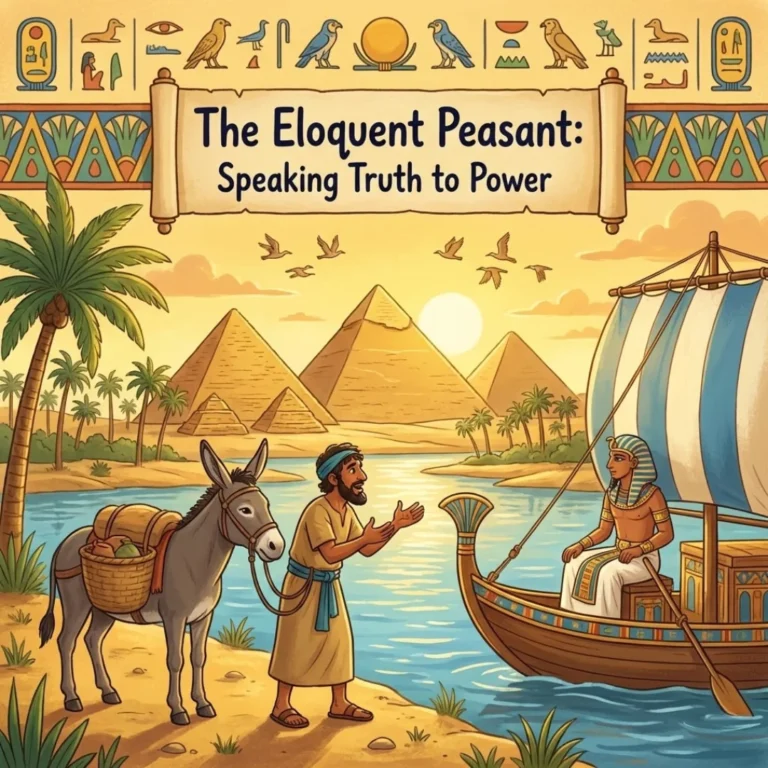
Once upon a time, in the heartlands of ancient Egypt, there lived a wise and humble peasant named Khufu. He led a simple life, tending his fields under the radiant sun and sleeping under the twinkling tapestry of stars each night. His house was small, made from sun-baked bricks, but it was filled with love and laughter from his beautiful wife, Nefertari, and their three energetic children.
One day, as Khufu was leading his donkeys laden with crops to the market, he came across a narrow path obstructed by a big, gleaming chariot. It belonged to Horemheb, the powerful governor of their province. Khufu tried to guide his donkeys around the chariot, but one slipped and his load was scattered all over the path. At that moment, Horemheb emerged, full of anger.
“Who dares block my path?” he bellowed, his voice echoing off the nearby cliffs.
“It’s me, Khufu,” the peasant replied calmly, his eyes showing no fear. “I apologize for the disturbance. My donkey slipped.”
“I should have you punished for this insolence,” Horemheb threatened, his face red with rage. But Khufu, instead of cowering, stood tall.
“Is it not a greater insult to block the public path with your chariot?” Khufu asked. “After all, the path is meant for all to use.”
Horemheb was taken aback. He wasn’t used to being talked back to, especially not by a mere peasant. Intrigued by Khufu’s courage, he decided to take him to the Pharaoh, thinking he could entertain the ruler with his bold words.
Standing before the Pharaoh’s golden throne in the grand palace, Khufu didn’t falter. With a calm voice, he said, “Great Pharaoh, I stand before you not because I’ve done wrong but because I spoke the truth.”
“Speak, Khufu,” the Pharaoh commanded. “My ears are open to your words.”
And so Khufu spoke. He spoke of the injustice of the governor’s actions, of the hardship faced by the peasants, of the misuse of power by the high and mighty. His words were simple yet powerful, and the entire court was hushed as they listened. Even Horemheb was silent, his eyes wide in surprise.
The climax came when Khufu said, “Great Pharaoh, with all due respect, the power granted to you is to protect your people, not to oppress them. If a man of power misuses his authority, it is the duty of the Pharaoh to correct it.”
There was a deafening silence as his words echoed in the grand hall. The Pharaoh sat quietly, his face unreadable. And then, he rose from his throne, his golden robes shimmering in the torchlight.
“Khufu, your words are brave and true,” he said, his voice resonating in the hall. “A true leader listens to his people, no matter their status. Horemheb, you will replace Khufu’s lost crops and ensure the paths are clear for all henceforth.”
Horemheb bowed, and although he didn’t say anything, his expression showed he had learned a valuable lesson. The court erupted into whispers, some shocked, some awed, but all acknowledging the power of truth that a simple peasant had dared to speak.
The Pharaoh granted Khufu a bag of gold as a reward, but Khufu only had one request. “Great Pharaoh, I ask not for gold but for the assurance that all Egyptians, rich or poor, are treated with fairness and respect.”
The Pharaoh nodded, touched by Khufu’s wisdom and humility. “Your request is granted, Khufu. You have reminded us all of the value of truth and justice.”
And so, Khufu returned home. His children ran to greet him, their laughter filling the air. As he hugged them, he knew he had not only stood up for himself but for all the peasants of Egypt.
That night, as Khufu looked up at the stars, he felt a deep contentment. He had spoken truth to power, and his words had made a difference. From that day forward, his story was told and retold, a testament to the power of truth, courage, and the eloquent words of a simple peasant.
Frequently Asked Questions
What is the moral lesson of The Eloquent Peasant: Speaking Truth to Power?
What age is this story appropriate for?
How long does it take to read The Eloquent Peasant: Speaking Truth to Power?
What culture does this story come from?
Can I use this story for teaching?
Frequently Asked Questions
What is The Eloquent Peasant story about?
The Eloquent Peasant is an ancient Egyptian tale about a humble farmer named Khufu who courageously speaks truth to power after a confrontation with a powerful governor. It explores themes of justice, wisdom, and the courage it takes for ordinary people to stand up against those in authority.
What does ‘speaking truth to power’ mean in the context of this story?
In this story, speaking truth to power means that Khufu, a simple peasant, refuses to stay silent or cower when wrongly confronted by the powerful governor Horemheb. Instead of accepting injustice, he calmly and eloquently challenges authority, showing that wisdom and moral courage can be more powerful than wealth or status.
What moral lesson does The Eloquent Peasant teach children?
The story teaches children that honesty, calmness, and courage matter more than social status. It encourages kids to stand up for what is right, speak respectfully but fearlessly, and understand that truth and justice should apply to everyone equally, regardless of power or privilege.
📚 Recommended Books
Handpicked for readers like you
As an Amazon Associate, we earn from qualifying purchases. These recommendations are personalized based on this story's themes and your reading history.
Is The Eloquent Peasant based on a real ancient Egyptian story?
Yes, The Eloquent Peasant is inspired by one of ancient Egypt’s most celebrated literary texts, dating back roughly 4,000 years. The original tale features a peasant who delivers remarkably sophisticated speeches appealing for justice, making it one of history’s earliest examples of eloquent advocacy for the common person.
Why does Khufu show no fear when confronting the powerful governor?
Khufu shows no fear because he knows he has done nothing wrong and believes in the principle of fairness. His confidence comes not from wealth or power, but from his strong moral grounding and inner wisdom. The story suggests that a clear conscience and commitment to truth can give ordinary people extraordinary courage.