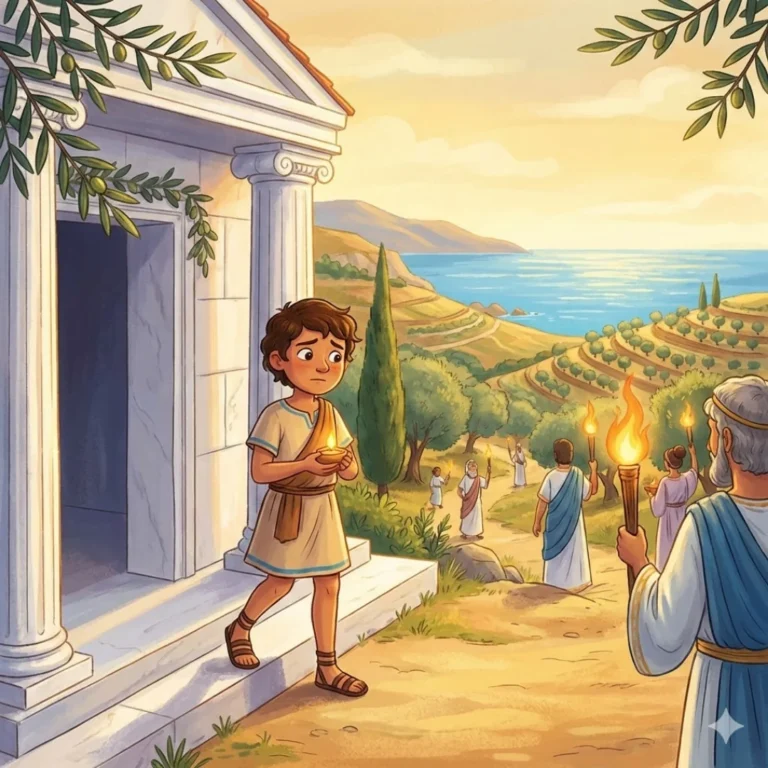
This moral story for children ages 6-12 combines entertainment with important values.
Once upon a time, in a kingdom awash in the golden glow of dawn, there ruled a king named Midas. His eyes gleamed with the same luster as the gold that filled his treasure rooms—cold, bright, and empty. While his people laughed and danced in the streets below, Midas spent his days counting coins, running his fingers through piles of golden jewelry, and dreaming of even greater riches.
“More gold,” he would whisper to himself, his heart beating faster at the very thought. “More treasure, more wealth, more power.”
His daughter, Marigold, often watched him from the doorway, her small face creased with worry. “Father,” she would say, “won’t you come play with me in the garden? The roses are blooming, and the birds are singing such beautiful songs.”
But Midas would wave her away, his attention fixed on his treasure. “Not now, my dear. Can’t you see I’m busy? Gold doesn’t count itself.”
One balmy afternoon, as the scent of blooming jasmine hung heavy in the air, Midas discovered an unexpected visitor sleeping beneath the shade of a grand olive tree. It was Silenus, an aged satyr with curling horns and a gentle smile, who had wandered far from the revels of his companion Dionysus, the god of wine.
Most kings would have thrown out such a strange creature, but Midas recognized Silenus immediately. If I treat him well, he thought, perhaps Dionysus will reward me with even more gold!
For ten days, Midas hosted Silenus with sumptuous feasts and sweet music. Marigold delighted in the visitor’s funny stories and merry songs, her laughter ringing through the halls like bells. For the first time in months, Midas smiled—not at his gold, but at his daughter’s joy.
On the eleventh day, Dionysus himself arrived at the palace gates, his presence as vibrant as a festival, his robes shimmering like the morning mist. “King Midas,” he proclaimed, his voice rich and warm like summer honey, “you have shown great kindness to my dear friend. For this, I shall grant you any wish your heart desires.”
Midas’s pulse quickened, his palms growing damp with excitement. This was it—the moment he had dreamed of! “I wish,” he declared, his voice trembling with eagerness, “that everything I touch turns to gold!”
Dionysus’s smile faded, replaced by a shadow of deep concern. “Are you certain, King Midas? Think carefully. Gold cannot love you back. It cannot laugh or cry or hold your hand.”
But Midas, blinded by visions of golden splendor, heard only what he wanted to hear. “Yes, yes, I am certain! Grant me my wish!”
Dionysus sighed deeply, a sound like wind through autumn leaves. “So be it. But remember, Midas—you cannot unspeak a wish once it is granted.” And with those words, the god vanished.
Midas could barely contain his excitement as he rushed through his palace, touching everything in sight. The cool stone pillars transformed into gleaming gold. The wooden doors, the silk curtains, the marble statues—all turned to brilliant, shimmering gold. His world became a radiant paradise, each object a testament to his newfound power.
“I’m rich! I’m the richest man in the world!” he shouted, his voice echoing off the golden walls.
Venturing into the garden, Midas touched the roses his daughter loved so dearly. Instantly, they transformed—but instead of soft, fragrant petals, they became hard, cold metal. The leaves crumbled like dried parchment, and the sweet perfume vanished, replaced by the smell of metal and earth.
For a moment, doubt flickered in Midas’s heart. But he pushed it aside. What did flowers matter when he had gold?
As the sun dipped below the horizon, painting the sky in shades of orange and purple, hunger gnawed at Midas’s stomach. His servants laid a magnificent feast before him—roasted meats, fresh bread, ripe fruits, and sweet wine. His mouth watered at the sight.
But when he lifted the bread to his lips, it turned hard as a brick, cold and inedible. The succulent meat became a golden sculpture. The wine transformed into molten gold the moment it touched his lips, scalding his tongue.
Panic began to rise in his chest, cold and sharp as winter ice. “No,” he whispered. “No, this can’t be happening.”
Just then, Marigold burst into the room, her face bright with excitement. “Father! Father, look at your beautiful golden garden!” She hadn’t noticed that her favorite roses were now lifeless metal, that the grass crunched like coins beneath her feet.
“Stay back!” Midas cried, his hands trembling as he held them away from his body. “Don’t come near me!”
But Marigold, thinking he was playing a game, laughed and ran toward him. “Don’t be silly, Father!” She flung her arms around his waist—
And turned to gold.
The transformation happened in an instant. Her warmth vanished. Her heartbeat stopped. Her laughter died mid-note. All that remained was a perfect golden statue of his beloved daughter, frozen forever with her arms outstretched, her smile still on her lips.
Midas’s world shattered. He fell to his knees, sobs tearing from his throat like thunderclaps. “No! No, no, no! Marigold! My daughter! What have I done?” He tried to embrace the golden statue, but it was cold and unyielding. He couldn’t feel her warmth, couldn’t hear her heartbeat, couldn’t see her chest rise and fall with breath.
“DIONYSUS!” he screamed, his voice raw with anguish. “Please! Please, I was a fool! Take back this curse! I don’t want gold—I want my daughter! I want her laugh, her smile, her warm hand in mine! Please!”
Dionysus appeared slowly, sadly, as if he had been waiting. His eyes held no anger, only infinite compassion. “King Midas,” he said gently, “you were warned. You chose gold over love, wealth over warmth.”
“I know!” Midas wept, tears streaming down his cheeks. “I was wrong! I was so terribly wrong! Please, I’ll give up everything—my kingdom, my treasure, my life—just give me back my daughter!”
The god studied him for a long moment, seeing the true change in the king’s heart. “Very well. I will show mercy. Go to the river Pactolus and wash yourself in its waters. The river will carry away your golden touch.”
Without wasting a single second, Midas ran from the palace. His lungs burned, his legs ached, but he didn’t stop until he reached the river’s edge. He plunged his hands into the cool, flowing water, gasping as he felt the curse slip away like chains falling from his wrists.
He rushed back to his palace, hope and fear warring in his chest. Would it work? Would he be too late?
There, in the dining hall, Marigold stood—alive! Her cheeks pink, her eyes bright, her chest rising and falling with sweet, precious breath.
“Father?” she said, looking confused. “What happened? Why are you crying?”
Midas swept her into his arms, holding her so tightly she squeaked. He buried his face in her hair, feeling her warmth, her realness, her aliveness. “You’re here,” he sobbed. “You’re really here. You’re warm and breathing and alive!”
“Of course I am, silly father,” Marigold giggled, hugging him back fiercely. “Where else would I be?”
From that day forward, Midas was a changed man. He gave away his golden treasures to the poor and needy. He spent his days in the garden with Marigold, helping her plant new roses to replace the ones he had destroyed. He learned to treasure her laughter more than any coin, her hugs more than any jewel, her love more than all the gold in the world.
And the river Pactolus? Its sands still shimmer with gold to this day, a reminder of the time when a king learned that the greatest treasure isn’t something you can hold in your hands—it’s something you hold in your heart.
The golden statues remained in the garden, silent witnesses to Midas’s folly and redemption. Whenever Marigold asked about them, Midas would kneel beside her and say, “They remind me never to forget what truly matters. And what truly matters, my dearest daughter, is you.”
Frequently Asked Questions
What is the moral lesson of Once upon a time, in a kingdom a…?
What age is this story appropriate for?
How long does it take to read Once upon a time, in a kingdom a…?
What culture does this story come from?
Can I use this story for teaching?
Frequently Asked Questions
What is the moral story of King Midas about?
The moral story of King Midas is about a greedy king who values gold above everything else, including his own daughter. Through a magical encounter, he learns that love, family, and simple joys in life are far more precious than any amount of wealth or treasure.
What age group is this King Midas moral story suitable for?
This moral story is designed for children aged 6 to 12. It combines entertaining storytelling with important life values, making it ideal for bedtime reading, classroom discussions, or any time you want to share a meaningful lesson with young readers in a fun and engaging way.
What lesson do kids learn from the story of King Midas?
Kids learn that greed and obsession with material wealth can blind you to what truly matters. The story teaches children to appreciate relationships, nature, and love over money and possessions — a timeless and important value for young minds to understand early in life.
📚 Recommended Books
Handpicked for readers like you
As an Amazon Associate, we earn from qualifying purchases. These recommendations are personalized based on this story's themes and your reading history.
Who are the main characters in this moral story?
The main characters are King Midas, a gold-obsessed ruler, and his caring daughter Marigold. The story also features Silenus, a mysterious aged satyr discovered sleeping under an olive tree, whose appearance sets the magical events of the story into motion.
Is the King Midas story based on a real myth?
Yes, King Midas originates from ancient Greek mythology. This retelling adapts the classic myth for children, making it more accessible and emotionally engaging while preserving its core moral message about the dangers of greed and the true meaning of happiness and wealth.