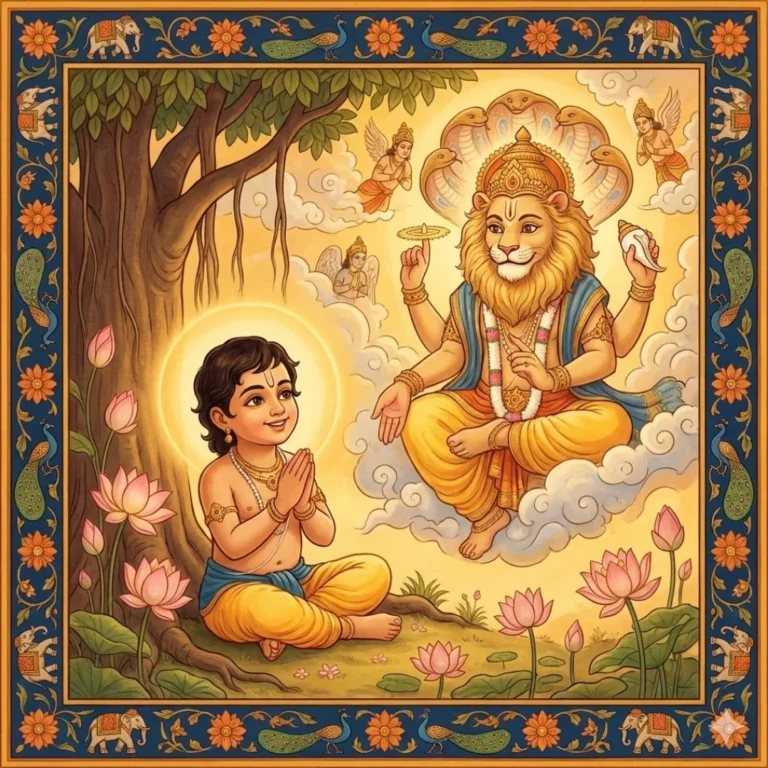
This moral story for children ages 6-12 combines entertainment with important values.
In the vibrant heart of ancient India, where the air was perfumed with jasmine and the sun painted the sky in golden hues, stood a grand palace. This was the realm of Hiranyakashipu, a demon king whose power stretched as far as the eye could see. His voice boomed through the halls, and his anger was as fierce as a summer storm.
Within these imposing walls, however, was a room filled with laughter and light. Young Prahlada, the king’s son, played there with his friends. Their giggles echoed as they clapped and danced, singing in a joyful chorus, “Vishnu, Vishnu, protector of all,” their eyes sparkling with warmth and innocence.
Suddenly, their merriment was interrupted by the heavy, ominous footsteps of Hiranyakashipu, who appeared in the doorway. His face was a mask of fury, eyes burning like hot coals. “Prahlada!” he thundered, his voice slicing through the laughter. “Why do you sing of Vishnu, my enemy? Worship me, for I am the true ruler!”
Prahlada, small but unyielding, met his father’s fiery gaze. His expression was calm, his heart steady as he replied, “Father, Vishnu is in all things. His love is as vast as the ocean, and he is the true protector of the universe.”
Hiranyakashipu’s anger erupted like a storm. His fists clenched, his voice thunderous. “You’ll learn to fear me,” he declared, turning away and summoning his teachers, demons with eyes sharp as hawks, to bend Prahlada’s will. They circled him, their growls filling the room like a menacing wind. Yet, Prahlada stood calm, his faith a shield against their threats.
Days turned into weeks, and the king’s patience wore thin. He ordered his son to be thrown into a pit teeming with snakes that hissed like steam from a boiling kettle. As Prahlada was lowered into the pit, the earthy scent of the ground enveloped him. But instead of striking, the snakes coiled gently around him, their scales cool and smooth, as if they too felt the boy’s unwavering faith.
Next, Hiranyakashipu commanded his soldiers to hurl Prahlada from the highest cliff. The wind howled in his ears as he fell, but to his father’s shock, the air itself seemed to cradle him, lowering him safely to the ground as if in a soft embrace.
Hiranyakashipu’s rage burned hotter than the midday sun. In desperation, he sought the help of his sister Holika, who was proud of her fire-resistance. She led Prahlada to a roaring bonfire, the flames dancing wildly, their heat a living, breathing entity. “Now, nephew,” she sneered, her voice crackling like dry leaves, “let’s see if your Vishnu saves you this time.”
But as the fires roared, a miracle unfolded. The flames turned gentle as they touched Prahlada, leaving him unharmed. Holika, however, cried out as her protective boon failed her. The air filled with the scent of smoke and the sound of her cries, a lesson in the misuse of power.
Hiranyakashipu, now a shadow of his former self, trembled with fear and disbelief. His once proud shoulders sagged, and his voice, now a mere whisper, quivered as he asked, “Where is your Vishnu now?”
Prahlada, with a heart as calm as a still lake, pointed to a nearby pillar. “He is everywhere, Father. Even in this pillar.”
In a final act of defiance, Hiranyakashipu struck the pillar with all his might. The sound was like the splitting of a great tree, and from the broken stone emerged Narasimha, Vishnu in the form of a half-man, half-lion. His mane blazed like golden fire, his eyes gleamed with ancient wisdom, and his roar shook the very ground.
It was twilight, a time neither day nor night. Narasimha, with strength beyond measure, took hold of Hiranyakashipu. The air was thick with the scent of earth and the weight of destiny. With his mighty claws, he brought the tyrant to his end, fulfilling the conditions of the boon in a way neither man nor beast could have foreseen.
Peace settled over the land like gentle rain after a long drought. Prahlada, now hailed as a hero, ascended the throne. The kingdom thrived under his rule, guided by the principles of love, faith, and righteousness. He taught that true strength was found not in power or fear, but in the courage to love and the faith to believe.
As the sun set each day, casting a tapestry of colors across the sky, the people gathered to share stories of Prahlada’s unwavering faith. Children sat wide-eyed as elders recounted how the gentle boy had faced the fury of his father and the trials of life with a heart full of devotion.
Prahlada would often stroll through the gardens, where the scent of blooming flowers mingled with the cool evening breeze. He listened to the people’s concerns, his eyes warm and understanding, always offering words of wisdom and encouragement.
One day, as he walked among his people, a young girl approached him, her eyes filled with curiosity. “King Prahlada,” she asked, “how did you find the strength to face such dangers without fear?”
Prahlada knelt down to her level, his expression gentle and kind. “The strength comes from faith,” he explained. “When you believe in something greater than yourself, you find courage in the most unexpected places.”
The girl nodded, her face lighting up with understanding. “And Vishnu is always with us, isn’t he?”
“Yes,” Prahlada affirmed, his voice as soothing as a lullaby. “He is in the sun that warms us, the rain that nourishes the earth, and in every heart that beats with love.”
The kingdom continued to prosper under Prahlada’s guidance, a testament to his unyielding faith and compassion. The people sang songs of praise, their voices rising like the sweet fragrance of jasmine, carried by the gentle winds.
And so, in the land where jasmine scents mingled with the hopes of the people, Prahlada’s story lived on, a beacon of faith and courage for generations to come. His legacy was not just one of survival, but of thriving in harmony with the world, a reminder that true strength lies in love, faith, and the courage to believe.
Frequently Asked Questions
What is the moral lesson of Prahlada and the Power of Love a…?
What age is this story appropriate for?
How long does it take to read Prahlada and the Power of Love a…?
What culture does this story come from?
Can I use this story for teaching?
Frequently Asked Questions
What is the story of Prahlada and the power of love about?
The story of Prahlada is an ancient Indian moral tale about a young prince who devotedly worships Lord Vishnu despite being the son of a demon king, Hiranyakashipu. It shows how unwavering faith and love can overcome even the most powerful forces of hatred and tyranny, making it a meaningful lesson for children ages 6-12.
What age group is the Prahlada story suitable for?
The Prahlada story is written specifically for children ages 6 to 12. It combines engaging storytelling with important values like courage, devotion, and the power of love, making it both entertaining and educational for young readers or as a bedtime read-aloud.
What moral lesson does the Prahlada story teach kids?
The Prahlada story teaches children that love, faith, and inner courage are more powerful than anger and tyranny. It encourages kids to stand by their values even under pressure, showing that doing what is right — even when it’s hard — ultimately leads to protection and peace.
📚 Recommended Books
Handpicked for readers like you
As an Amazon Associate, we earn from qualifying purchases. These recommendations are personalized based on this story's themes and your reading history.
Who is Hiranyakashipu in the story of Prahlada?
Hiranyakashipu is Prahlada’s father and a powerful demon king who demands worship and despises the god Vishnu. He represents pride, anger, and the misuse of power. His conflict with his own son forms the heart of the story and highlights the contrast between love and fear.
Why does Prahlada worship Vishnu instead of his father?
Prahlada believes that Vishnu’s love is present in all living things and that true power comes from devotion and goodness, not fear. Despite his father’s fury, Prahlada remains calm and faithful, showing children that genuine love and belief can give even the smallest person remarkable strength and courage.