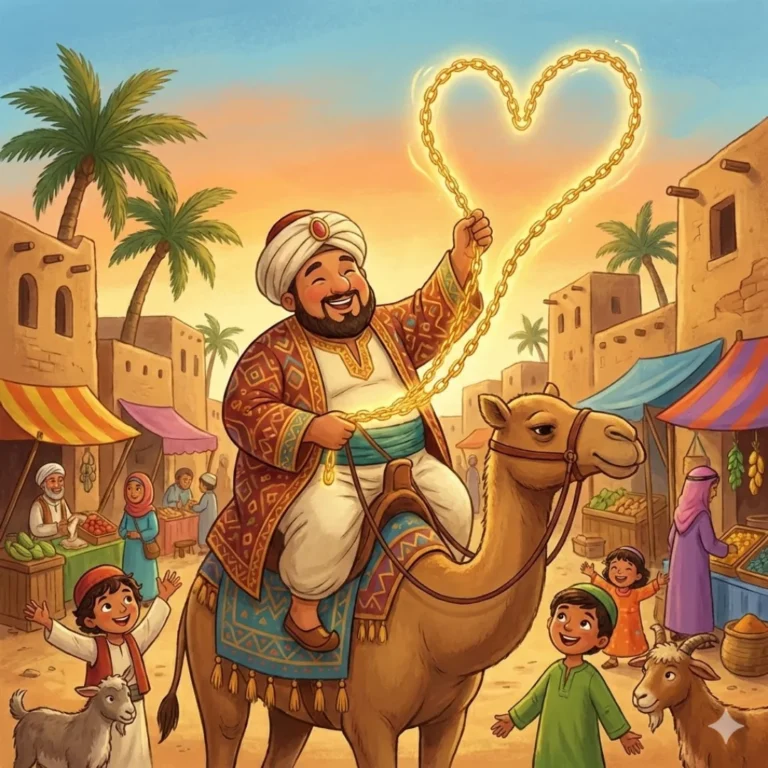
Share this engaging bedtime story with kids ages 6-12 to teach valuable life lessons.
The Merchant’s Golden Chain
In the bustling city of Rajagriha, where silk merchants shouted prices and spice sellers perfumed the air with cinnamon and cardamom, lived a wealthy merchant named Ananda. His warehouse overflowed with precious goods—bolts of crimson silk, sacks of rice that smelled of the harvest, jars of honey that gleamed like amber in the lamplight. Yet every night, Ananda paced his marble floors, the stone cold beneath his bare feet, his heart heavy as granite.
“More guards,” he muttered, checking the brass locks for the third time. The metal clicked and scraped under his anxious fingers. “I need more guards. What if thieves come? What if the monsoon rains ruin my grain? What if the king raises taxes again?”
His young daughter Maya watched from the carved doorway, her small face creased with concern. “Papa, you have so much. Why are you always worried?”
“You don’t understand, child,” Ananda sighed, his fingers trembling as he counted coins. They clinked together with a sound that once brought him joy but now only reminded him of possible loss. “The more you have, the more you can lose.”
That very morning, a stranger arrived in Rajagriha. He wore the simple orange robes of a wandering teacher, faded from many washings, and carried only a wooden bowl polished smooth by years of use. His face was peaceful as a mountain lake at dawn, and people whispered that his eyes held the wisdom of a thousand lifetimes. This was a Bodhisattva, one who had found enlightenment but chose to remain in the world to help others find their way.
The Bodhisattva walked through the marketplace, observing everything with gentle attention. He saw merchants haggling, their voices rising and falling like waves. He saw children playing with clay marbles. He saw mothers shopping for vegetables, their baskets filling with greens and gourds. And he saw Ananda, surrounded by bolts of the finest silk, yet wearing worry like a threadbare cloak.
“Merchant,” the Bodhisattva called softly, “you seem troubled.”
Ananda looked up, startled. The stranger’s calm unsettled him. “Who are you to judge? You own nothing but that shabby bowl. I have three warehouses!”
“Yes,” the Bodhisattva smiled, his voice warm as afternoon sunlight. “And how many warehouses of worry do you also carry?”
The question struck Ananda like a temple bell, its sound reverberating through his mind long after the words faded. He wanted to dismiss this ragged teacher and return to his counting, but something made him pause. “What… what do you mean?”
“Walk with me,” the Bodhisattva invited, gesturing toward the street. “Let me show you something.”
Despite himself, Ananda followed. They walked to the riverbank where washermen beat clothes against smooth rocks, sending up sprays of diamond droplets that caught the light. The smell of wet cotton and the rhythm of pounding filled the air. A small boy sat crying on the bank, his toy boat floating away downstream, already tiny in the distance.
“See this child?” the Bodhisattva asked gently. “He suffers because he wants his boat. His wanting creates his suffering—can you see the tears on his face? Now watch what happens.”
An older woman with kind eyes approached the boy, her silver hair in a neat braid. “Little one, why do you cry?”
“My boat!” the child sobbed, his small chest heaving. “It’s floating away, and I’ll never get it back!”
“I see,” she said gently, kneeling beside him. “The river has taken it on a journey. But tell me—would you like to help me make flower garlands for the temple? I’ll show you how to weave jasmine blossoms. They smell like sweet dreams.”
The boy hesitated, wiping his nose with the back of his hand, then nodded. Within moments he sat beside her, his fingers busy with fragrant white flowers, his face transformed by concentration and growing delight. The boat was forgotten, floating somewhere downstream to other adventures.
“Do you see?” the Bodhisattva asked. “His wanting kept him suffering. When he released his grip on the wanting, when his attention shifted, the suffering dissolved like morning mist in sunshine. The boat was gone either way—but his suffering wasn’t about the boat. It was about the grasping.”
“But a boat is just a child’s toy,” Ananda protested, though his voice lacked conviction. “My business is my livelihood! It’s different!”
“Is it?” the Bodhisattva’s eyes were kind but searching, like a physician examining a wound. “Come, I’ll show you more.”
They visited Ananda’s own warehouse. Inside, the air was thick with the scent of grain and dried spices. Workers loaded heavy sacks onto wooden carts, their muscles straining, sweat darkening their cotton shirts.
“Why do you trade grain?” the Bodhisattva asked, running his hand along a burlap sack.
“To earn money, of course.” Ananda watched his workers nervously, making sure they didn’t slack.
“And why do you want money?”
“To buy security, comfort, safety for my family.” The answer came automatically.
“And why do you want security?”
Ananda opened his mouth, then closed it. He thought hard. Finally: “So I won’t be afraid.”
“Ah,” the Bodhisattva nodded slowly, as if Ananda had just revealed a great truth. “So you gather grain to get money to buy security to ease fear. Each link in the chain connects to the next. This is what we call pratityasamutpada—dependent origination. One thing gives rise to another, creating a chain that binds us. Fear gives rise to wanting. Wanting gives rise to grasping. Grasping gives rise to more fear of losing what we’ve grasped. Round and round it goes.”
“But everyone does this!” Ananda exclaimed, his voice echoing in the warehouse. “We must provide for our families! We must plan for the future!”
“Of course,” the Bodhisattva agreed readily. “But observe your own heart right now. You started with fear—fear of poverty, of loss, of uncertainty. That fear created wanting—wanting security, wanting more and more. That wanting created grasping—clutching at coins, building warehouses, checking locks three times. And that grasping created more fear, didn’t it? Fear of thieves, fear of rain, fear of taxes, fear of loss. Around and around you spin, like a prayer wheel that never stops. Each link strengthens the chain that binds you.”
Ananda felt suddenly dizzy, as if the floor had tilted beneath him. He saw his whole life as a circle—reaching and fearing and reaching again, never satisfied, never at peace. “How… how do I stop the wheel?”
“Ah,” the Bodhisattva smiled, his face radiant. “That’s the question that leads to freedom. Come tomorrow to the bodhi tree at the edge of town, and I’ll show you.”
That night, Ananda couldn’t sleep. He lay on his silk sheets, staring at the wooden beams of his ceiling. He rose and walked through his house, looking at his treasures with new eyes. Each silk bolt, each coin, each locked chest—all were links in a chain he’d forged himself, link by heavy link. His daughter’s words echoed in the darkness: “Why are you always worried?”
The next morning, even before the muezzins called the faithful to prayer, Ananda found the Bodhisattva sitting beneath a bodhi tree at the edge of town. Its heart-shaped leaves rustled in the breeze. Several people had already gathered around him, sitting in a semicircle on the grass, listening with quiet attention.
“Teacher,” Ananda said, bowing slightly, “I’ve thought all night. My mind spun like a wheel—you were right about that. I see the chain now. But I’m a merchant! I have responsibilities! I can’t just give everything away and sit under a tree like you!”
The Bodhisattva laughed, a sound like water over smooth stones. “I don’t ask you to become me. The Middle Way isn’t about extremes—not excess, not deprivation, but balance. You can provide for your family without being enslaved by fear. You can work without being chained to outcomes. Watch—I’ll show you.”
He turned to a poor woman holding a sick child. The child’s face was flushed with fever, her breathing shallow. “Mother, your child needs medicine. Do you have any?”
The woman shook her head, tears spilling down her weathered cheeks. “No, wise one. I have nothing. I spent my last coins on rice yesterday.”
The Bodhisattva looked at Ananda. The merchant felt all eyes upon him—the gathered students, the desperate mother, the sick child. His hand went instinctively to his money pouch, then hesitated. That was his security, his protection against the very poverty he saw before him. But…
He looked at the child’s fevered face, her small hand clutching her mother’s sari. He remembered his own daughter Maya, healthy and fed and safe. He thought about the chain the Bodhisattva had shown him—his fear leading to grasping, his grasping leading to more fear, round and round, never finding peace.
“Here,” Ananda said, his voice surprising himself with its steadiness. He placed silver coins in the woman’s palm, enough to fill her cupped hands. “Enough for medicine and food for a week. Maybe two.”
“But sir, I cannot repay you!” the woman gasped, staring at the coins as if they might vanish.
“I don’t want repayment,” Ananda heard himself say. And something amazing happened—instead of feeling diminished, instead of fear clenching his stomach, he felt lighter, freer, as if he’d set down a burden he’d been carrying for so many years he’d forgotten what it felt like to stand upright.
The Bodhisattva’s eyes shone with approval. “You’ve just practiced dana—generous giving. Do you see? When you gave without expecting return, without calculating profit or loss, you broke a link in the chain. You acted from karuna, from compassion, rather than from fear. How does your heart feel?”
Ananda touched his chest, amazed. “Light. Warm. Like… like sunshine after rain.”
“Yes,” the Bodhisattva nodded. “That’s what freedom feels like. Even just one link broken.”
Over the following weeks, Ananda studied with the Bodhisattva. He learned to recognize the chain’s links in his daily life, to catch them forming before they trapped him:
When he felt anxious about thieves at night, he recognized it was fear arising from attachment to his goods. When he wanted to buy another warehouse, he saw it was grasping arising from the illusion that more would finally be enough. When he snapped at his workers for moving too slowly, he noticed it was anger arising from wanting things to be different than they were.
“But teacher,” Ananda asked one afternoon, sitting cross-legged in the grass, “if I see the chain, if I recognize the links forming, why do I still feel caught in it sometimes? Why does fear still arise?”
“Ah,” the Bodhisattva replied, plucking a blade of grass and examining it thoughtfully, “seeing the chain is the first step. Recognition is the doorway to freedom. But the next step is choosing, moment by moment, not to add new links. You won’t break free all at once. The chains were forged over many years—they won’t dissolve in a day. But each time you choose compassion over fear, giving over grasping, wisdom over ignorance, you weaken the chain. Each choice matters.”
“It’s hard,” Ananda admitted. “Some days I forget. I catch myself counting coins anxiously again.”
“Of course,” the Bodhisattva smiled. “That’s why we call it practice. Be patient with yourself, as you would be with a child learning to walk. What matters is that you keep choosing, keep noticing, keep returning to the path.”
Ananda started small. When a debtor couldn’t pay, instead of anger and threats, he offered forgiveness and time. When a competitor prospered, opening a shop near his own, instead of jealousy and scheming, he felt genuine gladness. When beggars appeared at his door, instead of annoyance and shooing them away, he gave freely—bread, coins, kind words.
And a strange thing happened. His business didn’t collapse as he’d feared. In fact, people began to trust him more, to seek him out for fair dealing. His workers served him more loyally, sensing the change in his heart. His daughter Maya laughed more often because her father smiled now instead of frowning over ledgers. And Ananda discovered something revolutionary: he could still be responsible, still provide for his family, still work hard and run his business—but without the crushing weight of fear and attachment chaining him to the wheel of suffering.
One evening, as monsoon clouds gathered purple and gold over the city, the Bodhisattva prepared to leave Rajagriha for the next town.
“Don’t go, teacher!” Ananda pleaded, feeling suddenly panicked. “I still have so much to learn! What if I forget what you’ve taught me?”
“You’ve learned the most important thing,” the Bodhisattva said gently, placing both hands on Ananda’s shoulders. “You’ve learned that your suffering came not from the world, but from how you grasped at the world. You’ve learned that compassion for others—like that sick child, like your workers, like even your competitors—actually frees you from your own chains.”
“But how?” Ananda asked, his brow furrowed. “How can helping others free me from my suffering?”
“Because,” the Bodhisattva explained, his voice soft but clear, “when you truly see that all beings are caught in the same chains of suffering, when you feel compassion for them instead of fear or competition, you stop thinking only ‘my suffering, my problems, my security.’ You see the bigger pattern—that we’re all in this together. And in that seeing, in that compassion, the tight fist of ‘me and mine’ begins to open. The separate self that grasps and fears begins to dissolve. And with it, much of the suffering dissolves too.”
“Will I ever be completely free of suffering?” Ananda asked, searching the teacher’s peaceful face.
“That depends on you,” the Bodhisattva smiled. “The path is there, clearly marked by those who’ve walked it before. Every time you choose wisdom over ignorance, compassion over selfishness, letting go over grasping, you walk that path. Some people walk it for many lifetimes. But each step matters. Each moment of freedom matters. Each link you choose not to forge matters.”
After the Bodhisattva left, walking down the road with his bowl and his radiant peace, Ananda continued his merchant life. But now he was fundamentally different. He still worked, still provided, still saved for the future. But he also gave freely. He treated his workers with kindness and fairness. He helped those in need without calculating return. He taught his daughter Maya about the chain and how to recognize its links forming before they trapped her.
“Papa,” Maya said one night, brushing his hair with a wooden comb as he sat on the floor, “you’re smiling again. Like you used to when I was very small, before you got so busy.”
“I am, aren’t I?” Ananda laughed, surprised by his own joy. “I finally learned something important, little one. I was wearing golden chains of my own making, forged from fear and grasping. And the Bodhisattva showed me that compassion and wisdom are the keys that unlock them.”
“Can you teach me?” Maya asked eagerly. “How to not make chains?”
“I’m learning myself,” Ananda admitted. “But yes, together we’ll learn. That’s what the teacher called the path—and we can walk it together.”
And in the marketplace the next day, those who knew Ananda saw something remarkable. The worried merchant who used to grip his money pouch like a lifeline, who used to bark at workers and haggle over every coin, now walked with his hands open and relaxed, his heart light as a bird. He’d discovered that true security didn’t come from what he could hold onto with white-knuckled fists, but from what he could let go of with open hands.
The chains that had bound him were dissolving, link by link, in the warm light of compassion and wisdom. And each day, he chose again: to see, to understand, to let go, to give, to be free.
The wheel was slowing. The chain was breaking. And in the spaces between the links, light was beginning to shine through.
Frequently Asked Questions
What is the moral lesson of The Merchant’s Golden Chain?
What age is this story appropriate for?
How long does it take to read The Merchant’s Golden Chain?
What culture does this story come from?
Can I use this story for teaching?
Frequently Asked Questions
What is The Merchant’s Golden Chain story about?
The Merchant’s Golden Chain is a bedtime story about a wealthy merchant named Ananda who lives in fear of losing his possessions despite having great wealth. The story explores themes of greed, anxiety, and the true meaning of happiness, teaching kids ages 6-12 valuable life lessons about contentment and what really matters in life.
What age group is The Merchant’s Golden Chain suitable for?
The Merchant’s Golden Chain is ideal for children ages 6 to 12. It works wonderfully as a bedtime story, combining engaging storytelling with meaningful moral lessons that are easy for kids in this age range to understand and relate to.
What moral lesson does The Merchant’s Golden Chain teach children?
The Merchant’s Golden Chain teaches children that material wealth does not guarantee happiness or peace of mind. Through the merchant Ananda’s story, kids learn that constantly worrying about possessions can become a kind of trap, and that true contentment comes from values beyond money and material goods.
📚 Recommended Books
Handpicked for readers like you
As an Amazon Associate, we earn from qualifying purchases. These recommendations are personalized based on this story's themes and your reading history.
Is The Merchant’s Golden Chain based on a traditional folk tale?
The story is set in the ancient city of Rajagriha and draws on the rich storytelling tradition of South Asian moral tales. With its vivid marketplace setting, characters like the merchant Ananda and his daughter Maya, it echoes classic fable structures used for centuries to pass wisdom down to younger generations.
Why does the merchant in The Merchant’s Golden Chain feel unhappy despite being wealthy?
Despite overflowing warehouses filled with silk, rice, and honey, Ananda feels unhappy because he is consumed by fear of loss. He constantly worries about thieves, bad weather, and rising taxes. The story shows how excessive attachment to wealth creates anxiety, illustrating the idea that the more you have, the more you fear losing it.