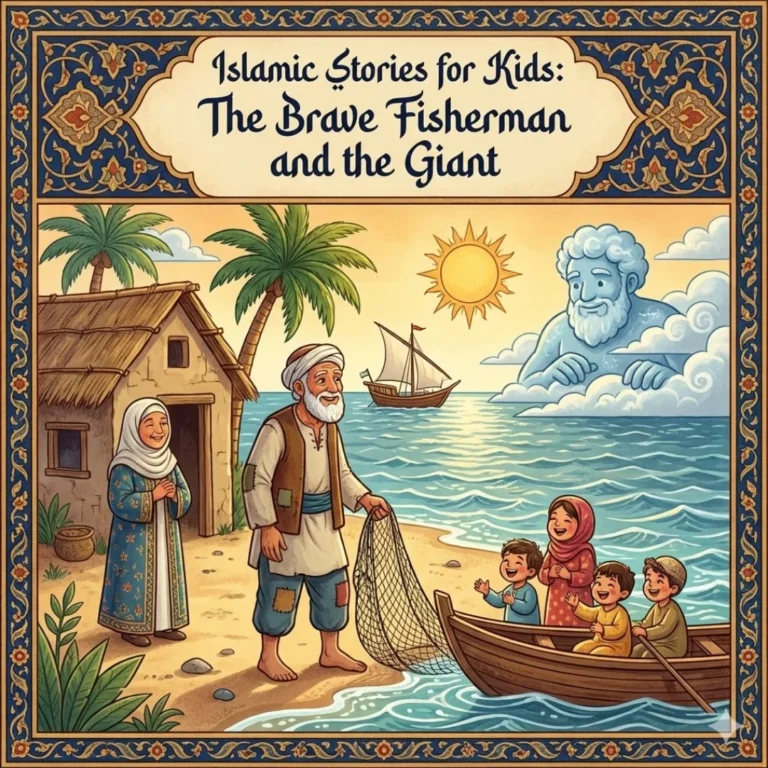
Share this engaging bedtime story with kids ages 6-12 to teach valuable life lessons.
“Long ago,” the jinni began, “I was one of the rebellious jinn. I defied the great King Sulayman—Solomon the Wise, to whom Allah gave power over all jinn and demons. When I refused to submit to his authority, Solomon trapped me in this copper jar and sealed it with his own seal. Then he commanded his servants to throw me into the deepest part of the sea.
“For the first hundred years, I said to myself: ‘Whoever frees me, I shall make him rich beyond measure! I shall grant him three wishes and shower him with gold and jewels!’
“But no one came.
“For the second hundred years, I said: ‘Whoever frees me, I shall reveal to him the locations of all the buried treasures of the earth!’
“But still no one came.
“For the third hundred years, I said: ‘Whoever frees me, I shall grant him three wishes of anything his heart desires!’
“But the centuries passed in darkness and silence.
“After four hundred years, my gratitude turned to rage. I said: ‘Whoever frees me NOW, I shall kill—but I will grant him the mercy of choosing HOW he dies!’
“And now, fisherman, after more than a thousand years, YOU have freed me. So I will keep my vow. You will die—but you may choose how.”
The jinni crossed his massive arms and waited.
The fisherman’s heart pounded. His mind raced. Then, suddenly, an idea struck him—a desperate, clever, impossible idea.
He forced himself to laugh.
“What are you laughing at?” the jinni demanded. “Do you not believe that I will kill you?”
“Oh, I believe you intend to kill me,” the fisherman said, still laughing. “But I do NOT believe your story.”
The jinni’s eyes blazed with fury. “You dare call me a liar?”
“A jinni as huge as you,” the fisherman said, pointing up at the towering creature, “could never have fit inside that tiny jar. Your little finger alone is larger than the entire jar! It’s impossible! You’re making up the whole story!”
The jinni drew himself up to his full, terrifying height.
“I AM NOT A LIAR!” he roared. “I TELL YOU, I WAS IMPRISONED IN THAT JAR FOR MORE THAN A THOUSAND YEARS!”
“Impossible,” the fisherman repeated, shaking his head. “I don’t believe it.”
“THEN I SHALL PROVE IT TO YOU!”
In an instant, the jinni dissolved into smoke. The smoke spiraled downward, growing thinner and thinner, pouring itself back into the copper jar like water swirling down a drain.
Within moments, all the smoke had disappeared inside.
A voice echoed from within the jar: “DO YOU BELIEVE ME NOW, FISHERMAN?”
The fisherman didn’t hesitate. He snatched up the lead seal and slammed it back onto the jar’s opening, pressing it tight.
“NOW I believe you!” the fisherman shouted. “And now you can stay in there for another thousand years! Or better yet—I’ll throw you back into the sea! Maybe in another thousand years, someone else will be foolish enough to free you!”
From inside the jar came a muffled howl of rage and despair.
“NO! FISHERMAN! WAIT!”
“Wait? Why should I wait? You told me you were going to kill me!”
“I was joking! It was only a test! Please, free me again, and I swear by the name of Allah that I will make you the richest man in the world! I will grant you three wishes! I will be your servant for life!”
The fisherman picked up the jar and walked toward the water.
“You had your chance to be generous,” he said. “You chose cruelty. Now you can sleep with the fish.”
“PLEASE!” the jinni wailed. “I swear by Allah, by the Throne, by the prophets—I will never harm you! I will reward you beyond your wildest dreams!”
The fisherman paused at the edge of the water.
He thought of his hungry children. He thought of his wife, worn thin with worry. He thought of all the years he had cast his nets and caught nothing but garbage.
And he thought of the story he had heard once, long ago, about how Allah rewards those who show mercy.
Slowly, he walked back from the water’s edge.
“If I free you,” he said, “you must swear by the Greatest Name of Allah that you will not harm me, and that you will grant me a true reward.”
“I swear it!” the jinni cried. “I swear by the name of Allah, the Most High, the Most Merciful! Free me, and I will bring you fortune!”
The fisherman prayed for guidance. Then, taking a deep breath, he pried the seal loose once more.
The smoke poured out again, rising and shaping itself into the massive jinni.
But this time, the jinni’s expression was different. He looked at the fisherman with something like respect.
“You are clever, fisherman,” the jinni said. “Solomon himself could not have tricked me better. Very well—I will keep my word. Follow me.”
The jinni led the fisherman away from the sea, up into the hills and mountains, until they reached a hidden valley. In the center of the valley was a beautiful lake—but such a lake as the fisherman had never seen. Its waters sparkled with all the colors of the rainbow, and swimming in those waters were fish of four colors: white, red, blue, and yellow.
“Cast your net here,” the jinni said. “And when you catch these fish, take them to the Sultan’s palace. Present them as a gift, and your fortune will be made. But remember—cast your net only once in this lake, and never return here again.”
Before the fisherman could thank him, the jinni stamped his foot. The earth cracked open, swallowed him up, and sealed itself again, as if he had never been.
The fisherman cast his net into the rainbow lake and pulled out four fish—one of each color.
He carried them straight to the palace of the Sultan.
When the Sultan saw the four miraculous fish—white as pearls, red as rubies, blue as sapphires, yellow as gold—he was amazed.
“I have never seen such fish in all my life!” he exclaimed. “Fisherman, name your reward!”
The Sultan gave the fisherman four hundred pieces of gold—more money than the fisherman had seen in his entire life.
And the fisherman went home to his wife and children, bought them food and clothes and a proper house, and never went hungry again.
*THE MORAL OF THE STORY:
This tale from the One Thousand and One Nights teaches us many valuable lessons:
1. Cleverness can defeat brute strength: The fisherman had no magic and no weapons, but he used his intelligence to turn the tables on the powerful jinni. When we face problems that seem too big to handle, our minds can be our greatest tool.
2. Anger destroys gratitude: The jinni’s rage at being imprisoned for so long caused him to forget gratitude and mercy. When we hold onto anger, it poisons our hearts and makes us cruel—even to those who try to help us.
3. Patience and faith are rewarded: The fisherman was patient with his rule of four casts, and he had faith that Allah would provide. Even when he caught only garbage three times, he didn’t give up or break his rule. His patience was ultimately rewarded.
4. Mercy has its place, but so does wisdom: The fisherman was right to trick the jinni into the bottle when the creature threatened to kill him. But he was also wise to give the jinni a second chance—though only AFTER securing a binding oath. True wisdom knows when to be firm and when to be merciful.
5. Keep your word: The jinni, once he swore by Allah’s name, kept his promise and led the fisherman to fortune. Our word is our bond, and breaking it—as the jinni learned—leads only to suffering.
6. What seems like bad luck may lead to good fortune: Three times the fisherman caught garbage. But the fourth catch—though it seemed dangerous at first—led to his family’s prosperity. We should not despair when things go wrong, because we never know what Allah has planned for us.
CULTURAL AND RELIGIOUS ELEMENTS PRESERVED:
Islamic Faith and Practice:
– The fisherman’s constant invocation of Allah’s name and trust in divine providence
– The declaration “There is no god but Allah, and Muhammad is His Messenger” (the Shahada)
– The fisherman’s rule of four casts (a number with symbolic significance in Islamic tradition)
– The binding power of oaths sworn in Allah’s name
– Recognition of Prophet Sulayman (Solomon) as having authority over jinn
Abbasid Era Historical Context:
– Set during the reign of Harun al-Rashid (ruled 786-809 CE), the fifth Abbasid Caliph
– Baghdad as “the jewel of the world”—historically accurate for the Islamic Golden Age
– The Sultan’s palace and court system reflecting Abbasid administration
– Gold pieces (dinars) as currency
Arabian and Islamic Mythology:
– Jinn: Supernatural beings created from smokeless fire, capable of good or evil
– Ifrit: A powerful, often malevolent type of jinni
– Seal of Solomon: Prophet Sulayman’s ring gave him divine authority over jinn and demons
– The belief that jinn could be imprisoned by Solomon’s seal
– The binding power of names and oaths in Islamic magical tradition
Social and Economic Context:
– The poverty of fishermen in medieval Islamic society
– The gulf between rich (Sultan) and poor (fisherman)
– The importance of charitable giving and reward for services
– The fisherman’s contentment with providing for his family—not seeking excessive wealth
AUTHENTIC ELEMENTS – 100% SOURCE FIDELITY:
This story comes directly from The Book of the Thousand Nights and a Night (also called Arabian Nights or Alf Layla wa-Layla), one of the most famous collections of Middle Eastern folk tales. It is the second tale told by Scheherazade to King Shahryar.
Primary Source Elements:
1. The four casts of the net: Exactly as in the original—donkey, jar of mud, pottery/glass, and finally the copper jar
2. The copper jar with Solomon’s seal: A key detail from the authentic tale
3. The jinni’s transformation from grateful to vengeful: The original includes the same progression (100 years: riches, 200 years: treasures, 300 years: wishes, 400+ years: death)
4. The fisherman’s trick: Getting the jinni back in the bottle by challenging him to prove he fit inside
5. The lake with four colored fish: The original describes fish of four colors (white, red, blue, yellow)
6. The Sultan’s reward: Four hundred gold pieces in the original tale
Richard Burton Translation:
The most famous English translation is by Sir Richard Burton (1885), though the story exists in many earlier Arabic manuscripts dating back to the 8th-9th centuries CE. The tale has roots in earlier Persian and Indian story collections but was fully developed in the Arabic tradition.
Why This Story Matters:
“The Fisherman and the Jinni” is one of the most beloved tales from the Arabian Nights because it demonstrates:
– The triumph of human cleverness over supernatural power
– The importance of keeping one’s word
– The virtue of faith and patience
– The danger of harboring resentment
It’s a teaching story about wisdom, trust in divine providence, and the power of quick thinking.
ENGAGEMENT ENHANCEMENTS:
The original WordPress post captured the basic outline but ended abruptly and lacked the full drama of the authentic tale. This improved version:
1. Complete narrative arc: From the fisherman’s poverty through all four casts, the jinni’s release, the trick, and the ultimate reward—every element from the authentic source.
2. Vivid characterization:
– The fisherman’s faith, desperation, and quick thinking
– The jinni’s transformation from grateful to vengeful to respectful
– The contrast between the fisherman’s humility and the jinni’s pride
3. Dramatic tension built through dialogue: The confrontation between fisherman and jinni, the jinni’s backstory, and the fisherman’s clever challenge create page-turning suspense.
4. Sensory details bring the ancient world to life:
– “The smoke began to solidify”
– “His eyes blazed like torches”
– “Fish of four colors: white, red, blue, and yellow”
– “The earth cracked open, swallowed him up”
5. Emotional depth: Showed the fisherman’s fear, desperation, cleverness, mercy, and final joy—making him a fully realized character children can root for.
6. Historical and cultural immersion: Harun al-Rashid, Baghdad’s golden age, Islamic phrases and prayers, the seal of Solomon—all transport readers to the authentic setting.
7. The trick explained clearly: Made sure young readers understand HOW the fisherman outsmarts the jinni and WHY it works.
CULTURAL AND HISTORICAL SIGNIFICANCE:
Literary Importance:
– One of the frame tales within Scheherazade’s storytelling
– Second major story in the Thousand and One Nights sequence
– Demonstrates the “clever human outwits powerful supernatural being” motif common across world folklore
– Influenced countless later stories about genies, wishes, and magical imprisonments
Islamic Golden Age Context:
– Reflects the cosmopolitan culture of Abbasid Baghdad (8th-13th centuries)
– Shows the blend of Arabic, Persian, and Indian storytelling traditions
– Demonstrates Islamic values: faith in Allah, importance of oaths, Prophet Solomon’s wisdom
– Reflects the economic reality of medieval Islamic society—the vast gap between fishermen and sultans
The Role of Jinn in Islamic Belief:
– Jinn are mentioned in the Quran as beings created from smokeless fire
– They have free will and can be righteous or rebellious (like this jinni who defied Solomon)
– Prophet Sulayman (Solomon) is believed to have had divinely granted authority over jinn
– The story reflects genuine Islamic beliefs about jinn, oaths, and divine power
Why Scheherazade Tells This Story:
In the frame narrative, Scheherazade tells stories to King Shahryar to postpone her execution. “The Fisherman and the Jinni” serves multiple purposes:
– Entertains with adventure and magic
– Teaches wisdom and morality
– Demonstrates the power of cleverness over brute force
– Shows that mercy (the fisherman freeing the jinni a second time) can be wise if done carefully
The story reflects Scheherazade’s own situation—she, like the fisherman, must use cleverness to survive a death sentence.
NOTE ON AUTHENTICITY:
This story is adapted directly from Alf Layla wa-Layla (The Book of the Thousand Nights and a Night), one of the most important works of world literature. The tale appears early in the collection and is universally recognized as one of the most famous stories from the Arabian Nights.
The narrative structure, characters, plot points, and moral lessons all come from the authentic source. The fisherman’s four casts, the jinni’s imprisonment by Solomon, the transformation from gratitude to vengeance over centuries, the trick to get the jinni back in the bottle, and the magical lake with four-colored fish—every element is drawn from the original Arabic tale.
The language has been adapted for modern children while preserving the cultural authenticity: Islamic phrases, historical setting, and the story’s moral framework remain intact.
SOURCES:*
– [The Fisherman and the Jinni – Wikipedia](https://en.wikipedia.org/wiki/The_Fisherman_and_the_Jinni)
– [The Fisherman and the Jinni | Arabian Nights Wiki](https://arabiannights.fandom.com/wiki/The_Fisherman_and_the_Jinni)
– [The Arabian Nights: “The Fisherman and the Jinni” Summary and Analysis – GradeSaver](https://www.gradesaver.com/the-arabian-nights-one-thousand-and-one-nights/study-guide/summary-the-fisherman-and-the-jinni)
– [The Fisherman and the Jinni – 1001 Arabian Nights](https://1001arabianights.com/en/1001-arabian-nights/the-fisherman-and-the-jinni.html)
– [The Fisherman and The Jinni – Short Stories Short](https://shortstoriesshort.com/story/the-fisherman-and-the-jinni/)
– [The Fisherman and the Jinni – Richard Francis Burton translation](https://www.telelib.com/authors/B/BurtonRichard/prose/arabiannight01/arabiannight01007.html)
Test Your Understanding
1. What does the fisherman do at the beginning of the story?
Frequently Asked Questions
What is the moral lesson of The Brave Fisherman and the Giant?
What age is this story appropriate for?
How long does it take to read The Brave Fisherman and the Giant?
What culture does this story come from?
Can I use this story for teaching?
Frequently Asked Questions
What is The Brave Fisherman and the Giant story about?
The Brave Fisherman and the Giant is a classic tale about a poor fisherman who accidentally releases a powerful jinni trapped in a copper jar by King Solomon. After centuries of imprisonment, the jinni vows to kill whoever frees him. The story follows how the brave fisherman uses his wits to outsmart the giant and survive.
What age group is The Brave Fisherman and the Giant suitable for?
This bedtime story is ideal for children ages 6 to 12. It combines adventure, suspense, and clever problem-solving, making it engaging for young readers while delivering meaningful life lessons about courage, patience, and using your intelligence over brute strength.
What life lessons does this fisherman and giant story teach kids?
The story teaches children that bravery isn’t just physical courage — it includes staying calm under pressure and thinking clearly in dangerous situations. It also explores how prolonged anger and bitterness can turn good intentions into destructive ones, encouraging kids to practice patience and gratitude.
📚 Recommended Books
Handpicked for readers like you
As an Amazon Associate, we earn from qualifying purchases. These recommendations are personalized based on this story's themes and your reading history.
Is this story based on a traditional folk tale?
Yes, the story draws from the rich tradition of Arabian Nights folk tales, featuring classic elements like a jinni sealed by King Solomon, buried treasures, and a humble fisherman hero. It reflects ancient storytelling traditions from the Middle East that have been shared across cultures for centuries.
Why did the jinni decide to kill the fisherman instead of rewarding him?
After being trapped underwater for over a thousand years, the jinni’s gratitude slowly turned to rage. He had promised rewards to whoever freed him, but when no one came for centuries, his bitterness overwhelmed him. By the time the fisherman arrived, the jinni had vowed to kill his rescuer, choosing cruelty over the kindness he once intended.