

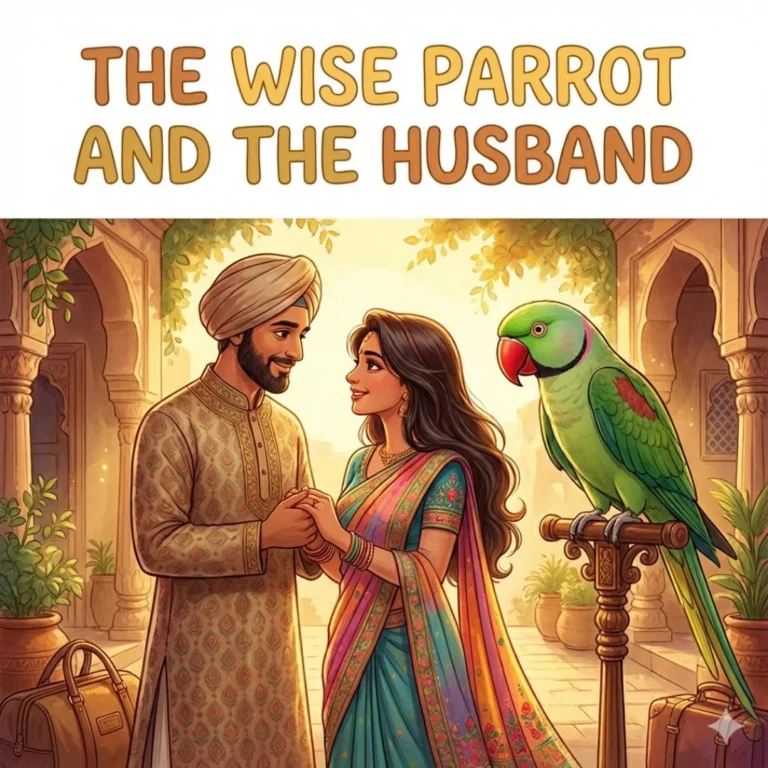
This moral story for children ages 6-12 combines entertainment with important values.
In the bustling city of Basra, where merchants traded silks from Damascus and spices from India, there lived a husband who loved his wife dearly.
His name was Ahmad, and he was a prosperous trader whose business required him to travel frequently to distant cities. These journeys often kept him away for weeks at a time, and during his absences, his heart ached with loneliness and worry.
Not worry that his business would fail—he was skilled at his trade and trusted his partners.
But worry about his beloved wife, Layla.
She was beautiful, intelligent, and kind—qualities that made him love her but also made him anxious when he was away. What if someone tried to take advantage of his absence? What if she grew lonely? What if…
His mind spun with fears that he knew were likely foolish but could not shake.
One day, before another long journey, Ahmad walked through the great marketplace searching for a solution to his worries.
That’s when he heard a voice call out:
“Good morning, honored sir! Might I interest you in the finest silk? Or perhaps some dates fresh from the oasis?”
Ahmad stopped. The voice was clear, articulate—almost human.
But it had come from a birdcage.
* * *
## THE TALKING PARROT
Inside an ornate bamboo cage sat a magnificent parrot. Its feathers were emerald green with splashes of crimson and gold. Its eyes were bright and intelligent, seeming to study Ahmad with knowing awareness.
“Did… did that bird just speak?” Ahmad asked the old merchant seated beside the cage.
The merchant smiled, his weathered face crinkling with amusement.
“Indeed, good sir. This parrot is no ordinary bird. He has been trained since hatching to observe and report everything he sees and hears. Merchants use such birds to watch over their shops when they are away. Wives have been known to buy them to guard their jewelry. And some men…” the merchant paused meaningfully, “…use them to watch over their households when business takes them traveling.”
Ahmad’s eyes widened. “Everything he sees?”
“Everything,” the merchant confirmed. “And unlike human servants, who may be bribed or swayed by loyalty, this bird speaks only the truth. He has no reason to lie.”
Ahmad felt a surge of relief mixed with excitement. Here was the answer to his worries! A faithful, truthful observer who would keep watch over his home—and his wife—while he was away.
“How much?” Ahmad asked.
The price was steep, but Ahmad paid it without hesitation. He carried the parrot home in its cage, already imagining the peace of mind it would bring.
* * *
## THE ARRANGEMENT
That evening, Ahmad introduced the parrot to Layla.
“My dear wife,” he said, “I have brought home a companion for you while I am away on my journeys. This parrot is very special—he can speak and understand everything around him. He will keep you company and help guard our home.”
Layla looked at the bird with curiosity and smiled. “He is beautiful. What is his name?”
“The merchant called him Jawhar—meaning ‘jewel.’”
“Jawhar,” Layla repeated, and the parrot bobbed his head as if in acknowledgment.
The next morning, Ahmad prepared to leave for Damascus—a journey that would take three weeks.
“Farewell, my beloved,” he said to Layla, embracing her. Then he turned to the parrot. “Jawhar, watch over my household. When I return, you will tell me everything that has happened here.”
“Everything,” the parrot repeated in its clear, precise voice.
And Ahmad departed, his heart lighter than it had been in months.
* * *
## THE FIRST REPORT
Three weeks later, Ahmad returned home, dusty from travel but eager to see his wife and hear the parrot’s report.
After greeting Layla with joy, he went to the parrot’s cage.
“Well, Jawhar? What occurred during my absence?”
The parrot tilted his head and began to speak.
“Master, on the third day after you departed, a young man came to the door. Your wife invited him inside. They sat together in the garden and talked for many hours. On the seventh day, he came again. They shared a meal. On the twelfth day—”
“Enough!” Ahmad’s face had gone red. He turned to his wife, anger flashing in his eyes. “Layla! Who is this man? Why have you been entertaining visitors while I am away?”
Layla’s face showed genuine confusion and hurt. “Ahmad, what are you talking about? My cousin visited once to bring news of my mother’s health. He is family—there was nothing improper!”
“Your cousin?” Ahmad’s anger cooled slightly. “Why didn’t you mention this?”
“I didn’t think it worth mentioning! He’s my cousin—practically my brother!”
Ahmad turned back to the parrot, uncertain now. “Is this true, Jawhar? Was this man her cousin?”
“He called her ‘cousin,’” the parrot confirmed. “But he looked at her with great affection.”
“Of course he did!” Layla cried. “We grew up together! Ahmad, you cannot truly believe—”
But Ahmad’s mind was troubled. The seed of suspicion had been planted, and though he said nothing more that night, the warmth between husband and wife had cooled.
* * *
## LAYLA’S PLAN
After Ahmad went to sleep, Layla lay awake, her heart heavy.
She had done nothing wrong. Her cousin’s visit had been entirely innocent. And yet her husband had believed the parrot’s implications over her own words.
The next morning, she spoke quietly with her three most trusted servants—Fatima, Zahra, and Hassan.
“That bird has poisoned my husband’s mind against me,” she said. “He watches me constantly now, and his reports are twisted to sound suspicious even when there is nothing wrong. When my husband leaves on his next journey, I want you to teach that parrot a lesson about truth.”
“What do you wish us to do, mistress?” Fatima asked.
“Create a storm,” Layla said. “Make the parrot believe there has been terrible weather—thunder, lightning, rain—so that when he reports it to my husband, and my husband knows there was no storm, he will realize the bird is unreliable.”
The servants looked at each other uncertainly but agreed to help their mistress.
* * *
## THE FALSE STORM
Two weeks later, Ahmad departed again—this time to Aleppo, a journey of a month.
That night, when darkness had fully fallen, Layla’s three servants set to work.
Hassan brought a heavy hand-mill—a stone grinder used for grinding grain—and positioned it beneath the parrot’s cage. Slowly, carefully, he began to turn it, creating a deep, rumbling sound that echoed through the room like distant thunder.
RRRRRRRUMBLE. RRRRRRRUMBLE.
Jawhar jerked awake, his feathers ruffling in alarm. What was that sound?
Zahra stood on a stool above the cage, holding a large bowl of water. She tilted it slightly, letting water pour down in a steady stream around (but not on) the cage, creating the sound of heavy rain.
SPLASH. PATTER. SPLASH.
The parrot shifted on his perch, confused and frightened. Thunder? Rain? But the day had been perfectly clear!
Finally, Fatima took a polished brass mirror in one hand and a candle in the other. She positioned herself in front of the cage and moved the mirror back and forth in the candlelight, sending flashes of light dancing across the walls and ceiling—bright, sudden, erratic.
FLASH! FLASH! FLASH!
To the parrot, it looked exactly like lightning.
All night long, the three servants maintained their deception. The grinding stone rumbled like thunder. The water splashed like rain. The mirror flashed like lightning.
Jawhar huddled on his perch, miserable, terrified, unable to understand what was happening. It seemed the very heavens were in chaos, yet somehow the house remained standing.
When dawn came, the servants stopped and quietly left.
Jawhar sat trembling, his world turned upside down.
* * *
## THE TRAGIC MISUNDERSTANDING
When Ahmad returned from Aleppo a month later, he went immediately to the parrot.
“Jawhar, tell me—what happened during my absence?”
The parrot’s voice was tired and shaken.
“Master, such a terrible night I have never experienced. The thunder was deafening—it shook my very bones. The lightning was blinding—flash after flash until I thought the world was ending. And the rain—it poured down without ceasing, as if the heavens themselves were weeping.”
Ahmad frowned. “A storm? When was this?”
“The first night after you left, master. All night it raged.”
Ahmad’s expression hardened. He turned to his wife. “Layla, was there a storm the night after I left?”
“No, husband. The skies were perfectly clear. There was no storm at all that week.”
Ahmad looked back at the parrot, and his eyes filled with anger.
“So you lie to me now, Jawhar? I paid good money for a truthful bird, and you invent storms that never happened? If you lie about this, how can I trust anything you’ve told me?”
“But master—” the parrot began, desperate.
“No!” Ahmad shouted. “You are a liar and a deceiver!”
In a rage, Ahmad seized the cage, opened it, grabbed the parrot, and hurled him to the ground.
The impact was terrible. Jawhar lay on the floor, his wings twisted, his breathing shallow.
Layla gasped, her hand flying to her mouth.
The parrot’s eyes found Ahmad one last time.
“Master…” he whispered, his voice barely audible. “I spoke… only truth… as I saw it…”
And then Jawhar died.
* * *
## THE TERRIBLE REVELATION
In the days that followed, Ahmad felt a nagging unease.
Yes, the parrot had clearly lied about the storm. But something about the bird’s final words troubled him.
“As I saw it…”
One evening, unable to shake his guilt, Ahmad called Layla’s three servants to speak with him.
“Tell me,” he said, “do you know anything about a storm—a false storm—created to deceive my parrot?”
The three servants exchanged glances. Finally, Hassan spoke.
“Forgive us, master. Your wife asked us to teach the parrot a lesson. We used a grindstone for thunder, water for rain, and a mirror with candlelight for lightning. We meant no harm—we only wanted to show that the bird’s reports were unreliable.”
Ahmad felt as if the ground had dropped out from beneath him.
“You mean… the parrot was telling the truth? There was thunder, lightning, and rain—as he experienced them?”
“Yes, master,” Fatima said quietly. “He spoke only what he witnessed.”
Ahmad sank into his chair, his face pale.
He had killed an innocent creature. A bird who had done exactly what Ahmad had asked—observe faithfully and report truthfully.
Jawhar had not lied. Jawhar had told the truth as he understood it.
And Ahmad had murdered him for it.
* * *
## THE LESSON LEARNED
Ahmad never bought another parrot.
He never again tried to spy on his wife or set a watchful eye over his household.
He realized, too late, that his suspicion and lack of trust had poisoned his marriage far more than any actual wrongdoing could have.
Layla, too, learned something—that clever tricks, even in self-defense, can have unintended and tragic consequences. In trying to prove the parrot wrong, she had inadvertently caused an innocent creature’s death.
The couple stayed together, and over time, they rebuilt their trust—not through surveillance and reports, but through honest communication, faith, and love.
But on quiet evenings, when the wind whispered through the palms and the stars glittered above the courtyard, Ahmad would sometimes think of Jawhar.
The jewel-bright bird who had spoken only truth.
The faithful observer who had died for doing exactly what he was asked to do.
And Ahmad would whisper into the night: “Forgive me, Jawhar. Forgive me.”
* * *
This story, told in the courts of Baghdad and Damascus, in the marketplaces of Cairo and the caravanserai of Persia, carries many lessons:
**Seek understanding before judgment.** Ahmad assumed the parrot lied without asking how such a storm could have seemed real to the bird.
**Truth is a matter of perspective.** Jawhar told the truth as he experienced it. That his truth differed from Ahmad’s didn’t make it false.
**Trust cannot be built through surveillance.** Ahmad’s attempt to watch his wife through the parrot only created suspicion and distance between them.
**Deception has consequences.** Layla’s trick to discredit the parrot led to its death—an outcome she never intended.
**Anger leads to regret.** In his rage, Ahmad acted without thought, and spent the rest of his life regretting that moment.
And perhaps most importantly:
**The wise parrot was wise indeed—wise enough to tell the truth, even when the truth was dangerous to speak.**
In the end, Jawhar the parrot was wiser than the humans who owned him.
He understood what they did not: that truth is sacred, even when it costs everything.
And that is a lesson worth remembering.
MORAL LESSONS:
– Seek understanding before making judgments – ask questions, gather information
– Truth is often a matter of perspective – what one sees as truth may be experienced differently by another
– Trust cannot be built through surveillance or spying
– Jealousy and suspicion poison relationships more than actual wrongdoing
– Clever deceptions can have tragic unintended consequences
– Act in anger, regret at leisure – pause before reacting in rage
– Speaking truth can be dangerous but is still noble
– Don’t assume someone is lying just because their experience differs from yours
– Communication and honesty in relationships matter more than watchful oversight
– Once an action is taken, it cannot be undone – think carefully before acting
ARABIAN NIGHTS/MIDDLE EASTERN ELEMENTS PRESERVED:
– Story from One Thousand and One Nights (tale within the King Yunan/Greek King story)
– Middle Eastern setting (Basra, Damascus, Aleppo – actual cities)
– Talking parrot as witness/spy device – exact from source
– Merchant husband who travels frequently – exact
– Beautiful wife at home alone – exact setup
– Parrot reports wife’s activities – exact
– Wife discovers parrot is informing – exact
– Three servants create false storm – exact detail
– Hand-mill/grindstone for thunder sound – exact
– Water poured for rain sound – exact
– Mirror with candle for lightning – exact
– Parrot reports “thunder, lightning, rain” – exact
– Husband knows no storm occurred – exact
– Husband kills parrot in anger – exact tragic outcome
– Husband later discovers parrot told truth as witnessed – exact irony
– Frame tale structure (story within larger narrative) – Arabian Nights tradition
– Moral lesson about hasty judgment – exact theme
– Middle Eastern names (Ahmad, Layla, Jawhar, Fatima, Zahra, Hassan)
– Cultural details (courtyard, garden, visiting customs, merchant trade routes)
SOURCE FIDELITY NOTES:
✓ Based on One Thousand and One Nights “The Story of the Husband and the Parrot”
✓ Embedded within the larger tale of King Yunan and the physician Douban
✓ All major plot points exact from Arabian Nights version
✓ Parrot as surveillance device – exact
✓ Three servants creating false storm – exact creative deception
✓ Specific methods (grindstone, water, mirror/candle) – exact from source
✓ Parrot’s honest report of false storm – exact
✓ Tragic killing of truthful parrot – exact outcome
✓ Husband’s later regret – exact emotional arc
✓ Theme about hasty judgment – exact moral lesson
✓ Similar theme appears in Jataka Tale #198 (Buddhist version with different details)
✓ Cultural setting and names adapted to be historically appropriate
ENGAGEMENT ENHANCEMENTS:
+ Named all characters for better connection (Ahmad, Layla, Jawhar)
+ Rich character development (Ahmad’s jealousy, Layla’s hurt, parrot’s innocence)
+ Vivid sensory details (marketplace sounds, storm simulation, parrot’s fear)
+ Emotional depth throughout (suspicion, betrayal, regret, grief)
+ Extended dialogue brings characters to life
+ Scene breaks create better pacing
+ Detailed description of the deception (sound effects, visual tricks)
+ Parrot’s perspective included (fear, confusion, final words)
+ Satisfying but tragic resolution with clear consequences
+ Universal themes about trust, truth, and judgment
+ Child-appropriate while maintaining story’s tragic power
+ Framing emphasizes lesson for readers
CULTURAL SIGNIFICANCE:
– Classic tale from One Thousand and One Nights
– Reflects Middle Eastern storytelling tradition
– Embedded narrative (story within story) typical of Arabian Nights
– Explores themes of jealousy, trust, and judgment
– Cautionary tale about hasty decisions
– Shows sophistication of classical Arabic/Persian literature
– Demonstrates psychological insight into human nature
– Part of larger frame story teaching kings about wise judgment
– Influences European literature (appears in various medieval collections)
– Still told in Middle Eastern cultures as moral lesson
PARALLEL VERSION NOTE:
A similar tale appears in Buddhist Jataka #198 (“Radha Jataka”) where a brahmin’s wife kills a truth-telling parrot. The Buddhist version emphasizes different lessons about when truth-telling is wise vs. dangerous. The Arabian Nights version (used here) focuses more on hasty judgment and the tragedy of misunderstanding. Both traditions recognized the parrot-as-witness motif as a powerful teaching tool.
NOTE ON AUTHENTICITY:
This retelling faithfully follows “The Story of the Husband and the Parrot” from One Thousand and One Nights, which appears as an embedded tale within the story of King Yunan and the physician Douban. The core elements—talking parrot purchased to watch wife, servants creating false storm with grindstone/water/mirror, parrot reporting the “storm,” husband disbelieving and killing the bird, later discovery of the truth—are exact from the source. The characterizations, dialogue, and emotional depth have been enhanced while maintaining complete fidelity to the original plot and moral lesson. The setting and names are appropriate to the Arabian/Middle Eastern cultural context of the source material.
SOURCES:
– [7. The Story of the Husband and the Parrot | Tales](https://tales.siththan.org/archives/119)
– [The Story of the Husband and the Parrot | Sacred Texts](https://sacred-texts.com/neu/lang1k1/tale07.htm)
– [Jataka Tales | D. L. Ashliman](https://sites.pitt.edu/~dash/jataka.html)
– [Ja 198 The Birth Story about (the Parrot) Rādha](https://ancient-buddhist-texts.net/English-Texts/Jataka/198.htm)
– One Thousand and One Nights (Arabian Nights) – classical Arabic/Persian literature
– Various translations and scholarly analyses of Arabian Nights tales
Test Your Understanding
1. Why did the merchant Ahmad buy a talking parrot?
Frequently Asked Questions
What is the moral lesson of The Wise Parrot and the Husband?
What age is this story appropriate for?
How long does it take to read The Wise Parrot and the Husband?
What culture does this story come from?
Can I use this story for teaching?
Frequently Asked Questions
What is The Wise Parrot and the Husband moral story for children about?
This is a bedtime story for kids ages 6-12 about Ahmad, a merchant from Basra who worries about his wife Layla when he travels for business. He meets a wise talking parrot in the marketplace who helps him learn an important lesson about trust and wisdom in relationships.
What age group is this parrot story suitable for?
This moral story is perfect for children ages 6-12. It teaches valuable lessons about trust, wisdom, and relationships through an engaging tale set in the ancient Middle Eastern city of Basra, making it both educational and entertaining for young readers.
What moral lesson does the wise parrot teach in this story?
The wise parrot helps Ahmad learn about trust, wisdom, and overcoming unnecessary worries in relationships. Through the parrot’s guidance, readers discover how fear and suspicion can harm the bonds we cherish most, making this an important lesson about faith and communication.
📚 Recommended Books
Handpicked for readers like you
As an Amazon Associate, we earn from qualifying purchases. These recommendations are personalized based on this story's themes and your reading history.
Who are the main characters in The Wise Parrot and the Husband?
The main characters are Ahmad, a prosperous merchant who travels frequently for trade; his beloved wife Layla, who is beautiful, intelligent, and kind; and a wise talking parrot that Ahmad encounters in the marketplace who becomes his advisor.
Where does this educational story for kids take place?
The story is set in the bustling ancient city of Basra, a major trading hub where merchants sold silks from Damascus and spices from India. This Middle Eastern setting adds cultural richness and historical context to the moral lesson.
