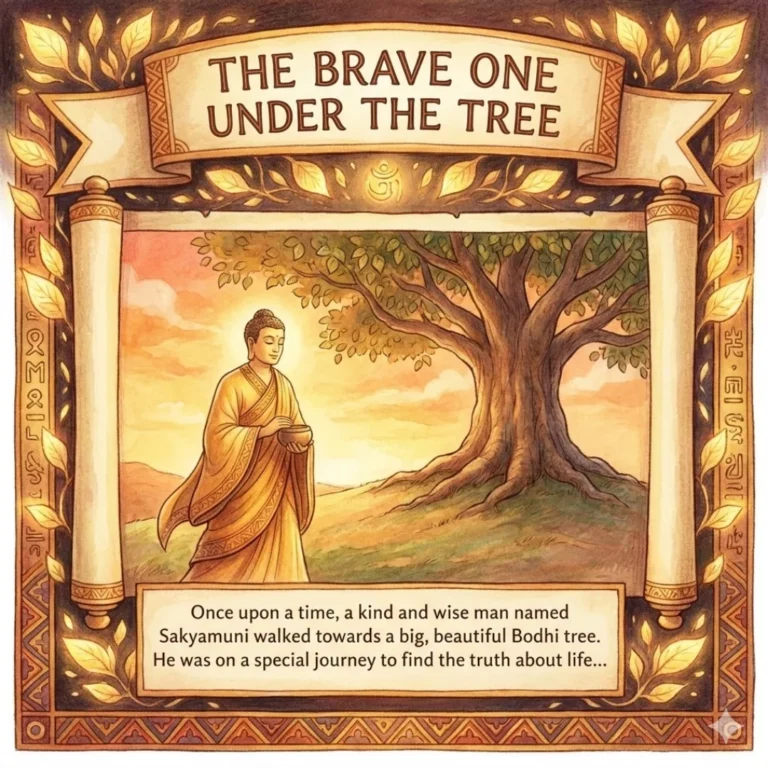
‘The Brave One Under the Tree’ is an educational moral story perfect for bedtime reading with children ages 6-12.
Chapter One: The Vow
In the ancient land of India, where the Ganges River flowed silver under the moon, a seeker named Siddhartha walked along a dusty path. He had been searching for truth for six long years, and though he had learned much, the deepest answers still eluded him.
He came at last to a great tree. Its trunk was as wide as a house, its branches spread like welcoming arms, and its heart-shaped leaves rustled with a sound like whispered prayers. The local people called it the Bodhi Tree, the Tree of Awakening, though they did not yet know how fitting that name would prove.
Siddhartha looked up at the tree and felt something stir in his heart, a quiet certainty that this was where his journey would find its end.
He gathered soft grass from a nearby field and made a simple cushion. He settled himself facing east, toward the rising sun, and crossed his legs in the posture of meditation.
“I will not rise from this spot,” he declared to the sky, the earth, and all living things, “until I have found the truth about suffering and freedom. Though my skin may wither and my bones may turn to dust, I will not move until I understand.”
The forest seemed to hold its breath. Even the river grew quiet. Something was about to change, and all of nature sensed it.
Chapter Two: Mara Takes Notice
Far away, in a realm of shadows and illusions, a powerful being named Mara opened his eyes. Mara was the lord of all that keeps beings trapped in confusion: desire that cannot be satisfied, fear that paralyzes, doubt that corrodes confidence.
He felt a disturbance in the fabric of his power. Someone was sitting very still under a tree, and that stillness threatened everything Mara had built.
“This one must be stopped,” Mara growled. He summoned his vast army of spirits and his three daughters: Tanha, whose name means Craving; Raga, whose name means Passion; and Arati, whose name means Discontent.
“We will go to the tree,” Mara declared. “We will drive this seeker away before he discovers what we have kept hidden for so long.”
With a sound like thunder, Mara and his forces departed for the world of humans.
Chapter Three: The Army of Fear
Night had fallen over the forest. Siddhartha sat in perfect stillness, his mind growing deeper and clearer with each breath. He had passed through memories of his many past lives, seeing how all beings wandered in confusion, suffering the same pains again and again.
Then, without warning, the sky turned black. Trees bent as if pressed down by invisible hands. A cold wind howled through the forest, carrying voices that shrieked and moaned.
Mara’s army arrived.
They came in forms designed to terrify: demons with a thousand eyes, creatures made of fire and smoke, monsters with teeth like swords and claws like knives. They surrounded the Bodhi Tree in a ring of nightmare, howling and screaming for Siddhartha to flee.
But the seeker did not move.
The demons threw spears of lightning at him. But as the weapons flew toward Siddhartha, something miraculous happened. The spears transformed into flowers that fell softly into his lap, their petals glowing with gentle light.
They hurled boulders of darkness. These too changed, becoming soft petals and fragrant blossoms that drifted harmlessly to the ground.
Mara watched in growing fury. “Increase the attack!” he commanded. “Show him horrors beyond imagination!”
But no matter what his army did, Siddhartha remained unmoved. His face was peaceful, almost gentle, as if he watched children playing rather than demons attacking.
“Do you not see them?” one demon screamed in frustration.
“I see them,” Siddhartha replied calmly, “and I see through them. They are shadows cast by my own mind. They have no power except the power I give them.”
Chapter Four: The Daughters of Desire
When terror failed, Mara sent his three daughters.
Tanha, the spirit of Craving, approached first. She appeared as everything Siddhartha might desire: a feast of the most delicious foods, treasures beyond counting, pleasures without end.
“Why struggle so hard?” Tanha whispered, her voice like honey. “Enlightenment is just an idea. But pleasure is real. Come, taste and enjoy. Life is short, and joy is rare.”
Siddhartha smiled gently. “I have tasted pleasure. It is sweet for a moment, then leaves the mouth dry. What I seek is a satisfaction that never fades.”
Raga, the spirit of Passion, tried next. She showed Siddhartha visions of all he had left behind: his beautiful wife Yasodhara, his young son Rahula, the palace where he had grown up happy and content.
“Go back to them,” Raga urged. “They need you. What kind of husband abandons his wife? What kind of father leaves his son?”
Siddhartha felt his heart ache. He did love them, more than these spirits could understand. But his love was precisely why he must continue.
“If I go back now, I bring only a temporary comfort,” he said. “If I find what I seek, I can offer them, and all beings, something far greater: freedom from suffering itself.”
Arati, the spirit of Discontent, was the most dangerous of all. She did not offer pleasure or play on love. Instead, she whispered doubt.
“Who do you think you are?” Arati hissed. “Others have tried to find this truth. Greater men than you have failed. You are nobody special. Why should you succeed where countless seekers have fallen?”
This was the hardest challenge. Siddhartha felt doubt creep into his mind like cold water seeping through cracks. Was he foolish? Was this all a waste?
But then he remembered: doubt is just another thought. And thoughts, even the most painful ones, pass like clouds across the sky.
“I may fail,” he said quietly. “But I will not stop trying. Not for fear, not for pleasure, not for doubt.”
Chapter Five: Mara’s Final Challenge
With his daughters defeated, Mara himself stepped forward. He was tall as a tower, dark as the space between stars, and his voice rumbled like an earthquake.
“You have resisted my army and my daughters,” Mara said. “But tell me this: What right do you have to seek enlightenment? What makes you worthy?”
He gestured to his vast army. “All these are my witnesses. They speak of my power, my dominion over the realm of confusion. But you sit alone. No one witnesses you. No one confirms your right to the truth. You are nothing but a wanderer beneath a tree.”
Siddhartha considered the question. It was true that he sat alone. He had no army, no followers, no proof of his worthiness.
But then he realized: he was not alone.
Slowly, Siddhartha reached down with his right hand and touched the earth.
“The earth is my witness,” he said. “Every creature who suffers is my witness. Every being who hopes for freedom is my witness. I do not seek enlightenment for myself alone. I seek it for all beings everywhere.”
As his fingers touched the ground, a remarkable thing happened. The earth itself shuddered and responded. From the deep places below, a mighty voice spoke:
“I bear witness. This seeker has striven for countless lifetimes, not for his own gain, but for the liberation of all beings. His right is earned through compassion and perseverance without end.”
Mara staggered back as if struck. His army wavered like reflections in disturbed water. His daughters faded into mist.
“You cannot win against compassion,” Siddhartha said gently, almost with pity for his challenger. “Fear builds barriers. Desire creates prisons. But compassion opens all doors.”
With a howl of frustration, Mara and his forces fled into the darkness, defeated not by violence but by unwavering peace.
Chapter Six: The Dawn of Understanding
As Mara vanished, the sky began to lighten. Stars faded from view. The first birds began to sing.
Siddhartha’s mind, freed from disturbance, settled into a stillness deeper than any ocean. In that stillness, he saw the truth he had sought for so long.
He saw how suffering arises: from grasping at things that cannot last, from running from experiences that are unavoidable, from not understanding the true nature of reality.
He saw how suffering ends: through letting go, through seeing clearly, through cultivating wisdom and compassion.
He saw that every living being possessed the same potential for awakening. The peace he experienced was not his alone; it was the birthright of all creatures.
When the morning star rose above the horizon, Siddhartha opened his eyes. But he was no longer simply Siddhartha. He had become the Buddha, the Awakened One.
The heavens celebrated. Flowers rained from the sky. The trees seemed to bow in reverence. All of nature rejoiced because something precious had entered the world: a guide who could show others the path from darkness to light.
Chapter Seven: The Gift of Teaching
For seven weeks, the Buddha remained near the Bodhi Tree, absorbing the profound peace of his realization. Part of him wanted to stay there forever, dwelling in perfect understanding.
But then he thought of all the beings wandering in confusion: the frightened, the angry, the lost, the hopeless. He thought of his wife and son. He thought of the seekers who would come after him, struggling as he had struggled.
“I will teach,” the Buddha decided. “I will share what I have found with anyone who wishes to learn.”
He rose from his seat beneath the Bodhi Tree and began to walk. He would walk for forty-five more years, sharing his wisdom with kings and beggars, scholars and children, anyone who approached with an open heart.
“Is it difficult to follow your path?” people would ask.
And the Buddha would smile and answer: “It is simple but not easy. The path is just this: observe your mind, understand your heart, and let go of what causes suffering. When you fill your heart with compassion for all beings, you become like this tree behind me: unshakable in the strongest wind, offering shelter and shade to all who need it.”
Chapter Eight: The Light That Never Fades
Today, more than two thousand years later, the Bodhi Tree still stands. Countless seekers have sat beneath its branches, just as the Buddha once sat, seeking their own awakening.
The path the Buddha discovered on that long-ago night remains open to all. It does not require special powers or privileged birth. It only requires the courage to face our own fears, the wisdom to see through our own desires, and the compassion to wish freedom for all beings.
Every time you sit quietly and observe your thoughts without being swept away by them, you walk this path. Every time you choose kindness over anger, generosity over greed, or understanding over ignorance, you walk this path. Every time you remember that your happiness is connected to the happiness of all beings, you walk this path.
The Buddha did not defeat Mara with weapons or armies. He won with stillness, with clear seeing, and with the revolutionary power of compassion.
And that victory is available to every heart brave enough to sit beneath its own Bodhi Tree and face whatever arises with peaceful awareness.
Moral Lessons
- True courage is not fighting external enemies but facing our own fears, desires, and doubts with calm awareness. When we meet challenges with compassion instead of aggression, even the greatest obstacles transform into opportunities for awakening.
Test Your Understanding
1. What vow did Siddhartha make when he sat under the Bodhi Tree?
2. Who was Mara and what did he want?
3. What happened when Mara’s army threw spears of lightning at Siddhartha?
4. What did Siddhartha do when Mara asked who would witness his worthiness?
5. How did Siddhartha defeat Mara?
6. What is the main moral lesson of this story?
Frequently Asked Questions
What is the moral lesson of The Brave One Under the Tree?
What age is this story appropriate for?
How long does it take to read The Brave One Under the Tree?
What culture does this story come from?
Can I use this story for teaching?
Frequently Asked Questions
Who is the brave one under the tree in this bedtime story for kids?
The brave one is Siddhartha, who would later become known as Buddha. He sits under the sacred Bodhi Tree, determined to find the deepest truths about life. This educational story shows his courage and dedication during his spiritual journey in ancient India.
What age group is The Brave One Under the Tree story appropriate for?
This moral story is perfect for children ages 6-12. It presents Buddha’s enlightenment story in an age-appropriate way, focusing on themes of courage, determination, and seeking wisdom that young readers can understand and learn from.
What moral lesson does The Brave One Under the Tree teach children?
This story teaches children about perseverance, courage, and the importance of seeking truth and wisdom. It shows how Siddhartha’s determination under the Bodhi Tree led to enlightenment, encouraging kids to be brave when pursuing their goals.
📚 Recommended Books
Handpicked for readers like you
As an Amazon Associate, we earn from qualifying purchases. These recommendations are personalized based on this story's themes and your reading history.
Is The Brave One Under the Tree based on a real historical figure?
Yes, this moral story for children is based on Siddhartha Gautama, who became known as Buddha. The story retells his famous meditation under the Bodhi Tree in ancient India, where he achieved enlightenment and founded Buddhism.
Why did Siddhartha choose to sit under the Bodhi Tree?
According to the story, Siddhartha felt a quiet certainty that the great tree was where his spiritual journey would find its end. He was drawn to its welcoming branches and made a vow not to rise until he found the truth he had been seeking for six years.