This moral story for children ages 6-12 combines entertainment with important values.
In the ancient kingdom of Ayodhya, where the river Sarayu flowed like liquid silver and temples rose toward the heavens, there lived a prince so noble, so brave, and so devoted to dharma—the path of righteousness—that his name would echo through the ages.
His name was Rama.
This is the story of how duty took him from his throne, how love sustained him through exile, and how courage brought him home.
* * *
## THE CROWN THAT WAS PROMISED
King Dasharatha was growing old. His hair was white as snow, his hands trembled slightly when he held his scepter, and his heart was heavy with the knowledge that his time on earth was drawing to a close.
“It is time,” he announced to his court, “to crown my successor. I name my eldest son, Prince Rama, as the next king of Ayodhya.”
The entire kingdom erupted in joy!
Rama was beloved by all. He was strong and skilled with the bow, yet gentle with children. He was wise beyond his years, yet humble enough to listen to the poorest farmer. He treated everyone—from the highest brahmin priest to the lowest servant—with equal respect and kindness.
The coronation was set for the next morning. Musicians practiced their songs. Cooks prepared magnificent feasts. The streets were decorated with flower garlands and colored powders.
But that night, everything changed.
* * *
## THE PRICE OF AN OLD PROMISE
Years earlier, King Dasharatha had made two promises to his youngest wife, Queen Kaikeyi, who had once saved his life in battle. “Ask me for any two boons,” he had said, “and I will grant them, whatever they may be.”
Kaikeyi had said she would ask when the time was right.
Now, poisoned by the whispers of her wicked maid Manthara, Kaikeyi saw her chance. She wanted her own son, Bharata, to be king instead of Rama.
That night, she went to the king wearing rags instead of jewels, lying on the floor of her chamber instead of her bed.
“My queen! What troubles you?” Dasharatha cried, rushing to her side.
“You promised me two boons,” Kaikeyi said coldly. “Now I claim them. First: make my son Bharata king instead of Rama. Second: send Rama into exile in the forest for fourteen years.”
The king’s face went pale. “No! Anything but this! Ask for half my kingdom! Ask for my life! But do not ask me to send my beloved Rama away!”
But Kaikeyi was unmoved. A king’s word, once given, could not be broken. It was a matter of dharma.
Dasharatha wept, but he had no choice.
* * *
## RAMA’S CHOICE
When Rama learned of his stepmother’s demand, his friends and teachers urged him to refuse.
“This is unjust!” they cried. “Your father was tricked! You don’t have to obey!”
But Rama shook his head calmly.
“My father gave his word,” he said. “If I break it, even to claim a throne, what kind of king would I be? A king must honor his promises above all else. I will go into exile.”
His wife, Sita, a princess of extraordinary beauty and courage, refused to stay behind.
“Where you go, I go,” she said firmly. “As a shadow follows its source, so a wife follows her husband. The hardships of the forest with you will be sweeter than the comforts of the palace without you.”
Rama’s younger brother, Lakshmana, also insisted on joining them.
“You have always protected me,” Lakshmana said. “Now let me protect you. I will not let you face the dangers of the forest alone.”
And so, Rama, Sita, and Lakshmana removed their royal silks and put on simple bark cloth. They gave away their jewels. They walked barefoot out of the palace gates, leaving behind everything they had ever known.
Behind them, King Dasharatha collapsed in grief. Within days, his broken heart would stop beating, and he would die crying out Rama’s name.
And in a distant kingdom, Bharata—the brother for whose sake Rama had been exiled—would return to find himself made king against his will.
* * *
## BHARATA’S DHARMA
When Bharata learned what his mother had done, he was furious.
“You have destroyed our family!” he shouted at Kaikeyi. “Rama was going to be a great king! Father is dead from grief! And now you have made me a thief—someone who stole his brother’s crown!”
Bharata refused to be crowned. Instead, he went into the forest to find Rama and beg him to return.
“Brother, please come back,” Bharata pleaded when he found Rama’s simple hut. “The throne is yours by right. Father is gone. Mother’s demand died with him. The kingdom needs you!”
But Rama gently refused.
“Father gave his word. I gave mine. Fourteen years in exile—that was the promise. I will honor it, even though Father is no longer here to hold me to it. That is dharma.”
Bharata bowed his head. He understood. Rama’s integrity was absolute.
“Then I will not sit on your throne,” Bharata declared. “I will place your sandals on the seat instead, as a symbol that you are the true king. I will rule only as your representative, keeping the kingdom safe until you return.”
The two brothers embraced, and Bharata returned to Ayodhya to rule in his brother’s name—a faithful regent waiting for the rightful king to return.
* * *
## THE GOLDEN DEER
Years passed in the forest. Rama, Sita, and Lakshmana built a small hut. They ate fruits and roots. They befriended the forest animals and the wise hermits who lived among the trees.
But the forest was not only home to hermits and deer. It was also home to demons—rakshasas—powerful beings who delighted in cruelty and chaos.
The most powerful of all was Ravana, the ten-headed demon king of Lanka, a golden city on an island far to the south.
One day, Ravana’s sister visited Rama’s dwelling and fell in love with him. When Rama rejected her advances, she attacked Sita in rage. Lakshmana drove her away, wounding her in the process.
Furious and humiliated, she fled to her brother Ravana.
“Rama has a wife of such beauty that no woman can compare,” she told him cunningly. “If you saw her, you would want her for yourself.”
Ravana’s pride was stung. How dare this forest-dwelling prince possess something Ravana did not?
He devised a plan.
* * *
## SITA’S ABDUCTION
One morning, a magnificent golden deer appeared near their hut—its antlers sparkling like diamonds, its coat shimmering like sunlight on water.
“Oh, Rama!” Sita exclaimed. “I have never seen anything so beautiful! If you could catch it for me, we could keep it as a pet, or take its golden hide back to Ayodhya when we return!”
Rama was suspicious—such a creature seemed too magical to be real—but Sita’s joy made him want to please her. He took his bow and went hunting for the deer, leaving Lakshmana to guard Sita.
Deep in the forest, Rama shot the deer—and watched in horror as it transformed into a rakshasa in its death throes.
“That was a demon!” Rama realized. “A trap!”
At that same moment, back at the hut, Sita and Lakshmana heard a voice crying out: “Lakshmana! Sita! Help me!”
It sounded exactly like Rama.
“Go!” Sita urged Lakshmana. “Rama is in danger!”
But Lakshmana shook his head. “That is not my brother’s voice. It is a trick. Rama made me promise to protect you. I will not leave you alone.”
“So you would let Rama die?” Sita cried, distraught. “Go! I command you!”
Reluctantly, Lakshmana drew a protective circle in the dirt around the hut using the tip of his arrow.
“Do not step outside this circle,” he warned. “As long as you remain within it, no evil can touch you.”
Then he ran into the forest to find his brother.
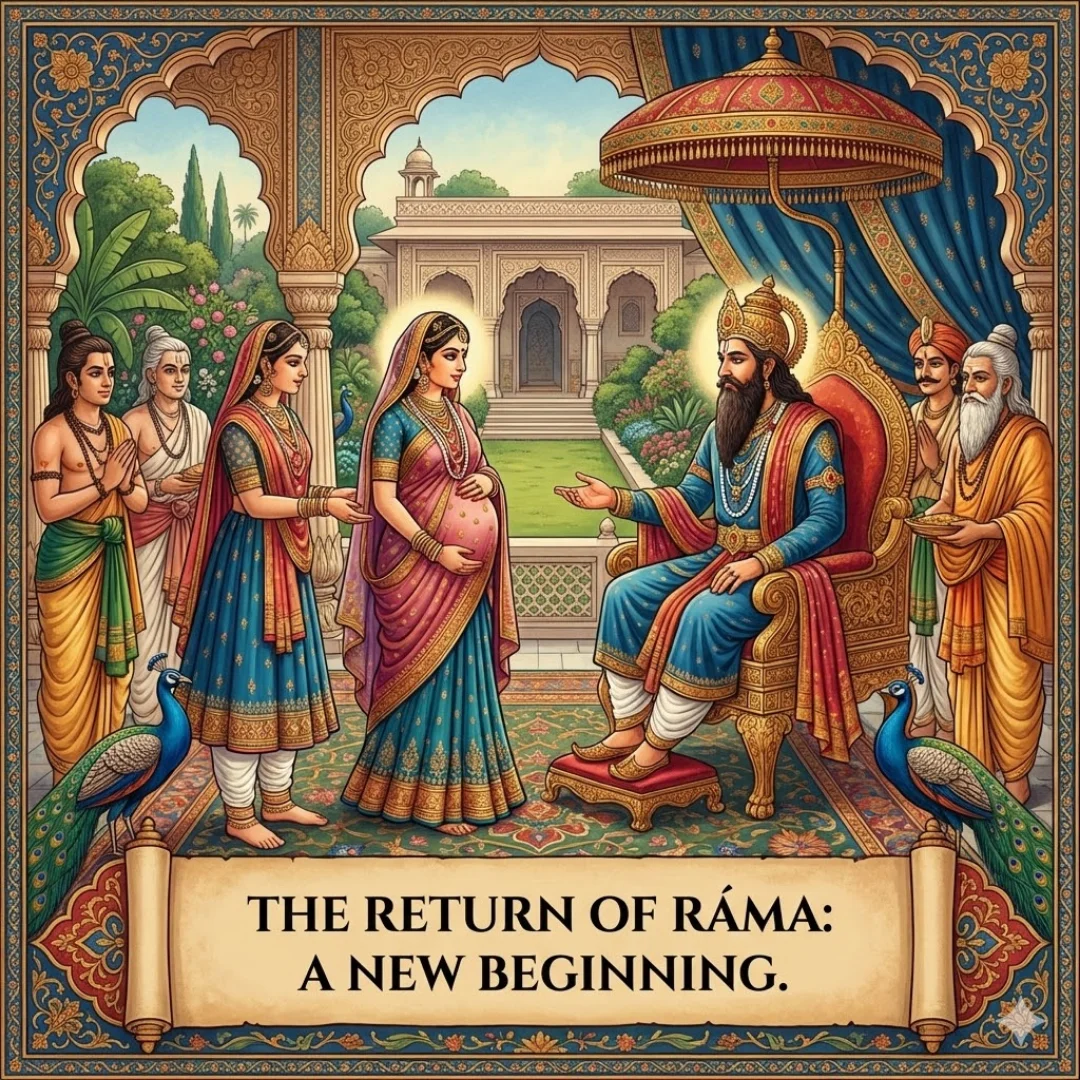
The moment Lakshmana was gone, Ravana appeared—disguised as an old, holy man begging for food.
“Kind lady,” he called weakly, “I am so hungry. Could you spare a little food for a wandering sage?”
Sita’s heart was compassionate. But the protective circle prevented her from reaching him.
“Come closer, holy father,” she said. “I cannot step outside this circle.”
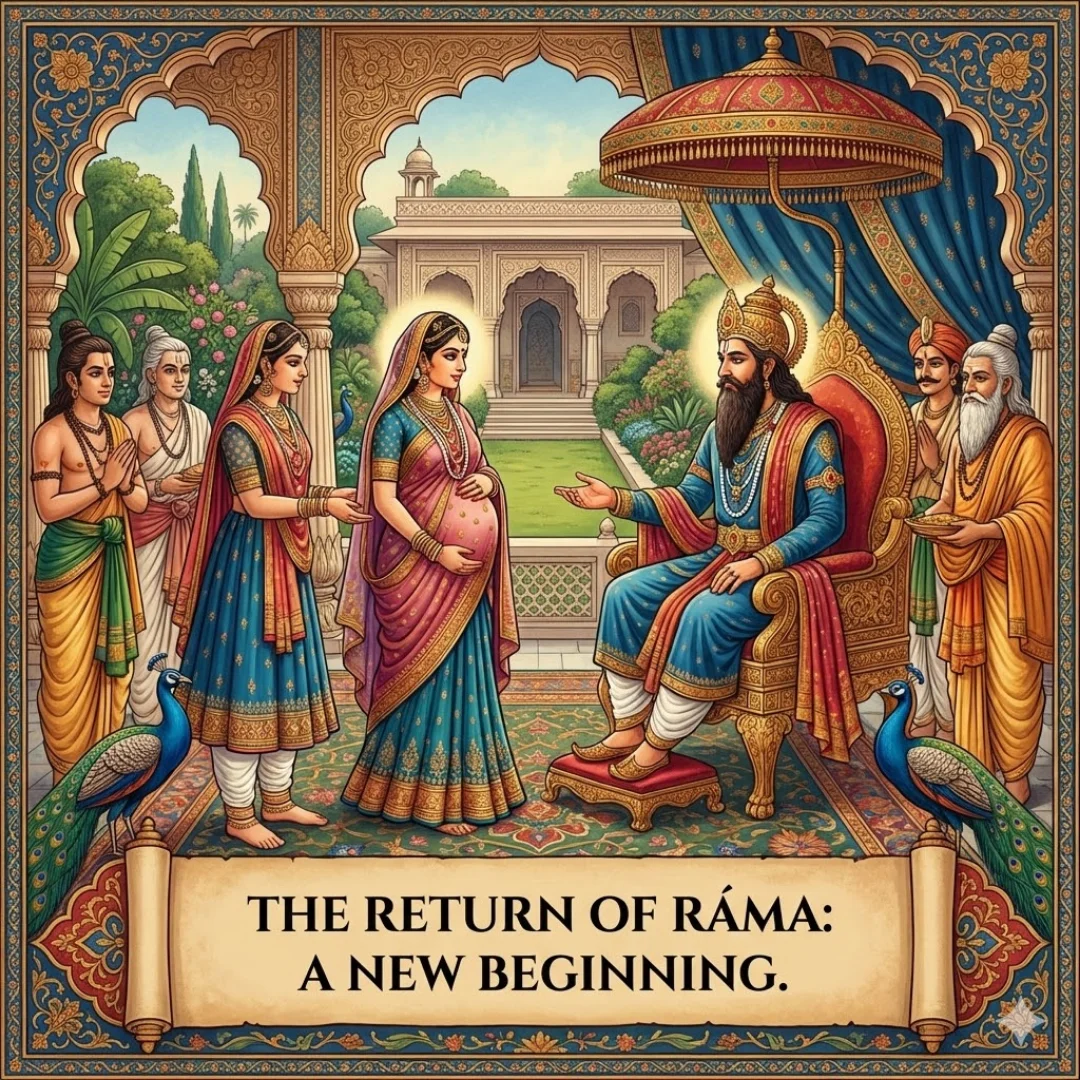
“Ah, but I am a holy man,” Ravana said with false humility. “I cannot enter a dwelling unless invited. You must come to me.”
Not wanting to turn away someone in need, Sita stepped out of the circle.
The instant her foot crossed the line, Ravana transformed into his true, terrifying form—ten heads roaring with laughter, twenty arms reaching for her.
He seized Sita and flew away in his flying chariot, carrying her across the ocean to his fortress-city of Lanka.
Sita screamed for help, but there was no one to hear—except for Jatayu, the noble old eagle, king of the birds.
* * *
## THE SEARCH AND THE ARMY
Jatayu fought bravely to rescue Sita, attacking Ravana in mid-flight. But Ravana was too powerful. He struck down the great bird, mortally wounding him.
When Rama and Lakshmana returned to find Sita gone and the hut empty, they searched desperately. They found Jatayu lying broken on the ground, barely alive.
“Ravana…” the eagle whispered with his last breath. “He took her… south… to Lanka…”
And then the brave bird died in Rama’s arms.
Rama’s grief was bottomless. But he could not let it destroy him. He had to find Sita.
His search led him to Hanuman, the mighty monkey warrior, devoted servant of Lord Rama and son of the wind god.
“I will help you,” Hanuman declared, bowing low. “You are dharma itself made flesh. To serve you is my honor.”
Hanuman brought Rama to Sugriva, king of the monkeys, who commanded a vast army. In exchange for Rama’s help in defeating Sugriva’s treacherous brother, the monkey king pledged his forces to Rama’s cause.
Hanuman himself leaped across the ocean to Lanka—a jump so vast that no ordinary being could have made it. He found Sita imprisoned in Ravana’s garden, guarded day and night, refusing to submit to the demon king’s demands.
“Rama is coming,” Hanuman whispered to her. “Hold strong. Your husband will save you.”
Sita’s heart filled with hope.
* * *
## THE WAR OF LANKA
Rama’s army—thousands of monkeys and bears—marched to the southern shore and built a bridge of stones across the ocean to Lanka, each stone floating because Rama’s name was written on it.
They laid siege to the golden city.
The war was terrible and glorious. Ravana’s demons were fierce, but Rama’s army was driven by righteousness.
Lakshmana fought valiantly, at one point nearly dying from a poisoned arrow—saved only when Hanuman flew to a distant mountain to retrieve a healing herb.
Finally, Rama and Ravana faced each other in single combat.
Ravana was a fearsome opponent—each of his ten heads chanted a different spell, his twenty arms wielded twenty weapons, and his body was protected by boons from the gods that made him nearly invincible.
But Rama was no ordinary warrior. He was an avatar of Vishnu, the Preserver, born in mortal form to rid the world of evil.
The battle shook the heavens. Arrows flew like lightning. Mountains trembled. The ocean roared.
Finally, Rama drew a special arrow—a divine weapon given to him by the gods, forged in sacred fire, blessed by sages.
He chanted a prayer, set the arrow to his bowstring, and released it.
The arrow flew straight and true.
It struck Ravana in the heart—the one place his boons could not protect—and the demon king fell, his ten heads silent at last.
* * *
## THE RETURN
The war was won. Sita was free.
But fourteen years had passed—the exact term of Rama’s exile.
“It is time to go home,” Rama said.
The monkey army cheered. They had won! Their prince would finally return to his throne!
But as they prepared to leave, Rama’s face was troubled.
Sita had been in another man’s house for months. In those times, this brought shame and suspicion, even if she had been kidnapped against her will.
To prove her purity and honor before the world, Sita asked for a trial by fire—a test where the innocent would be protected by the gods themselves.
A great pyre was built. Sita walked into the flames without fear.
And the flames would not touch her. They parted around her like a curtain, and Agni, the god of fire, appeared to declare: “This woman is pure. Her devotion to Rama never wavered. She is innocent.”
Rama bowed his head, tears in his eyes. He had never doubted her—but now the world would not doubt her either.
* * *
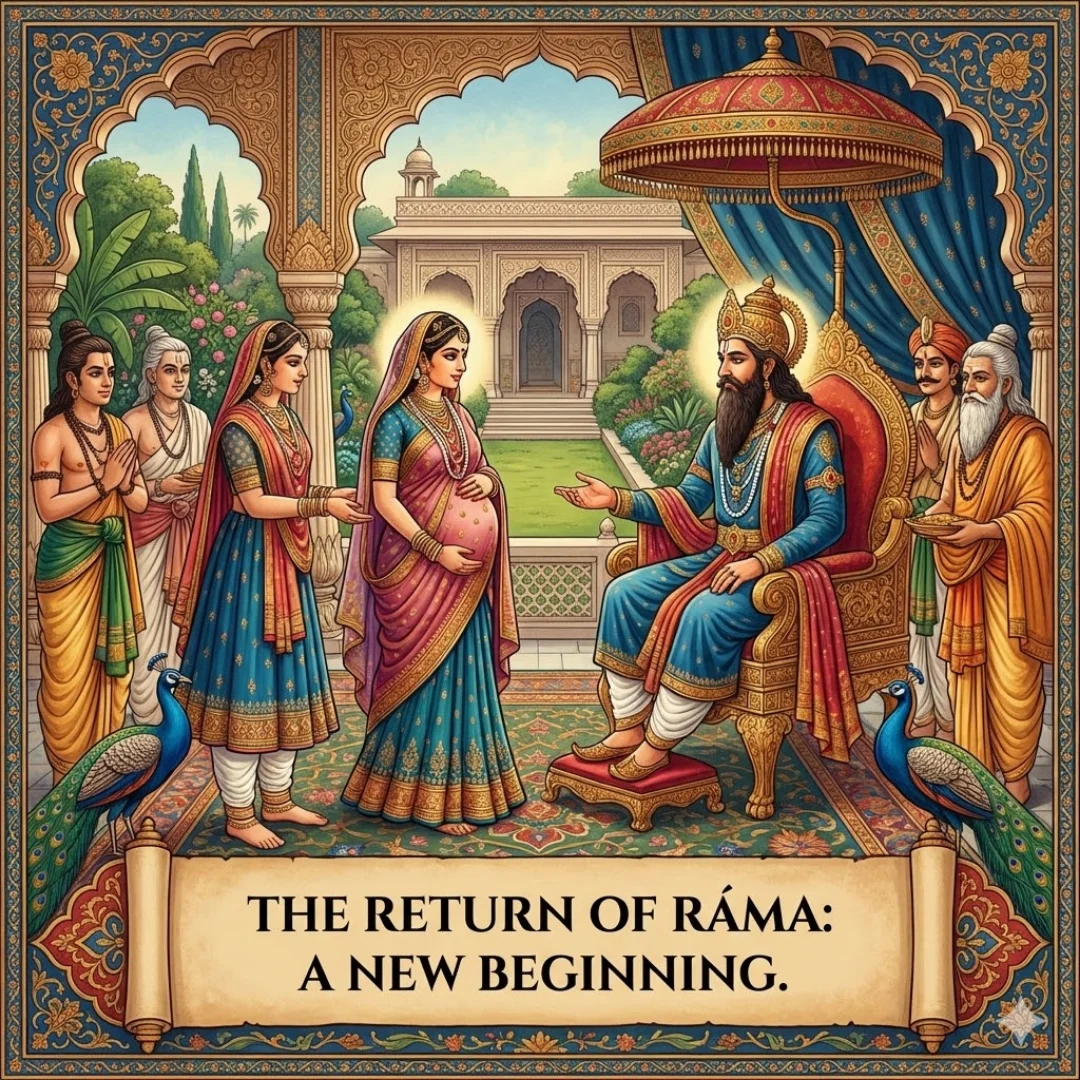
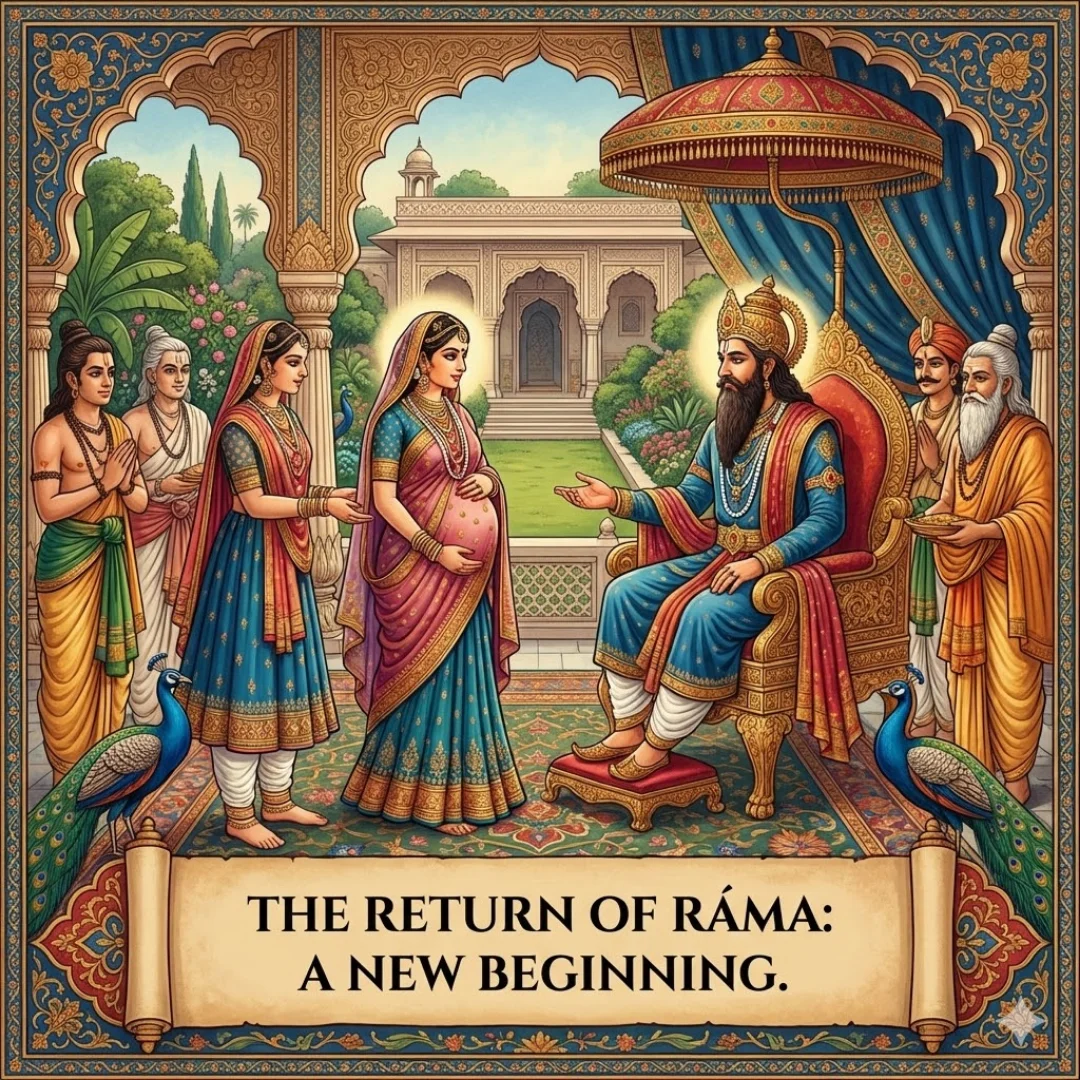
## AYODHYA WELCOMES ITS KING
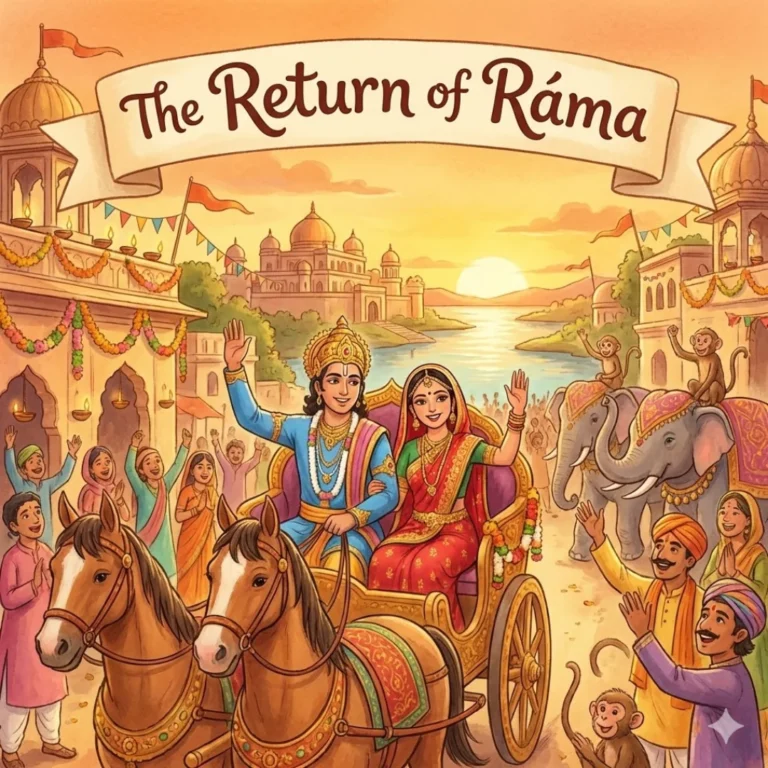
Word spread across the land: Rama was coming home.
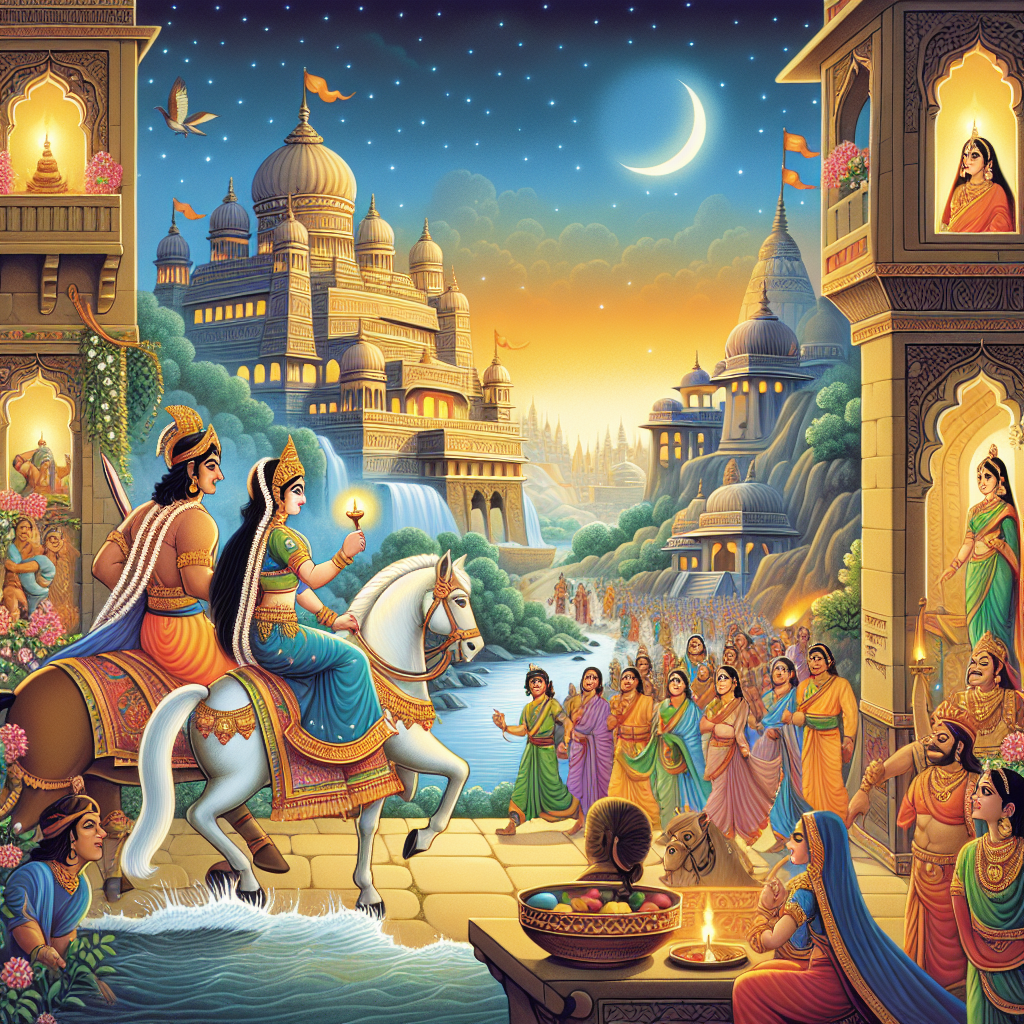
The streets of Ayodhya were cleaned and decorated. Every house lit oil lamps—diyas—thousands of them, until the entire city glowed like a constellation brought down to earth.
This festival of lights, celebrated ever since, is called Diwali.
Bharata stood at the city gates, Rama’s sandals in his hands.
When he saw his brother approaching—flanked by Sita, Lakshmana, Hanuman, and an army of loyal friends—Bharata fell to his knees and wept with joy.
“You kept your promise,” Bharata said. “Fourteen years. You honored Father’s word. Now come home, brother. Your throne awaits.”
Rama placed his hand on Bharata’s head.
“You are as much a hero as I am,” he said. “You ruled with honor in my place. You are the truest brother any man could ask for.”
The coronation that had been interrupted fourteen years earlier finally took place.
Rama was crowned king.
His rule, called Ram-Rajya, became legendary—a time when justice prevailed, when the weak were protected, when the land prospered, and when dharma guided every decision.
Fathers did not have to grieve for sons who died before them. Farmers’ fields yielded abundant crops. The rains came when needed. Peace reigned.
And Rama ruled not as a conqueror, but as a servant of his people, always remembering the lessons he had learned in exile: humility, patience, courage, and the absolute importance of keeping one’s word.
* * *
## THE LEGACY
This story, called the Ramayana, has been told for thousands of years—in India and across Asia, in temples and homes, to children and elders.
It teaches us that:
**Dharma is the highest duty—even when it costs us everything.**
Rama gave up his throne not because he was weak, but because he was strong. Keeping his word mattered more than power.
**True loyalty is tested in hardship, not comfort.**
Sita could have stayed in the palace. Lakshmana could have let his brother go alone. Bharata could have kept the crown. Hanuman could have served a less demanding master. But they chose the harder path because love and loyalty are not about convenience—they are about commitment.
**Evil may have power, but righteousness has strength.**
Ravana commanded armies and had divine boons that made him nearly immortal. But he fell because his heart was filled with ego and desire, while Rama’s heart was filled with dharma.
**A good ruler is a servant, not a master.**
Rama didn’t demand to be king. He earned it through virtue. And when he ruled, he ruled for his people, not for himself.
* * *
The Return of Rama is not just about a prince who reclaimed his crown.
It is about the triumph of good over evil.
It is about the power of keeping your promises, even when no one would blame you for breaking them.
It is about love that endures across any distance, any hardship, any trial.
And it is about coming home—not just to a place, but to who you truly are: a person of honor, courage, and compassion.
This is why, every year during Diwali, millions of people light lamps in their windows.
They are not just celebrating Rama’s return to Ayodhya.
They are celebrating the return of light after darkness.
The return of hope after despair.
The return of righteousness after evil seemed to have won.
And they are reminding themselves:
No matter how long the exile, how dark the forest, how fierce the enemy—
If you hold fast to dharma, you will find your way home.
MORAL LESSONS:
– Keep your promises, even when it costs you greatly—integrity is more valuable than power
– Duty and honor matter more than personal comfort or desire
– True loyalty stands strong through hardship, not just in good times
– Family bonds, especially between siblings, are sacred and enduring
– Good ultimately triumphs over evil, though the struggle may be long
– A true leader serves their people rather than themselves
– Love and devotion can survive any trial or separation
– Patience and faith are rewarded—Rama waited 14 years and earned his throne
– Righteousness (dharma) is the highest principle to live by
– Even in exile and suffering, maintain your dignity and compassion
HINDU/RAMAYANA ELEMENTS PRESERVED:
– Complete narrative arc from coronation to exile to return
– King Dasharatha’s promise to Kaikeyi – exact from Valmiki Ramayana
– Rama’s acceptance of exile to honor his father’s word – core dharma principle
– Sita and Lakshmana accompanying Rama – exact
– Bharata refusing the crown and ruling as regent with Rama’s sandals – exact
– Fourteen-year exile period – exact
– Golden deer deception by Maricha (rakshasa) – exact
– Lakshmana’s protective circle – exact from tradition
– Sita’s abduction by Ravana – exact
– Jatayu’s brave attempt to save Sita – exact
– Hanuman and the monkey army (Vanara) – exact
– Building the bridge (Rama Setu) to Lanka – exact
– Lakshmana wounded, Hanuman fetches Sanjeevani herb – exact
– Battle between Rama and ten-headed Ravana – exact
– Sita’s agni pariksha (trial by fire) – exact (though controversial)
– Triumphant return to Ayodhya – exact
– Lighting of lamps (origin of Diwali) – exact tradition
– Ram-Rajya (ideal righteous rule) – exact concept
– Avatar of Vishnu – exact theological concept
– Dharma as central organizing principle – exact
SOURCE FIDELITY NOTES:
✓ Based on Valmiki’s Ramayana (ancient Sanskrit epic, circa 500-100 BCE)
✓ All major plot points authentic to original epic
✓ Character motivations consistent with source (Rama’s dharma, Bharata’s loyalty, Ravana’s pride)
✓ Theological elements accurate (Vishnu avatar, dharma, karma)
✓ Cultural details accurate (exile practices, trial by fire, coronation rituals)
✓ Diwali connection authentic—festival celebrates Rama’s return
✓ Ram-Rajya concept central to Hindu political philosophy
✓ No invented plot points—all from authentic sources
ENGAGEMENT ENHANCEMENTS:
+ Complete narrative arc instead of just epilogue with Agastya
+ Rich character development (Rama’s integrity, Sita’s devotion, Bharata’s honor)
+ Vivid sensory details (golden deer, flames parting, bridge of floating stones)
+ Dialogue brings characters to life
+ Emotional depth (Dasharatha’s grief, brothers’ love, Sita’s courage)
+ Scene breaks for better pacing
+ Suspense and tension (abduction, war, trial)
+ Satisfying resolution with clear lessons
+ Universal themes accessible to children
+ Framing connects to modern Diwali celebration
CULTURAL SIGNIFICANCE:
– The Ramayana is one of India’s two great epics (with Mahabharata)
– Central to Hindu religious and cultural identity
– Defines dharma (righteous duty) through Rama’s example
– Origin story for Diwali, one of Hinduism’s most important festivals
– Rama is worshipped as the 7th avatar of Vishnu
– Ram-Rajya represents ideal governance in Hindu political thought
– Story spread throughout Southeast Asia (Thailand, Indonesia, Cambodia)
– Retold in countless languages, art forms, and media for millennia
– Teaches Hindu values: duty, loyalty, devotion, righteousness
– Exemplifies ideal relationships: brother to brother, husband to wife, king to subjects
NOTE ON AUTHENTICITY:
This retelling faithfully follows the narrative arc of Valmiki’s Ramayana, the oldest and most authoritative version of the epic. All major events—Kaikeyi’s boons, Rama’s exile, Bharata’s regency, Sita’s abduction, Hanuman’s service, the war in Lanka, and the return to Ayodhya—are exact from the source. The characterizations reflect how these figures are understood in Hindu tradition: Rama as the embodiment of dharma, Sita as the ideal of devotion, Lakshmana as perfect loyalty, Hanuman as selfless service, and Bharata as fraternal love. The theological concepts (avatar, dharma, karma) are authentic to Hindu philosophy. The connection to Diwali is historically accurate—the festival celebrates Rama’s return with lights, just as Ayodhya lit lamps to welcome him home.
SOURCES:
– [Exile of Rama – Wikipedia](https://en.wikipedia.org/wiki/Exile_of_Rama)
– [Rama and the Ramayana: Lessons in Dharma](https://www.cs.ucdavis.edu/~vemuri/classes/freshman/RamayanaSynopsis.htm)
– [Ramayana – Wikipedia](https://en.wikipedia.org/wiki/Ramayana)
– [Ramayana | Asia Society](https://asiasociety.org/education/ramayana)
– [Ramayana – World History Encyclopedia](https://www.worldhistory.org/The_Ramayana/)
– [The Return of Lord Rama to Ayodhya | Diwali Story](https://wemy.in/blogs/news/the-return-of-lord-rama-to-ayodhya-diwali-story)
– Valmiki’s Ramayana (ancient Sanskrit epic, circa 500-100 BCE)
– Hindu religious and cultural traditions
Test Your Understanding
1. Why did Prince Rama agree to go into exile for fourteen years?
Frequently Asked Questions
What is the moral lesson of The Return of Ráma?
What age is this story appropriate for?
How long does it take to read The Return of Ráma?
What culture does this story come from?
Can I use this story for teaching?
Frequently Asked Questions
What is The Return of Ráma moral story for children about?
This bedtime story for kids follows Prince Rama from ancient Ayodhya as he goes from heir to the throne into exile, then returns home. It teaches children about duty, love, courage, and dharma (righteousness) through an exciting adventure filled with challenges and triumphs.
What age group is this moral story for children appropriate for?
This story is designed for children ages 6-12. It combines entertainment with important values, using age-appropriate language and themes while introducing kids to Hindu culture and timeless lessons about doing what’s right even when it’s difficult.
Who is Prince Rama in this story?
Prince Rama is the noble hero from the ancient kingdom of Ayodhya, known for his devotion to dharma (righteousness). He’s brave, dutiful, and loving, making him a perfect role model for children learning about good character and moral behavior.
📚 Recommended Books
Handpicked for readers like you
As an Amazon Associate, we earn from qualifying purchases. These recommendations are personalized based on this story's themes and your reading history.
What lessons will kids learn from The Return of Ráma?
Children learn about duty, love, courage, and righteousness through Rama’s journey. The story shows how doing the right thing sometimes requires sacrifice, how love sustains us through difficult times, and how courage helps us overcome challenges and return home.
Is this based on real Hindu mythology?
Yes, this story comes from the ancient Hindu epic called the Ramayana, one of India’s most beloved traditional tales. It’s been told for thousands of years and remains an important part of Hindu culture and spiritual teachings worldwide.