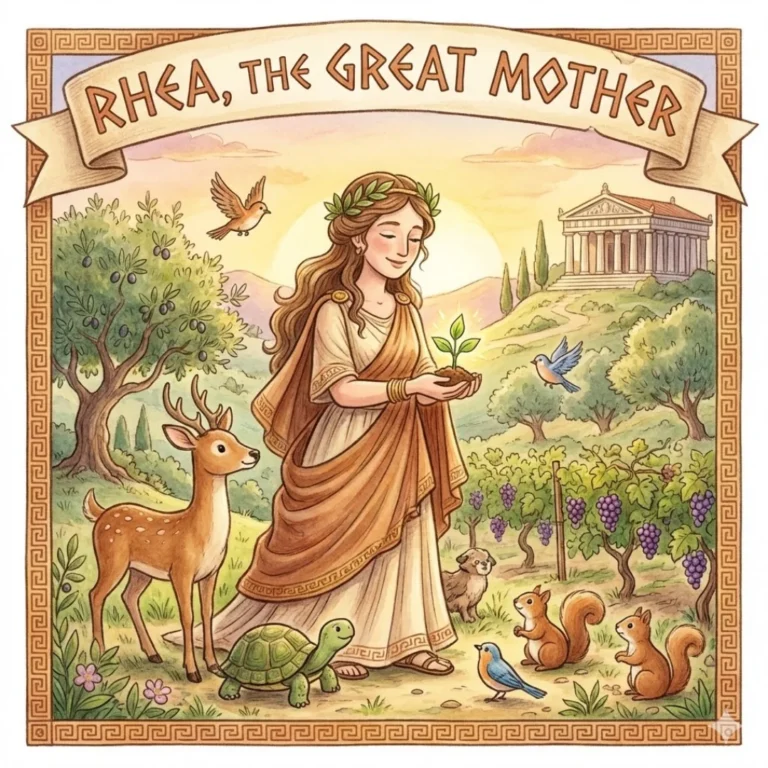
Share this engaging bedtime story with kids ages 6-12 to teach valuable life lessons.
In the beginning, before the gods of Mount Olympus ruled the world, there was a different reign—the reign of the Titans.
These mighty beings, children of Gaia the Earth and Uranus the Sky, ruled the cosmos with power beyond mortal understanding. And among the greatest of the Titans was Rhea, the Mother of All.
Rhea was beautiful and terrible, gentle and fierce. She was the goddess of fertility, of motherhood, of the flowing generations of life that pour forth from the earth like water from a spring.
She wore a crown shaped like the towers of great cities, for civilization itself was born from mothers. Lions walked at her side, for she commanded the wild things as well as the tame. The mountains were her throne, and the forests her temple.
And she was married to Cronus, the King of the Titans.
* * *
Cronus was a complex being—both liberator and tyrant.
Long ago, his father Uranus had imprisoned his youngest siblings, the Cyclopes and Hundred-Handed Ones, deep within the Earth’s belly. Gaia had pleaded with her children to free them, but only Cronus had the courage to act.
With a sickle of adamantine metal, Cronus had defeated Uranus and taken his place as ruler of the cosmos. The age of Sky gave way to the age of Time, for Cronus was time itself—inevitable, consuming, unstoppable.
Rhea loved him. They had been allies in that ancient rebellion. Together, they would rule justly. Together, they would create a better world than the one that came before.
Or so Rhea believed.
* * *
Rhea gave birth to her first child on a spring morning when the world was young and full of hope.
She was a daughter, radiant and beautiful. Rhea named her Hestia, and held her close, feeling a love deeper than the roots of mountains.
“Look,” she said to Cronus, smiling through tears of joy. “Look at what we have created. Isn’t she perfect?”
Cronus looked at the infant. And in his eyes, Rhea saw something that made her blood run cold.
Fear.
“Give her to me,” Cronus said.
“What? Why?”
“Gaia has prophesied,” Cronus said, his voice hollow. “One of our children will overthrow me, just as I overthrew my father. The cycle will continue. Unless…”
“Unless what?” Rhea asked, though dread was already filling her heart.
Cronus took the infant from her arms.
And swallowed her whole.
Rhea’s scream echoed across the mountains.
“No! CRONUS, NO!”
But it was done. Hestia was gone, trapped in the darkness of her father’s belly, neither dead nor truly alive—suspended in a timeless prison.
“I am sorry,” Cronus said, and perhaps he even meant it. “But I will not be overthrown. I will not fall as my father did. This is the only way.”
Rhea wept for a month without ceasing. The rivers swelled with her tears. The earth grew cold from her grief.
But Cronus would not relent.
* * *
One by one, Rhea’s children were born.
Demeter, golden-haired goddess of harvest. Swallowed.
Hera, queen of heaven, majestic even as an infant. Swallowed.
Hades, dark-eyed lord of hidden riches. Swallowed.
Poseidon, powerful as the sea itself. Swallowed.
Each time, Rhea pleaded. Each time, Cronus refused. And each time, her heart broke anew as she watched her husband devour their children.
Five times, Rhea gave life. Five times, Cronus took it away.
The other Titans looked away. They did not approve, but they did not interfere. Who could stand against Cronus, King of the Titans, master of Time itself?
Rhea’s grief turned to rage. Her rage turned to determination.
When she felt the stirrings of a sixth child growing within her, she did not tell Cronus.
Instead, she went to her mother.
* * *
“Mother Gaia,” Rhea said, kneeling on the earth, pressing her hands into the soil. “Help me. Show me how to save this child. Show me how to break this terrible cycle.”
The earth rumbled. Trees swayed though there was no wind.
And Gaia’s voice rose from the ground itself, ancient and powerful as stone.
“Go to Crete,” the Earth Mother said. “Go to the sacred cave on Mount Dicte. Bear your child there in secret. I will help you deceive Cronus. But know this: the child you save will grow to fulfill the prophecy. He will make war upon his father. There will be great suffering before the new age can begin.”
“Let there be war,” Rhea said fiercely. “Anything is better than watching my children disappear into darkness. If Cronus fears the prophecy, then let the prophecy come true. He has brought this upon himself.”
“So be it,” Gaia said. “Go. Quickly. Before Cronus notices.”
* * *
Rhea fled in the night, traveling swiftly to the island of Crete.
She climbed Mount Dicte until she found the cave Gaia had shown her—a deep cavern hidden from the sky, where water dripped from ancient stones and the air smelled of minerals and mystery.
There, in darkness and secrecy, Rhea gave birth to her sixth child.
He was beautiful. Strong. His eyes were bright with intelligence even moments after birth. When he cried, thunder rumbled in the distance.
“I will call you Zeus,” Rhea whispered, holding him close. “And you will be free. I promise you—you will be free.”
But she could not stay. Cronus would notice her absence. She had to return.
Rhea gave the infant Zeus to the care of the Curetes—warrior spirits who dwelt in the mountains. They would guard him, raise him in secret, and clash their spears against their shields whenever he cried, so the sound would not carry to Cronus’s ears.
Then Rhea did something clever.
She took a large stone from the cave floor. She wrapped it in swaddling clothes. She held it as she would hold a baby.
And she returned to Cronus.
* * *
“My husband,” Rhea said, her voice carefully neutral. “I have borne another child.”
Cronus turned to her, his eyes cold. “You know what must be done.”
“Yes,” Rhea said. She stepped forward and held out the bundled stone. “Take him. Take our son. Do what you believe you must.”
Cronus took the bundle without looking at it too closely. He was used to this ritual by now. Without hesitation, he swallowed it whole.
Rhea watched him swallow the stone and felt a fierce satisfaction in her heart.
You fool, she thought. You have become so consumed by fear that you cannot see what is real and what is illusion. You deserve what is coming.
“It is done,” Cronus said. “The prophecy is broken. Our children cannot overthrow me if they never grow strong enough to challenge me.”
“Yes,” Rhea said quietly. “It is done.”
But in her heart, she was already imagining the day Zeus would return.
* * *
On Crete, in the sacred cave, the infant Zeus grew.
He drank the milk of the goat Amalthea. He ate honey gathered by sacred bees. He grew strong under the care of the Curetes and the nymphs who dwelt in the mountain.
As he grew, Rhea would visit him in secret, telling him stories of his siblings trapped in their father’s belly, teaching him about justice and mercy, about the difference between power and tyranny.
“Your father rules through fear,” Rhea told young Zeus. “You must rule through wisdom. He hoards power. You must share it. He stands alone. You must build alliances. This is how you will succeed where he will fail.”
Zeus listened, and learned, and grew.
* * *
Years passed. Zeus became a young man—tall, strong, wise, and powerful.
When he was ready, Rhea came to him one last time.
“The moment has come,” she said. “Metis, the Titaness of wisdom, has created a potion. If Cronus drinks it, he will vomit up everything he has swallowed. Your brothers and sisters will be freed.”
“How will we make him drink it?” Zeus asked.
“Leave that to me,” Rhea said. “I am still his wife. He trusts me.”
She smiled, but there was no warmth in it. Only cold determination.
“Good,” Zeus said. “Then let us end this age of fear. Let us begin something new.”
* * *
Rhea returned to Cronus’s palace and prepared a great feast.
“My husband,” she said. “It has been so long since we celebrated anything. Let us have one night of joy. Let us remember why we fought to build this kingdom.”
Cronus, tired and worn from centuries of paranoid rule, agreed.
They drank wine together. They ate rich food. And in Cronus’s cup, Rhea poured the potion Metis had made.
Cronus drank deeply.
Almost immediately, he clutched his stomach. His face turned pale. He fell to his knees.
And then he began to vomit.
First came the stone—the wrapped stone Rhea had given him years ago, still in its swaddling clothes. It clattered across the marble floor.
Then came Poseidon, fully grown, powerful, disoriented but free.
Then Hades, dark and terrible.
Then Hera, imperious and furious.
Then Demeter, grief-stricken but strong.
Then Hestia, gentle but determined.
Five children, fully grown, freed from their prison after years in darkness.
They stood before their father, and their eyes blazed with righteous anger.
“What have you done?” Cronus gasped, staring at Rhea in betrayal.
“I have done what you should have done,” Rhea said coldly. “I have freed our children. I have broken your cycle of fear.”
“There is a sixth,” Cronus said, realization dawning on his face. “The stone… you tricked me. Where is the sixth child?”
Thunder crashed outside the palace.
The doors burst open.
And Zeus strode in, lightning crackling around his fists.
“Here I am, Father,” Zeus said. “The son you tried to destroy. The prophecy you tried to prevent. I am Zeus, and I have come to end your reign.”
* * *
What followed was the War of the Titans—ten years of battle that shook the cosmos.
Zeus and his siblings fought against Cronus and most of the Titans. Rhea sided with her children, for she had seen what Cronus’s fear had made him become.
The war was terrible. Mountains were thrown like stones. Seas boiled. The sky itself cracked with lightning.
But Zeus had allies—not just his siblings, but the Cyclopes and Hundred-Handed Ones, whom he freed from their ancient prison. They forged lightning bolts for him, the weapons that would win the war.
In the end, Zeus and his siblings were victorious.
Cronus and the defeated Titans were cast down into Tartarus, the deepest pit of the underworld, to be imprisoned there for eternity.
The age of Titans ended.
The age of Olympians began.
* * *
Zeus became king of the gods, ruling from Mount Olympus. He divided the world with his brothers—Poseidon took the sea, Hades the underworld, and Zeus himself claimed the sky.
His sisters took their places as goddesses of hearth, harvest, and marriage.
And Rhea?
Rhea withdrew from the affairs of gods. She had done what needed to be done. She had saved her children. She had ended a tyrant’s reign.
She took her place as the Great Mother, honored and revered. In Crete, they celebrated her with festivals. In Phrygia, she was called Cybele and worshipped with wild dances and drums. In Rome, she would be known as Ops.
But she asked for no throne. She demanded no kingdom.
She had never wanted power. She had only wanted her children to be free.
And that, at last, she had achieved.
* * *
The stone that Cronus swallowed—the stone that had saved Zeus—was placed at Delphi as a monument. For thousands of years, mortals would pour oil over it and honor it as a sacred relic.
It was a reminder of a mother’s cleverness.
A reminder that even the mightiest tyrant can be deceived by love.
A reminder that the cycle of violence can be broken, but only by those brave enough to defy fate itself.
And whenever mothers prayed for strength to protect their children, they prayed to Rhea, the Great Mother, who had stood against time itself and won.
MORAL LESSONS:
– A mother’s love gives her the courage to stand against tyranny
– Fear and paranoia can turn even the mighty into monsters
– Those who rule through fear will ultimately be overthrown
– Cleverness and patience can defeat even the strongest opponents
– Breaking cycles of violence requires both courage and sacrifice
– True power comes from wisdom, not from hoarding control
– Family bonds can be stronger than prophecy or fate
– Even gods must face the consequences of their actions
CULTURAL ELEMENTS PRESERVED:
– Rhea as Titanis (female Titan), daughter of Gaia and Uranus
– Marriage to Cronus (Kronos), King of Titans and god of time
– Six Olympian children: Hestia, Demeter, Hera, Hades, Poseidon, Zeus
– Cronus swallowing his children due to prophecy
– Rhea’s deception with the stone wrapped in swaddling clothes
– Zeus born in secret in Dictaean Cave on Mount Crete
– Curetes (warrior spirits) protecting infant Zeus with shield-clashing
– Amalthea the goat nursing Zeus
– Metis creating the emetic potion
– Stone placed at Delphi as sacred monument
– Titanomachy (War of the Titans) lasting ten years
– Zeus freeing Cyclopes and Hecatonchires (Hundred-Handed Ones)
– Division of cosmos among three brothers
– Rhea’s identification with Cybele in Phrygia and Ops in Rome
– Rhea’s crown shaped like city towers (mural crown)
– Lions as her sacred animals
– Mountain caves as her sacred spaces
SOURCE FIDELITY NOTES:
✓ Based on Hesiod’s Theogony (c. 700 BCE), the primary ancient source
✓ References from Homeric Hymns, Orphic Hymns
✓ Details from Pausanias’s Description of Greece
✓ Elements from Diodorus Siculus, Ovid’s Fasti
✓ All major plot elements authentic to Greek mythology:
– Rhea as Cronus’s wife and Titan goddess
– Prophecy that Cronus would be overthrown by his son
– Cronus swallowing all his children
– Rhea’s grief and determination
– Flight to Crete to give birth to Zeus secretly
– Deception using stone wrapped as baby
– Zeus raised in Dictaean Cave by Curetes
– Metis’s potion making Cronus regurgitate children
– Stone vomited first, then children in reverse order
– Titanomachy resulting in Zeus’s victory
– Cronus cast into Tartarus
– Division of cosmos among Olympians
✓ Character relationships authentic to Greek mythology
✓ Cultural and religious details accurate to ancient Greek sources
✓ No invented plot points—all from authentic mythological tradition
ENGAGEMENT ENHANCEMENTS:
+ Emotional depth showing Rhea’s anguish and determination
+ Suspenseful pacing building to Zeus’s revelation
+ Vivid characterization of Cronus as tragic figure consumed by fear
+ Mother-son relationship developed through secret visits
+ Dramatic confrontation when Zeus reveals himself
+ Rhea’s cleverness and agency emphasized
+ Moral complexity: cycle of fathers fearing sons
+ Bittersweet ending: victory achieved through necessary violence
+ Child-appropriate language with emotional resonance
+ Female heroism centered in narrative
CULTURAL SIGNIFICANCE:
– Theogony by Hesiod (c. 700 BCE) is foundational Greek mythological text
– Rhea’s story explains the succession of divine rulers: Uranus → Cronus → Zeus
– Central theme of Greek mythology: younger generation must overthrow older
– Rhea as archetypal mother goddess across Mediterranean cultures
– Influenced Roman religion (as Ops), Phrygian religion (as Cybele)
– The Dictaean Cave on Crete was actual pilgrimage site in ancient world
– Stone at Delphi (omphalos stone) was real religious artifact
– Story explores Greek concepts of fate, free will, and prophecy
– Maternal love and cleverness triumph over masculine tyranny
– Foundation myth for Olympian order that dominated Greek religion
NOTE ON AUTHENTICITY:
This is a faithful retelling of Rhea’s role in Greek mythology as recorded in Hesiod’s Theogony (c. 700 BCE) and other ancient sources. All major plot elements—Rhea’s six children, Cronus swallowing them due to prophecy, Rhea’s secret journey to Crete, the substitution of a stone for baby Zeus, Zeus’s upbringing in the Dictaean Cave, the potion that freed the swallowed children, and the subsequent Titanomachy—are authentic to ancient Greek mythology. Rhea was syncretized with the Phrygian goddess Cybele and the Roman goddess Ops, showing her importance across ancient Mediterranean cultures. The story of Rhea represents one of Greek mythology’s most powerful examples of maternal courage and cleverness triumphing over tyranny.
SOURCES:
– [Rhea – Theoi.com](https://www.theoi.com/Titan/TitanisRhea.html)
– [Rhea – Wikipedia](https://en.wikipedia.org/wiki/Rhea_(mythology))
– [Rhea – Mythopedia](https://mythopedia.com/topics/rhea/)
– [Rhea – World History Encyclopedia](https://www.worldhistory.org/Rhea/)
– [Rhea – Britannica](https://www.britannica.com/topic/Rhea-Greek-goddess)
– [Rhea – Greek-Gods.org](https://www.greek-gods.org/titans/rhea.php)
– Hesiod’s Theogony (c. 700 BCE) – primary source
– Homeric Hymns (7th-4th century BCE)
– Pausanias’s Description of Greece (c. 150 CE)
– Diodorus Siculus, Bibliotheca Historica (1st century BCE)
Test Your Understanding
1. What did Cronus do to his children because of a prophecy?
Frequently Asked Questions
What is the moral lesson of Rhea, the Great Mother?
What age is this story appropriate for?
How long does it take to read Rhea, the Great Mother?
What culture does this story come from?
Can I use this story for teaching?
Frequently Asked Questions
Who is Rhea and why is she called the Great Mother?
Rhea was one of the most powerful Titans in Greek mythology, known as the Mother of All. She was the goddess of fertility and motherhood who gave birth to the Olympic gods including Zeus. She’s called the Great Mother because she protected her children and helped bring about the age of the gods that children learn about in mythology.
Is this bedtime story about Rhea appropriate for kids ages 6-12?
Yes, this story is specifically written for kids ages 6-12 as a gentle bedtime story. It focuses on Rhea’s protective, nurturing qualities as a mother figure rather than violent aspects of mythology. The story teaches valuable lessons about family, protection, and standing up for what’s right in language children can understand.
What moral lesson does Rhea’s story teach children?
Rhea’s story teaches children about the power of a mother’s love and protection. It shows how sometimes we must be brave and clever to protect those we care about, even when facing powerful opponents. The story demonstrates that wisdom and determination can overcome even the greatest challenges.
📚 Recommended Books
Handpicked for readers like you
As an Amazon Associate, we earn from qualifying purchases. These recommendations are personalized based on this story's themes and your reading history.
How does Rhea connect to other Greek mythology bedtime stories for kids?
Rhea is the mother of famous Greek gods like Zeus, Poseidon, and Hera that children often learn about first. Understanding Rhea’s story helps kids better appreciate how these well-known gods came to power and why they’re so protective of mortals. She’s essentially the grandmother figure of Greek mythology.
What makes Rhea different from other goddesses in Greek myths?
Unlike other goddesses who ruled over specific domains, Rhea commanded both wild and civilized worlds. She wore a crown like city towers, had lions as companions, and made mountains her throne. This made her uniquely powerful as both a nurturing mother figure and a fierce protector of all life.