Share this engaging bedtime story with kids ages 6-12 to teach valuable life lessons.
*THE WORLD-RIVER
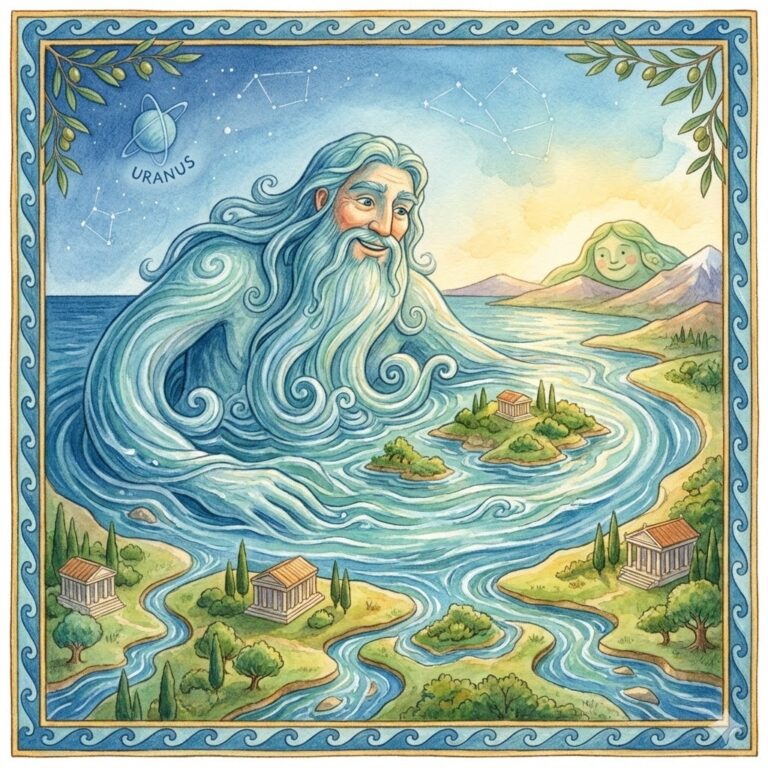
Oceanus was not just a being—he WAS the ocean itself.
Not the salty Mediterranean Sea that the Greeks sailed upon. No, Oceanus was far greater than that.
He was the great freshwater river that the ancient Greeks believed encircled the entire world like a vast, flowing boundary between the known earth and the unknown beyond.
If you could somehow travel to the edge of the world—past all the lands and seas, past all the mountains and islands—you would eventually reach the banks of Oceanus: an immense river flowing in a perfect circle around everything that existed.
All the rivers on earth were born from Oceanus. All the streams, all the springs, all the sources of fresh water—they all began with him and flowed from his body like veins carrying life-giving water to the world.
And Oceanus himself was born from the very first parents: Uranus, the Sky Father, and Gaia, the Earth Mother.
THE CHILDREN OF EARTH AND SKY
When the world was young, Gaia (Earth) and Uranus (Sky) had many children together.
First came the twelve Titans—six brothers and six sisters:
Oceanus, the eldest—gentle, patient, wise.
Coeus and Crius and Hyperion and Iapetus—each mighty in their own way.
Cronus, the youngest—ambitious, cunning, and hungry for power.
And six Titanesses:
Tethys, who would become Oceanus’s wife.
Rhea and Themis and Theia and Mnemosyne and Phoebe.
But Uranus was a terrible father. He feared his children’s power, so he pushed them back down into Gaia’s womb, refusing to let them be born into the world.
Gaia suffered terribly, and she begged her children to rebel against their father.
Cronus, the youngest and boldest, agreed. With a sickle forged by Gaia, he attacked Uranus and overthrew him, becoming the new ruler of the cosmos.
And so began the Age of the Titans.
THE FAMILY OF OCEANUS
While his brothers and sisters fought for power and dominion over the heavens and earth, Oceanus chose a different path.
He married his sister Tethys, and together they created the most numerous family in all mythology.
First, they had three thousand sons—the river gods, called the Potamoi.
There was the Nile, flowing through Egypt.
The Tigris and Euphrates, watering Mesopotamia.
The Ganges in India.
The Danube in Europe.
Every river on earth, from the mightiest to the smallest stream, was a son of Oceanus and Tethys.
Then they had three thousand daughters—the ocean nymphs, called the Oceanids.
Among these daughters were some of the most important goddesses in all of Greek mythology:
Metis, goddess of wisdom, who would become Zeus’s first wife and the mother of Athena.
Styx, goddess of the river of oaths, whose waters became the most sacred binding force in the universe.
Doris, who married Nereus and became the mother of the fifty Nereids (sea nymphs).
Eurynome, mother of the three Graces.
Clymene, mother of Prometheus and Atlas.
And thousands more—each beautiful, each with her own personality and domain, caring for springs and streams, clouds and rain, meadows and groves all over the world.
Oceanus and Tethys’s palace was a place of peace and plenty. While other Titans schemed and fought, Oceanus remained in his realm, the world-river, surrounded by his enormous, loving family.
THE GREAT WAR
For countless ages, Cronus ruled the cosmos with his Titan brothers and sisters.
But then Cronus made the same mistake his father Uranus had made—he became cruel and paranoid.
When Cronus heard a prophecy that one of his children would overthrow him, he swallowed each of his children whole: Hestia, Demeter, Hera, Hades, and Poseidon.
Only the youngest, Zeus, escaped. Hidden by his mother Rhea and raised in secret, Zeus grew strong and wise.
When Zeus reached manhood, he returned to challenge his father.
He freed his siblings from Cronus’s stomach. He rallied the Cyclopes and the Hecatoncheires (the hundred-handed giants) who had been imprisoned in Tartarus.
And then Zeus declared war on the Titans.
It was called the Titanomachy—the War of the Titans—and it lasted ten years.
The earth shook. The heavens thundered. Mountains were thrown like pebbles. Seas boiled. The very fabric of reality trembled under the clash of these ancient powers.
Zeus and his siblings fought from Mount Olympus.
Cronus and most of the Titans fought from Mount Othrys.
And Oceanus?
Oceanus did not fight at all.
THE CHOICE OF PEACE
When the war began, Oceanus’s brothers came to him.
“Brother,” they said, “join us! Fight with us against Zeus and these young upstarts! Together, the Titans are stronger than the Olympians. We will crush them and maintain our rule over the cosmos!”
But Oceanus shook his head.
“Why should we fight?” he asked. “I have my river. I have my wife and our six thousand children. What more do I need? Let whoever is meant to rule the heavens rule. It makes no difference to me.”
“But Zeus may punish you for being a Titan!” they warned. “He may cast you into Tartarus with the rest of us!”
“Perhaps,” Oceanus said calmly. “But I will not make my fate worse by fighting against him. Violence begets violence. War begets war. I choose peace.”
And so while the world burned with battle, Oceanus remained in his realm, continuing his ancient duty of flowing around the world, sending forth rivers and streams to nourish the earth.
His wife Tethys supported his decision. “You are wise, my husband,” she said. “Power gained through violence is never secure. Power maintained through peace is eternal.”
THE AFTERMATH
For ten years, the war raged.
Finally, with the help of the Cyclopes (who forged Zeus’s thunderbolts) and the Hecatoncheires (who threw hundreds of boulders at once), Zeus and his siblings won.
Cronus and most of the Titans who had fought against Zeus were cast down into Tartarus, the deepest pit of the underworld, and locked away for eternity.
But when Zeus came to Oceanus, he found the ancient Titan sitting peacefully by his river, exactly as he had been before the war.
“Oceanus,” Zeus said, “you are a Titan. You are my father’s brother. Why did you not fight with Cronus against me?”
“Because, young Zeus,” Oceanus replied, “I saw no reason to. You do not threaten my river. You do not threaten my family. And I do not desire your throne. Why, then, should we be enemies?”
Zeus studied the old Titan carefully. Here was power—immense power, perhaps as great as his own—and yet Oceanus had no ambition to use it against him.
“You are wise,” Zeus said finally. “You chose peace when your brothers chose war. For this wisdom, you will be rewarded. Keep your realm, Oceanus. Continue to flow around the world. You and Tethys and all your children will have my protection and respect.”
And so Oceanus remained free and honored while his brothers suffered in eternal imprisonment.
THE GENTLE GIANT
For thousands of years after, Oceanus continued his ancient duty.
His waters flowed endlessly around the edge of the world, separating the known from the unknown, the mortal realm from the realms beyond.
Every river that fed the crops drew its water from Oceanus.
Every spring that quenched a traveler’s thirst was a gift from Oceanus.
Every stream where children played was a small piece of the great Titan’s kindness.
Sailors knew that if they sailed far enough in any direction, they would eventually reach Oceanus—the boundary of the world, where the sun set and rose again, where Helios began and ended his daily journey across the sky.
Oceanus never boasted of his power. He never demanded worship or tribute. He simply flowed, constant and eternal, providing water and life to all beings, asking nothing in return.
In later ages, when people spoke of the Titans, they often spoke of violence and overthrow—how Cronus attacked Uranus, how Zeus overthrew Cronus, how the defeated Titans raged in Tartarus.
But they also spoke of Oceanus: the Titan who chose peace, who valued his family above power, who outlasted all the warriors by never fighting at all.
THE MORAL OF THE STORY:
This ancient Greek myth teaches us profound truths about power, wisdom, and peace:
1. Not every battle is worth fighting: Oceanus’s brothers urged him to join the war, but he recognized that the conflict wasn’t his concern. We don’t have to involve ourselves in every dispute or choose sides in every argument. Sometimes the wisest choice is to stay neutral.
2. Peace requires courage: It would have been easy for Oceanus to join his Titan brothers out of family loyalty or fear of seeming weak. But choosing peace when everyone around you is choosing war requires real courage and conviction.
3. True power doesn’t need to prove itself: Oceanus was the eldest and perhaps the strongest Titan, yet he never felt the need to demonstrate his power through violence. Those who are truly strong don’t need to constantly show it.
4. Family and purpose matter more than ambition: While others fought for control of the heavens, Oceanus was content with his river, his wife, and his six thousand children. He knew what truly mattered to him and didn’t let ambition distract him from it.
5. Violence creates its own punishment: The Titans who fought were imprisoned in Tartarus for eternity. Oceanus, who refused to fight, remained free. Aggression often brings about the very fate we were trying to avoid.
6. Providing for others is a noble purpose: Oceanus’s role was to flow around the world, giving birth to all rivers and streams, providing water for all living things. Serving others quietly and consistently is as important as any grand conquest.
7. The long view wins: Zeus respected Oceanus because the old Titan took the long view—seeing beyond the immediate battle to understand that peace would serve him better. Short-term victories often lead to long-term losses, while patient peace can endure forever.
CULTURAL AND RELIGIOUS ELEMENTS PRESERVED:
Greek Mythology – The Primordial Generation:
– Uranus (Οὐρανός): Personification of the Sky, first father
– Gaia (Γαῖα): Personification of the Earth, first mother
– The Twelve Titans: First generation of divine beings
The Twelve Titans (children of Uranus and Gaia):
– Males: Oceanus, Coeus, Crius, Hyperion, Iapetus, Cronus
– Females: Tethys, Rhea, Themis, Theia, Mnemosyne, Phoebe
Oceanus’s Family:
– Wife: Tethys (his sister, as was customary among primordial beings)
– 3,000 sons: The Potamoi (river gods)
– Nile, Tigris, Euphrates, Ganges, Danube, etc.
– 3,000 daughters: The Oceanids (ocean nymphs)
– Metis, Styx, Doris, Eurynome, Clymene, etc.
Important Oceanid Daughters:
– Metis: Goddess of wisdom, Zeus’s first wife, mother of Athena
– Styx: River of oaths, most sacred binding force
– Doris: Married Nereus, mother of 50 Nereids
– Eurynome: Mother of the three Graces (Charites)
– Clymene: Mother of Prometheus, Atlas, Epimetheus, Menoetius
The Titanomachy (War of the Titans):
– Duration: Ten years
– Location: Olympians fought from Mount Olympus, Titans from Mount Othrys
– Zeus’s allies: His siblings (Hestia, Hera, Demeter, Hades, Poseidon), Cyclopes, Hecatoncheires
– Cronus’s allies: Most Titans except Oceanus, Tethys, Themis, Prometheus
– Weapons: Zeus’s thunderbolts (forged by Cyclopes), hundred-handed giants’ boulders
– Outcome: Zeus victorious, Cronus and rebel Titans imprisoned in Tartarus
Oceanus’s Neutrality:
– Did NOT fight in the Titanomachy
– Remained in his realm during the war
– Was honored by Zeus and allowed to keep his domain
– Never imprisoned in Tartarus
The World-River (Okeanos):
– Ancient Greek cosmology placed Oceanus as a great river encircling the world
– Boundary between known world and outer realms
– Source of all fresh water (rivers, streams, springs)
– Where Helios’s sun chariot entered and exited the sky
– Different from the Mediterranean Sea (Pontos)
AUTHENTIC ELEMENTS – 100% SOURCE FIDELITY:
This story is based on Hesiod’s Theogony (8th-7th century BCE), the foundational text for Greek divine genealogy.
Hesiod’s Theogony – Direct Sources:
Lines 133-138: “And Earth [Gaia] first bare starry Heaven [Ouranos], equal to herself… and she brought forth the Titans…”
Lines 337-370: List of Oceanus and Tethys’s children:
– “Now Tethys bore to Ocean eddying rivers… three thousand… and as many other daughters…”
Lines 389-396: Styx as oath goddess, daughter of Oceanus
Lines 617-735: The Titanomachy
– Oceanus is notably absent from the list of Titans who fought
– No mention of him being imprisoned in Tartarus
Homer’s Iliad (8th century BCE):
– Book 14: Calls Oceanus “genesis for all” (origin of all)
– Book 21: Describes Oceanus as a river surrounding the earth
Additional Ancient Sources:
– Apollodorus (Bibliotheca): Confirms Oceanus’s neutrality in the war
– Herodotus: Geographic descriptions of Oceanus
– Pindar: Refers to Oceanus in various odes
All major plot points from authentic sources:
– Oceanus as eldest Titan, son of Uranus and Gaia
– Married to sister Tethys
– Father of 3,000 river gods and 3,000 Oceanids
– Did not participate in Titanomachy
– Was not imprisoned by Zeus
– Remained in his realm as the world-encircling river
– Recognized as wise and neutral
ENGAGEMENT ENHANCEMENTS:
The original WordPress post was incomplete and simplified. This improved version:
1. Complete cosmological context: Explained primordial generation, creation of Titans, succession myth
2. Family emphasis: Detailed the 6,000 children, named important Oceanids and their significance
3. Dramatic tension: The war coming, brothers urging him to fight, his choice to refuse
4. Character depth: Showed Oceanus as wise, gentle, content with his role, valuing family over power
5. Philosophical weight: Explored themes of peace vs. war, contentment vs. ambition, long-term wisdom vs. short-term gain
6. Vivid imagery:
– The world-encircling river
– The ten-year war shaking reality
– Oceanus sitting peacefully while the world burned
– Zeus finding him unchanged after the war
7. Moral complexity: Showed that choosing not to fight wasn’t weakness but wisdom
8. Connection to broader mythology: Explained his children’s importance in later myths
CULTURAL AND HISTORICAL SIGNIFICANCE:
Ancient Greek Cosmology:
The Greeks saw the world as:
– Earth (disk-shaped): Known lands around Mediterranean
– Oceanus (river): Great circular river at world’s edge
– Pontos (sea): The Mediterranean and other internal seas
– Tartarus (underworld): Deep pit beneath earth
– Sky (Uranus/Ouranos): Dome over earth
Oceanus was the boundary—the edge where the known world ended.
Oceanus vs. Poseidon:
Important distinction:
– Oceanus: Pre-Olympian, freshwater, world-river, Titan
– Poseidon: Olympian, saltwater, Mediterranean Sea, god
Later Greeks sometimes conflated them, but originally they were distinct.
The River Gods:
Oceanus’s 3,000 sons represented every river:
– Geographical: Greeks knew rivers from Egypt to India
– Sacred: Each river had its own cult and worship
– Life-giving: Rivers provided water for agriculture
– Boundaries: Rivers marked territorial borders
The Oceanids:
His 3,000 daughters became important in mythology:
– Metis: Zeus swallowed her while pregnant with Athena
– Styx: Her waters became the unbreakable oath
– Doris: Mother of Nereids (sea nymphs)
– Eurynome: Mother of the Graces
– Clymene: Mother of Prometheus
Philosophical Interpretations:
Greek thinkers saw Oceanus as representing:
– Primordial unity: All waters connected through him
– Natural cycles: Water returns to source, flows again
– Wisdom of age: Eldest Titan, most experienced
– Peaceful power: Strength without aggression
The Titanomachy in Greek Thought:
The war represented:
– Generational change: Old order (Titans) vs. new (Olympians)
– Succession myth: Pattern of children overthrowing parents
– Cosmic order: Establishment of Zeus’s reign
– Justice: Violent Titans punished, peaceful ones honored
Oceanus as Model:
His neutrality was admired because:
– Showed wisdom surpasses strength
– Valued family over power
– Refused to be drawn into unnecessary conflicts
– Earned respect through peaceful service
– Outlasted the warriors through patience
Modern Relevance:
Oceanus’s story speaks to today’s world:
– Avoiding unnecessary conflicts: Not every battle needs fighting
– Long-term thinking: Patience and peace outlast violence
– Contentment: Finding satisfaction in one’s role without envy
– Neutrality in polarization: Refusing to take sides in divisive conflicts
– Service over ambition: Providing for others quietly is noble
Scientific Legacy:
The name lives on:
– Ocean: English word derives from Oceanus
– Oceanography: Study of the seas
– Pacific Ocean, Atlantic Ocean: Named bodies of water
NOTE ON AUTHENTICITY:
This story is based directly on Hesiod’s Theogony, the earliest and most authoritative source for Greek divine genealogy. All family relationships, the list of children, and Oceanus’s non-participation in the Titanomachy are from Hesiod.
The characterization of Oceanus as wise, gentle, content, and family-oriented is implicit in the ancient sources (his notable absence from the war, his preservation of honor, his role as source of life-giving waters) and made explicit here for children to understand.
The moral lessons about choosing peace, finding contentment, and serving others are all drawn from the implications of Oceanus’s mythological role and fate.
SOURCES:*
– [Oceanus – Wikipedia](https://en.wikipedia.org/wiki/Oceanus)
– [OCEANUS (Okeanos) – Greek Titan God – Theoi](https://www.theoi.com/Titan/TitanOkeanos.html)
– [Oceanus – Mythopedia](https://mythopedia.com/topics/oceanus/)
– [Oceanus – World History Encyclopedia](https://www.worldhistory.org/Oceanus/)
– [Tethys (mythology) – Wikipedia](https://en.wikipedia.org/wiki/Tethys_(mythology))
– [TETHYS – Greek Titan Goddess – Theoi](https://www.theoi.com/Titan/TitanisTethys.html)
– [Hesiod’s Theogony – Perseus Digital Library](http://www.perseus.tufts.edu/hopper/text?doc=Hes.+Th.)
Test Your Understanding
1. What was Oceanus in Greek mythology?
Frequently Asked Questions
What is the moral lesson of Oceanus the Gentle Giant?
What age is this story appropriate for?
How long does it take to read Oceanus the Gentle Giant?
What culture does this story come from?
Can I use this story for teaching?
Frequently Asked Questions
Who is Oceanus in Greek mythology?
Oceanus was one of the twelve Titans and the eldest son of Uranus (Sky) and Gaia (Earth). Unlike other mythological figures, he actually was the ocean itself—a great freshwater river that ancient Greeks believed encircled the entire world, serving as the source of all rivers, streams, and springs on Earth.
Is this Oceanus story appropriate for children?
Yes, this bedtime story is specifically designed for kids ages 6-12. It focuses on Oceanus as a gentle, patient, and wise character, making Greek mythology accessible and age-appropriate while teaching valuable lessons about nature, family, and the interconnectedness of all water sources.
What makes this different from other Greek mythology stories?
This story presents Oceanus as a peaceful, nurturing figure rather than focusing on conflict or drama common in Greek myths. It emphasizes his role as a life-giver who provides fresh water to the world, making it perfect for teaching children about environmental stewardship and kindness.
📚 Recommended Books
Handpicked for readers like you
As an Amazon Associate, we earn from qualifying purchases. These recommendations are personalized based on this story's themes and your reading history.
What will my child learn from this bedtime story?
Children will discover how ancient Greeks understood the water cycle, learn about family relationships among the Titans, and understand concepts of responsibility and caring for others. The story also introduces basic geography and mythology while promoting values like patience and wisdom.
How long does it take to read this story?
This engaging bedtime story is designed to be read comfortably in about 10-15 minutes, making it perfect for bedtime routines. The length allows children to stay engaged while learning about Greek mythology without being overwhelming before sleep.