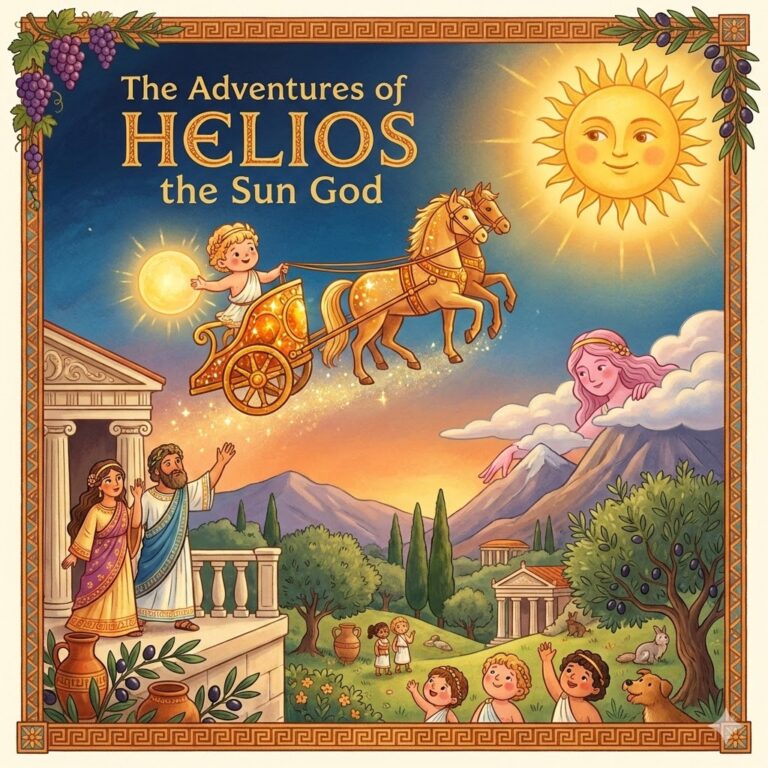
‘The Adventures of Helios the Sun God’ is an educational moral story perfect for bedtime reading with children ages 6-12.
*THE SUN GOD’S DAILY JOURNEY
Helios was born before even Zeus ruled the heavens—in the ancient time when the Titans held power over the cosmos.
He was the son of Hyperion, the Titan of Heavenly Light, and Theia, the Titaness of Sight and Brilliance. Together they had three children who illuminated the world:
Helios, the Sun—golden, blazing, all-powerful.
Selene, the Moon—silver, gentle, mysterious.
Eos, the Dawn—rosy-fingered, beautiful, heralding each new day.
While the other Titans fought against Zeus in the great Titanomachy (the war between Titans and Olympians), Helios and his sisters remained neutral. They had no interest in power struggles—they had their own sacred duties.
For Helios, that duty was simple but absolute:
Every single day, without fail, he must drive the Sun across the sky from east to west.
THE GOLDEN CHARIOT
Each morning, when the first hint of light appeared in the east, Helios would rise from his palace in the far eastern lands beyond the ocean.
His sister Eos would go before him, opening the gates of heaven with her rosy fingers, painting the clouds pink and gold to announce her brother’s arrival.
Then Helios himself would appear.
He wore a crown that blazed with light—so bright that mortals could not look directly at it without being blinded. His chariot was made of pure gold, studded with jewels that caught and magnified his radiance.
The four fire-breathing horses would be harnessed and ready, stamping their hooves eagerly, flames shooting from their nostrils.
And with a crack of the golden reins, Helios would begin his journey.
Up, up, up he would climb—higher and higher into the sky until he reached his zenith at noon, the brightest point of the day when his light and heat were strongest.
Then he would begin his descent toward the western ocean, where evening waited.
As Helios approached the horizon, his sister Selene would prepare to take her turn, readying her silver chariot and pale horses to light the night with her gentler glow.
And when Helios finally sank below the western edge of the world, something magical would happen:
He and his chariot and horses would board a great golden cup—a boat made specially for him by Hephaestus, god of the forge—and sail back across the Ocean (the great river that encircled the earth) to his palace in the east.
All night he would sail in this golden vessel, resting and preparing for the next day’s journey.
And when morning came, he would rise again, as he always did, as he always would, forever.
THE ALL-SEEING GOD
From his high vantage point in the sky, Helios could see everything that happened in the world below.
Every action, every secret, every hidden deed—nothing escaped the gaze of the Sun.
This made Helios incredibly valuable to the other gods when they needed information.
And one day, a desperate goddess came to him seeking the truth about her missing daughter.
DEMETER’S SEARCH
Demeter, the great goddess of the harvest and grain, was frantic with grief.
Her daughter Persephone had vanished.
One moment, Persephone had been playing in a meadow, picking flowers with her companions. The next moment—gone, as if the earth had swallowed her whole.
And in a sense, it had.
For nine days and nine nights, Demeter searched the world for her daughter. She carried two torches, searching even in the darkest caves and deepest forests. She questioned every river, every mountain, every tree.
But no one had seen what happened to Persephone.
Finally, Demeter came to a realization: if anyone knew the truth, it would be Helios. From his position high in the sky, surely he must have seen what happened to her daughter.
Demeter waited until Helios completed his daily journey, and then she approached him as he prepared to board his golden cup.
“Helios,” she pleaded, her face wet with tears, “you who see all things from your place in the heavens—please, tell me what happened to my daughter. Where is Persephone? Who took her from me?”
Helios looked at the grieving mother with compassion. He knew the truth, and he knew it would bring her pain. But he also knew she deserved to know.
“Demeter,” Helios said gently, “I saw what happened. And I tell you this not to cause you suffering, but because you have a right to know.”
“Tell me!” Demeter demanded. “Please!”
“Your daughter was taken by Hades, the god of the Underworld,” Helios revealed. “He came up through a chasm in the earth, seized her, and carried her down to his dark kingdom to be his queen.”
Demeter’s scream of anguish echoed across the world.
“But,” Helios added quickly, “this was not done without permission. Zeus himself, lord of the gods and Persephone’s father, gave his consent to Hades. He believed it would be a good match—the god of the dead taking the goddess of spring as his bride.”
“Zeus gave away my daughter without consulting me?” Demeter’s grief turned to rage. “My own daughter, stolen and married off to the lord of death?”
“I am sorry,” Helios said. “I tell you only what I saw.”
Demeter’s grief and anger were so great that she abandoned her duties entirely. She let the crops fail, the grain wither, the earth grow cold and barren.
Winter came to the world for the first time.
Eventually, Zeus had to intervene. A compromise was reached: Persephone would spend part of the year in the Underworld with Hades (the dark months when Demeter mourned and the world grew cold) and part of the year on Earth with her mother (the bright months when Demeter rejoiced and the world bloomed with life).
And thus the seasons were born.
But it was Helios who had told Demeter the truth—the Sun who saw everything and could not keep secrets from those who deserved to know them.
THE BURDEN OF SEEING
Being the all-seeing god was not always a blessing.
Helios witnessed every terrible thing that happened in the world:
Wars and murders.
Betrayals and lies.
Suffering and cruelty.
And he could do nothing to stop most of it. His duty was to observe, to illuminate, to continue his eternal journey across the sky.
Sometimes mortals would pray to him: “Helios, you who see all, witness my oath!” And they would swear solemn vows beneath his gaze, knowing that the Sun could testify to their honesty.
Other times, people would curse the Sun: “Why do you shine on such wickedness? Why do you illuminate the deeds of evil men?”
But Helios had no choice. He was the Sun. He brought light to all things, good and evil alike.
His light did not judge. It simply revealed.
THE RECKLESS SON
Helios had many children, but his most famous son was named Phaethon.
Phaethon was young and reckless, and he desperately wanted to prove that he was truly Helios’s son. (Some people doubted it, since Phaethon’s mother was a mortal woman.)
“Father,” Phaethon said one day, “grant me one wish to prove I am your son. Let me drive your chariot—just for one day! Let me drive the Sun across the sky!”
Helios immediately shook his head. “No, my son. It is too dangerous. Even Zeus himself does not drive my chariot. The horses are wild and strong. The path is treacherous. The heat is unbearable. You would not survive it.”
But Phaethon begged and pleaded until finally, reluctantly, Helios agreed.
“Very well,” Helios said. “But you must follow the path exactly. Do not climb too high or the heat will scorch the heavens. Do not drop too low or you will burn the earth. Hold the reins firmly. Do not let the horses stray.”
Phaethon swore he would be careful.
But when he mounted the golden chariot and took the reins, the fire-breathing horses immediately sensed that this was not their master. They reared and bucked. They veered off course.
Phaethon pulled the reins in panic, making them climb too high—the constellations caught fire, burning across the night sky.
Then he overcorrected, dragging them too low—whole forests burst into flame, rivers boiled dry, deserts were created where fertile lands had been.
The Earth itself cried out to Zeus: “Stop him! He is destroying the world!”
Zeus, with great sorrow, had no choice. He hurled a thunderbolt at Phaethon, striking him from the chariot.
The boy fell like a shooting star, plunging into the Eridanus River far below.
Helios wept bitterly for his son. For one entire day, the Sun’s light was dim with grief.
But the next day, as always, Helios rose and drove his chariot across the sky. Because that was his duty—his eternal, unchanging duty.
THE LESSON OF HELIOS
And so Helios continues his journey, day after day, year after year, century after century.
From his high path, he sees all the joys and sorrows of the world.
He watches children being born and old people dying.
He sees lovers meeting and friends parting.
He witnesses truth and lies, kindness and cruelty, beauty and ugliness.
And he understands something that mortals often forget:
Everything passes.
Every day ends with sunset. Every night ends with dawn.
Joy turns to sorrow, and sorrow turns to joy.
Nothing lasts forever—except the Sun’s eternal journey.
And perhaps that is the real gift of Helios: not just light and warmth, but the promise that no matter how dark the night, the Sun will always rise again.
THE MORAL OF THE STORY:
This ancient Greek myth teaches us important truths about witness, duty, and the nature of time:
1. Truth will always be revealed: Helios sees everything from his position in the sky. Eventually, all secrets come to light. No matter how well hidden, the truth has a way of emerging.
2. Those who see much carry a heavy burden: Being the all-seeing god means Helios witnesses all suffering and cannot prevent most of it. Those who are aware of the world’s problems carry a weight that others don’t understand.
3. Duty continues even through grief: When Helios lost his son Phaethon, he still had to drive the Sun the next day. Sometimes life requires us to carry on with our responsibilities even when our hearts are breaking.
4. Know your limits: Phaethon’s tragedy came from attempting something beyond his ability. Helios warned him, but the boy’s pride wouldn’t listen. Understanding our limitations isn’t weakness—it’s wisdom.
5. Light does not discriminate: The Sun shines on everyone—good people and bad, the beautiful and the ugly. True justice and fairness mean treating all equally, not playing favorites.
6. Everything passes with time: As Helios crosses the sky each day, he sees that joy and sorrow are both temporary. “This too shall pass” applies to all things.
7. Consistency is powerful: The Sun’s greatest gift isn’t a single dramatic act—it’s the reliable, daily repetition of rising and setting. Small, consistent actions over time create the foundation of life itself.
CULTURAL AND RELIGIOUS ELEMENTS PRESERVED:
Greek Mythology – The Titan Generation:
– Helios (Ἥλιος): Titan personification of the Sun itself
– Hyperion (Ὑπερίων): Father, Titan of Heavenly Light
– Theia (Θεία): Mother, Titaness of Sight and Brilliance
– Selene (Σελήνη): Sister, goddess of the Moon
– Eos (Ἠώς): Sister, goddess of the Dawn
The Sun’s Daily Journey:
– Golden chariot: Made of pure gold and jewels
– Four horses: Pyrois, Aeos, Aethon, Phlegon—all fire-breathers
– East to west path: Rising from Ocean stream in east, setting in west
– Golden cup/boat: Vessel that carries Helios back to the east overnight
– Made by Hephaestus: The craftsman god forged the special cup
Role as All-Seeing God:
– Witness of oaths: Mortals swore vows under the Sun’s gaze
– Source of truth: Could reveal secrets because he saw everything
– Helped Demeter: Told her who abducted Persephone
– Neutral observer: Light shines on all equally
The Phaethon Story:
– Reckless son: Wanted to prove his divine parentage
– Dangerous request: Begged to drive the sun chariot
– Loss of control: Horses sensed inexperienced driver
– Scorched earth: Created deserts, dried rivers, burned constellations
– Zeus’s intervention: Thunderbolt killed Phaethon to save the world
– Father’s grief: Helios dimmed the sun in mourning
– River Eridanus: Where Phaethon fell (often identified with the Po River)
Later Mythology:
– Conflation with Apollo: In later Greek and Roman times, Apollo took over Helios’s role
– Rhodes: Island sacred to Helios, site of the Colossus of Rhodes
– Helios’s cattle: Sacred herds on the island of Thrinacia (Odyssey)
AUTHENTIC ELEMENTS – 100% SOURCE FIDELITY:
This story draws from multiple ancient Greek sources:
Hesiod’s Theogony (8th-7th century BCE):
– Lines 371-374: “And Theia was subject in love to Hyperion and bare great Helios and clear Selene and Eos…”
– Establishes Helios’s parentage and siblings
Homeric Hymn 31 to Helios (7th-6th century BCE):
– “As he rides in his chariot, he shines upon men and deathless gods, and piercingly he gazes with his eyes from his golden helmet. Bright rays beam dazzlingly from him…”
– Vivid description of Helios in his chariot
Homeric Hymn 2 to Demeter (7th-6th century BCE):
– Lines 62-87: Demeter asks Helios who abducted Persephone
– Helios reveals it was Hades with Zeus’s permission
– “Helios, have pity on me… tell me who it was that ravished her away from me…”
Homer’s Odyssey (8th century BCE):
– Book 12: Helios’s sacred cattle on Thrinacia
– Odysseus’s men eat the cattle, Helios demands punishment from Zeus
Ovid’s Metamorphoses (1st century CE):
– Book II, lines 1-328: Full story of Phaethon
– The reckless request, loss of control, Zeus’s thunderbolt
– Helios’s grief after his son’s death
Other Ancient Sources:
– Apollodorus (Bibliotheca): Various Helios myths
– Pausanias: Descriptions of Helios sanctuaries and worship
– Pindar: References to Helios in odes
Common Elements Across Sources:
– Titan born to Hyperion and Theia
– Brother of Selene and Eos
– Drives golden chariot with fire-breathing horses
– All-seeing god who witnesses everything
– Daily journey from east to west
– Returns in golden cup at night
– Father of Phaethon (tragic story of hubris)
– Told Demeter about Persephone
ENGAGEMENT ENHANCEMENTS:
The original WordPress post was simplified and incomplete. This improved version:
1. Complete mythology: Full context of Titan generation, family relationships, daily journey
2. Authentic Demeter story: The Homeric Hymn episode where Helios reveals truth about Persephone
3. Phaethon tragedy: Complete story from Ovid showing consequences of hubris
4. Philosophical depth: Explored burden of being all-seeing, duty through grief, light without judgment
5. Vivid imagery:
– Four fire-breathing horses with names
– Golden chariot studded with jewels
– Eos’s rosy fingers painting dawn
– Golden cup sailing back east at night
6. Character development:
– Helios as compassionate but bound by duty
– Demeter’s grief and rage
– Phaethon’s reckless pride
– The horses sensing inexperienced driver
7. Multiple story layers: Daily journey + all-seeing role + Demeter + Phaethon = complete portrait
8. Moral complexity: Light shines equally on good and evil, duty continues through suffering
CULTURAL AND HISTORICAL SIGNIFICANCE:
Helios in Greek Religion:
Worship of Helios was ancient:
– Pre-Greek origins: Sun worship existed before Greek civilization
– Rhodes: Main cult center, famous for the Colossus of Rhodes (one of Seven Wonders)
– Oaths: Swearing by Helios guaranteed truthfulness
– Sacrifices: White horses and bulls offered to the sun god
– Festivals: Annual celebrations of the solstices
The Colossus of Rhodes:
One of the most famous monuments to Helios:
– Built: 292-280 BCE
– Height: About 33 meters (108 feet)
– Location: Harbor of Rhodes
– Destruction: Earthquake in 226 BCE (stood only 54 years)
– One of Seven Wonders: Of the ancient world
– Modern influence: Statue of Liberty design inspired by descriptions
Helios vs. Apollo:
Important mythological evolution:
– Early period: Helios distinct, Apollo god of prophecy/music
– Classical period: Some overlap, both associated with light
– Hellenistic/Roman period: Apollo Helios—merged identity
– Modern confusion: Apollo often wrongly called “sun god” in early periods
Scientific Legacy:
Helios gave us scientific terms:
– Heliocentric: Sun-centered (Copernican system)
– Helium: Element discovered in sun’s spectrum (from Greek helios)
– Heliotrope: Sun-following plants
– Perihelion/Aphelion: Closest/farthest from sun
Phaethon Story:
This myth influenced:
– Astronomy: Phaeton was an alternative name for planet Jupiter
– Scorched earth: Ancient explanation for deserts and dry regions
– Milky Way: Some versions say Phaethon’s burn created it
– Literary symbol: Of youthful ambition and parental warnings ignored
– Art: Countless paintings (Rubens, Delacroix, etc.)
Demeter-Persephone Connection:
Helios’s role as witness crucial:
– Only he could tell Demeter the truth
– His revelation drives the rest of the myth
– Shows sun god as impartial observer
– Connects cosmic order (sun’s journey) to seasonal cycle
Philosophical Interpretations:
Ancient thinkers saw Helios as representing:
– Truth and revelation: All things brought to light
– Cosmic order: Reliable, unchanging daily cycle
– Justice: Equal treatment (sun shines on all)
– Divine witness: Nothing hidden from the gods
Modern Relevance:
The Helios myths still resonate:
– Surveillance society: All-seeing god parallels modern monitoring
– Climate change: Sun’s power to scorch earth feels relevant
– Parental warnings: Phaethon story timeless about hubris
– Consistency: Value of showing up daily, doing your job
– Transparency: “Sunlight is the best disinfectant” (Justice Brandeis)
NOTE ON AUTHENTICITY:
This story combines authentic elements from multiple ancient sources:
– Family and daily journey: Hesiod’s Theogony, Homeric Hymns
– Demeter revelation: Homeric Hymn to Demeter (lines 62-87)
– Phaethon tragedy: Ovid’s Metamorphoses Book II
All details—the four horses’ names, the golden cup returning east, the crown of blazing light, Helios’s role as witness, Demeter’s search, Phaethon’s fall—are from authentic ancient texts, not modern inventions.
The characterization of Helios as burdened by his all-seeing nature, bound by duty even through grief, and impartial in his illumination are all implicit in the ancient sources and made explicit here for children to understand.
SOURCES:*
– [Helios – Wikipedia](https://en.wikipedia.org/wiki/Helios)
– [HELIUS (Helios) – Greek Titan God of the Sun – Theoi](https://www.theoi.com/Titan/Helios.html)
– [Helios – Greek Mythology](https://www.greekmythology.com/Other_Gods/Helios/helios.html)
– [Helios – Mythopedia](https://mythopedia.com/topics/helios/)
– [Hyperion (Titan) – Wikipedia](https://en.wikipedia.org/wiki/Hyperion_(Titan))
– [HYPERION – Greek Titan God of Heavenly Light – Theoi](https://www.theoi.com/Titan/TitanHyperion.html)
– [Homeric Hymns – Perseus Digital Library](http://www.perseus.tufts.edu/hopper/text?doc=Perseus:text:1999.01.0138)
– [Ovid’s Metamorphoses – Book II (Phaethon)](http://www.perseus.tufts.edu/hopper/text?doc=Perseus:text:1999.02.0028:book=2)
Test Your Understanding
1. What is Helios’s daily duty in Greek mythology?
Frequently Asked Questions
What is the moral lesson of The Adventures of Helios the Sun God?
What age is this story appropriate for?
How long does it take to read The Adventures of Helios the Sun God?
What culture does this story come from?
Can I use this story for teaching?
Frequently Asked Questions
Who is Helios in Greek mythology?
Helios was the ancient Greek Sun God, son of the Titan Hyperion and Theia. Unlike other Titans who fought against Zeus, Helios remained neutral and focused on his sacred duty of driving the sun across the sky every single day in his golden chariot.
What was Helios the Sun God’s main responsibility?
Helios had one absolute, sacred duty that he never failed to perform – driving the sun across the sky from east to west every single day. This daily journey in his golden chariot brought daylight to the entire world and was his most important responsibility.
Who were Helios’s family members?
Helios’s parents were Hyperion (Titan of Heavenly Light) and Theia (Titaness of Sight and Brilliance). His sisters were Selene, the Moon goddess, and Eos, the Dawn goddess. Together, the three siblings illuminated the world with sun, moon, and dawn light.
📚 Recommended Books
Handpicked for readers like you
As an Amazon Associate, we earn from qualifying purchases. These recommendations are personalized based on this story's themes and your reading history.
Is this story suitable for children to read at bedtime?
Yes, this educational moral story is specifically designed for children ages 6-12 and perfect for bedtime reading. It teaches about Greek mythology in an age-appropriate way, focusing on Helios’s dedication to his duties rather than violent battles or scary themes.
What was the Titanomachy mentioned in the story?
The Titanomachy was the great war between the older Titans and the newer Olympian gods led by Zeus. Unlike other Titans who fought in this epic battle, Helios and his sisters remained neutral and continued focusing on their sacred duties of bringing light to the world.