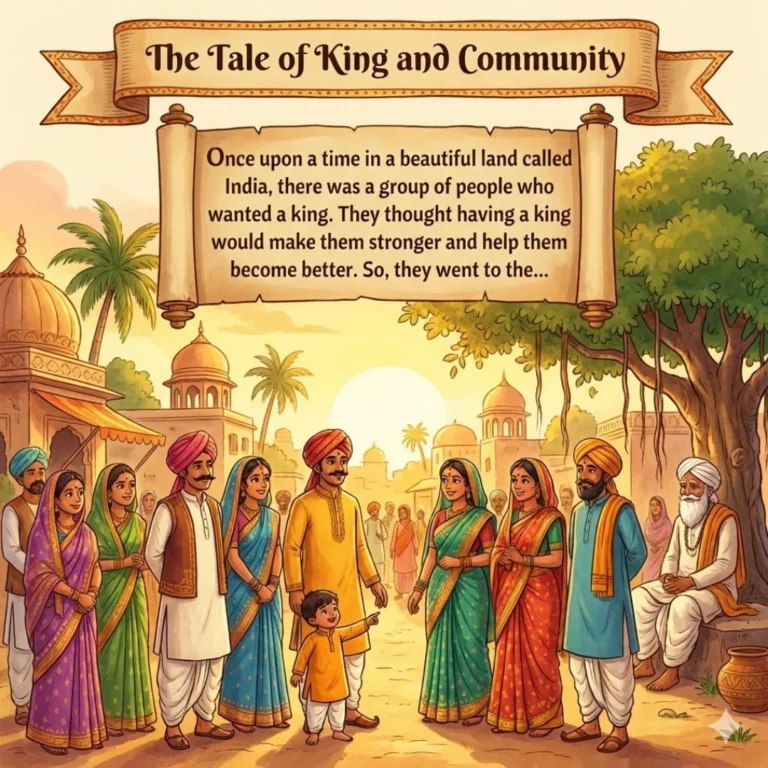
This moral story for children ages 6-12 combines entertainment with important values.
CHAPTER ONE: THE GATHERING OF VOICES
The monsoon rains had finally stopped, and the village of Shanti Nagar gleamed like a freshly polished copper pot under the afternoon sun. Children splashed through puddles while their mothers hung colorful saris to dry on long bamboo poles. It was a peaceful day, but underneath the calm, a great debate was brewing.
“We need a king!” declared Vikram, the cloth merchant, pounding his fist on a wooden crate in the village square. His voice carried across the marketplace where dozens of villagers had gathered.
“A king would make us strong,” agreed Priya, the potter, wiping clay from her hands. “The village across the river has a king, and look how prosperous they have become!”
Twelve-year-old Ravi watched from behind a stack of mangoes at his father’s fruit stall. His best friend Meera stood beside him, her dark eyes wide with curiosity.
“What do you think, Ravi?” Meera whispered. “Would a king be good for us?”
Ravi scratched his chin thoughtfully. “I don’t know. We’ve always made decisions together, haven’t we? My grandfather says that’s what makes us special.”
The crowd grew larger as more villagers joined the discussion. Some wanted a king desperately; others looked uncertain. Finally, someone shouted, “Let us ask Guruji! The wise man Samuel will know what to do!”
* * *
CHAPTER TWO: THE WISE MAN’S WARNING
Guruji Samuel lived in a small ashram at the edge of the village, surrounded by mango trees and jasmine flowers. His white beard reached his chest, and his eyes sparkled with the wisdom/” title=”More stories about wisdom”>wisdom of many decades.
The villagers found him sitting cross-legged on a woven mat, feeding pieces of roti to a family of sparrows.
“Guruji,” Vikram said, bowing respectfully, “we have come to ask for your guidance. We wish to have a king to rule over us.”
Guruji Samuel nodded slowly, his expression thoughtful. “Sit, my children. All of you, sit.”
The villagers arranged themselves in a large circle around the old teacher. Ravi and Meera squeezed to the front, eager to hear every word.
“So you wish to have a king,” Guruji Samuel said, stroking his beard. “Tell me, why do you believe a king will help you?”
“A king will protect us from enemies!” said one man.
“A king will make fair laws!” added a woman.
“A king will make us rich and powerful!” shouted another.
Guruji Samuel raised his hand, and the crowd fell silent.
“I will tell you what having a king truly means,” he said, his voice gentle but serious. “Listen carefully, for these words come from ancient wisdom.”
He closed his eyes for a moment, as if gathering his thoughts from some distant place.
“If you choose a king, he will take your sons to serve him. Some will become soldiers, learning to fight with swords and spears. Others will run before his chariot, clearing the road wherever he travels. Your strong young men will spend their days serving the king instead of helping their own families.”
The crowd murmured nervously, but Guruji continued.
“Your daughters, too, will be called to serve. The king will need cooks to prepare elaborate feasts, bakers to make fine breads, and perfumers to create sweet fragrances for his palace. Your talented girls will work in the royal household instead of learning your family crafts.”
Ravi looked at Meera, whose mother was teaching her the art of pottery. Meera’s face had grown pale.
* * *
CHAPTER THREE: THE PRICE OF POWER
“But that is not all,” Guruji Samuel said, his voice growing more serious. “A king needs wealth to maintain his power. He will take your best fields—the ones where the mangoes grow sweetest and the rice grows tallest. He will give these lands to his loyal servants and advisors.”
“Our fields?” gasped Ravi’s father, who had inherited his mango orchard from his father, who had inherited it from his father before him.
“Yes,” Guruji nodded. “And from what remains, the king will take a portion of your harvest. Where you now keep ten baskets of grain, you will keep only nine—or perhaps only eight. The king’s granaries must always be full.”
An old woman in the crowd began to weep softly. “My husband and I built our farm with our own hands,” she said. “Will a king truly take what we have worked so hard to create?”
Guruji Samuel’s eyes were filled with compassion. “I tell you these things not to frighten you, but because you must understand the truth. A king is not a magical solution to your problems. A king is a person with his own needs and desires, and those needs will become your burden to bear.”
He paused, letting his words settle over the crowd like morning mist.
“There may come a day when you cry out because of the king you have chosen. You will say, ‘We should never have asked for this!’ But by then, it may be too late to return to the way things were.”
* * *
CHAPTER FOUR: THE STRENGTH WITHIN
The sun was beginning to set, painting the sky in shades of orange and pink. The villagers sat in troubled silence, considering everything they had heard.
Ravi raised his hand timidly. “Guruji, may I ask a question?”
The wise man smiled warmly. “Of course, young one. What troubles your heart?”
“If we don’t have a king, how will we protect ourselves? How will we solve our problems?”
Guruji Samuel’s smile grew wider. “That, my child, is the wisest question of all.” He gestured for Ravi to come closer, then addressed the entire crowd.
“Look around you,” he said. “What do you see?”
“Our neighbors,” someone said.
“Our friends,” added another.
“Our family,” whispered Meera.
“Exactly!” Guruji Samuel clapped his hands together. “You see a community. And a community, my dear children, is stronger than any king.”
He pointed to the blacksmith. “When Gopal’s forge caught fire last month, who helped him rebuild it?”
“We all did,” the blacksmith said, his eyes glistening.
“And when the river flooded the eastern fields, who worked together to save the crops?”
“Everyone pitched in,” said a farmer. “Young and old, men and women.”
“That,” said Guruji Samuel, “is your true strength. A king rules from above, making decisions for everyone. But a community works together, each person contributing their unique gifts. When you face a problem as a community, you have not one mind but many. You have not one pair of hands but hundreds.”
* * *
CHAPTER FIVE: THE DECISION
The villagers talked late into the night, long after the stars had appeared in the velvet sky. Ravi and Meera sat together, listening as the adults debated.
“I think I understand now,” Meera said quietly. “A king might make things seem easier, but we would lose something precious.”
“Our freedom to choose,” Ravi nodded. “Our ability to help each other as equals.”
As dawn approached, Vikram the merchant stood up. His face looked different now—thoughtful rather than determined.
“Friends,” he said, “I was the one who spoke loudest for having a king. But tonight, I have listened and learned. Guruji is right. Our strength lies not in a single ruler, but in our unity.”
One by one, other villagers stood and shared their thoughts. The potter Priya spoke of how she had always solved problems by working with her neighbors. The old woman who had wept earlier shared how the community had cared for her when her husband fell ill.
Finally, as the first rays of sunlight touched the village square, the people of Shanti Nagar made their decision.
“We will remain a community of equals,” announced the village elder. “We will face our challenges together, making decisions as one. No single person will rule over us, for we are all responsible for each other.”
A great cheer rose up from the crowd. Children who had stayed awake all night began to dance with joy. Neighbors embraced neighbors, and someone began to play a joyful tune on a bamboo flute.
* * *
CHAPTER SIX: A NEW BEGINNING
In the weeks that followed, the village of Shanti Nagar became famous throughout the region. Other villages heard of their decision and came to learn their ways.
Ravi and Meera became the village’s youngest ambassadors, traveling to nearby towns to share Guruji Samuel’s wisdom.
“We are stronger together than apart,” Ravi would explain to curious listeners. “When everyone shares the burden, no one is crushed beneath it.”
“And when everyone shares the joy,” Meera would add, “happiness multiplies instead of dividing.”
The villagers created a new tradition. Every full moon, they would gather in the square to discuss their problems and celebrate their successes. Every voice was heard, from the oldest grandmother to the youngest child who could speak.
Years later, when Ravi had grown into a man with children of his own, he would sit in that same village square and remember the night when his community chose unity over power.
“What is the most important thing in life, Papa?” his daughter once asked him.
Ravi smiled, thinking of Guruji Samuel, of Meera, of all the neighbors who had become his extended family.
“The most important thing,” he said, pulling her close, “is to remember that we are never alone. We are part of something bigger than ourselves—a community of people who care for each other. And as long as we work together, there is no challenge we cannot face.”
His daughter nodded, then ran off to play with the other village children, her laughter joining a chorus of happy voices that echoed through Shanti Nagar—the Village of Peace—where the people had learned that true strength comes not from a crown, but from countless hands joined together in friendship and love.
Moral Lessons
- A strong community is built on teamwork and friendship, where everyone helps each other rather than relying on a single leader.
Test Your Understanding
1. Who was the wise man that the villagers consulted about having a king?
2. What was the name of the village in the story?
3. According to Guruji Samuel, what would a king take from the villagers?
4. What did Guruji Samuel say was the villagers’ true strength?
5. What new tradition did the villagers create after making their decision?
6. What is the main moral lesson of this story?
Frequently Asked Questions
What is the moral lesson of The Tale of King and Community?
What age is this story appropriate for?
How long does it take to read The Tale of King and Community?
What culture does this story come from?
Can I use this story for teaching?
Frequently Asked Questions
What is The Tale of King and Community story about?
This moral story follows a peaceful Indian village called Shanti Nagar where villagers debate whether they need a king to lead them or should continue making decisions together as a community. The story explores themes of leadership, democracy, and collective decision-making through the eyes of two children, Ravi and Meera.
What age group is this king and community story suitable for?
This story is designed for children ages 6-12. It combines entertainment with important moral lessons about community participation and leadership, making it perfect for elementary school-aged children who are beginning to understand concepts of fairness, cooperation, and how groups make decisions.
What moral lesson does this story teach kids?
The story teaches children about the importance of community involvement in decision-making versus relying on a single leader. It explores themes of democracy, collective responsibility, and how different forms of governance affect people’s lives, helping kids understand the value of having a voice in their community.
📚 Recommended Books
Handpicked for readers like you
As an Amazon Associate, we earn from qualifying purchases. These recommendations are personalized based on this story's themes and your reading history.
Is this a good bedtime story for kids?
Yes, this moral story makes an excellent bedtime story for kids. Set in a peaceful village with relatable child characters, it provides thoughtful discussion topics about leadership and community while maintaining an engaging, age-appropriate narrative that won’t be too stimulating before sleep.
Where does The Tale of King and Community take place?
The story is set in Shanti Nagar, a traditional Indian village after the monsoon rains. The setting includes a vibrant marketplace, fruit stalls, and a village square where community members gather to discuss important decisions, providing children with a window into different cultures and ways of life.