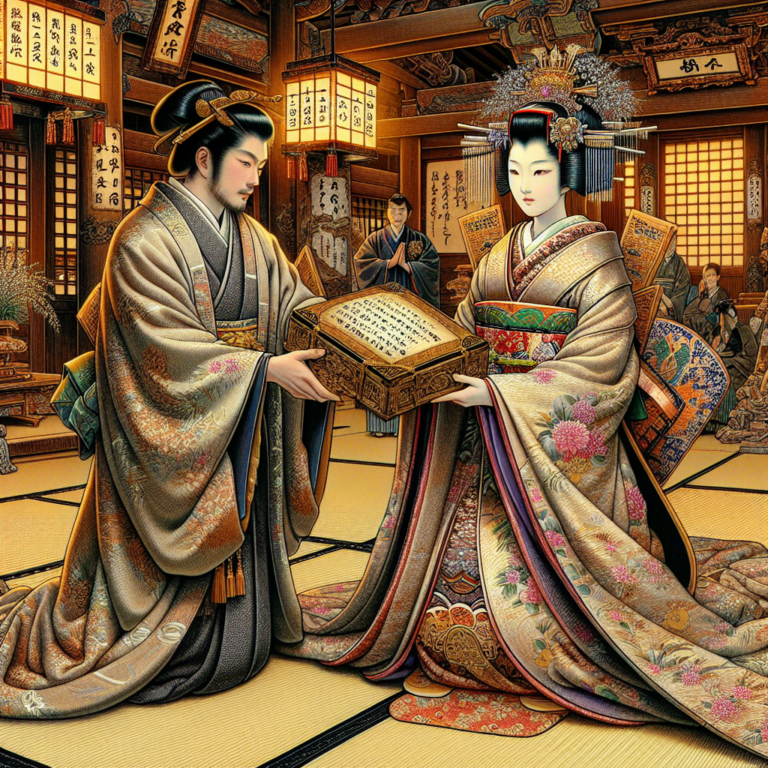
This bedtime story for kids, ‘Embracing Echoes: The Enchanted Journey through Japan’s Ancient Chronicles’, teaches children ages 6-12 about important moral values.
Chapter One: The Keeper of Two Treasures
In the imperial capital of Nara, where cherry blossoms drifted like pink snow and ancient temples raised their curved roofs toward heaven, there lived an old scholar named Akio. His small house sat at the edge of the palace grounds, unremarkable from the outside but containing within it the most precious treasures in all of Japan: the only complete copies of two sacred texts, the Kojiki and the Nihon Shoki.
Akio had spent his entire life studying these books, from the time he was a young apprentice with ink-stained fingers to now, when his hair had turned white as winter clouds and his eyes needed special polished lenses to read the ancient characters.
One spring morning, as Akio was preparing to begin his daily reading, he heard a commotion outside his door. There stood his granddaughter Yuki, twelve years old and as bright as the moon for which she was named, along with two of her friends: Kenji, a merchant’s son who asked questions about everything, and Hana, a girl from the neighboring village who had an artist’s eye for beauty.
“Grandfather!” Yuki called out. “Our teacher said we must learn about the ancient stories for our studies. Will you tell us about your books?”
Akio smiled, his wrinkled face creasing into a hundred happy lines. “Come in, come in. You have asked to hear the greatest stories ever written in our language. But first, let me tell you why we have two books instead of one.”
Chapter Two: The Tale of Two Chronicles
The children settled on silk cushions around Akio’s low table, where the two sacred texts lay wrapped in their protective cloths.
“Eight years before the Nihon Shoki was completed,” Akio began, carefully unwrapping the older text, “Empress Gemmei received this: the Kojiki, the Records of Ancient Matters. It was compiled by a man named O no Yasumaro, who wrote down the stories that had been memorized perfectly by a woman named Hieda no Are.”
“A woman?” Hana asked, surprised. “I didn’t know women could be scholars in ancient times.”
“Hieda no Are had an extraordinary gift,” Akio explained. “She could hear something once and remember it forever, word for word. The emperor himself had asked her to memorize all the ancient myths and histories so they would never be lost. And so she did, carrying the entire history of Japan in her remarkable mind.”
Kenji leaned forward eagerly. “So the Kojiki has all the stories?”
“Many of them, yes. But here is where it becomes interesting.” Akio carefully unwrapped the second book. “Eight years later, Prince Toneri and O no Yasumaro worked together to create the Nihon Shoki. This book was written entirely in Chinese characters, using the formal style of Chinese historical writing.”
“But why?” Yuki asked. “If they already had the Kojiki?”
“Ah,” Akio said, his eyes twinkling, “that is the heart of the mystery. The Nihon Shoki was meant to be understood by scholars across all of Asia. It presented Japan’s history in a way that Chinese, Korean, and other East Asian scholars would recognize and respect. It showed that Japan’s history was just as ancient and glorious as China’s.”
Chapter Three: The Birth of the World
“Tell us a story from the books!” Kenji begged. “Tell us how the world began!”
Akio nodded and began to recite from memory, his voice taking on a rhythmic, ancient quality:
“In the beginning, heaven and earth were not separated. They were like an egg, containing all things mixed together within them. The lighter, purer part rose up to become heaven. The heavier, denser part sank down to become earth.”
“Like cream rising in milk!” Hana observed.
“Exactly so. From this primordial chaos, three gods emerged, beings of pure spirit who had no physical form. They are called the Three Creating Deities. After them came two more gods, making five in all. These five are known as the Heavenly Gods.”
The children listened, their eyes wide, as Akio described how god after god came into being, each representing different aspects of existence. The stories flowed like a river of wonder, carrying them into an ancient world where the boundaries between mortal and divine were thin as rice paper.
“But the most important gods for our story,” Akio continued, “were the brother and sister pair: Izanagi, the Male Who Invites, and Izanami, the Female Who Invites. The heavenly gods gave them a jeweled spear and commanded them to create the land.”
Chapter Four: Izanagi and Izanami
“Standing on the Floating Bridge of Heaven,” Akio narrated, “Izanagi and Izanami stirred the ocean with the jeweled spear. When they lifted it out, drops of salt water fell from its tip and piled up, becoming the first island, Onogoro.”
“Dripping an island into existence!” Kenji exclaimed. “That’s amazing!”
“They descended to this island and built a great pillar there. Walking around it in opposite directions, they met and greeted each other, and from their union came the eight great islands of Japan, along with many smaller islands and countless gods.”
Yuki raised her hand. “Grandfather, in our village, they say that Izanami died. Is that true?”
Akio’s expression grew solemn. “Yes, it is true, and this brings us to one of the most important differences between our two books. In the Kojiki, when Izanami died giving birth to the fire god, Izanagi was so grief-stricken that he journeyed to Yomi, the Land of the Dead, to bring her back.”
“Did he succeed?” Hana asked softly.
“He found her, but she had already eaten the food of the dead and could not return. When Izanagi looked upon her despite her warning not to, he saw that her body had begun to decay. In horror, he fled. Izanami, furious and ashamed, sent demons to chase him.”
“But the Nihon Shoki tells it differently?” Kenji guessed.
“The Nihon Shoki says that the ‘Even Pass of Hades’ that Izanagi crossed was not a real place, but the moment when life’s breath ceases. You see, the Nihon Shoki was written to be more philosophical, to explain the deeper meanings behind the myths. The Kojiki preserves the raw, ancient stories as they were told around fires for countless generations.”
Chapter Five: The Lessons of the Chronicles
As the afternoon shadows lengthened, Akio led the children through more stories: the birth of Amaterasu the sun goddess from Izanagi’s left eye, the mischief of her brother Susanoo, the tale of the white hare of Inaba, and the adventures of Prince Yamato Takeru.
“Grandfather,” Yuki said during a pause for tea, “the Kojiki and the Nihon Shoki sometimes tell the same story differently. Which one is right?”
Akio set down his tea cup and smiled at his granddaughter. “That, my child, is the wisest question you could ask. And the answer is: perhaps both, or perhaps neither, in the way you mean.”
Seeing the children’s confused expressions, he elaborated. “These stories are not meant to be history in the way we think of it today. They are truths wrapped in the clothing of myth. The Kojiki preserves the emotional truth, the stories as our ancestors felt them in their hearts. The Nihon Shoki preserves the philosophical truth, the meanings our scholars found hidden within the tales.”
“So a story can be true even if it didn’t happen exactly that way?” Kenji asked, his brow furrowed as he worked through this idea.
“A story about a dragon teaching a princess to be brave might never have happened,” Akio agreed, “but the truth that courage can be learned? That is as real as the sun in the sky.”
Chapter Six: The White Hare’s Wisdom
“Let me tell you one more story,” Akio said, “one that appears in the Kojiki but not in the Nihon Shoki. Perhaps its omission will teach you something about how stories are chosen.”
The children settled in eagerly.
“Once, a white hare lived on a small island and wished to cross to the mainland. Being clever, he tricked a family of sea crocodiles by pretending to count them, hopping across their backs like stepping stones. But his cleverness turned to foolishness when he bragged about his trick before reaching the shore. The furious crocodiles stripped off his fur, leaving him in agony.”
“Poor hare!” Hana said.
“Eighty gods passed the suffering hare, and when he asked for help, they told him to wash in salt water and dry himself in the wind. But this only made his pain worse. Then came the youngest brother, a kind god named Okuninushi. He told the hare to wash in fresh water and roll in cattail pollen. The hare was healed and prophesied that Okuninushi would win the hand of the princess all his brothers sought.”
“Why would the Nihon Shoki leave out such a good story?” Yuki asked.
“Perhaps because it was considered too simple, too much like a folk tale for a formal history,” Akio suggested. “But does that make it less true? The lesson that kindness succeeds where cleverness and cruelty fail, is that not worth preserving?”
Chapter Seven: The Living Legacy
As the sun set over Nara, painting the sky in shades of orange and purple that matched the most beautiful kimono, the children prepared to leave.
“Grandfather,” Yuki said, pausing at the door, “will the Kojiki and Nihon Shoki always survive? What if something happens to your copies?”
Akio walked them to the gate, gesturing at the city around them. “Look around you. Every shrine, every festival, every story parents tell their children at bedtime, these all carry pieces of these ancient books. The words might be locked in old texts, but the spirit lives in the hearts of our people.”
He placed his hand on Yuki’s shoulder. “And now it lives in you three as well. You have heard the stories of creation, of gods and heroes, of wisdom and folly. When you share these stories with your own children someday, you become part of a chain stretching back through countless generations to the very beginning of Japan.”
The children bowed deeply to the old scholar and made their way home through the torch-lit streets, their minds alive with images of jeweled spears dripping islands, of journeys to the land of the dead, and of a kind god helping a suffering hare.
And in his small house, Akio carefully rewrapped his precious books, smiled at the memory of eager young faces, and knew that the ancient stories would live on for another generation.
Moral Lessons
- Stories may be told in different ways across cultures and generations, but their core truths remain unchanged. Understanding and respecting how different perspectives share wisdom helps us grow wiser ourselves.
Test Your Understanding
1Who was the Empress that received the Records of Ancient Matters?
Frequently Asked Questions
What is the moral lesson of Embracing Echoes: The Enchanted Journey through Japan’s Ancient Chronicles?
What age is this story appropriate for?
How long does it take to read Embracing Echoes: The Enchanted Journey through Japan’s Ancient Chronicles?
What culture does this story come from?
Can I use this story for teaching?
Frequently Asked Questions
What is the bedtime story ‘Embracing Echoes: The Enchanted Journey through Japan’s Ancient Chronicles’ about?
It’s a children’s bedtime story set in ancient Nara, Japan, following a young girl named Yuki and her friends as they learn from her grandfather Akio, a scholar who guards Japan’s sacred texts, the Kojiki and Nihon Shoki. The story teaches important moral values to kids ages 6 to 12 through an enchanted adventure.
What age group is this Japan’s Ancient Chronicles bedtime story suitable for?
This story is written for children between the ages of 6 and 12. It uses accessible language and engaging characters to introduce kids to Japanese history and moral lessons in a way that feels like a magical adventure rather than a history lesson.
What moral values does this children’s story about Japan teach?
While the story unfolds throughout the chapters, it centers on values like respect for knowledge, cultural heritage, curiosity, and wisdom passed down through generations. The characters Yuki, Kenji, and Hana each represent different virtues that children can relate to and learn from.
📚 Recommended Books
Handpicked for readers like you
As an Amazon Associate, we earn from qualifying purchases. These recommendations are personalized based on this story's themes and your reading history.
What are the Kojiki and Nihon Shoki mentioned in the story?
The Kojiki and Nihon Shoki are real ancient Japanese texts — among the oldest written chronicles in Japan. They contain myths, legends, and historical accounts of the Japanese imperial lineage. In the story, they serve as magical treasures guarded by the scholar Akio, sparking the children’s enchanted journey.
Is this bedtime story based on real Japanese history or mythology?
The story blends real historical elements, like the ancient capital of Nara and the sacred texts Kojiki and Nihon Shoki, with fictional characters and an enchanted adventure. This makes it a great way to gently introduce children to Japanese culture and mythology while keeping them entertained at bedtime.