Share this engaging bedtime story with kids ages 6-12 to teach valuable life lessons.
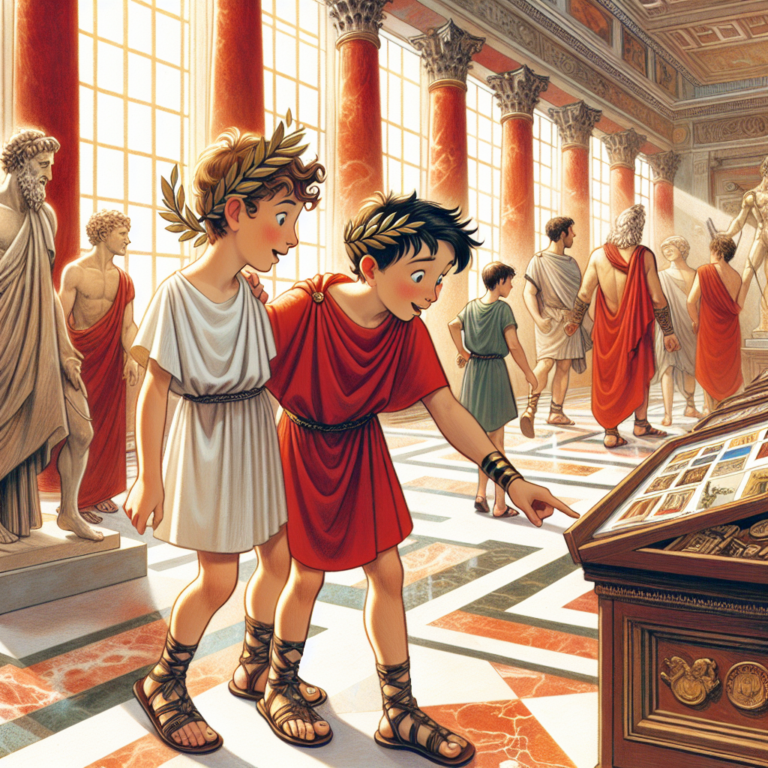
“Hurry up, Marcus!” called Lucius, running ahead through the marble halls of the great museum. “The gladiator exhibit opens soon!”
Marcus laughed and jogged to catch up with his older brother. They were visiting the National Archaeological Museum of Naples with their grandfather, a retired history professor who knew more about ancient Rome than anyone they had ever met.
“Boys, boys,” Grandfather called gently. “The gladiators will wait. But look here—what do you see?”
He had stopped before a series of beautiful drawings—lithographs, the signs said—showing scenes from Roman life. But these were not scenes of battle or conquest. They showed friends embracing, couples walking together, children playing at their parents’ feet.
“These are scenes of love and friendship,” Grandfather explained. “The Romans valued these things as much as they valued military glory—perhaps more. A Roman without friends was considered the poorest of men, no matter how much gold he possessed.”
The three of them sat on a bench, and Grandfather began to teach.
“The Romans believed in certain virtues—qualities that every good citizen should cultivate. These virtues were not just nice ideas. They were the foundation of Roman greatness.”
He counted on his fingers:
“*Virtus: This meant courage, but not just in battle. It meant having the strength to do what is right, even when it is difficult.
“Pietas: Duty and devotion—to the gods, to your family, to your country. A Roman would never abandon his responsibilities, no matter the personal cost.
“Fides: Faithfulness and reliability. When a Roman gave his word, he kept it. Treaties, promises, contracts—all depended on fides.
“Gravitas: Seriousness of purpose and dignity. This did not mean never laughing or having fun. It meant taking important things seriously and not being distracted by foolishness.
“Dignitas: Personal dignity and reputation. A Roman worked hard to build a good name and worked even harder to preserve it.
“Auctoritas: The respect you earn through wisdom and experience. This could not be bought or demanded—it had to be earned over a lifetime.”
Marcus thought about this. “Did all Romans really live by these values?”
Grandfather smiled sadly. “No, of course not. That is why Rome eventually fell. But for centuries, enough Romans followed these virtues that their civilization became the greatest the world had ever seen.”
“Let me tell you a story,” Grandfather said, “about a Roman who truly embodied these virtues.”
The boys leaned in eagerly.
“His name was Lucius Quinctius Cincinnatus, and he lived about 2,500 years ago. He had been an important leader in Rome but had retired to his small farm outside the city. He wanted nothing more than to grow his crops and live simply.
“But then Rome faced a terrible crisis. An enemy army had trapped Roman soldiers in the mountains. Defeat seemed certain. In desperation, the Senate voted to make Cincinnatus dictator—a special position with absolute power, given only in emergencies.
“Messengers rushed to his farm and found him plowing his fields, wearing simple farmer’s clothes. They told him that Rome needed him.
“Cincinnatus could have refused. He was comfortable on his farm. Or he could have abused the power he was given—many others would have. Instead, he put down his plow, went to Rome, raised an army, marched to the mountains, and defeated the enemy in a single day.
“And then—this is the important part—he gave up his power. Sixteen days after becoming dictator, Cincinnatus resigned, returned his authority to the Senate, and went back to his farm to finish plowing.
“He could have been king. He could have been rich beyond imagining. But he only wanted to do his duty and return to his simple life.”
Lucius was amazed. “He just gave up all that power?”
“He did. And that is why the Romans remembered him as one of their greatest heroes. Not for the battles he won, but for the power he refused.”
They walked on through the museum, past statues of emperors and warriors, past jewelry and coins, past painted vases and carved gems. Everywhere, history spoke to them.
“Why do we study ancient history?” Marcus asked suddenly. “These people have been dead for thousands of years.”
Grandfather nodded approvingly. “An excellent question. There are many reasons.
“First, we study history to understand ourselves. We are not so different from the Romans. They loved their families, worried about the future, made mistakes, and tried to do better. By understanding them, we understand ourselves.
“Second, we study history to avoid repeating mistakes. The Romans made many errors that we can learn from. They became too proud. They trusted the wrong people. They forgot the virtues that made them great. By knowing their mistakes, we can try not to make the same ones.
“Third, we study history because it is beautiful. These works of art, these stories of courage and sacrifice, these examples of human creativity—they enrich our lives. A person who knows nothing of history is like a person who has never seen the stars. They are missing something wonderful.”
As they entered a hall dedicated to the later Roman Empire, the mood grew more somber. The artifacts here showed signs of their age—worn, faded, incomplete.
“All empires rise and fall,” Grandfather said quietly. “Rome was no exception.”
“What happened?” Lucius asked. “If they were so great, why did they fall?”
“Ah, that is the question that the historian Edward Gibbon spent his whole life trying to answer. He wrote a famous book called ‘The History of the Decline and Fall of the Roman Empire,’ and it took him many years to complete.
“There was no single cause. It was many things working together:
“First, the Romans became divided. They stopped seeing themselves as one people and began fighting among themselves for power.
“Second, they forgot their virtues. The courage, duty, and faithfulness that built Rome were replaced by selfishness and greed.
“Third, they stopped investing in their future. Roads and bridges went unrepaired. Schools closed. The arts declined.
“Fourth, they stopped adapting to change. The world around them was changing, but they refused to change with it.
“Finally, when enemies came, Rome was too weak to resist. The city that had conquered the world was itself conquered.”
But Grandfather’s voice brightened as they entered the final gallery.
“Yet look around you. Rome fell over fifteen hundred years ago, but here we are, studying their art, learning from their history, speaking languages that come from Latin, using laws that come from Roman laws.
“Rome as a political power is gone. But Roman ideas—justice, citizenship, engineering, law, philosophy—these live on. They shaped Europe. They shaped America. They shape us still.
“The things that truly last are not empires or armies. They are ideas and values. The virtues I told you about—courage, duty, faithfulness—these cannot be destroyed by invading armies.
“And stories. Stories last. The story of Cincinnatus has been told for twenty-five centuries. It will be told for twenty-five more. Because it teaches something true about human nature.”
That evening, at dinner, Marcus and Lucius could not stop talking about what they had learned.
“I want to be like Cincinnatus,” Lucius said. “Doing my duty without expecting rewards.”
“I want to learn more about history,” Marcus added. “There’s so much I don’t know.”
Their parents exchanged pleased looks.
Grandfather smiled. “Then my day’s teaching has been successful. But remember: learning about virtue is not enough. You must practice it.
“When you keep a promise even when it is inconvenient—that is fides.
“When you take your responsibilities seriously—that is pietas.
“When you stand up for what is right even when it is hard—that is virtus.
“You do not need to be a Roman to live by Roman virtues. You only need to choose them, every day, in small ways and large.
“The Romans built an empire of stone and law. But you can build something even greater: a life of character and purpose. No one can take that from you.”
As they walked home through the streets of Naples, the evening light turned the old buildings golden. In the distance, Mount Vesuvius stood silently, a reminder of nature’s power.
“Grandfather,” Marcus asked, “do you think people will study us in the future? The way we study the Romans?”
“Perhaps. If we create things worth remembering. If we live lives worth studying. Every generation adds to the great story of humanity. The question is not whether future people will study us, but whether what they find will be worthy of study.
“The Romans left behind roads and aqueducts, poetry and philosophy, examples of both virtue and vice. What will we leave behind?
“That, my boys, is up to you.”
The stars were coming out now, the same stars that the Romans had watched, the same stars that future generations would watch. And somewhere in that vast continuity, Marcus and Lucius found their place.
This journey through Roman history teaches several important lessons.
First, virtues are timeless. The qualities the Romans valued—courage, duty, faithfulness, dignity—are just as important today as they were two thousand years ago. These are not old-fashioned ideas but eternal truths about good character.
Second, power should be used responsibly. Cincinnatus could have made himself king but chose to return to his farm. True greatness is not about accumulating power but about using it wisely and letting it go when the time is right.
Third, we must learn from history. Rome fell because its people forgot their virtues, fought among themselves, and stopped investing in the future. These same mistakes can destroy any community or nation.
Finally, what truly lasts are ideas, not empires. Rome as a political power is gone, but Roman values, laws, and culture continue to shape our world. The things we create with our minds and hearts outlive the things we build with our hands.
This retelling faithfully preserves authentic Roman history and values:
The virtues described—virtus, pietas, fides, gravitas, dignitas, and auctoritas—were genuinely central to Roman culture and are well-documented in ancient sources.
Cincinnatus is a real historical figure (c. 519-430 BCE) whose story was famous throughout Roman history. He was appointed dictator twice and both times voluntarily gave up power. George Washington was compared to Cincinnatus for similar reasons.
“The History of the Decline and Fall of the Roman Empire” (1776-1789) is a real and influential work, still studied today for its insights into why civilizations decline.
The National Archaeological Museum of Naples contains one of the world’s greatest collections of Roman art and artifacts, including the famous lithographs and artworks mentioned in the story.
– Virtus: The Roman virtue of courage and moral excellence; doing what is right
– Pietas: Duty and devotion to gods, family, and country
– Fides: Faithfulness, reliability, keeping one’s word
– Gravitas: Seriousness of purpose and dignity
– Dignitas: Personal dignity and reputation earned through honorable conduct
– Auctoritas: The respect and influence earned through wisdom and experience
– Dictator: In Roman times, a leader given temporary absolute power during emergencies
– Cincinnatus: Roman hero famous for accepting power only when needed and immediately giving it up
– Decline and Fall: The gradual weakening and eventual collapse of the Roman Empire in the West (completed 476 CE)
1. Which Roman virtue do you think is most important? Why? (Values, character development)
2. Cincinnatus gave up power when he could have kept it. Can you think of modern examples of people who gave up power or position for the right reasons? (Leadership, integrity)
3. Grandfather says the Romans fell because they forgot their virtues. What happens in a family, school, or community when people forget their values? (Ethics, community)
4. Why is it important to study history? What can we learn from people who lived long ago? (Historical thinking, learning from the past)
5. Grandfather asks what we will leave behind for future generations. What would you like to leave behind? (Legacy, purpose)
– Gibbon, Edward, “The History of the Decline and Fall of the Roman Empire” (1776-1789)
– Livy, “Ab Urbe Condita” (History of Rome) – Source for Cincinnatus story
– National Archaeological Museum of Naples collection
– Classical sources on Roman virtues and values
This story uses the treasures of the Naples museum and the wisdom of Roman history to teach children about timeless virtues, the importance of learning from the past, and the kind of character that builds lasting legacies.*
Test Your Understanding
1Who were the two brothers exploring the Royal Museum at Naples?
Frequently Asked Questions
What is the moral lesson of Jupiter and Mars: The Grand Adventure through Time’s Echoes?
What age is this story appropriate for?
How long does it take to read Jupiter and Mars: The Grand Adventure through Time’s Echoes?
What culture does this story come from?
Can I use this story for teaching?
Frequently Asked Questions
What is the Jupiter and Mars Grand Adventure story about?
Jupiter and Mars: The Grand Adventure through Time’s Echoes is a bedtime story for kids ages 6-12 set in the National Archaeological Museum of Naples. It follows two brothers, Marcus and Lucius, and their grandfather as they explore ancient Roman history, discovering timeless lessons about friendship, love, and what truly matters in life.
What age group is the Jupiter and Mars bedtime story best suited for?
This story is specifically designed for children ages 6 to 12. It blends adventure and history in a way that keeps younger kids engaged while offering deeper life lessons that older children can reflect on and discuss with parents or grandparents.
What life lessons does this Jupiter and Mars story teach kids?
The story teaches children that true wealth lies in friendship and love, not material possessions. Drawing from ancient Roman values, it shows kids that meaningful relationships matter more than glory or gold — a lesson as relevant today as it was in ancient Rome.
📚 Recommended Books
Handpicked for readers like you
As an Amazon Associate, we earn from qualifying purchases. These recommendations are personalized based on this story's themes and your reading history.
Is this story historically accurate about ancient Roman culture?
Yes, the story is grounded in genuine historical insights. Romans did place enormous value on friendship and social bonds, considering a person without friends to be truly poor. The museum setting and references to Roman lithographs and daily life add authentic educational detail for young readers.
Can I use this bedtime story to start a conversation with my child about values?
Absolutely. The story naturally opens discussions about friendship, family, and what makes a good life. The grandfather character models thoughtful storytelling, making it easy for parents to pause and ask kids questions like ‘What do you think real wealth means?’ as you read together.