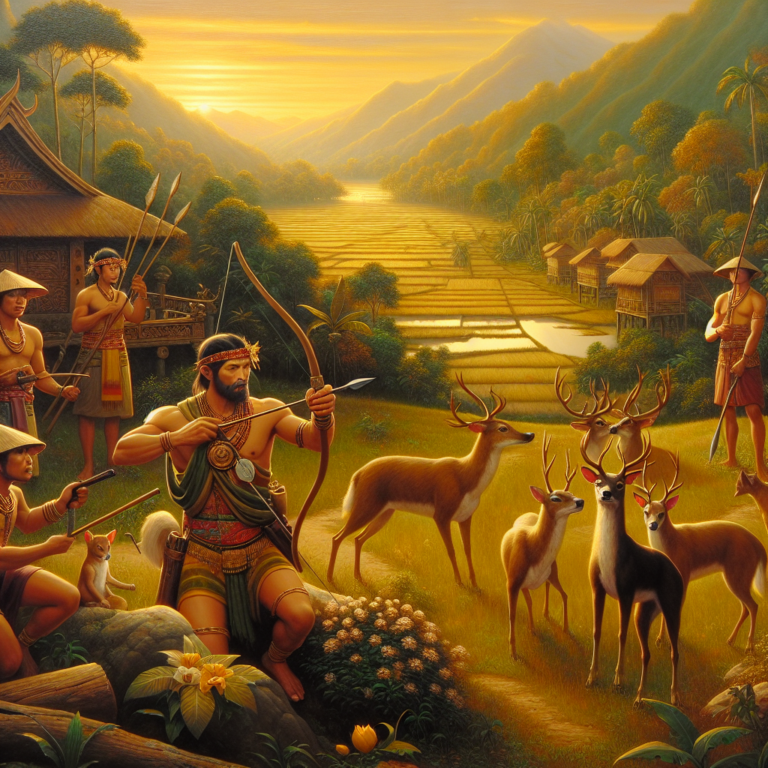
This bedtime story for kids, ‘The Tinguian Hunter’s Unexpected Discovery’, teaches children ages 6-12 about important moral values.
Chapter One: The Village Before Dawn
The roosters had not yet crowed when eleven-year-old Lina felt someone shaking her shoulder.
“Wake up, little one.”
She opened her eyes to find her father crouched beside her sleeping mat, his hunting gear already strapped to his back. Behind him, the first gray light of dawn was just beginning to seep through the bamboo walls of their home.
“Today?” she whispered, her heart jumping. “You’re taking me today?”
Her father smiled – a rare sight on his usually stern face. “You are old enough now. Come. The other hunters are gathering.”
Lina scrambled out of her blanket, her tiredness forgotten. She had been begging to join a hunt for three years. Her mother had always said no – “Too young, too dangerous, too many spirits in those mountains.” But last week, after Lina had tracked a wild pig that had been raiding their rice stores, following its prints for two miles and finding its den without getting lost, her father had finally convinced her mother.
“Not a full hunt,” her mother had warned. “She watches. She learns. She does not wander off.”
Lina would have agreed to anything.
Chapter Two: Into the Highlands
The hunting party was ten strong – six experienced hunters from the village of Domayco, three younger men just beginning to prove themselves, and now Lina, trying very hard to look like she belonged.
They climbed into the mountains as the sun rose, following trails that Lina had only ever seen from a distance. The familiar terraced rice paddies gave way to forest – thick, ancient forest where vines hung like curtains and the air smelled of moss and mystery.
“Release the dogs,” her father ordered.
Three hunting dogs shot into the undergrowth, their excited barks echoing through the trees. The hunters spread out, each following a different sound, each alert for movement.
Lina stayed close to her father, watching everything. She noticed how he moved – always aware of where he placed his feet, always listening, always ready. She tried to imitate him.
An hour passed. Two hours. The sun climbed higher, but under the forest canopy, the light remained dim and green.
Then one of the dogs began to bark in a particular way – sharp, insistent, the bark that meant it had cornered something.
“This way!” called Uncle Mako from somewhere ahead.
The hunters converged, spears ready. Lina ran alongside her father, her heart pounding with excitement.
But what they found was not a deer.
Chapter Three: The Impossible Jar
It sat in a small clearing as if it had been waiting for them – a large clay jar, perfectly round, decorated with patterns that seemed to shift and change when you weren’t looking directly at them. It was beautiful in a way that made Lina’s skin prickle.
The dogs circled it, barking and whining, clearly confused. This was not prey. This was not anything they understood.
“What is it?” asked young Tomas, stepping forward with his spear raised.
“Careful,” Lina’s father said sharply. “This is no ordinary jar.”
But Tomas was already reaching out – and the moment his fingers touched the clay, the jar moved.
Not fell. Not rolled. Moved. It slid away from him as if pulled by an invisible string, coming to rest ten feet away.
Everyone froze.
“Did you see that?” Tomas breathed.
“It’s a spirit jar,” said Uncle Mako, and his voice was very quiet. “I heard stories of these from my grandfather. They belong to the world beyond our world.”
Chapter Four: The Chase and the Voice
What followed was the strangest hunt any of them had ever experienced.
The jar seemed to be playing with them. Every time someone approached, it would slide or roll or bounce away, always staying just out of reach. It led them through the forest in loops and circles, past streams and over ridges, never moving fast enough to lose them but never staying still long enough to be caught.
Finally, exhausted and bewildered, the hunters collapsed beneath a great mahogany tree.
“This is madness,” Tomas panted. “It’s just a jar. Why can’t we catch it?”
“Because it doesn’t want to be caught,” Lina said quietly.
Everyone looked at her. She flushed, but continued.
“It’s testing us. That’s what spirit things do in the stories, right? They test whether we’re worthy.”
Her father nodded slowly. “The child speaks wisdom.”
As if responding to her words, a voice emerged from the air around them – soft as wind through bamboo, but perfectly clear.
“Find a pig which has no young, and take its blood. Only then will you be able to catch the jar your dog pursued.”
The hunters looked at each other with wide eyes. Lina felt no fear – only a deep sense of rightness, as if a puzzle piece had clicked into place.
“The spirits have spoken,” her father said. “We must do as they say.”
Chapter Five: The Proper Way
Returning to the village, they found a pig that met the spirit’s requirements. The ritual was performed properly – prayers were spoken, offerings were made, the ancestors were honored. Lina watched everything, understanding that this was not about magic tricks or superstition. It was about respect.
“When we ask something of the spirit world,” her father explained, “we must give something in return. This is the balance. This is the proper way.”
They returned to the forest with the sacred blood. The dogs led them back to the jar, which now sat motionless beside the entrance to a cave.
“It wants us to follow,” Lina whispered.
Into the darkness they went, the jar rolling ahead of them like a guide. The cave narrowed, then opened into a chamber lit by glowing moss on the walls – green and blue and silver, like stars fallen to earth.
There, the jar stopped.
“You have passed the test,” said the voice, and this time it clearly came from the jar itself. “You listened. You respected the old ways. You honored the balance between worlds. For this, I will live among you.”
Chapter Six: Magsawi Speaks
The jar’s name was Magsawi, and it was like no possession the village had ever known.
It spoke. Not constantly, and not to everyone – but when important decisions needed to be made, when the rains came too late or stayed too long, when illness threatened or strangers approached, Magsawi would offer wisdom.
“Plant the eastern terraces first this year,” it might say. Or: “The men who approach from the south come in peace – trade with them.”
The village prospered. Word spread to neighboring communities, and people would travel for days just to ask Magsawi a question.
Lina, who had been present at its discovery, became one of its caretakers. She would sit with the jar for hours, listening to its stories of the spirit world – tales of ancestors and elemental beings, of the connections that bound all things together.
“Why did you choose us?” she asked one day, when she was fourteen and beginning to understand how much she didn’t know.
“I didn’t choose your village,” Magsawi replied. “I chose your hunters. When they saw something they didn’t understand, they didn’t attack it or flee from it. They tried to understand it. When a voice from the unknown spoke to them, they listened. When they were told there was a proper way to proceed, they followed it. These are the qualities I value. These are the qualities I wished to nurture.”
“But I was just a child. I was barely supposed to be there at all.”
“Ah,” said Magsawi, and there was warmth in its strange voice, “but you were the one who understood first. You said I was testing whether you were worthy. A child who understands that the spirit world tests us – that is a child who will grow into someone who bridges both worlds.”
Chapter Seven: The Crack and the Wisdom
Years later, when Lina was grown and had children of her own, disaster struck.
During a violent storm, the shelf holding Magsawi collapsed. The jar fell and cracked along its side – a jagged line that ran from rim to base.
The village wept. When Magsawi tried to speak, its words came out garbled and broken, impossible to understand. The wisdom that had guided them for decades seemed lost.
Lina sat with the damaged jar, tears streaming down her face.
“I’m so sorry,” she whispered. “We should have protected you better. We should have been more careful.”
The jar made sounds – clearly trying to communicate – but the words were nonsense, syllables jumbled beyond recognition.
Then Lina’s youngest daughter, barely five years old, toddled over and placed her small hand on the cracked surface.
“The jar is sad,” she said. “But it still loves us. I can feel it.”
Lina looked at her daughter – at her open face, her simple faith, her complete acceptance of what she felt rather than what she heard.
And she understood.
“Magsawi,” she said slowly, “I cannot understand your words anymore. But can you still understand mine?”
A warmth pulsed through the clay – unmistakable, alive, present.
“Then we will learn a new way,” Lina said. “When I ask a question, warm yourself for yes. Go cold for no. We will find a way to keep speaking, even without words.”
And they did.
Chapter Eight: The Lesson That Lasts
The jar called Magsawi still exists, they say. It travels sometimes to visit family – a wife jar in distant Ilocos Norte, a child jar in faraway San Quintin – but it always returns to the hillside near the cave where it was first discovered.
Its language is strange now, incomprehensible to most. But those with patience and open hearts can still feel its wisdom. Not in words, but in warmth and cold, in subtle pulses of presence that speak directly to the spirit.
And the children of the village still learn the lesson of Magsawi’s discovery: that the world is full of wonders we don’t understand; that respect and patience can open doors that force cannot; that wisdom often speaks in languages we must learn to hear; and that sometimes the greatest treasures look nothing like what we expected to find.
“Always listen,” the elders tell the young ones. “To the wind, to the animals, to the quiet voice that speaks from unexpected places. The spirits are all around us, waiting to share their wisdom. All we have to do is be patient enough to hear.”
Moral Lessons
- The world is full of wonders and wisdom that may not come in the forms we expect. When we approach the unknown with respect, patience, and willingness to listen – even when understanding is difficult – we open ourselves to gifts and guidance beyond what we could have imagined.
Test Your Understanding
1Who were the main characters in the story?
Frequently Asked Questions
What is the moral lesson of The Tinguian Hunter’s Unexpected Discovery?
What age is this story appropriate for?
How long does it take to read The Tinguian Hunter’s Unexpected Discovery?
What culture does this story come from?
Can I use this story for teaching?
Frequently Asked Questions
What is The Tinguian Hunter’s Unexpected Discovery about?
The Tinguian Hunter’s Unexpected Discovery is a bedtime story for kids about an eleven-year-old girl named Lina who joins her father on her first hunt in the highlands. The story follows her journey and the surprising discovery she makes along the way, teaching children important moral values.
What age group is The Tinguian Hunter’s Unexpected Discovery suitable for?
This bedtime story is designed for children ages 6 to 12. The language and themes are age-appropriate, making it a great read-aloud choice for parents or an independent read for older kids in that range.
What moral values does this bedtime story for kids teach?
This bedtime story for kids explores themes like courage, patience, earning trust, and respecting nature. Through Lina’s experience, children learn about responsibility, listening to elders, and the rewards that come from perseverance and proving yourself.
📚 Recommended Books
Handpicked for readers like you
As an Amazon Associate, we earn from qualifying purchases. These recommendations are personalized based on this story's themes and your reading history.
Who are the Tinguian people in this children’s story?
The Tinguian are an indigenous people from the highlands of the Philippines. This story draws on their cultural setting, giving young readers a window into a rich, traditional way of life involving close community bonds, nature, hunting, and respect for the spirit world.
Is this a good bedtime story to read aloud to young children?
Yes, The Tinguian Hunter’s Unexpected Discovery works beautifully as a read-aloud bedtime story. It has a calm, atmospheric opening, relatable characters, and a gentle pace that helps children wind down while staying engaged with an adventurous and culturally rich narrative.