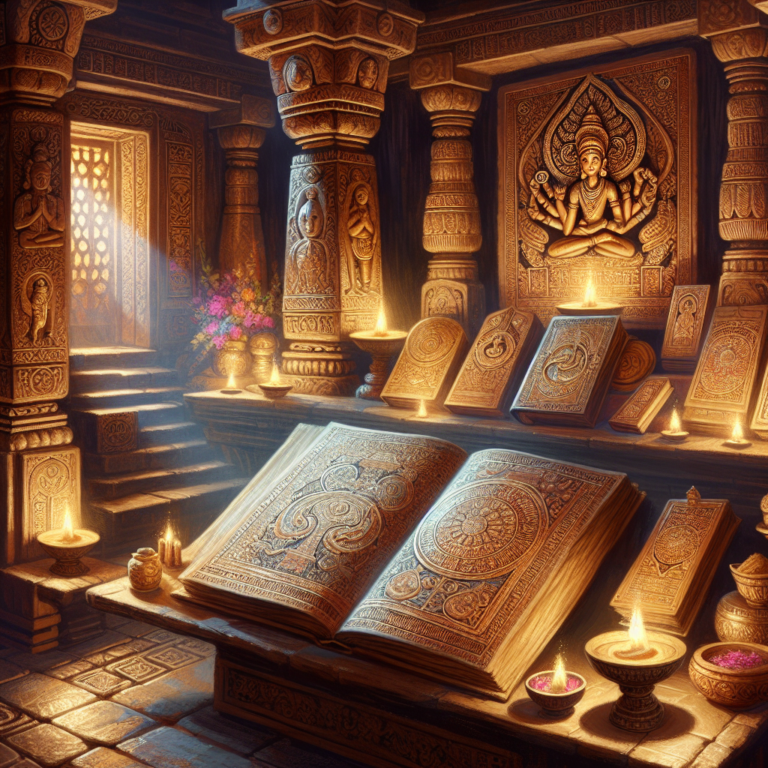
This bedtime story for kids, ‘The Magical Books of Wisdom: Journey to Righteous Living’, teaches children ages 6-12 about important moral values.
Chapter One: The Boy Who Asked Too Many Questions
In the bustling city of Jaipur, India, where pink sandstone palaces glowed in the afternoon sun and vendors called out their wares in melodious voices, a boy named Ravi sat in his grandfather’s bookshop, surrounded by questions.
“Dada,” he said, using the Hindi word for grandfather, “why do bad things happen to good people?”
His grandfather, a silver-haired man named Sharma Ji who wore reading glasses perched on the end of his nose, looked up from the book he was cataloging.
“Ah. The eternal question. What made you think of this today?”
Ravi kicked at the leg of the table, frustrated. “My friend Deepak is the nicest person I know. He always shares his lunch, helps with homework, never says mean things about anyone. And yesterday his father lost his job, and now they might have to move away. How is that fair?”
Sharma Ji closed his catalog book and removed his glasses, polishing them slowly on his kurta.
“Come with me,” he said. “There is a section of this shop I have never shown you. I think you are ready now.”
Chapter Two: The Hidden Room
Behind the ordinary bookshelves full of textbooks and novels, there was a door Ravi had always assumed led to a storage closet. But when his grandfather pushed it open, Ravi gasped.
The room beyond was small but magical. Its walls were lined with ancient books – not the mass-produced paperbacks of the main shop, but hand-bound volumes with leather covers and gold-embossed titles, scrolls tied with silk ribbons, palm-leaf manuscripts held together with wooden boards.
“These are the sacred texts,” his grandfather said softly. “The wisdom of India, collected by our family over twelve generations.”
Ravi’s eyes were wide. “I didn’t know these existed.”
“Some knowledge must wait until the student is ready. Your question today tells me you are ready.”
He gestured to a cushioned seat by the window.
“Sit. Today we will explore three great treasures: the Upanishads, the Puranas, and the stories of Krishna. By the end, I think you will understand something important about your friend Deepak, and about life itself.”
Chapter Three: The First Treasure – The Upanishads
Sharma Ji selected an ancient book bound in faded indigo cloth.
“The Upanishads,” he said, “were written over two thousand years ago by sages who spent their lives seeking truth. The word means ‘sitting near’ – because students would sit near their teachers to receive wisdom.”
He opened to a page marked with a golden ribbon and read:
“The face of truth is covered with a golden disc. Remove it, O Sun, so that I who love the truth may see it.”
“What does that mean?” Ravi asked.
“It means that the truth is always there, but it is hidden behind illusions – like gold covering a mirror. Our job is to lift the covering and see clearly.”
“But what does that have to do with bad things happening to good people?”
“Patience. The Upanishads teach that the world we see is not the complete picture. Behind everything – the happiness and the sadness, the success and the failure – there is a greater reality called Brahman. Think of the ocean and its waves.”
He drew a line on a piece of paper.
“When you look at the ocean, you see individual waves – some big, some small, some crashing, some gentle. Each wave seems separate. But they are all made of the same water. They are all part of the same ocean.”
Ravi frowned, thinking hard. “So… we’re like waves?”
“Yes. Our individual lives are like waves – sometimes high, sometimes low. But we are all part of something much larger. When Deepak’s family faces hardship, it is like a wave falling. But they are still part of the ocean. They are still connected to everything.”
Chapter Four: The Second Treasure – The Puranas and Karma
Sharma Ji set aside the Upanishads and selected another volume, this one decorated with intricate paintings of gods and demons.
“The Puranas tell stories,” he said. “Stories of the creation of the universe, the adventures of the gods, the histories of ancient kings. But hidden in these stories are profound truths about how life works.”
He opened to a page showing a great cosmic wheel.
“This is the wheel of Karma. Every action we take creates a ripple in the universe. Good actions create good ripples that eventually return to us. Bad actions create bad ripples that also return.”
“So if Deepak is good, why is his family suffering?”
“Ah, but Karma does not work on our timetable. It works across lifetimes. The Puranas teach that we live many lives – each one an opportunity to learn and grow. The difficulties Deepak faces now may be the result of actions from a previous life. Or they may be opportunities for his soul to grow stronger.”
Ravi’s face scrunched up. “That seems… complicated.”
“It is. But here is the important part.” Sharma Ji leaned forward. “Karma is not punishment. It is teaching. Every challenge we face is an opportunity to become wiser, more compassionate, more understanding. When Deepak faces this hardship with courage and kindness, he is creating powerful good Karma that will ripple forward through his future.”
“So the hardship isn’t wasted?”
“Nothing is wasted. Every experience, good or bad, is part of our education. The Puranas call this Dharma – the righteous path. When we face difficulties with grace and continue to do what is right, we are walking the path of Dharma.”
Chapter Five: The Third Treasure – The Stories of Krishna
“Now,” said Sharma Ji, his eyes twinkling, “for my favorite part.”
He selected a smaller book, its pages filled with colorful illustrations of a blue-skinned boy with a mischievous smile.
“This is the Prem Sagar – the Ocean of Love. It contains stories of Krishna, one of the most beloved figures in all of Hindu tradition.”
“I know Krishna!” Ravi said. “He’s the one who plays the flute!”
“Yes, but he is so much more. Krishna is an avatar – a divine being who came to Earth to teach and to play. Let me tell you one of my favorite stories.”
He began:
“When Krishna was a little boy, not much younger than you, he was always getting into mischief. One day, his mother Yashoda came home to find that someone had broken into her butter pot and eaten all the freshly churned butter.
“She looked around and found Krishna sitting in the corner, butter smeared all over his face, hands, and clothes.
“‘Krishna!’ she scolded. ‘Did you eat all the butter?’
“‘No, Mother,’ Krishna said, his eyes wide and innocent.
“‘Then why is your face covered with butter?’
“‘Perhaps the butter jumped onto my face by itself.’
“Yashoda tried to be stern, but how could she? She burst out laughing, and Krishna laughed with her, and soon the whole house was filled with joy.”
Ravi giggled. “He’s funny.”
“He is. But there is wisdom in the humor. Krishna teaches that life is meant to be lived with joy, even in difficult times. The butter was gone – that was the reality. But what mattered was not the lost butter. What mattered was the love between mother and son, the laughter they shared, the memory they created.”
Chapter Six: The Answer Takes Shape
The afternoon sun had shifted, casting long golden beams through the dusty windows of the hidden room. Ravi had been listening for hours, but he didn’t feel tired. Something was fitting together in his mind, like pieces of a puzzle.
“So let me see if I understand,” he said slowly. “The Upanishads say that we’re all connected to something bigger, so even when things are hard, we’re not alone.”
“Yes.”
“And the Puranas say that everything that happens – good or bad – is part of a bigger pattern, and if we face it with Dharma, we create good Karma for the future.”
“Exactly.”
“And Krishna teaches that even in the middle of difficulties, we can find joy and love.”
Sharma Ji smiled broadly. “You have learned well today, grandson.”
Ravi thought about Deepak – his kind friend who was facing such an unfair situation.
“I can’t make his father’s job come back,” Ravi said. “I can’t stop them from having to move. But I can… I can be a good friend. I can help him feel less alone. I can remind him that this hardship won’t last forever, and that how he faces it matters.”
“Now you truly understand,” his grandfather said. “The sacred texts are not just ancient words to be memorized. They are guides for living. When you help your friend face difficulty with courage and joy, you are practicing the wisdom of the Upanishads, the Puranas, and Krishna all at once.”
Chapter Seven: The Living Wisdom
That evening, Ravi went to Deepak’s house. His friend was sitting on the front steps, looking miserable.
Ravi sat down beside him.
“I heard about your father’s job,” he said. “I’m really sorry.”
Deepak shrugged, not meeting his eyes.
“I don’t know what’s going to happen,” Ravi continued. “But I know this: you’re my friend, no matter what. If you move away, we’ll write letters. If you stay, I’ll help however I can. And right now…”
He pulled out a package of sweets he had bought with his allowance.
“Right now, we can eat these and you can tell me about the new video game you wanted to show me.”
Deepak looked at the sweets, then at Ravi. Slowly, a small smile crept across his face.
“You’re a good friend, Ravi.”
“I’m trying to be.”
They sat together as the stars came out, talking and laughing, two friends facing an uncertain future with the most powerful tools available: love, loyalty, and the timeless wisdom that difficulties are not forever, but kindness is.
Moral Lessons
- Life brings challenges to everyone, good and bad alike. True wisdom lies not in avoiding hardship, but in facing it with courage, maintaining our connection to others, and remembering that our actions – especially acts of kindness during difficult times – create ripples of good that extend far beyond what we can see.
Test Your Understanding
1Who translated the Vishnu Purana from the original Sanskrit?
Frequently Asked Questions
What is the moral lesson of The Magical Books of Wisdom: Journey to Righteous Living?
What age is this story appropriate for?
How long does it take to read The Magical Books of Wisdom: Journey to Righteous Living?
What culture does this story come from?
Can I use this story for teaching?
Frequently Asked Questions
What age group is The Magical Books of Wisdom bedtime story suitable for?
The Magical Books of Wisdom is written for children ages 6 to 12. It uses simple, engaging language and relatable characters to introduce important moral values and life lessons in a way that young readers can easily understand and connect with.
What moral values does The Magical Books of Wisdom teach kids?
This story teaches children core moral values like kindness, fairness, empathy, and righteous living. Set in Jaipur, India, it follows a boy named Ravi who explores deep life questions with his grandfather, helping kids understand why good behaviour matters even when life feels unfair.
Why do bad things happen to good people according to this story?
This is one of the central questions young Ravi asks in the story. Rather than giving a quick answer, his grandfather guides him on a journey through wisdom and moral understanding, helping children process this difficult question in a thoughtful, age-appropriate and comforting way.
📚 Recommended Books
Handpicked for readers like you
As an Amazon Associate, we earn from qualifying purchases. These recommendations are personalized based on this story's themes and your reading history.
Is The Magical Books of Wisdom a good bedtime story for kids?
Yes, it works wonderfully as a bedtime story. It features a calm, reflective tone with vivid storytelling set in India. The grandfather-grandchild relationship gives it a warm, soothing feel, while the moral lessons give children something meaningful to think about as they drift off to sleep.
Where is The Magical Books of Wisdom story set?
The story is set in Jaipur, India, famously known as the Pink City. The rich cultural backdrop of pink sandstone palaces, bustling markets, and a cosy bookshop creates an immersive setting that brings the journey to righteous living to life for young readers.