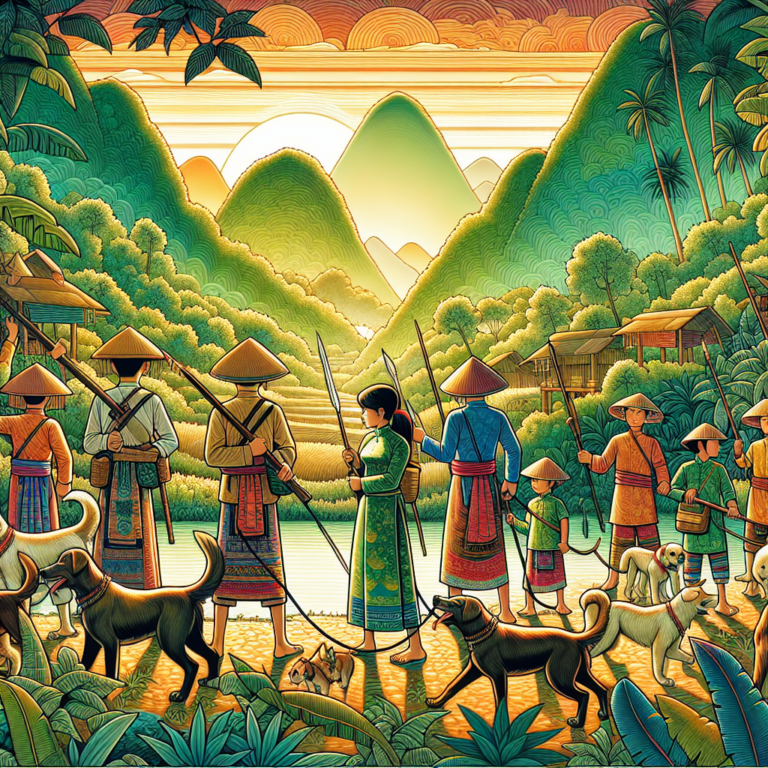
This bedtime story for kids, ‘The Enchanted Jar and the Tinguian Tribe’s Test of Patience’, teaches children ages 6-12 about important moral values.
Chapter One: The Hunt Begins
The morning mist still clung to the valley like a soft cotton blanket when twelve-year-old Lakay woke to the sound of his father’s voice.
“Wake up, son. Today you join the deer hunt.”
Lakay’s heart leaped. He had been waiting for this day for three years, ever since his older brother Kawan first went hunting with the men. Now, finally, he was old enough.
He scrambled out of his sleeping mat, quickly wrapping himself in his woven g-string and pulling on the traditional red cloth that marked him as Tinguian. His mother handed him a small pouch of cooked rice wrapped in banana leaves and pressed her palm to his forehead.
“May the spirits guide you safely, my son,” she whispered.
Outside, the men of Domayco village were already gathering – tall, muscular warriors with spears strapped to their backs and head-axes gleaming in the early light. A pack of hunting dogs whined and strained at their rope leashes, eager to be released into the wild mountain forests.
“Stay close to me,” Lakay’s father said, resting a calloused hand on the boy’s shoulder. “Watch everything. Say little. The forest teaches those who listen.”
Chapter Two: Something Strange in the Forest
They climbed for hours, following ancient trails that wound through bamboo groves and across rushing streams. The dogs were released, their barks echoing through the green cathedral of trees. The hunters spread out, each following the sound that called to him.
Lakay stayed close to his father and uncle, his legs burning from the climb but his spirit soaring. This was it – his first real hunt, his step into manhood.
Suddenly, a dog’s sharp, excited bark cut through the forest noise. Then another. And another.
“They’ve found something!” Lakay’s uncle said, his eyes brightening. “Come!”
They crashed through the undergrowth toward the sound, expecting to find a deer cornered against a cliff face or tangled in vines. What they found instead made them stop in their tracks.
The dogs were circling a large clay jar.
It sat in a small clearing as if it had been waiting for them – round and beautiful, decorated with intricate patterns that seemed to shift and change in the dappled sunlight. It was the size of a small child, glazed in rich browns and reds.
“A jar?” Lakay breathed. “In the middle of the forest?”
His father’s face was troubled. “This is no ordinary jar. Stay back.”
Chapter Three: The Chase
One of the younger hunters, a brash man named Tomas, laughed and strode toward the jar.
“It’s treasure! Someone must have hidden it here long ago. I’ll just -“
The moment his fingers brushed the clay, the jar moved. It rolled away from him, spun in a circle, and came to rest ten feet away.
Everyone gasped.
Tomas lunged again, and again the jar danced away, always staying just beyond reach. It was almost playful, like a child teasing an adult.
“Catch it!” someone shouted. “Don’t let it get away!”
The entire hunting party joined the chase. They ran, they dove, they tried to corner the jar against rocks and trees. But no matter what they did, it always escaped – rolling through gaps that seemed too small, bouncing over obstacles as if gravity had forgotten it.
Finally, exhausted and bewildered, the hunters collapsed beneath a giant dao tree, gasping for breath.
“What kind of sorcery is this?” Tomas demanded, wiping sweat from his face.
Lakay’s father pulled out his brass betel-nut box, the traditional sign that it was time to think and discuss. The men prepared their betel-nut wraps in silence, chewing thoughtfully.
Then, from nowhere and everywhere, a voice spoke.
Chapter Four: The Spirit’s Instruction
“Find a pig which has no young, and take its blood.”
Lakay nearly jumped out of his skin. He looked around wildly, but there was no one there – no one they could see.
“Only then,” the voice continued, soft as wind through bamboo, “will you be able to catch the jar your dog pursued.”
The men exchanged uneasy glances. Lakay’s father was the first to speak.
“This is a spirit jar. The voice has given us instructions. We must follow them exactly.”
“But why does a jar need pig’s blood?” Tomas asked, his bravado now replaced by nervous uncertainty.
“The spirits have their reasons,” Lakay’s father replied. “Our task is not to understand everything – it is to respect what is sacred and follow what is right.”
Chapter Five: The Sacrifice
They returned to the village and found a pig that met the spirit’s requirements. The sacrifice was made properly, with prayers and offerings, and Lakay watched as the ritual unfolded – ancient words spoken by his grandfather, smoke rising to carry their intentions to the spirit world.
“Now we go back,” his father said, holding a small vessel of the sacrificial blood. “But Lakay – you must understand something. The spirits test us. They want to know if we can listen, if we can be patient, if we respect powers greater than ourselves. This hunt is no longer about catching a deer. It’s about proving ourselves worthy.”
They returned to the forest, the dogs leading them once more to the strange jar. This time, when they approached, the jar did not flee.
Instead, it rolled slowly toward the entrance of a dark cave none of them had noticed before.
“It wants us to follow,” Lakay whispered.
Into the darkness they went.
Chapter Six: Magsawi Speaks
The cave was cool and damp, the only light coming from their hastily made torches. They followed the jar deep into the mountain until they emerged into a chamber lit by some strange phosphorescence in the rocks.
There, in the center of the chamber, the jar stopped.
“You have passed the test,” the voice said, and this time it clearly came from the jar itself. “You listened when I spoke. You honored the old ways. You made the proper sacrifice. For this, I will stay with your people.”
Lakay crept forward, his heart pounding. “Who – who are you?”
“I am Magsawi,” the jar replied. “I am a spirit who has chosen this form. Long ago, I lived as you do – I loved, I lost, I learned. Now I exist between worlds, and I have chosen your village as my home.”
“Why?” Lakay asked.
“Because you still remember how to listen. Because you respect what you do not understand. Because your people honor the connection between the seen and unseen worlds.”
Chapter Seven: A Crack in the Clay
Years passed. Magsawi lived among the Tinguian, speaking wisdom to those who sought it, warning of dangers, blessing harvests. The jar was kept in a place of honor, and people came from distant villages just to hear its counsel.
Lakay grew into a man, married, and had children of his own. He became one of the jar’s caretakers, spending hours in conversation with the spirit inside.
But one day, tragedy struck. During a terrible storm, the shelf holding Magsawi collapsed. The jar fell, and a crack appeared along its side.
Magsawi still spoke, but now its language had changed. The words came out garbled, shifted, impossible to understand – like trying to hear a song through rushing water.
Lakay wept. “Can we repair you? Please, tell us what to do!”
But the jar’s response was incomprehensible, a cascade of sounds that no longer formed words.
Chapter Eight: A Different Kind of Listening
For months, Lakay despaired. The village had relied on Magsawi’s guidance for so many years. How would they manage without it?
Then, one evening, his young granddaughter Amaya came to him with a drawing.
“Look, Lolo,” she said. “I drew Magsawi. And I think I understand what the jar is saying.”
Lakay studied the drawing – a child’s rendering of the cracked jar, surrounded by symbols.
“What do you mean, little one?”
“Magsawi still speaks, but not with words anymore. It speaks through feelings. When I sit with the jar, I feel things. Happy things. Warning things. Loving things.”
Lakay sat very still. Then, slowly, he rose and went to the jar. He sat beside it, closed his eyes, and opened his heart.
And there it was – not words, but something deeper. A warmth. A presence. A sense that he was not alone, that the spirits still watched over his people, that the connection between worlds remained unbroken.
“Thank you,” he whispered. “I understand now.”
The jar seemed to hum in response.
Chapter Nine: The Lesson Endures
To this day, they say Magsawi still exists. Sometimes it travels to visit family – another jar-spirit wife in Ilocos Norte, a small jar-spirit child in San Quintin. But it always returns to the hillside near the cave where it was first caught.
And the Tinguian still remember its lessons: that the spirit world is all around us; that patience and respect open doors that force cannot; that listening is a skill that goes beyond ears; and that even when we cannot understand the words, we can still feel the love.
Moral Lessons
- Patience, respect for the sacred, and willingness to listen – even when understanding is difficult – can connect us to wisdom far greater than ourselves. The spirit world speaks to those who approach with humility and open hearts.
Test Your Understanding
1Who embarked on a daring adventure at the beginning of the story?
Frequently Asked Questions
What is the moral lesson of The Enchanted Jar and the Tinguian Tribe’s Test of Patience?
What age is this story appropriate for?
How long does it take to read The Enchanted Jar and the Tinguian Tribe’s Test of Patience?
What culture does this story come from?
Can I use this story for teaching?
Frequently Asked Questions
What is The Enchanted Jar and the Tinguian Tribe’s Test of Patience about?
It’s a bedtime story for kids ages 6-12 that follows a young Tinguian boy named Lakay on his first deer hunt. Through his adventure with an enchanted jar, the story teaches important moral values about patience, perseverance, and growing up within the traditions of the Tinguian tribe of the Philippines.
What age group is The Enchanted Jar and the Tinguian Tribe’s Test of Patience suitable for?
This story is best suited for children ages 6 to 12. It works well as a bedtime story or a read-aloud, offering engaging adventure while gently teaching kids about patience and cultural traditions in a way that’s easy to understand and enjoy.
What moral lesson does this Tinguian patience story teach children?
The story teaches children that patience is a valuable skill worth developing. Through Lakay’s journey, kids learn that rushing important things can lead to mistakes, while waiting, observing, and trusting the process leads to better outcomes and personal growth.
📚 Recommended Books
Handpicked for readers like you
As an Amazon Associate, we earn from qualifying purchases. These recommendations are personalized based on this story's themes and your reading history.
Who are the Tinguian tribe in this kids’ story?
The Tinguian are an indigenous people from the Cordillera region of the Philippines. In the story, they are portrayed as skilled hunters and warriors with rich cultural traditions, including distinctive woven clothing and spiritual beliefs, giving children a window into a real and vibrant culture.
Is this enchanted jar story based on Filipino folklore?
The story draws inspiration from Filipino indigenous culture, particularly Tinguian traditions and folklore. While it is a crafted moral tale for children, it incorporates authentic cultural elements like traditional dress, hunting customs, and spiritual practices to give the enchanted jar story authentic roots.