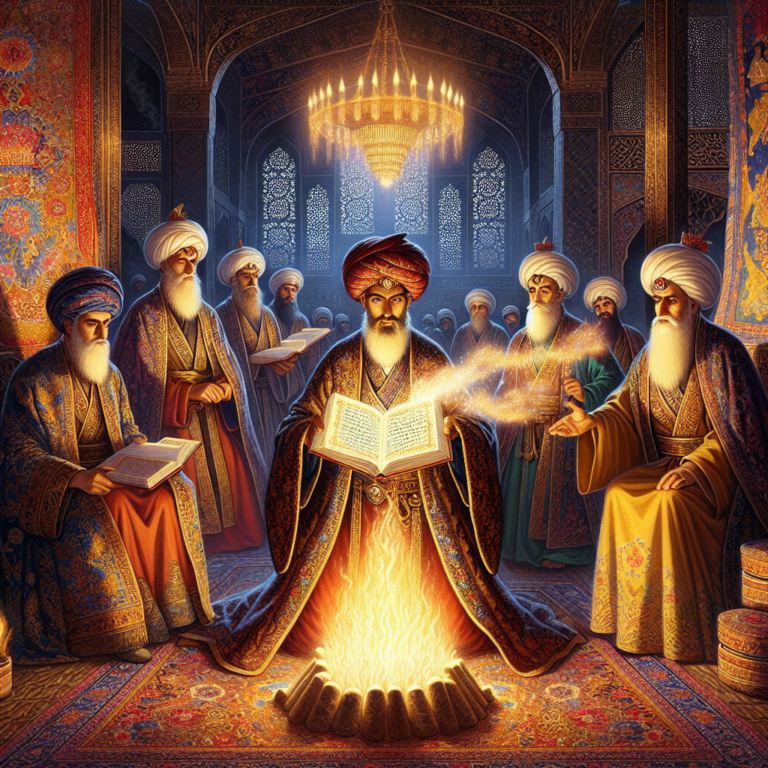
‘The Discovery Of The Zend-Avesta’ is an educational moral story perfect for bedtime reading with children ages 6-12.
Chapter One: The Fire That Never Dies
In the great temple of Yazd, in the heart of ancient Persia, a fire burned that had never been allowed to go out. For over a thousand years, priests had tended this sacred flame, feeding it five times each day with sandalwood and prayers.
This was the fire of Ahura Mazda, the Wise Lord, the god of light and truth who had revealed himself to the prophet Zoroaster in the mountains long, long ago.
Young Mehraban was ten years old when he first entered the fire temple to begin his training as a priest. The head priest, Dastur Ardeshir, placed a white robe over the boy’s shoulders and tied a sacred cord around his waist.
“This cord,” Dastur Ardeshir explained, “is called the kusti. It has seventy-two threads, one for each chapter of our holy book, the Yasna. When you tie it each morning, you remind yourself that you are bound to truth and to the fight against lies.”
Mehraban looked at the dancing flames, their orange light flickering across the walls. “Dastur, why do we keep the fire burning? Why can we never let it die?”
“Because, young one, the fire represents the presence of Ahura Mazda himself. It represents truth, righteousness, and the light that drives away darkness. As long as our fires burn, our faith lives.”
Chapter Two: The Storm from the West
For many years, Mehraban studied the ancient teachings. He learned to recite the prayers in Avestan, the sacred language. He learned the stories of Zoroaster, how the prophet had received wisdom from Ahura Mazda, how he had taught that the world was a battleground between good and evil, and how every person must choose which side to serve.
He learned about the Amesha Spentas, the seven divine beings who helped Ahura Mazda, each representing a holy virtue: Good Mind, Truth, Right Thinking, Devotion, Wholeness, and Immortality. He learned that fire, water, earth, and air were sacred, and must never be polluted.
But when Mehraban was twenty-five years old, a great storm came from the west. Armies swept across Persia, conquering city after city. The old Persian Empire, which had ruled for over a thousand years, fell.
Many Zoroastrians were forced to accept a new faith. Temples were destroyed. Priests were scattered. The holy texts, written on thousands of cowhide scrolls, were burned by the thousands.
“What will happen to us?” Mehraban asked Dastur Ardeshir, now very old and frail. “What will happen to the fire?”
“We must save what we can,” the old priest whispered. “We must keep the flame alive, even if we must carry it across the sea.”
Chapter Three: The Journey to India
And so began the great exodus.
Mehraban joined a group of families who refused to abandon their ancient faith. They gathered what sacred texts they could save, wrapped them in oilcloth to protect them from water, and set out for the coast.
The journey was long and dangerous. They traveled by night to avoid detection, hiding in caves and abandoned buildings during the day. Some of the group fell ill. Others were captured. But the survivors pressed on, driven by their sacred duty.
Finally, they reached the sea. There, they found ships willing to take them across the water to India, a land they had heard was welcoming to strangers.
On the night before they set sail, Mehraban sat on the beach with an elderly woman named Shireen, who carried a bundle of scrolls pressed against her heart.
“What do you carry?” Mehraban asked.
“These are the hymns of Zoroaster himself, the Gathas,” she said. “They are his own words, spoken three thousand years ago. They are the most sacred words we possess. I will die before I let them be destroyed.”
“But they are just words on leather,” Mehraban said. “Surely the words live in our hearts?”
Shireen smiled. “The words in our hearts will fade with time. Each generation remembers a little less. But written words can live forever. If we save these scrolls, children a thousand years from now will be able to hear Zoroaster speak.”
Chapter Four: The Raja’s Bargain
After many weeks at sea, the refugees landed on the coast of Gujarat in India. They were exhausted, hungry, and uncertain of their welcome.
The local ruler, Raja Jadi Rana, came to meet them with his soldiers. Mehraban stepped forward, his heart pounding.
“Great Raja,” he said, “we are refugees from Persia. We have fled because we refused to abandon our ancient faith. We ask only for a place to live in peace, where we can worship our god and tend our sacred fire.”
The raja was silent for a long moment. Then he called for a servant to bring a bowl. It was a bowl of milk, filled to the very brim.
“This bowl is like my kingdom,” the raja said. “It is full. There is no room for more.”
Mehraban’s heart sank. But then Shireen stepped forward. She asked for a spoonful of sugar, and when she received it, she carefully stirred it into the milk. The sugar dissolved completely, making the milk sweeter without causing it to overflow.
“Great Raja,” she said, “we will be like this sugar. We will dissolve into your land, making it sweeter, but taking no space. We will never be a burden.”
The raja smiled. “Well spoken, old mother. Your people may stay. But you must promise never to seek to convert my people to your faith.”
“We promise,” Mehraban said. “Our faith teaches that everyone must choose their own path between truth and lies. We cannot force wisdom upon anyone.”
And so the Zoroastrians, who came to be called Parsis, meaning “Persians,” made their new home in India.
Chapter Five: The Temple of the New Fire
The Parsis settled in the town of Sanjan and built a new fire temple. They called their sacred flame the Iranshah, meaning “King of Iran,” in memory of their lost homeland.
Mehraban, now the chief priest, supervised the creation of the new fire. According to their laws, the sacred temple fire must be created by combining sixteen different types of fire: fire from a lightning strike, fire from a funeral pyre, fire from a blacksmith’s forge, fire from a potter’s kiln, and many others. Each flame was purified through elaborate rituals before being combined.
It took months to gather all the fires and years to complete the purification. But finally, the new sacred flame was lit.
When the fire blazed to life in the new temple, Mehraban wept.
“Why do you weep, Dastur?” asked a young student. “Is this not a happy day?”
“I weep for what we have lost,” Mehraban said. “I weep for the temples destroyed, the scrolls burned, the prayers silenced. But I also weep with joy, for we have kept our promise. The fire of Ahura Mazda still burns. The words of Zoroaster will live on.”
Chapter Six: The Book That Traveled Through Time
Centuries passed. The Parsis prospered in India, becoming known as honest merchants, skilled craftsmen, and generous benefactors. They kept their promise to the raja, never seeking converts, but always keeping their faith alive.
And they kept the Zend-Avesta safe.
The Zend-Avesta is not one book but a collection of sacred texts. The most ancient part, the Gathas, contains the actual words of Zoroaster himself. Other sections include the Yasna (worship ceremonies), the Visperad (festival prayers), the Vendidad (laws and customs), and the Yashts (hymns to divine beings).
Much was lost during the conquest. Scholars believe that only about a quarter of the original texts survived. But what survived was precious beyond measure.
In 1723, a young French scholar named Abraham Anquetil-Duperron read about the mysterious Parsis and their ancient scriptures. He was determined to learn their secrets.
He traveled to India and spent years living among the Parsis, learning their language, earning their trust, and studying their texts. In 1771, he published the first European translation of the Zend-Avesta.
For the first time, people in Europe could read the words of Zoroaster, the prophet who had taught about one God, about the battle between good and evil, about heaven and hell, about the coming of a savior. Scholars began to realize how much this ancient faith had influenced later religions.
Chapter Seven: The Fire Still Burns
Today, there are about 100,000 Parsis in India and perhaps 200,000 Zoroastrians worldwide. They are a small community, but they have had an outsized impact on the world.
In Mumbai (once called Bombay), the house of Tata, a Parsi family, built industries that shaped modern India. Parsi scientists, musicians, artists, and philanthropists have contributed far beyond their numbers.
And in fire temples across India and Iran, the sacred flames still burn. Priests still recite the ancient prayers in Avestan. Children still tie the kusti around their waists, binding themselves to truth.
The Zend-Avesta still teaches what Zoroaster taught three thousand years ago:
“Happiness comes to the one who brings happiness to others.”
“With an open mind, seek and listen to the truth.”
“The world is a battleground between Truth and Lies. Choose Truth.”
The fire of Zoroaster was never just a fire in a temple. It was the fire of knowledge, the fire of wisdom, the fire of courage that refuses to let the light die out.
And as long as people choose truth over lies, light over darkness, that fire will never go out.
Moral Lessons
- Wisdom and faith are worth preserving against all odds. What people are willing to sacrifice everything to protect reveals what they truly value. The light of knowledge, once kindled, can shine for thousands of years.
Test Your Understanding
1Who are the Parsis?
Frequently Asked Questions
What is the moral lesson of The Discovery Of The Zend-Avesta?
What age is this story appropriate for?
How long does it take to read The Discovery Of The Zend-Avesta?
What culture does this story come from?
Can I use this story for teaching?
Frequently Asked Questions
What is the Zend-Avesta and why is it important?
The Zend-Avesta is the holy scripture of Zoroastrianism, one of the world’s oldest religions. It contains sacred hymns, prayers, and teachings revealed to the prophet Zoroaster. In this story, children discover its significance through young Mehraban’s journey as a temple priest in ancient Persia.
What age group is The Discovery of the Zend-Avesta story suitable for?
This educational moral story is perfect for children ages 6 to 12. It works especially well as a bedtime story, blending adventure with lessons about truth, devotion, and ancient culture in a way that young readers can easily understand and enjoy.
What does the sacred fire in the Zend-Avesta story represent?
The sacred fire represents Ahura Mazda, the Zoroastrian god of light and truth. In the story, priests in the great temple of Yazd have kept this flame burning for over a thousand years, symbolising eternal devotion, purity, and the ongoing battle between truth and lies.
📚 Recommended Books
Handpicked for readers like you
As an Amazon Associate, we earn from qualifying purchases. These recommendations are personalized based on this story's themes and your reading history.
What moral lesson does this Zend-Avesta story teach children?
The story teaches children the value of truth, commitment, and honouring sacred traditions. Through Mehraban’s priestly training, young readers learn that our daily rituals and responsibilities — like the kusti cord’s 72 threads — can remind us to stay bound to honesty and goodness.
What is the kusti cord mentioned in the Zend-Avesta story?
The kusti is a sacred cord worn by Zoroastrian priests and believers. It has 72 threads, each representing a chapter of the Yasna, part of the Zend-Avesta. Tying it each morning is a daily reminder to live by truth and resist dishonesty — a key theme throughout the story.