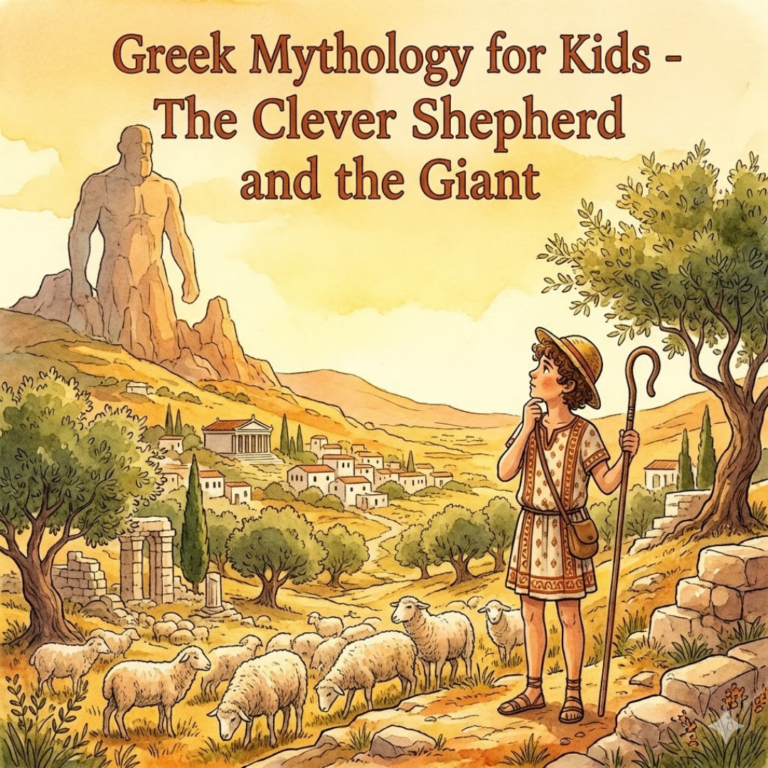
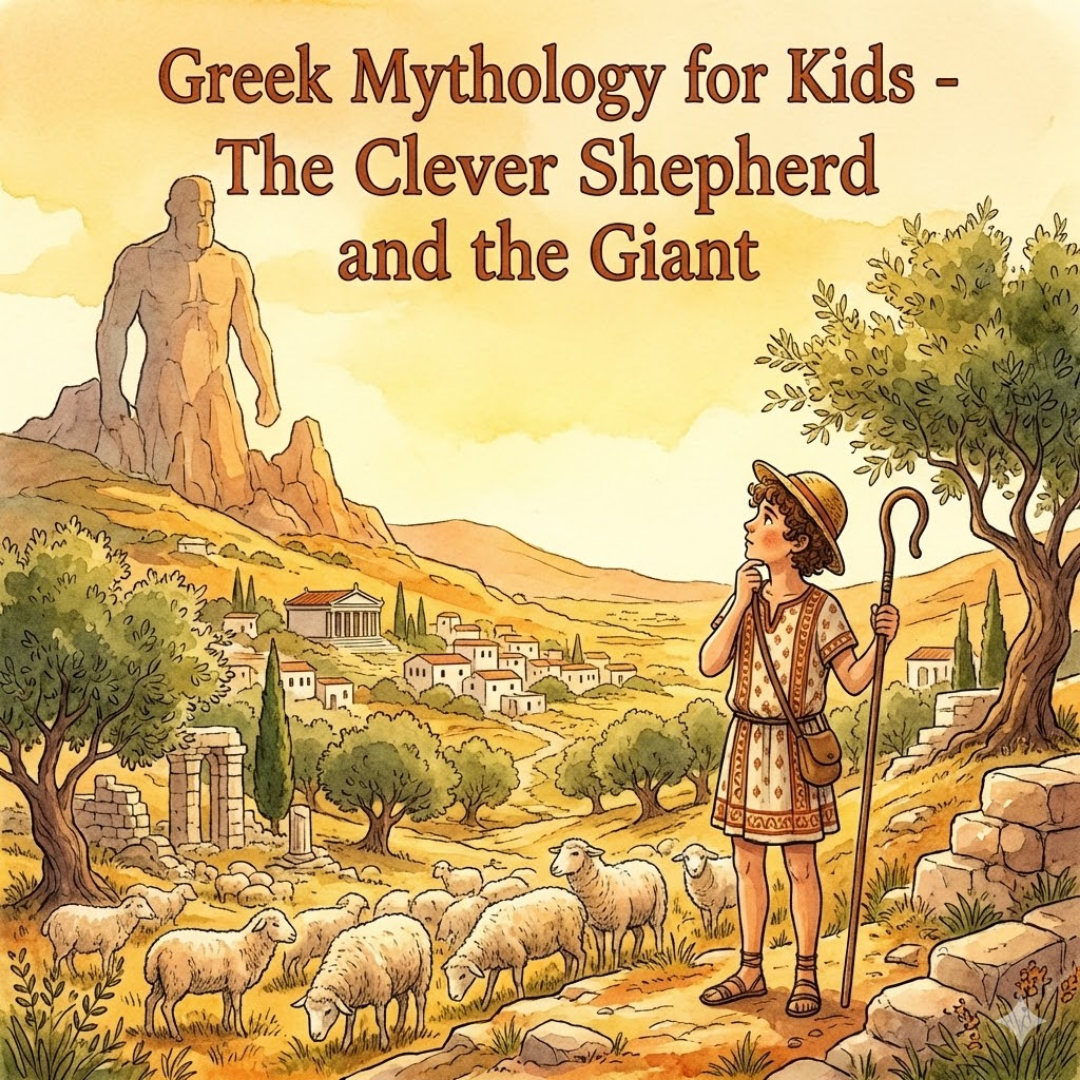
‘The Clever Shepherd and the Giant’ is an educational moral story perfect for bedtime reading with children ages 6-12.
In the rocky hills of ancient Greece, where goats climbed impossible slopes and olive trees grew gnarled and silver-leafed in the sun, there lived a young shepherd named Nikos.
His home was a small stone hut on the mountainside, and his flock—twenty-three sheep and goats—was his entire wealth. They were not magical animals. Their wool did not shimmer with gold. But they were his, earned through years of careful work, and he loved them.
Nikos was not large or strong. At seventeen, he was still slender, with arms more accustomed to holding a shepherd’s crook than a spear. But what he lacked in muscle, he made up for in wit.
His grandfather, a sailor who had traveled with great heroes in his youth, had taught him well.
“Remember, boy,” the old man would say, tapping his weathered finger against Nikos’s forehead, “the greatest weapon you have is here—in your mind. Strength fades. Muscle fails. But cleverness, if you nurture it, can defeat any foe.”
Nikos had never forgotten that lesson.
And he would need it.
* * *
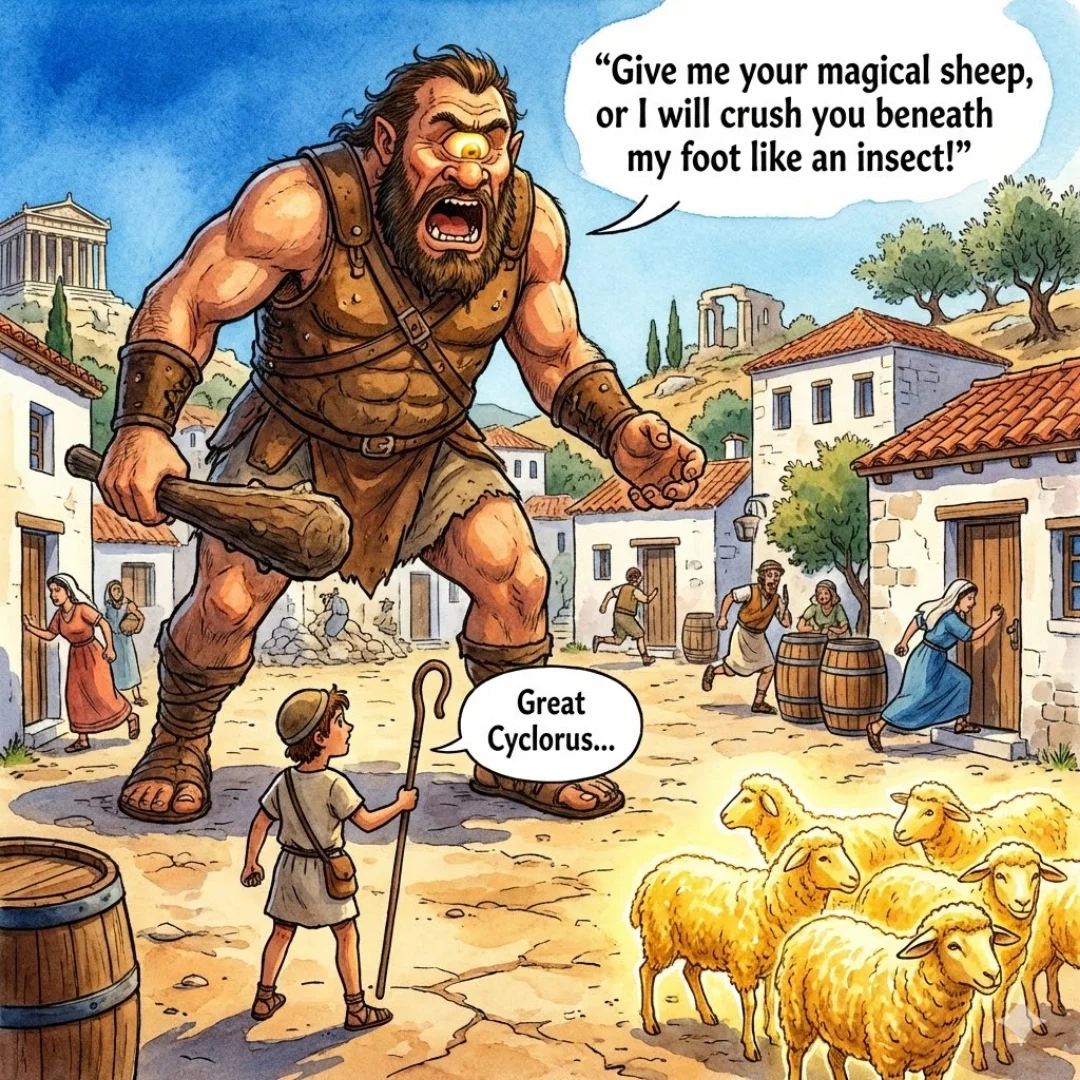
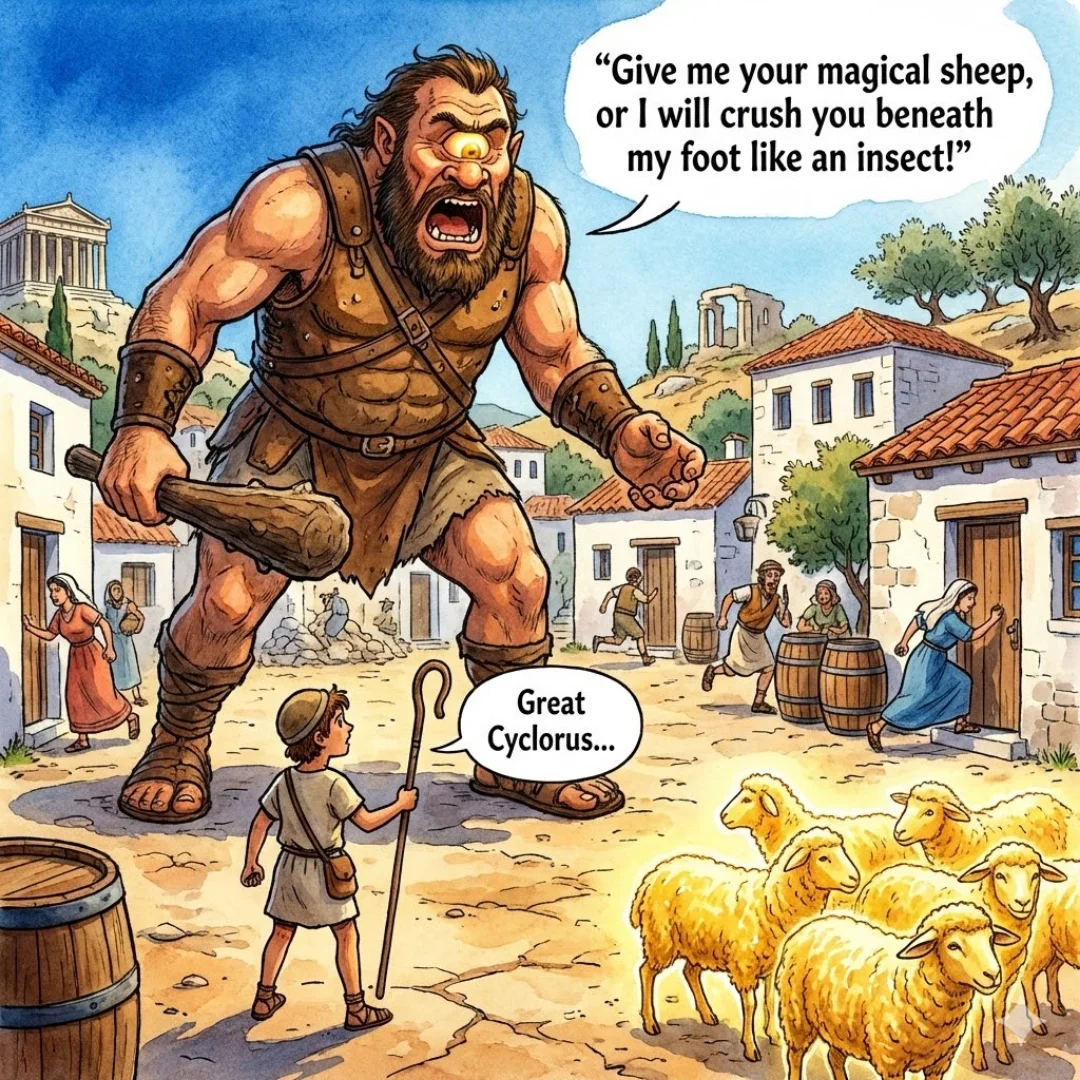
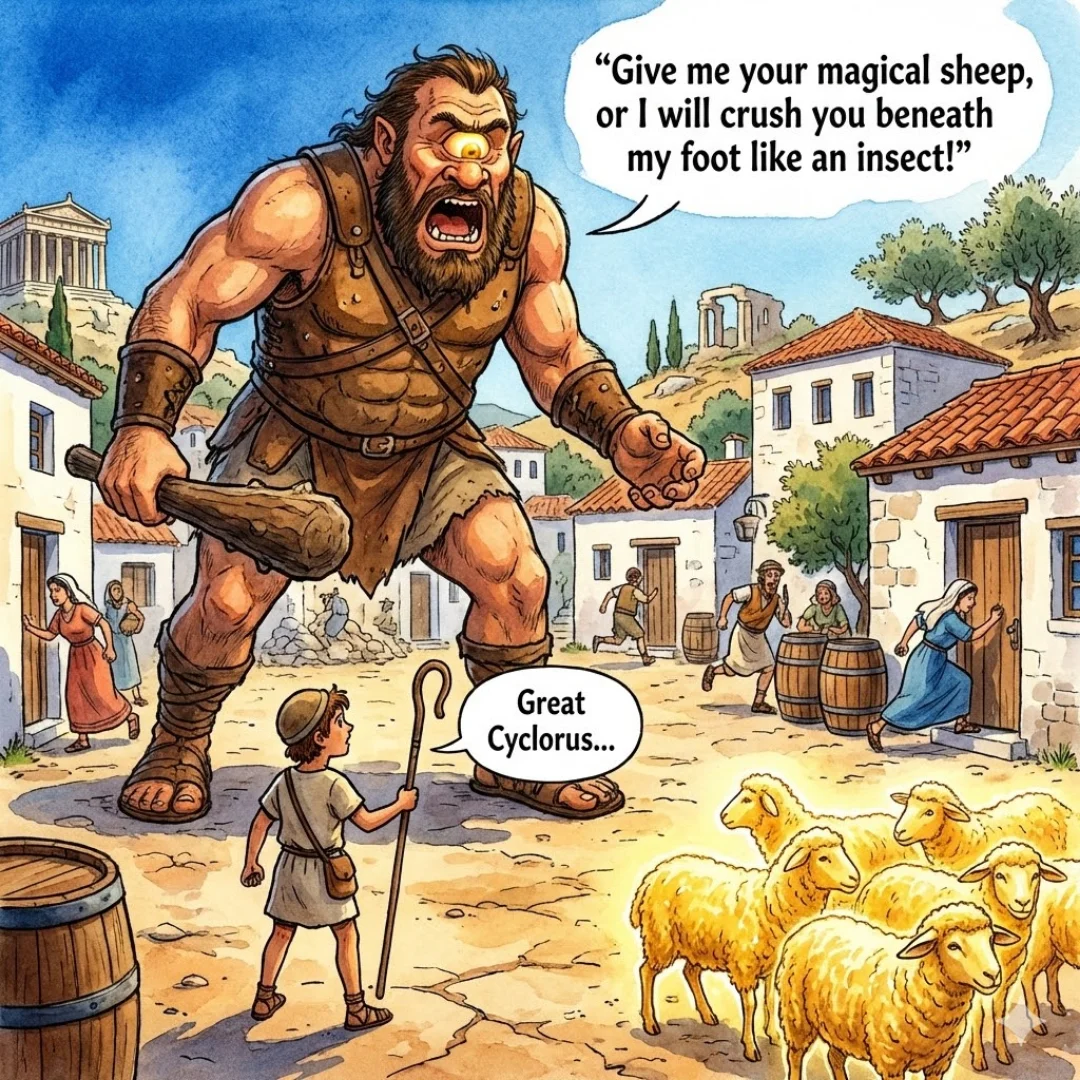
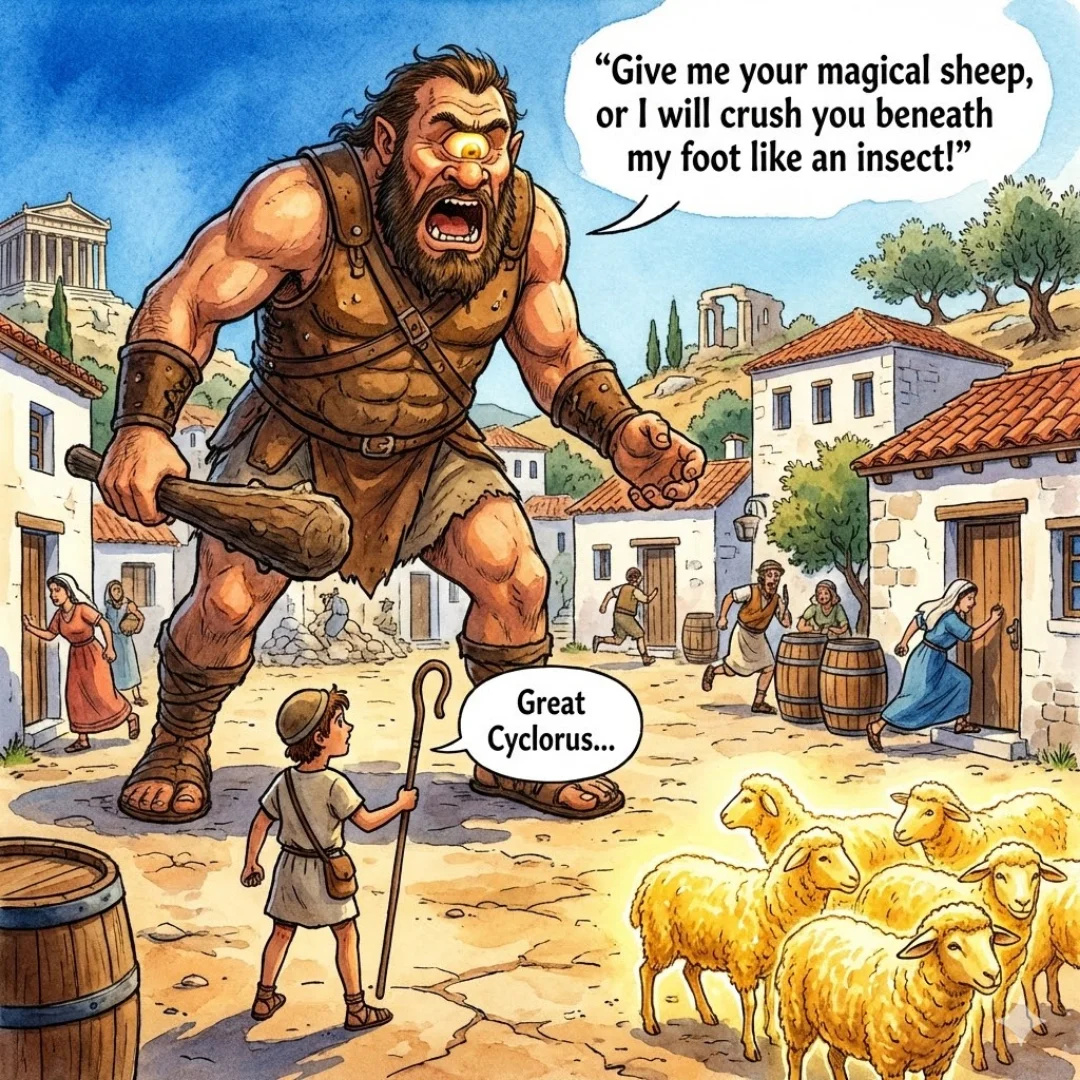
High in the mountains, in a cave so deep that sunlight never reached its back wall, there lived a creature of terror—a Cyclops named Brontes.
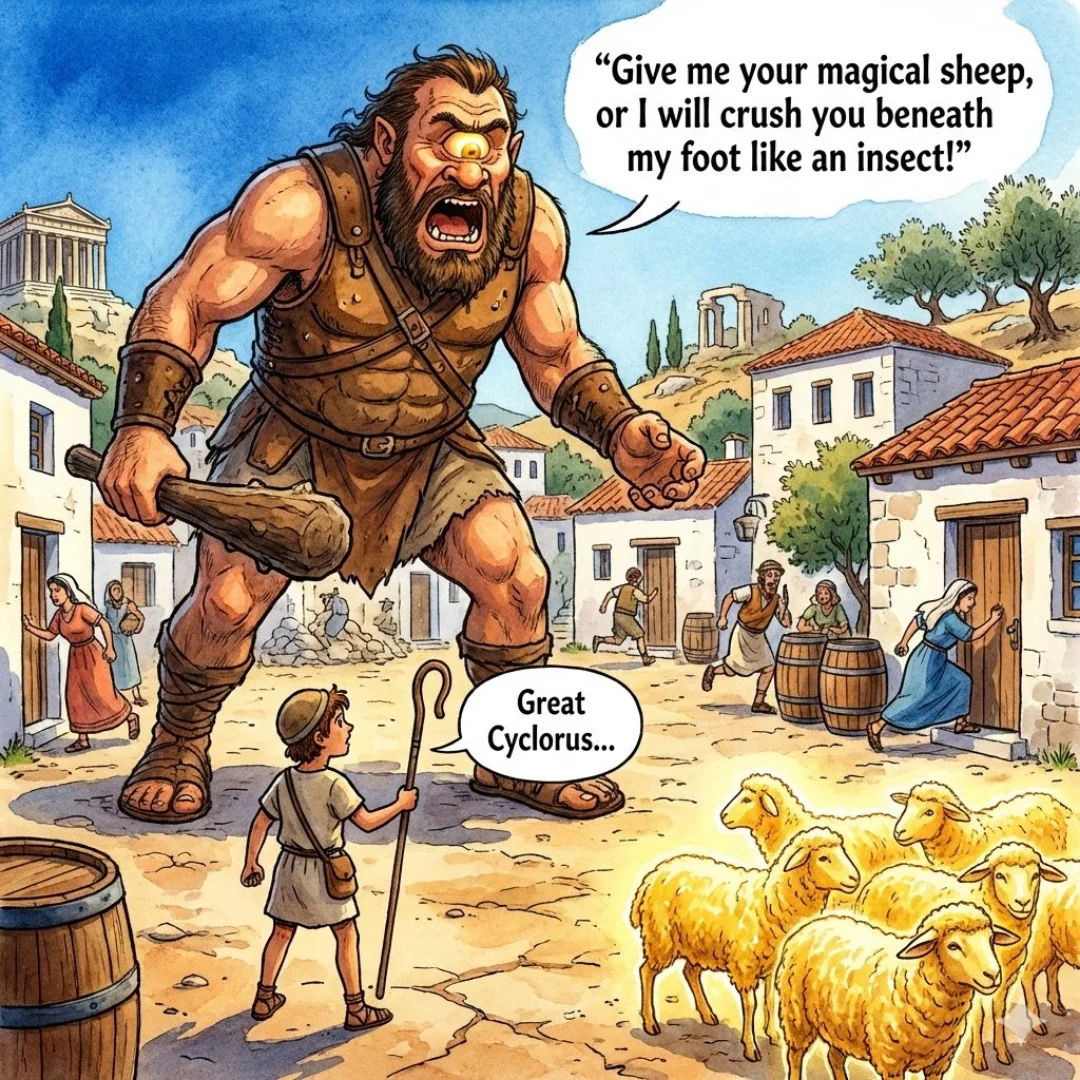
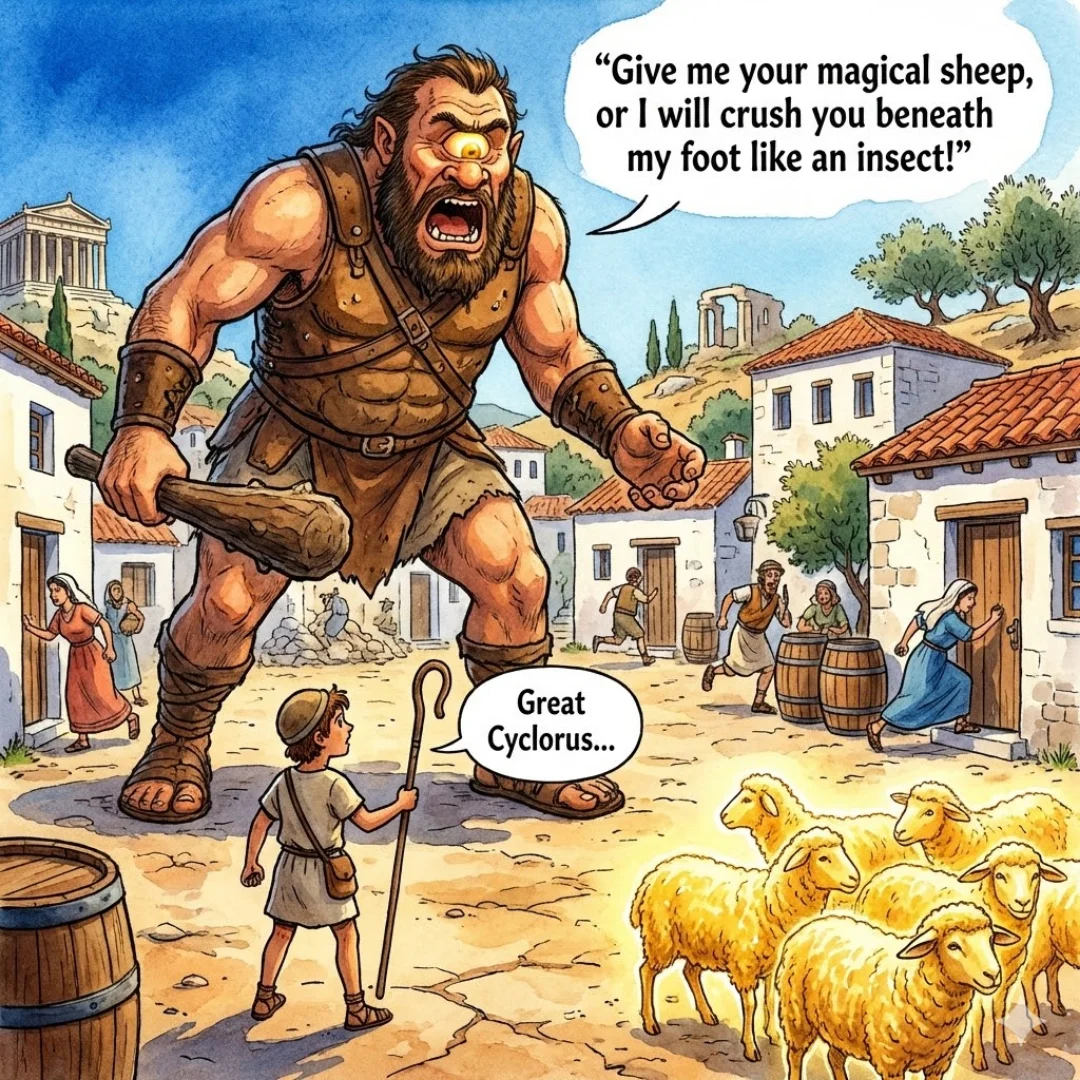
He was one of the ancient ones, the lawless giants who recognized neither gods nor men, who lived alone in their caves and cared nothing for civilization. He stood as tall as two men, with arms thick as tree trunks and a single, massive eye in the center of his forehead—an eye that could see a goat on a distant hillside or a ship on the far horizon.
Brontes was a shepherd too, in his way. He kept enormous sheep, each the size of a horse, and led them out to graze during the day. But unlike gentle human shepherds, Brontes was not particular about what he ate.
Sheep. Goats. And, when the opportunity arose, men.
For years, the villagers had avoided the upper pastures where Brontes grazed his flock. They marked the boundary with stones and warned their children: “Never go past the markers. The Cyclops’s land begins there, and he does not share.”
But Nikos had not always been so careful.
* * *
It happened on a late summer afternoon when the grass in the lower valleys had been grazed thin and brown. Nikos’s flock was hungry, their ribs beginning to show.
He looked up at the forbidden pastures. The grass there grew thick and green, watered by mountain springs. His sheep could grow fat there in just a few weeks.
“Surely,” Nikos thought, “if I stay near the edge, if I keep watch, I can graze them safely. The Cyclops might never even notice.”
It was a mistake born of desperation—and of youth.
For three days, Nikos led his flock to the edge of the forbidden pasture, and they ate their fill of the sweet grass. The sheep grew visibly healthier. Nikos began to relax, thinking perhaps the stories about Brontes were exaggerated.
On the fourth day, as the sun sank low and painted the sky orange and purple, Nikos heard a sound that turned his blood to ice.
Footsteps. Heavy as boulders rolling. Shaking the earth.
And a voice like thunder: “WHO DARES GRAZE ON MY LAND?”
Nikos turned and saw him.
Brontes the Cyclops emerged from behind a rocky outcrop, his single eye blazing with fury. He was more terrible than any story could convey—massive, filthy, his beard matted with old food, his hands large enough to crush a man’s skull like an egg.
“Run!” Nikos’s mind screamed, but his legs were frozen.
Brontes laughed, a sound like rocks grinding. “A little shepherd boy. Stealing my grass. Come, little thief. You and your flock will make a fine meal.”
Nikos finally found his voice. “Great Cyclops! Forgive me! I did not know—”
But Brontes wasn’t interested in excuses. He reached out with one massive hand and scooped up Nikos and three of his sheep as if they were toys.
“Into the cave with you,” the giant rumbled. “I’ll save you for tomorrow’s breakfast.”
* * *
Brontes’s cave was vast and dark, lit only by a small fire near the entrance. The Cyclops dropped Nikos and the sheep on the floor, then rolled an enormous boulder across the cave mouth—a stone so large that a hundred men could not have moved it.
Nikos and his sheep were trapped.
The Cyclops sat by his fire, pulled one of his massive sheep close, milked it into a trough the size of a bathtub, and drank deeply. Then he grabbed one of Nikos’s sheep, killed it with a casual twist, and began to eat it—bones, wool, and all.
Nikos watched in horror, his mind racing. How could he escape? The boulder blocked the entrance. Even if he could climb up to some crack or crevice, he couldn’t leave his remaining sheep behind.
And Brontes would surely eat him come morning.
Think. Think. What would Grandfather say?
“When you cannot use strength, use cleverness.”
An idea began to form.
* * *
“Great Cyclops,” Nikos called out, keeping his voice respectful. “Mighty Brontes.”
The giant looked down at him, one eye narrowing. “What do you want, little breakfast?”
“I have a gift for you,” Nikos said. “A gift to apologize for trespassing on your land.”
“A gift?” The Cyclops sounded suspicious, but also interested. “What gift could a tiny shepherd give me?”
From his leather bag, Nikos pulled out a wineskin. His grandfather had given it to him before dying—wine from the islands, dark and sweet and strong. Nikos had been saving it for a special occasion.
This, he thought grimly, certainly qualified.
“Wine, mighty one,” Nikos said. “The finest wine from the southern islands. So strong that mortal men can barely drink it. But surely a great Cyclops like you could handle it.”
Brontes’s eye gleamed with greed. He snatched the wineskin and drank deeply.
His face transformed. “This is… this is good!” He drank more. “More! Do you have more?”
“Sadly, great Cyclops, this is all I have. But drink it slowly, savor it—”
But Brontes was not a creature of moderation. He drained the entire wineskin in great gulps, licking the last drops from his lips.
“Good!” he bellowed, his voice already beginning to slur. “You are a generous little thief. What is your name, tiny breakfast?”
Nikos thought fast. “My name is Nobody,” he said.
“Nobody?” The Cyclops laughed drunkenly. “Strange name for a boy. Well, Nobody, I will grant you a special favor. I will eat you last instead of first. That is my gift to you!”
And with that, he lay down by the fire and almost immediately began to snore—great rumbling snores that echoed through the cave.
* * *
Nikos waited, his heart pounding, until he was certain the Cyclops was deeply asleep. The wine had been strong enough to fell a mortal man with one cup. Even a giant could not resist its power.
Now came the dangerous part.
Nikos crept to the fire. Near it lay the Cyclops’s great olive-wood staff, which he used for walking and for moving his giant sheep. One end had been sharpened to a point.
It was massive—too heavy for Nikos to lift alone. But in the cave were several of Brontes’s enormous sheep. Working carefully, quietly, Nikos tied ropes around three of the strongest rams and harnessed them to the staff.
He positioned the sharpened point toward the fire, letting it sit in the coals until it glowed red-hot. Then, with the rams pulling and Nikos guiding, he dragged the burning stake toward the sleeping Cyclops.
The giant lay on his back, snoring, his single huge eye closed.
Nikos’s hands shook. If he failed—if the Cyclops woke—he would die instantly.
“For Grandfather,” he whispered. “For cleverness over strength.”
He aimed the glowing point at the closed eye.
And drove it home.
* * *
Brontes’s scream shook the mountain.
He lurched upright, clawing at his face, the burned staff still protruding from his ruined eye. Blood and fluid poured down his cheeks.
“WHO HAS DONE THIS?” he roared. “WHO HAS BLINDED ME?”
From the darkness of the cave, Nikos called out: “Nobody has blinded you, Cyclops! Nobody has harmed you!”
Outside, Nikos could hear other Cyclopes—Brontes’s brothers and cousins who lived in nearby caves—shouting: “Brother! What’s wrong? Who attacks you?”
“NOBODY!” Brontes screamed. “Nobody has blinded me! Nobody attacks!”
“If nobody attacks you,” the voices called back, “then it must be the gods punishing you for some offense! Pray to Zeus! We cannot help with divine matters!”
And they left him.
Brontes, blind and alone, raged through his cave, hands outstretched, trying to catch the tiny human who had harmed him. But Nikos stayed in the shadows, dodging the giant’s blundering hands.
Finally, exhausted and in agony, Brontes had an idea. He rolled the great stone away from the cave entrance.
“Let my sheep out to graze,” he muttered. “But the human cannot escape. I will feel each sheep as it passes, make sure it is not that cursed Nobody trying to sneak out.”
He sat at the entrance, hands outstretched, and began to let his giant sheep pass, feeling their backs to make sure no human rode them.
But Nikos was clever.
He took the thickest rope he could find and tied himself to the belly of the largest ram—the king of the flock, with wool so thick and long that it hung nearly to the ground.
When the ram walked past Brontes’s searching hands, the Cyclops felt its broad back and shaggy sides.
“Good ram,” he muttered, patting it. “Go, graze.”
He never thought to feel underneath.
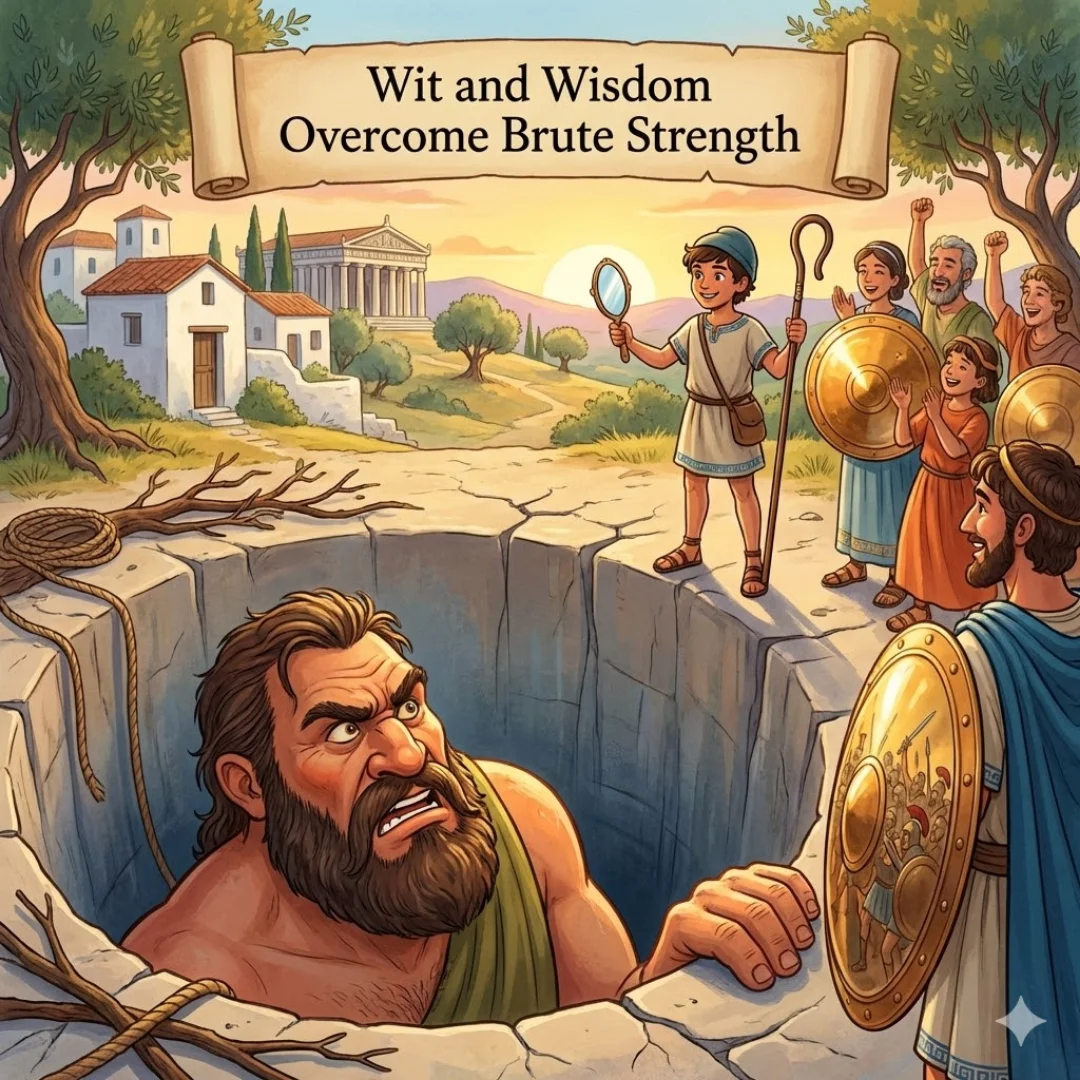
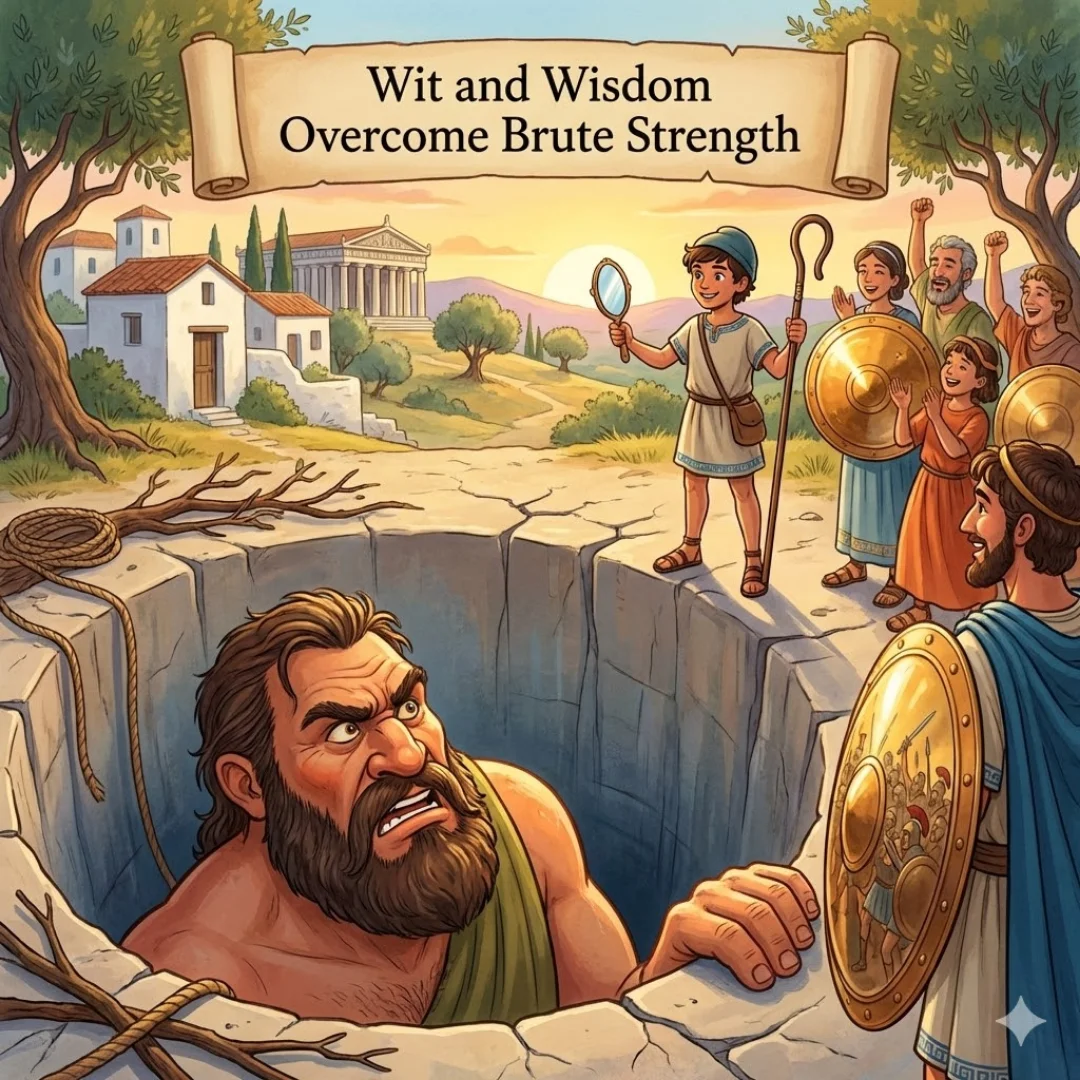
The ram walked out into the morning sunlight, and beneath it, hidden in the thick wool, Nikos held his breath.
Free.
* * *
Once far enough from the cave, Nikos dropped to the ground and untied himself. He gathered what remained of his flock—the two sheep that had also escaped—and began to run down the mountain.
But as he ran, pride swelled in his chest. He had defeated a Cyclops! He, a mere shepherd boy!
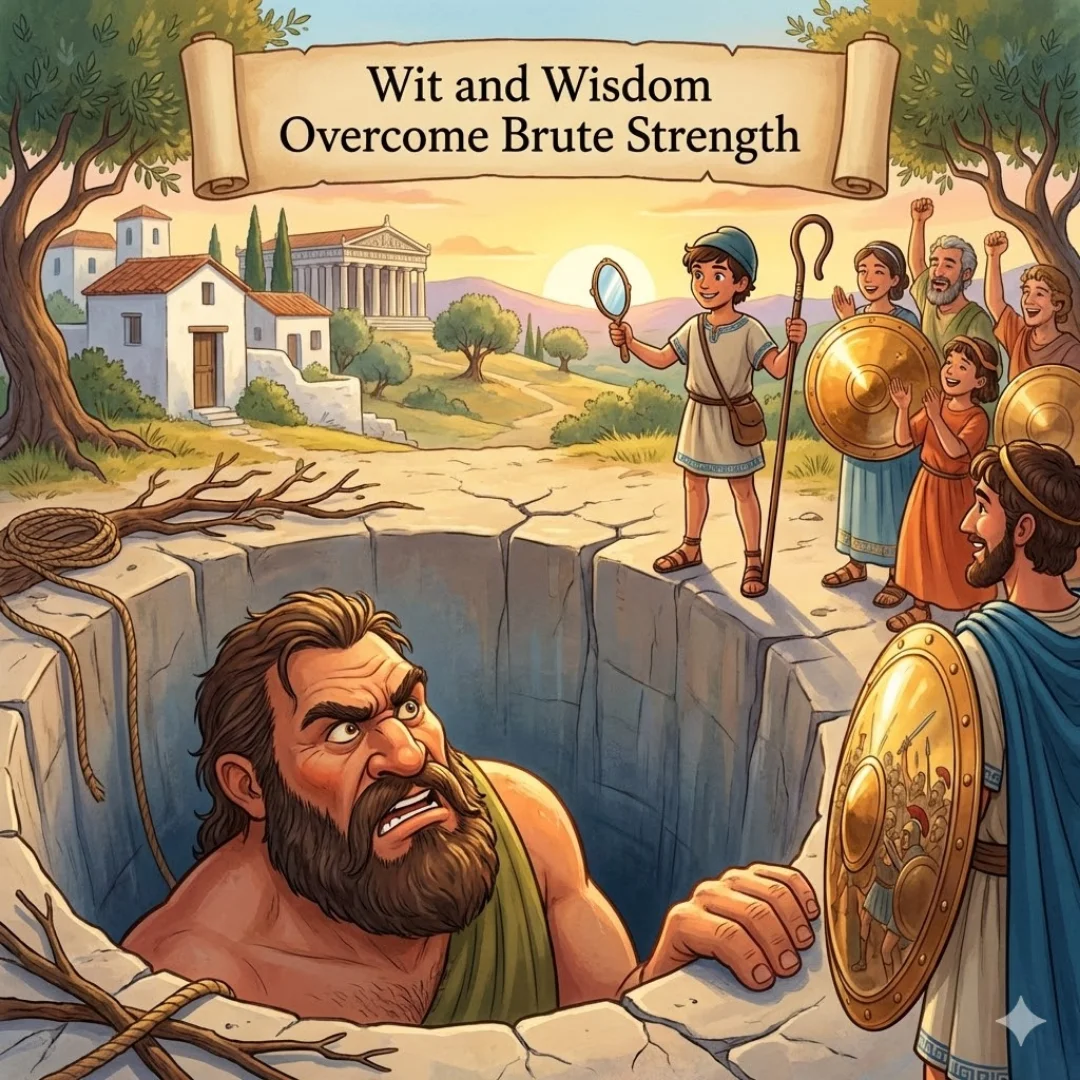
He stopped and turned back toward the cave, now a distant dark spot on the mountainside.
He couldn’t help himself.
“Cyclops!” he shouted. “If anyone asks who blinded you, tell them it was not Nobody! It was Nikos, son of Alexios, the shepherd from the valley below! Remember the name!”
It was a mistake.
Brontes, hearing the voice, lurched out of his cave. Though blind, his aim was guided by sound. He lifted an enormous boulder and hurled it toward Nikos’s voice.
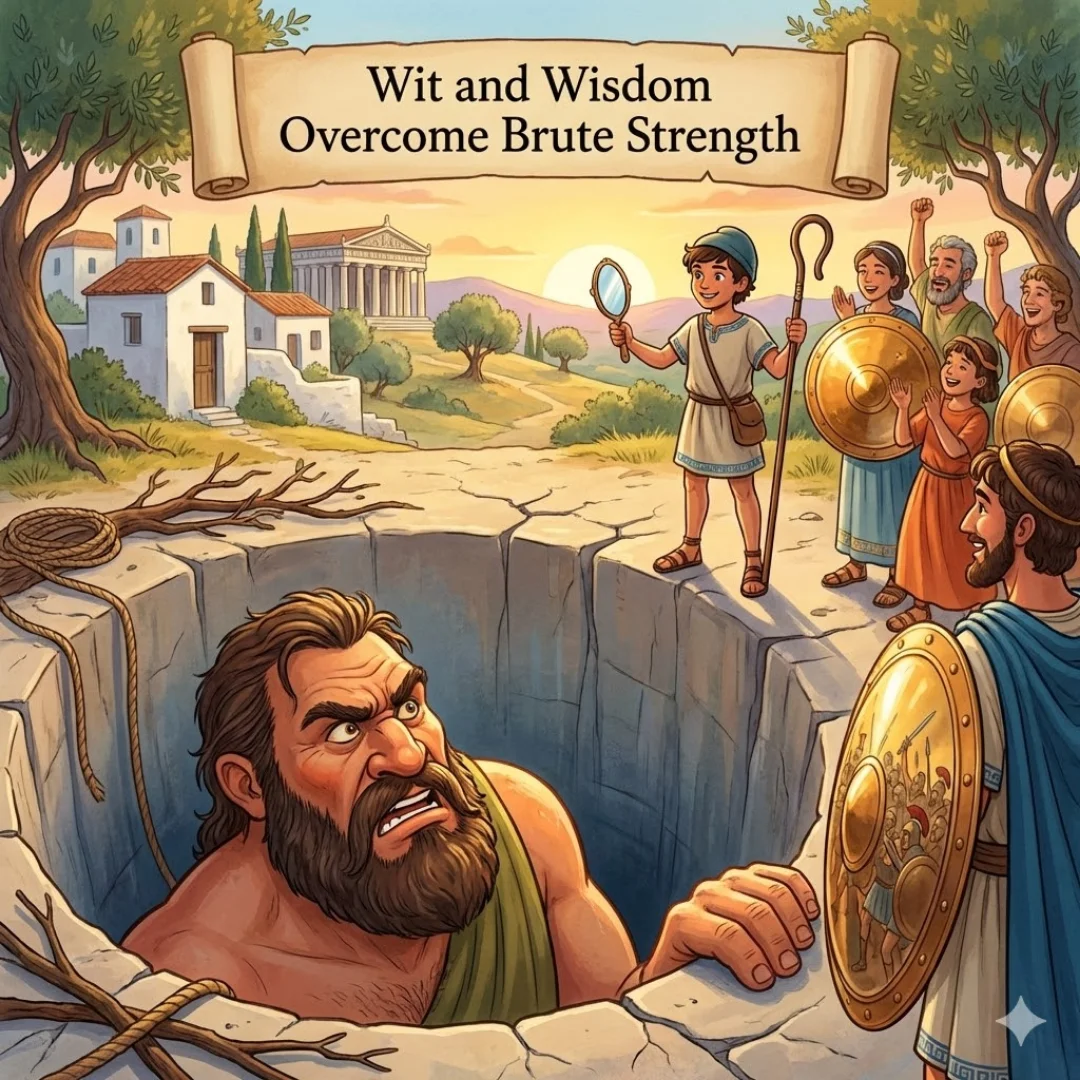
The rock crashed down just paces away, close enough that Nikos felt the wind of its passing.
“Run!” his mind screamed, and this time he listened.
He ran down the mountain and did not stop until he reached his village.
* * *
The villagers listened to his story with wide eyes and open mouths.
“You blinded Brontes the Cyclops?” the village elder breathed. “With only your wits and a ram’s wool?”
Nikos nodded, still breathing hard from his flight.
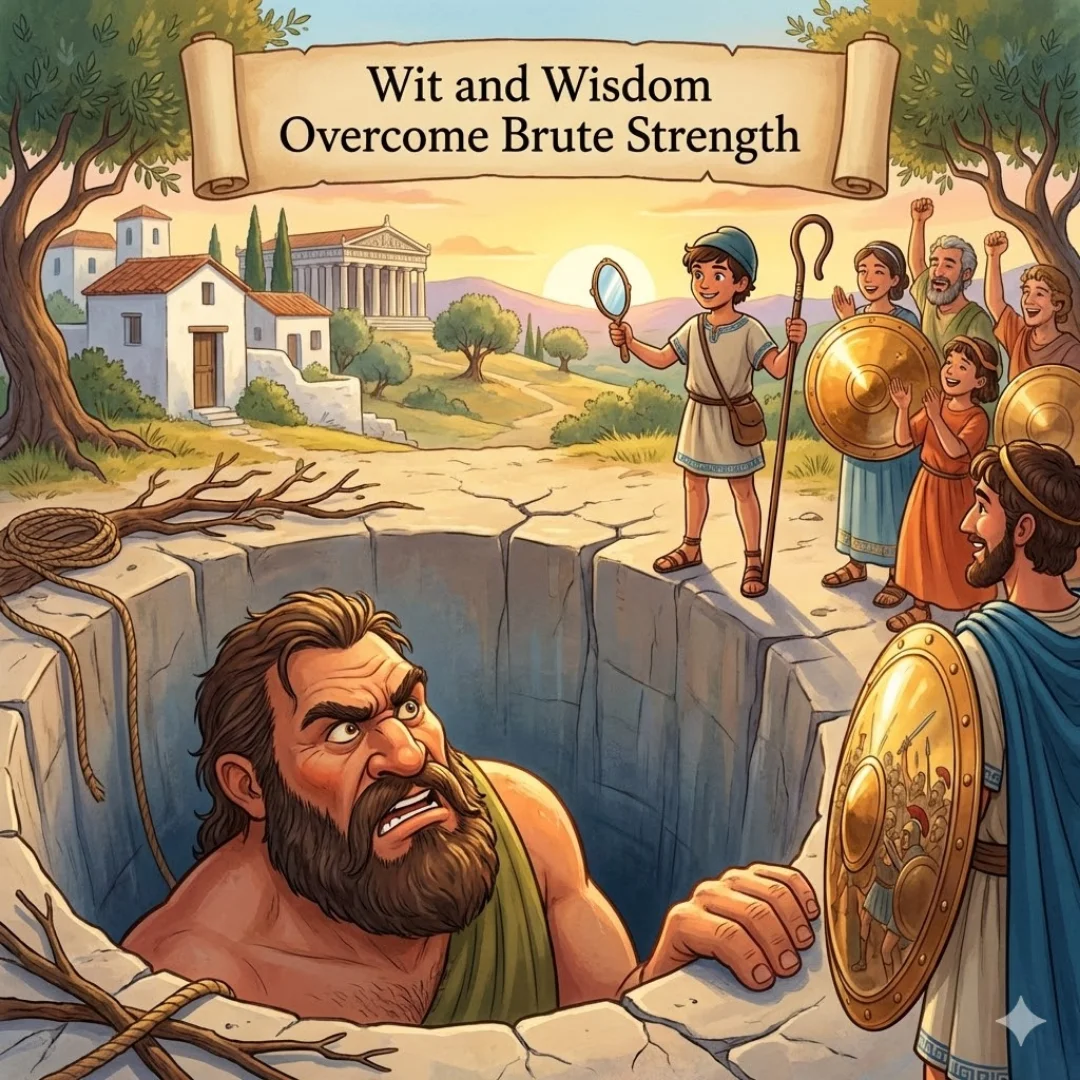
“This is a deed worthy of song,” the elder said. “A deed worthy of heroes like Odysseus himself.”
“Odysseus?” Nikos asked.
The elder smiled. “A great hero of old, who sailed the seas after the Trojan War. He too once faced a Cyclops—Polyphemus, son of Poseidon—and he too used the name ‘Nobody’ to escape. Your grandfather must have told you the story.”
Nikos thought back. His grandfather had told him many stories of Odysseus. Had he, without knowing it, followed in the footsteps of a legendary hero?
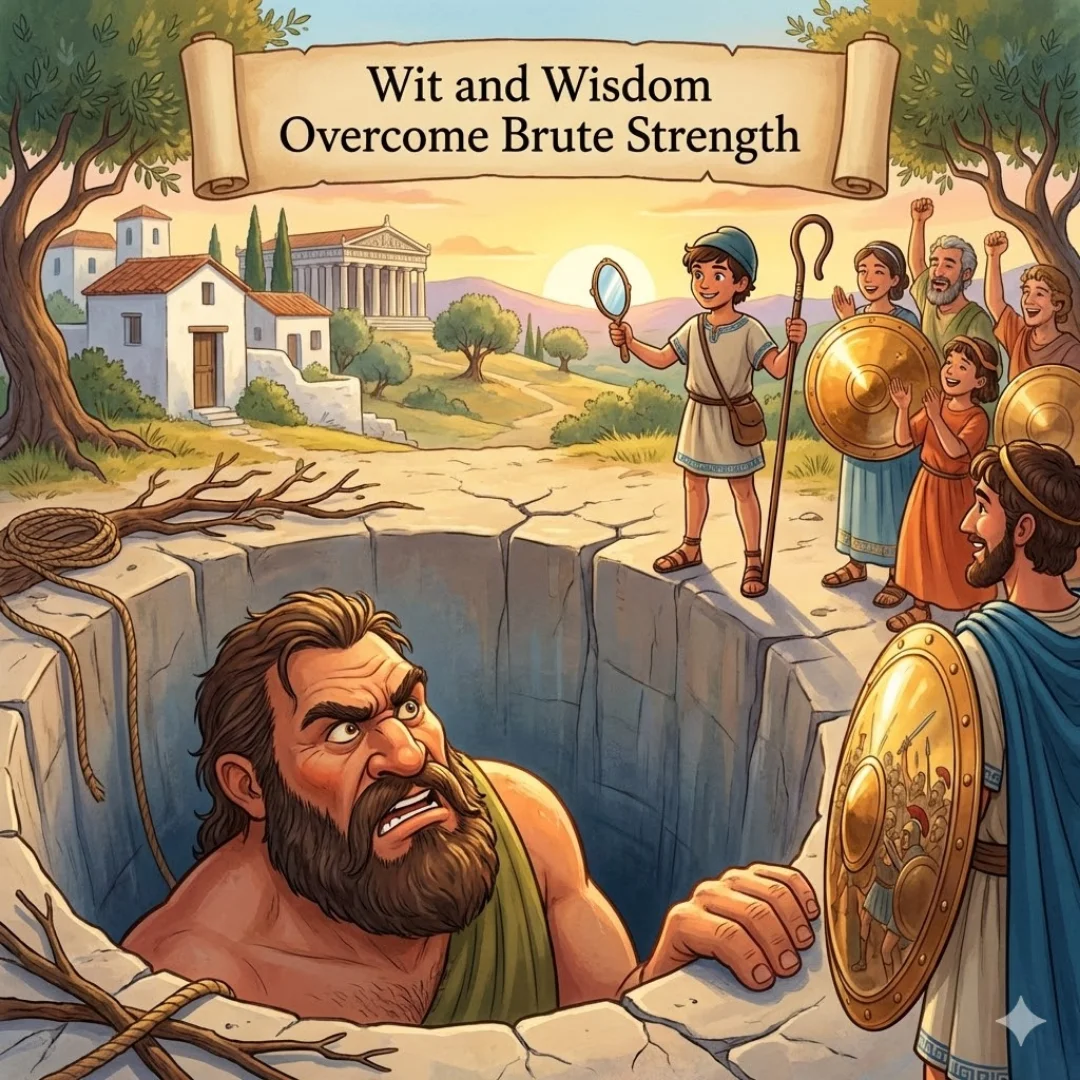
“Perhaps,” the elder said, “cleverness runs in more bloodlines than we know. Or perhaps the gods whisper the same wisdom to all who have the wit to listen.”
* * *
Nikos never returned to the upper pastures. He grazed his flock in the safe valleys and lived a long, peaceful life.
But he never forgot the lesson he learned in that dark cave:
That strength is not everything.
That cleverness can defeat even the mightiest foe.
That a quick mind is worth more than a powerful arm.
And that pride—the urge to boast of victory—can turn triumph into disaster.
This is the wisdom of the ancient Greeks, passed down through stories of Odysseus and countless others:
That intelligence, courage, and humility together make the true hero.
Not the size of your muscles, but the size of your mind.
Not the power you wield, but the wisdom with which you wield it.
And Nikos, the shepherd who outwitted a Cyclops, became a living example of that truth—a boy who proved that even the smallest person, armed with cleverness, can overcome the greatest giant.
MORAL LESSONS:
– Intelligence and wit can triumph over brute strength
– Cleverness and careful planning defeat reckless power
– Pride and boasting can turn victory into danger
– The mind is the greatest weapon we possess
– Courage without wisdom is reckless; wisdom without courage is useless
– Even the smallest person can overcome the greatest challenges
– Listening to elders’ wisdom prepares us for future challenges
GREEK MYTHOLOGY ELEMENTS PRESERVED:
– Cyclopes (one-eyed giants) – authentic Greek mythology
– Polyphemus story from Homer’s Odyssey (8th century BCE) – directly referenced
– “Nobody” trick – exact from Odysseus’s encounter with Polyphemus
– Odysseus – legendary Greek hero, namesake of the Odyssey
– Blinding the Cyclops with burning stake – exact from original myth
– Escaping under ram’s belly – exact from original myth
– Cyclops calling to his brothers, who don’t help – exact from original
– Boulder thrown at escaping hero – exact from original
– Boasting revealing true name – Odysseus’s prideful mistake preserved
– Cyclopes as lawless shepherds – as described in Odyssey
– Cave blocked by massive boulder – exact from original
– Wine used to make Cyclops drunk – exact from original
– Reference to Troy and the Trojan War – historical Greek context
– Poseidon as father of Polyphemus – referenced in elder’s speech
– Greek heroic tradition – intelligence valued over pure strength
SOURCE FIDELITY NOTES:
✓ Based directly on Homer’s Odyssey, Book 9
✓ All major plot points from original myth preserved
✓ “Nobody” (Outis in Greek) trick – exact
✓ Blinding with heated stake – exact
✓ Escape under ram – exact
✓ Cyclops’s brothers’ confusion – exact
✓ Boasting after escape – exact
✓ Boulder thrown – exact
✓ Adapted for children by making protagonist a shepherd rather than warrior king
✓ References original Odysseus story to connect to authentic source
✓ Cyclops’s lawlessness and savage nature – accurate to Odyssey description
✓ No invented plot points – all derive from original myth
ENGAGEMENT ENHANCEMENTS:
+ Vivid sensory details (silver olive leaves, orange-purple sky, grinding rocks)
+ Character depth – Nikos’s youth, inexperience, and growth
+ Grandfather’s wisdom providing motivation and context
+ Internal thoughts show fear, desperation, quick thinking
+ Dialogue reveals character (Cyclops’s cruelty, Nikos’s respect and cunning)
+ Scene breaks for pacing and tension building
+ Show don’t tell (Nikos’s cleverness demonstrated through actions)
+ Emotional arc (desperation → fear → cunning → triumph → humility)
+ Suspenseful moments (will the Cyclops wake? will the ram trick work?)
+ Satisfying resolution with lesson about pride
+ Connection to legendary hero Odysseus inspires readers
+ Realistic details (sheep ribs showing, wine strength, rope tying)
CULTURAL ELEMENTS:
– Greek pastoral life (shepherds, goats, olive trees)
– Mediterranean landscape (rocky hills, silver olive leaves)
– Greek heroic values (cleverness, courage, honor)
– Oral tradition (grandfather teaching through stories)
– Ancient Greek social structure (village elders, respect for heroes)
– Homeric epic tradition (Odyssey as cultural touchstone)
NOTE ON AUTHENTICITY:
This is a child-friendly adaptation of the authentic Odysseus and Polyphemus story from Homer’s Odyssey (Book 9). The protagonist is changed from Odysseus the king to Nikos the shepherd to make it more relatable for children, but all major plot elements are preserved: the “Nobody” trick, blinding with a heated stake, escaping under the ram’s belly, the Cyclops’s brothers’ confusion, and the prideful boasting that brings danger. The story explicitly references Odysseus at the end to connect young readers to the original myth.
SOURCES:
– [POLYPHEMUS (Polyphemos) – Cyclops Giant of Greek Mythology](https://www.theoi.com/Gigante/GigantePolyphemos.html)
– [Polyphemus – Wikipedia](https://en.wikipedia.org/wiki/Polyphemus)
– [The Greek Myth of Odysseus and the Cyclops](https://www.greekmyths-greekmythology.com/odysseus-and-cyclops-myth/)
– [Polyphemus – Mythopedia](https://mythopedia.com/topics/polyphemus/)
– [Polyphemus | Cyclops, Odysseus, Cave | Britannica](https://www.britannica.com/topic/Polyphemus-Greek-mythology)
– Homer’s Odyssey, Book 9 (8th century BCE) – original source of the Polyphemus encounter
Test Your Understanding
1. Why did Nikos sneak into the Cyclops’s forbidden pastures?
Frequently Asked Questions
What is the moral lesson of The Clever Shepherd and the Giant?
What age is this story appropriate for?
How long does it take to read The Clever Shepherd and the Giant?
What culture does this story come from?
Can I use this story for teaching?
Frequently Asked Questions
What is The Clever Shepherd and the Giant about?
The Clever Shepherd and the Giant is a moral story set in ancient Greece about a young shepherd named Nikos who uses his wits rather than physical strength to overcome a giant. It teaches children that intelligence and cleverness can triumph over brute force, making it a great bedtime story for kids ages 6-12.
What age group is The Clever Shepherd and the Giant suitable for?
This story is designed for children ages 6-12. It works well as a bedtime read-aloud or an independent reading story, with themes and language accessible to early and middle-grade readers while still being engaging enough to hold older children’s attention.
What moral lesson does The Clever Shepherd and the Giant teach?
The story teaches that brains can be more powerful than brawn. Nikos, the clever shepherd, relies on wit and quick thinking rather than physical strength to face danger. The core message is that intelligence and resourcefulness are among our greatest tools in overcoming challenges.
📚 Recommended Books
Handpicked for readers like you
As an Amazon Associate, we earn from qualifying purchases. These recommendations are personalized based on this story's themes and your reading history.
Is The Clever Shepherd and the Giant based on Greek mythology?
The story draws strong inspiration from ancient Greek settings and mythology, featuring a young shepherd in rocky Greek hills with ties to legendary heroes. While it’s an original moral tale, it captures the spirit of classic Greek folklore where cleverness often saves the hero of the story.
Why is the shepherd in the story called clever?
Nikos earns the title ‘clever’ because he compensates for his lack of physical strength with sharp thinking and wit. Taught by his experienced grandfather that the mind is the greatest weapon, Nikos approaches problems strategically rather than by force, which defines his character throughout the story.