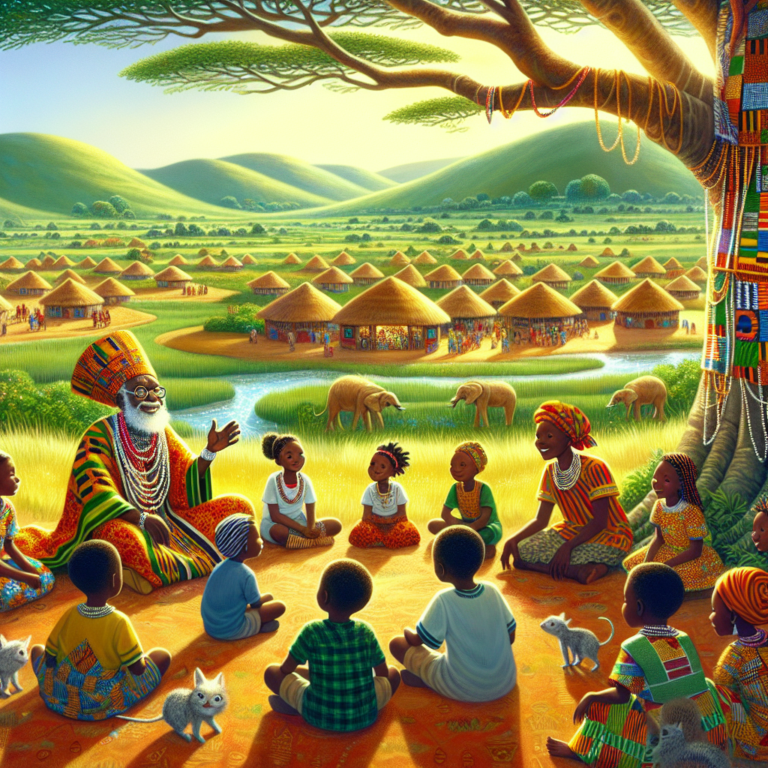
Share this engaging bedtime story with kids ages 6-12 to teach valuable life lessons.
## Chapter One: The Village Between the Hills
Between two green hills, where the river Mto flowed cool and clear, there nestled a village so peaceful that travelers who passed through often stayed longer than they planned.
This village had no special wealth. Its huts were made of the same mud and thatch as huts everywhere. Its crops were the same millet and sorghum that grew in fields across the land. Its animals were ordinary goats and cattle, chickens and guinea fowl.
Yet there was something different about this place. Visitors noticed it right away, though they could not always put it into words. The people here seemed… happier. More at ease. They laughed more easily and helped each other more readily. Quarrels were rare, and when they happened, they were quickly resolved.
“What is your secret?” travelers would ask.
And the villagers would smile and say, “We have no secret. We simply remember what others have forgotten.”
At the heart of the village stood a great baobab tree, its trunk so wide that ten men joining hands could barely circle it. Its roots went deep into the earth, and its branches reached high toward the sky. The villagers called it Mti wa Hekima – the Tree of Wisdom.
And beneath this tree, every evening as the sun painted the sky in shades of fire, an old man named Mzee Amani would sit and share stories with the children of the village.
## Chapter Two: The Elder Who Carried the Past
Mzee Amani was so old that even the oldest people in the village remembered him as old when they were children. His hair was white as the clouds. His face was a landscape of wrinkles, each one earned through years of laughter and tears, joy and sorrow. His eyes were clouded with age, yet they seemed to see things that younger, sharper eyes could not.
But it was not his age that made Mzee Amani special. It was his memory.
Mzee Amani remembered everything. He remembered the stories his grandmother had told him when he sat on her lap as a child. He remembered the songs his mother sang while grinding millet. He remembered the wisdom his father shared while they walked the cattle to water.
And more than that, he remembered the stories his grandmother’s grandmother had told, and the stories told before that, stretching back through generations like beads on a string, all the way to the first people who walked this land.
“I am a library,” Mzee Amani would say with a gentle laugh. “But a library that walks and talks and sometimes needs to sit down because its old bones are tired.”
The children loved him. Every evening, they would race to the baobab tree, jostling for the best spots near his feet, their faces eager with anticipation.
“Tell us a story, Mzee!” they would cry. “Tell us a story!”
And Mzee Amani would smile his slow smile and say, “Ah, but which story shall I tell tonight?”
## Chapter Three: Jengo Who Wanted to Be Alone
One evening, as the first stars began to appear in the darkening sky, Mzee Amani gathered the children and began a tale that would change them forever.
“Listen well, little ones,” he said, “for this is the story of Jengo and his journey to find wisdom.”
The children settled in, and the old man began.
“Long ago, when my grandmother’s grandmother was just a girl, there lived in this very village a young man named Jengo. Now, Jengo was intelligent – perhaps the most intelligent young person anyone could remember. He learned quickly and remembered everything he was taught. By the time he was twelve, he could recite the history of the village going back ten generations. By fifteen, he could solve problems that stumped the elders.”
“Was he smarter than you, Mzee?” asked little Amara, the youngest of the children.
Mzee Amani chuckled. “Perhaps, little one. Perhaps. But here is the thing about Jengo: his intelligence made him proud. He began to think he was better than others. And worse, he began to think he didn’t need others at all.”
“But everyone needs other people,” said Kofi, a boy of about ten.
“Ah, but Jengo didn’t believe that. He thought, ‘Why should I spend my time with people who cannot match my thinking? Why should I waste my days in the noise and bustle of the village when I could be alone with my thoughts, growing even wiser?’”
## Chapter Four: The Journey to Solitude
Mzee Amani paused to take a sip of water from a gourd, letting the tension build.
“One day,” he continued, “Jengo made an announcement. ‘I am leaving,’ he told his family and friends. ‘I am going to the forest to live alone. There, in silence and solitude, I will become the wisest person who has ever lived.’
“His mother wept. ‘Who will help you when you are sick?’ she cried.
“‘I will not get sick,’ Jengo replied.
“His father frowned. ‘Who will share your burdens when the work is hard?’
“‘I will have no burdens that I cannot carry alone,’ Jengo replied.
“His friends looked at each other with sad eyes. ‘Who will celebrate with you when good things happen? Who will comfort you when bad things happen?’
“‘I need no celebration and no comfort,’ Jengo replied. ‘I need only my thoughts and my wisdom.’
“And with that, he walked out of the village and into the forest, determined to live the life of a solitary sage.”
## Chapter Five: The First Year
“At first,” Mzee Amani continued, “Jengo was happy – or at least, he thought he was happy.
“He built a small hut by a stream. He gathered food from the forest – wild fruits, nuts, mushrooms, roots. He spent his days thinking great thoughts, and when evening came, he would congratulate himself on how wise he was becoming.
“‘Soon,’ he thought, ‘I will be the wisest person in the world. And I will have achieved it all by myself, without the distraction of other people.’
“But as the months passed, something strange began to happen.
“Jengo would have a brilliant thought, and he would turn to share it – but there was no one there. He would solve a difficult problem, and he would want to celebrate – but there was no one to celebrate with. He would see something beautiful – a sunset, a bird, a flower – and he would want to point it out – but there was no one to show.
“He told himself it didn’t matter. But late at night, when the forest was dark and the only sounds were the calls of owls and the rustle of creatures in the undergrowth, Jengo began to feel something he had never felt before.
“Loneliness.”
## Chapter Six: The Empty Wisdom
“The second year was worse,” Mzee Amani said.
“Jengo still had his thoughts, still had his intelligence. But what good was it? He could think great thoughts, but without someone to share them with, they felt hollow. He could solve problems, but the problems of a man alone in the forest were small problems – how to catch a fish, how to keep dry when it rained.
“He remembered the village – the sound of children laughing, the smell of cooking fires, the comfort of his mother’s embrace, the strength of his father’s hand on his shoulder. He remembered sitting under this very baobab tree, listening to the elders tell stories, feeling the warmth of belonging.
“He had thought he didn’t need these things. He had been wrong.
“But Jengo was proud, and pride is a stubborn thing. ‘I cannot go back,’ he told himself. ‘I said I would become wise alone, and I will prove that I can. This loneliness is just a weakness I must overcome.’
“So he stayed in the forest, growing thinner and sadder with each passing month, his brilliant mind circling the same thoughts again and again with no one to challenge them, no one to add new ideas, no one to make them grow.”
## Chapter Seven: The Dream That Changed Everything
“One night,” Mzee Amani said, lowering his voice so the children had to lean in close to hear, “Jengo had a dream.
“He dreamed he was standing in an empty plain that stretched to the horizon in every direction. There was nothing there – no trees, no animals, no people. Just Jengo, alone, in an endless emptiness.
“In the dream, he began to walk. He walked for what felt like years, searching for something – anything – but there was nothing. No matter how far he went, he was still alone in the empty plain.
“He began to scream. ‘Is anyone there? Please! Someone! Anyone!’


“But no one answered. His voice echoed in the emptiness and died.
“And then, just when despair was about to swallow him completely, he heard a voice. Not an ordinary voice – it seemed to come from everywhere at once, from the ground beneath his feet and the sky above his head and the very air he breathed.
“‘Jengo,’ the voice said, ‘do you understand now?’
“Jengo fell to his knees. ‘Who are you?’ he cried.
“‘I am the voice of your ancestors. I am the voice of all who came before you and all who will come after. I am the voice of your people, speaking from the land and the sky and your own heart.’
“‘What do you want from me?’ Jengo asked.
“‘We want you to understand,’ the voice replied. ‘We want you to understand what you have been too proud to see.’”
## Chapter Eight: The Lesson of the Ancestors
“‘Listen well, young one,’ the voice continued in Jengo’s dream.
“‘You thought wisdom was something you could find alone. But wisdom is not like a stone you can pick up from the ground. Wisdom is like a fire – it needs fuel to burn, and the fuel is the wood that others bring.
“‘When you share an idea with another person, that idea grows. When you face a challenge with others, you see angles you would never see alone. When you rejoice with others, your joy is multiplied. When you grieve with others, your grief is divided.
“‘You are not meant to be alone, Jengo. No one is. This is the great truth that your ancestors learned long ago, the truth that we call Ubuntu.
“‘Ubuntu means “I am because we are.” It means that you exist, you are real, you are fully yourself, only through your relationships with others. Without others, you are incomplete. Without others, even your brilliant mind is just a single candle in infinite darkness.
“‘With others, you become something more than yourself. You become part of a great tapestry that stretches back through time and forward into the future. You become connected to every person who has ever lived and every person who ever will live.
“‘This is the true wisdom, Jengo. This is what you went to the forest to find but could not find because you were looking in the wrong place.
“‘Now wake up. And go home.’”
## Chapter Nine: The Return
“Jengo woke from his dream,” Mzee Amani said, “and he wept.
“He wept for the years he had wasted, thinking he was too good for others. He wept for the loneliness he had inflicted on himself. He wept for the family and friends he had left behind.
“And when his tears were finished, he stood up, packed his few belongings, and began the walk back to the village.
“It was not an easy walk. Not because of the distance, but because of the shame he felt. How could he face the people he had rejected? How could he look his mother in the eye after abandoning her? How could he ask to rejoin a community he had thought himself too good for?
“But the voice of the ancestors had given him one more gift: the understanding that his pride was foolish. He had been wrong. Admitting that was not weakness – it was strength.
“When Jengo walked into the village, he expected anger. He expected rejection. He had left them; why should they take him back?
“But that is not what happened.
“His mother saw him from across the village and ran to him, tears streaming down her face, her arms open wide. His father followed, his eyes bright with joy. His friends surrounded him, slapping his back and laughing.
“‘You came back!’ they cried. ‘You came back!’
“‘I was a fool,’ Jengo said, his voice breaking. ‘I thought I didn’t need you. I was wrong. I am sorry.’
“His mother held his face in her hands. ‘Oh, my son,’ she said, ‘we are just glad you came home. That is all that matters. You are part of us, and we are part of you. That can never change, no matter how far you wander.’”
## Chapter Ten: The New Understanding
“From that day forward,” Mzee Amani said, “Jengo was a different person.
“His intelligence was still there – if anything, it was sharper than ever, honed by his years of solitary thought. But now he used it differently. Instead of thinking only for himself, he thought for others. Instead of hoarding his ideas, he shared them. Instead of looking down on those who were less clever, he listened to them – and often found wisdom in their simple words that his complicated thinking had missed.
“He became a teacher, not because he wanted to show off his knowledge, but because he wanted to give back what he had received. He taught the children their history and their language. He helped the farmers improve their crops with new techniques. He settled disputes by helping people see each other’s points of view.
“And every evening, just as I do now, he would sit under this very baobab tree and share stories with the children.
“His favorite story to tell was his own – the story of how he learned the true meaning of Ubuntu. ‘I had to lose everything,’ he would say, ‘before I could understand what I truly had. Do not make my mistake, children. Remember: you are not alone. You are part of something bigger than yourself. I am because we are. We are because of each other. This is the wisdom of our ancestors. This is the truth that will never grow old.’”
## Chapter Eleven: The Story’s Gift
Mzee Amani fell silent. The fire had burned low, and the stars above were thick as scattered grain.
The children sat quietly, processing the story. Some were thinking about times they had wanted to be alone and away from their families. Some were remembering times they had been proud or selfish. Some were simply feeling grateful for the people around them.
Finally, little Amara spoke up. “Mzee,” she said in her small voice, “the story is about more than just Jengo, isn’t it? It’s about all of us.”
Mzee Amani’s old face creased into a smile. “You are wiser than you know, little one. Yes, the story is about all of us. Every person, at some point in their life, is tempted to think they can go it alone. Every person sometimes forgets how much they need others.
“But here is the beautiful thing: when we remember – when we truly understand – Ubuntu becomes not a burden but a gift. It means we are never truly alone. It means that when we struggle, there are hands to help us. It means that when we succeed, there are hearts to rejoice with us. It means that our lives have meaning, because they are woven into the great tapestry of all lives.
“This is the wisdom of Africa. This is the wisdom of our ancestors. And now, children, it is your wisdom too. Carry it with you always. Share it with everyone you meet. And when you have children of your own, sit them under this tree and tell them the story of Jengo, who went away to find wisdom and discovered it could only be found at home, among those who loved him.”
## Chapter Twelve: The Living Truth
That night, as the children walked back to their homes, something had changed in them.
Young Kofi walked with his arm around his younger sister, something he rarely did. “I’m glad you’re my sister,” he told her, and she smiled up at him in surprise.
Amara ran straight to her grandmother and hugged her tight. “What is this for?” her grandmother asked, laughing.
“For being here,” Amara said. “For being part of my we.”
The other children, too, went to their families with new appreciation, new understanding. They saw their parents and siblings and grandparents with fresh eyes – not as people who were simply there, but as essential parts of who they themselves were.
And so the wisdom passed on, as it had passed on for countless generations before, as it would pass on for countless generations to come.
Ubuntu. I am because we are.
It is not just an African proverb. It is a truth as universal as the sun and the moon, as essential as breath and heartbeat.
We are all connected. We all need each other. We all become our best selves through our relationships with others.
Remember this, and you will never be truly lost.
Forget this, and you may wander for years before finding your way home.
The choice, as always, is yours.
But the ancestors are watching, and they are hoping you will choose wisely.
Moral Lessons
- True wisdom and happiness are found not in isolation but in connection with others. We are all interconnected, and our lives find meaning through our relationships. As the Ubuntu philosophy teaches: “I am because we are” – our humanity is fulfilled through how we relate to and care for others.
Test Your Understanding
1Who is Jengo in the story?
Frequently Asked Questions
What is the moral lesson of The Wise Elder’s Tale of Ubuntu and the United Village?
What age is this story appropriate for?
How long does it take to read The Wise Elder’s Tale of Ubuntu and the United Village?
What culture does this story come from?
Can I use this story for teaching?
Frequently Asked Questions
What is the Ubuntu story about in The Wise Elder’s Tale?
The Wise Elder’s Tale of Ubuntu and the United Village is a bedtime story set in an African village where people live by the principle of Ubuntu — the idea that we are stronger together. It follows villagers who discover happiness through community, kindness, and mutual support, making it a perfect moral story for kids ages 6 to 12.
What does Ubuntu mean and why is it important for kids to learn?
Ubuntu is an African philosophy meaning ‘I am because we are.’ It teaches children that their well-being is connected to the well-being of others. Learning Ubuntu helps kids develop empathy, cooperation, and community values — life skills that go far beyond the classroom and shape how they treat people throughout their lives.
What age group is this Ubuntu bedtime story suitable for?
This story is designed for children ages 6 to 12. The language is accessible and imaginative enough for younger kids, while the deeper moral lessons about community, unity, and wisdom give older children something meaningful to think about and discuss with parents or teachers after reading.
📚 Recommended Books
Handpicked for readers like you
As an Amazon Associate, we earn from qualifying purchases. These recommendations are personalized based on this story's themes and your reading history.
What life lessons does The Wise Elder’s Tale teach children?
The story teaches kids that true happiness comes from helping others, resolving conflicts peacefully, and living as a united community. It shows that a village — or family — doesn’t need material wealth to thrive. The real treasure is remembering to care for one another, a timeless lesson rooted in African Ubuntu values.
Is The Wise Elder’s Tale based on African culture and traditions?
Yes, the story draws heavily from East African culture. It features Swahili words like Mto (river) and Mti wa Hekima (Tree of Wisdom), along with a sacred baobab tree central to many African traditions. These authentic cultural elements make it both an engaging bedtime story and a gentle introduction to African heritage for children.