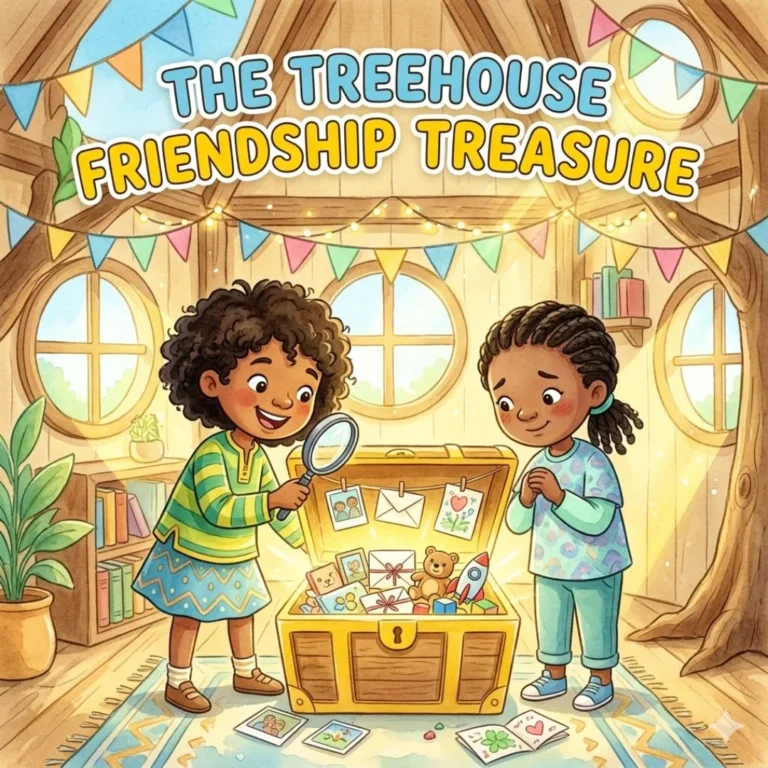
This bedtime story for kids, ‘The Curious GR and the Treasure of Friendship’, teaches children ages 6-12 about important moral values.
Chapter One: The Kingdom in the Clouds
High above the mortal world, where the clouds parted like curtains to reveal a realm of eternal sunshine, stood Mount Olympus – the home of the gods. Its marble palaces gleamed white and gold, and its gardens bloomed with flowers that never wilted. Here lived the Olympians: the divine beings who ruled over earth, sea, and sky.
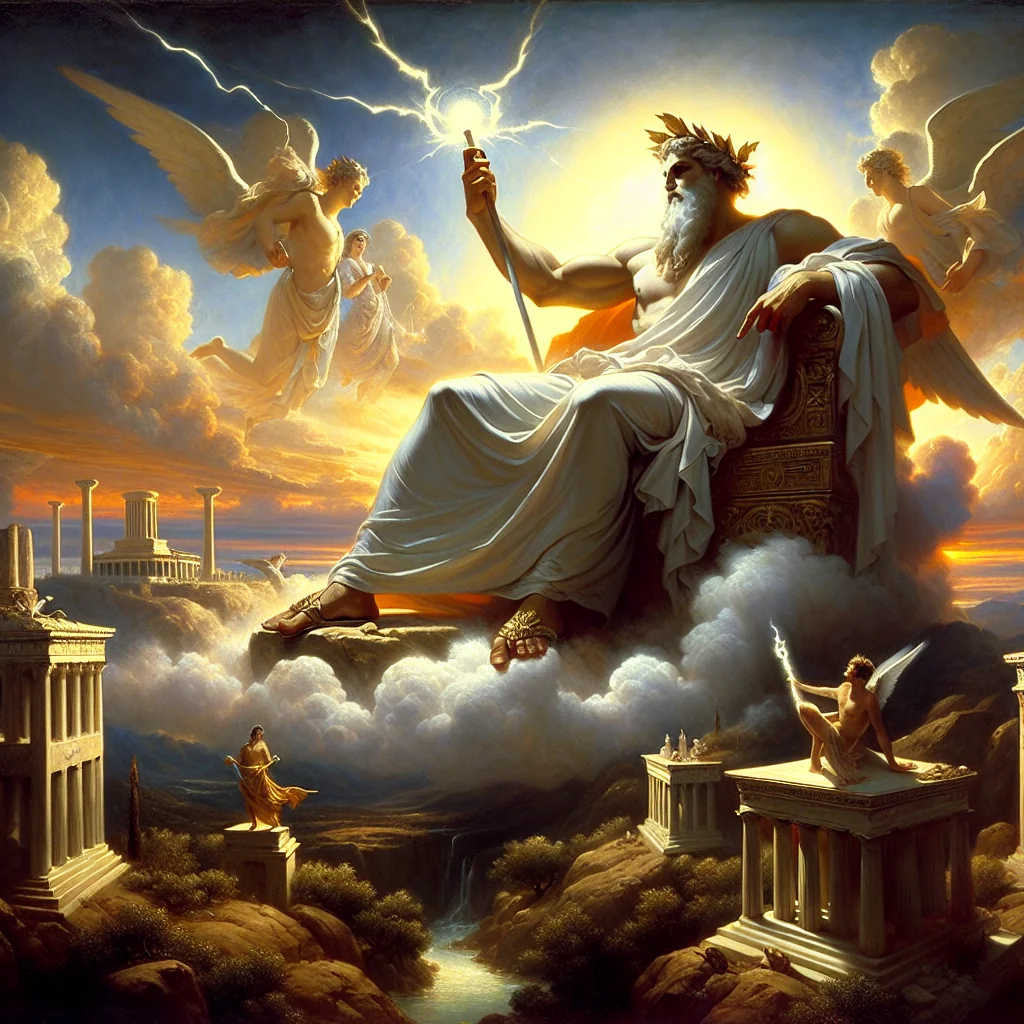
On his throne of lightning and storm clouds sat Zeus, king of all the gods. His hair and beard flowed like thunderclouds, and his eyes crackled with the power of the heavens. Zeus was mighty and powerful, but he had a weakness – he loved watching the mortals below and often intervened in their stories.
One mortal had caught his particular attention: a young hero named Perseus.
Perseus lived in the rocky island kingdom of Seriphos, where fishing boats bobbed in the harbor and olive trees grew on the hillsides. He had grown up knowing nothing of his true heritage – only that his mother, the beautiful Danae, had fled to this island when he was just a baby, escaping from her cruel father who had locked them both in a wooden chest and cast them into the sea.
What Perseus did not know was that his father was none other than Zeus himself, and that a great destiny awaited him.
Chapter Two: A Wicked King’s Scheme
King Polydectes ruled Seriphos with a greedy heart. He had fallen in love with Danae and wanted to marry her, but she refused him again and again. Perseus, now grown into a strong and courageous young man, protected his mother from the king’s unwanted advances.
“As long as that boy stands in my way,” Polydectes muttered to himself, “Danae will never be mine.”
So the wicked king hatched a scheme. He announced a great feast and declared that every nobleman must bring him a gift – a horse to add to his royal stables.
Perseus, who was poor and owned no horses, felt ashamed. “I will bring you any gift you desire, King Polydectes,” he declared boldly, “even if it is the head of Medusa herself!”
The hall fell silent. Medusa was one of the Gorgons – three monstrous sisters with snakes for hair and a gaze so terrible that anyone who looked upon her face would turn instantly to stone. Many heroes had tried to slay her. None had returned.
Polydectes smiled a cold smile. “I accept your offer, Perseus. Bring me Medusa’s head, or never show your face in Seriphos again.”
He had thought to send Perseus to his death. But the gods had other plans.
Chapter Three: The Messenger of the Gods
That night, as Perseus sat alone on the beach, wondering how he would ever complete such an impossible task, the air before him began to shimmer. A young man appeared, wearing winged sandals and carrying a staff entwined with two serpents. It was Hermes, the messenger of the gods.
“Greetings, Perseus,” Hermes said with a mischievous smile. “You’ve gotten yourself into quite a predicament. Fortunately, you have powerful friends.”
“Who are you?” Perseus asked, scrambling to his feet.
“I am Hermes, and I bring word from your father – Zeus, king of the gods. He has been watching you, Perseus, and he is proud. But even the son of Zeus cannot defeat Medusa without help. Come with me.”
Hermes led Perseus through the night to a sacred cave where the Oracle of Delphi dwelt. The Oracle was a priestess through whom the god Apollo spoke, revealing truths and prophecies about the future.
Chapter Four: The Oracle’s Words
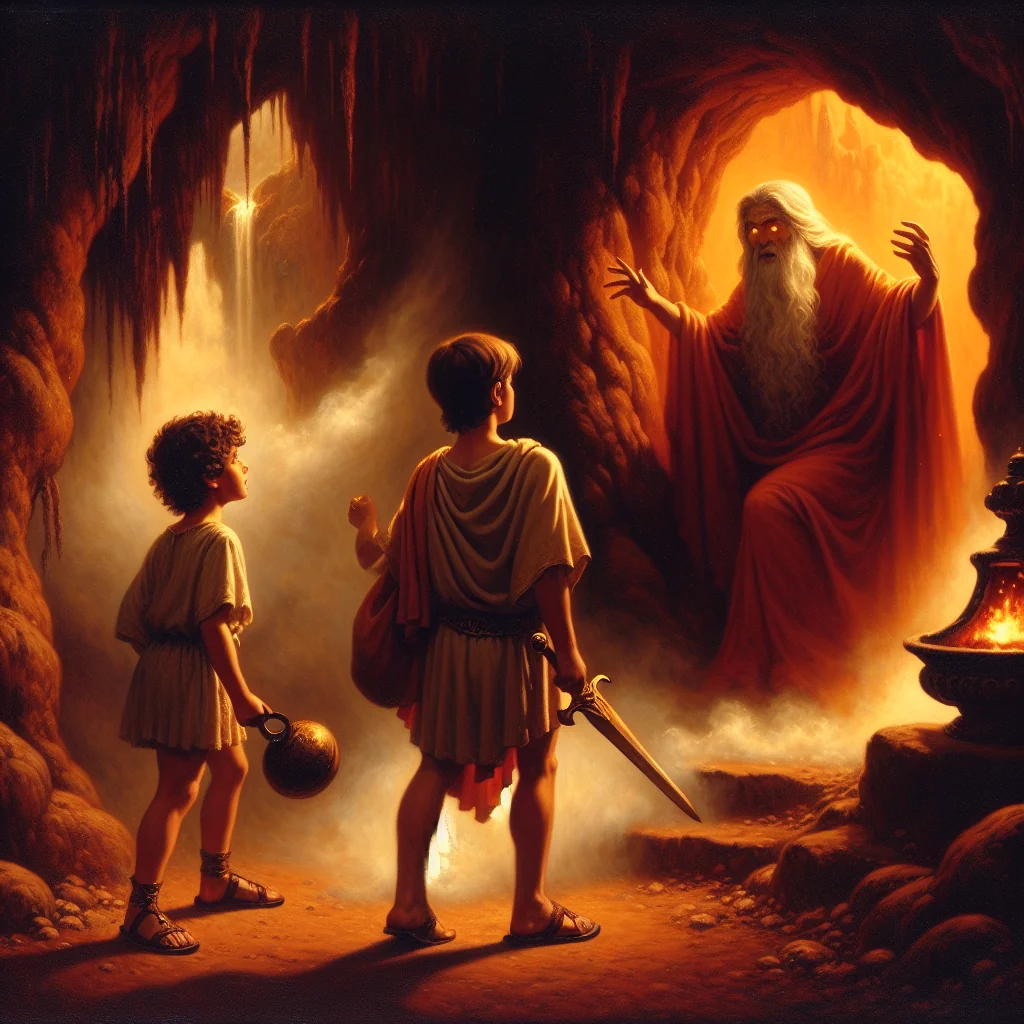
Inside the cave, smoke rose from a crack in the earth, filling the air with a strange, sweet scent. The Oracle sat on a three-legged stool, her eyes closed, her body swaying gently.
“Speak, young hero,” she intoned, her voice seeming to come from everywhere and nowhere at once. “Ask your question.”
Perseus knelt respectfully. “Wise Oracle, I am bound by my word to bring the head of Medusa to King Polydectes. How can I accomplish this impossible task?”
The Oracle’s eyes flew open, but they were not her own eyes anymore – they blazed with golden light.
“Son of Zeus, your destiny is greater than you know,” she proclaimed. “You shall not only slay Medusa, but you shall save a princess, found a kingdom, and become a legend sung throughout the ages. But first, you must prove yourself worthy.”
“How?” Perseus asked eagerly.
“Seek the Nymphs of the North, who guard three magical treasures. Only with these treasures can you face the Gorgon and survive. The way is long and dangerous, but bravery and cleverness will see you through. Remember: it is not strength alone that makes a hero, but wisdom, compassion, and the courage to do what is right.”
The light faded from the Oracle’s eyes, and she slumped forward, exhausted from channeling the god’s power.
Hermes touched Perseus’s shoulder. “Come. Your quest begins now.”
Chapter Five: The Treasures of the Nymphs
With Hermes as his guide, Perseus traveled to the edge of the world, where the garden of the Hesperides bloomed with golden apples and the Nymphs of the North danced in eternal twilight.
These were not ordinary nymphs. They were ancient beings, older than most of the Olympian gods, and they guarded treasures of immense power.
“Why should we help you, mortal?” asked the eldest nymph, her silver hair flowing like a waterfall.
Perseus bowed deeply. “I do not ask for myself alone. The wicked King Polydectes holds my mother captive with his unwanted desires. If I fail in this quest, she will suffer. I ask not for glory, but to protect one I love.”
The nymphs exchanged glances, impressed by the young man’s humility and devotion.
“Very well,” said the eldest. “We shall lend you three treasures. But remember – they must be returned when your quest is complete.”
First, they gave him a cap of invisibility – a helm of shadows that would make him unseen to any eye.
Second, they gave him a magical bag called a kibisis, which could safely contain Medusa’s deadly head.
Third, they gave him winged sandals like those Hermes wore, so he could fly through the air as swiftly as a bird.
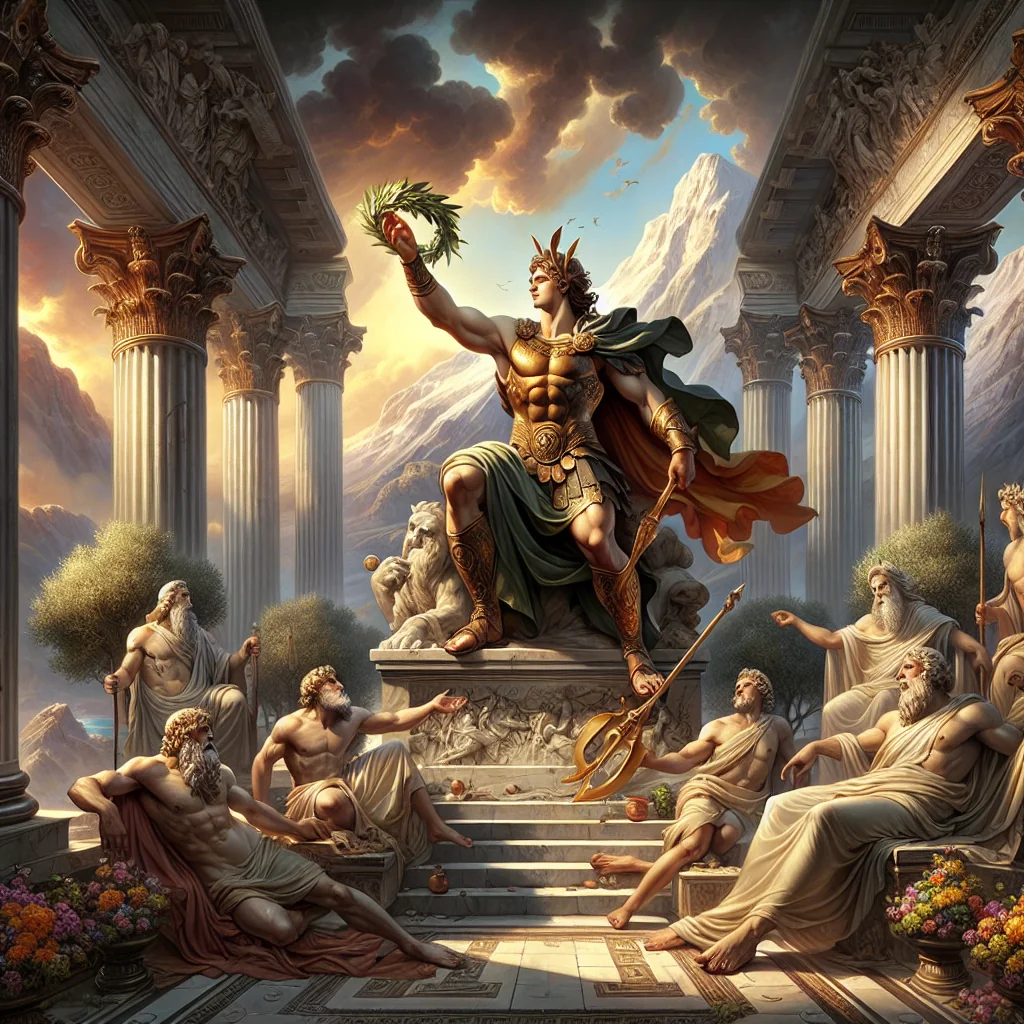
“Use these wisely,” the nymphs warned. “And never look upon Medusa’s face, or you will share the fate of all who have challenged her.”
Chapter Six: The Isle of the Gorgons
Wearing his new sandals, Perseus flew across wine-dark seas and barren lands until he reached the Isle of the Gorgons. It was a terrible place – no plants grew there, no birds sang. The ground was littered with the stone statues of warriors, their faces frozen in expressions of horror, their weapons still clutched in their petrified hands.
Perseus’s heart hammered in his chest, but he forced himself to be calm. “Think,” he told himself. “The Oracle said wisdom is as important as strength.”
He remembered something Hermes had told him: “You cannot look at Medusa directly. But her reflection cannot harm you.”
Perseus drew his sword – a blade given to him by Hermes, sharp enough to cut through anything – and polished its surface until it shone like a mirror. Then he put on the cap of invisibility and crept into the Gorgons’ lair.
There, on the floor of a dark cave, lay the three sisters – Stheno, Euryale, and Medusa. Two of them were immortal and could not be killed, but Medusa, the youngest, was mortal.
Moving silently, watching only the reflection in his sword, Perseus crept toward Medusa. He could see the snakes writhing in her hair, could hear them hissing softly as they slept. His hands trembled, but his resolve did not waver.
With one swift strike, he severed Medusa’s head and quickly stuffed it into the magical bag.
The other two Gorgons awoke with terrible screams, but Perseus was already flying away, invisible and swift as the wind.
Chapter Seven: The Princess in Chains
As Perseus flew homeward, he passed over the kingdom of Ethiopia. Looking down, he saw something that made his blood boil with righteous anger.
Chained to a rock by the sea was a beautiful young woman, the waves crashing around her feet, her face wet with tears. A massive sea monster circled in the waters below, waiting to devour her.
Perseus dove down like a falcon.
“Who are you, and why have you been left here to die?” he demanded.
“I am Andromeda, princess of Ethiopia,” the girl replied, struggling against her chains. “My mother boasted that I was more beautiful than the sea nymphs, and they convinced Poseidon to punish our kingdom. The Oracle said only my sacrifice would save my people.”
Perseus looked at the approaching monster, then at the terrified girl.
“Your people were wrong to sacrifice you,” he said firmly. “No one should die for another’s pride. Hold still.”
He drew Medusa’s head from the bag, being careful to look away, and held it toward the sea monster. The creature turned to stone in an instant, crashing into the waves as a massive boulder.
Then Perseus cut Andromeda’s chains and carried her safely to shore.
Chapter Eight: The Triumph of the Hero
Perseus returned to Seriphos with Andromeda, who had agreed to become his wife. But they found the island in turmoil. King Polydectes, believing Perseus dead, had forced Danae to take refuge in a temple to escape his advances.
Perseus strode into the palace, where Polydectes was feasting with his followers.
“Ah, the boy has returned!” the king mocked. “And where is my gift? Where is Medusa’s head?”
“Here it is, Your Majesty,” Perseus replied coldly, and he drew the head from the bag.
In an instant, Polydectes and all his wicked supporters were turned to stone – a fitting end for those who had plotted cruelty and injustice.
Perseus freed his mother and reunited her with Andromeda. He returned the magical treasures to the Nymphs of the North, as he had promised, and gave Medusa’s head to Athena, goddess of wisdom, who placed it on her shield.
True to the Oracle’s prophecy, Perseus went on to found a great kingdom, rule wisely and justly, and become a legend whose name would be remembered for thousands of years.
Chapter Nine: The Lesson of the Stars
Many years later, when Perseus had grown old and his adventures were long behind him, he would sit with his grandchildren and tell them the story of his quest.
“Was it hard, Grandfather?” they would ask. “Were you afraid?”
“Of course I was afraid,” Perseus would reply, his eyes twinkling. “Only fools feel no fear. But courage is not the absence of fear – it is choosing to do what is right despite being afraid.”
“And what about the Oracle?” the children would press. “Did everything happen exactly as she said?”
Perseus would look up at the night sky, where the gods had placed his image among the stars – Perseus the hero, forever holding Medusa’s head.
“The Oracle told me my destiny,” he said thoughtfully, “but I still had to choose to fulfill it. The gods may guide our paths, but we are the ones who must walk them. We can choose to be brave or cowardly, kind or cruel, wise or foolish. Our fate shows us where we might go, but our choices determine who we become.”
The children would nod seriously, not fully understanding but sensing the importance of his words.
“Remember,” Perseus would say, hugging them close, “you are all heroes in your own stories. You may not fight monsters or fly through the sky, but every day you face choices. Be brave. Be kind. Be clever. And when you feel afraid, remember that your grandfather was once afraid too – and he did great things anyway.”
And in the night sky above, the stars of Perseus still shine, reminding us all that destiny is what we make of it, and that true heroism lies not in magical gifts or divine parents, but in the courage to do what is right.
Moral Lessons
- Bravery, kindness, and wisdom are essential qualities to overcome challenges and fulfill one’s destiny. True heroism lies not in strength alone, but in the courage to do what is right and the wisdom to think before acting.
Test Your Understanding
1Who is the king of the gods in the story?
Frequently Asked Questions
What is the moral lesson of The Curious GR and the Treasure of Friendship?
What age is this story appropriate for?
How long does it take to read The Curious GR and the Treasure of Friendship?
What culture does this story come from?
Can I use this story for teaching?
Frequently Asked Questions
What is ‘The Curious GR and the Treasure of Friendship’ about?
It’s a bedtime story for kids ages 6-12 that blends Greek mythology with important moral lessons about friendship. The story follows a young hero named Perseus in the world of Mount Olympus and the Olympian gods, teaching children values like loyalty, courage, and the true meaning of friendship.
What age group is ‘The Treasure of Friendship’ story suitable for?
This bedtime story is designed for children between 6 and 12 years old. The language and themes are age-appropriate, making it a great read-aloud choice for parents, or an independent read for older kids in that range.
What moral values does this friendship story teach children?
The story focuses on the treasure of friendship and related values such as loyalty, bravery, and kindness. Set against a mythological backdrop with characters like Zeus and Perseus, it helps children understand why genuine friendships are one of life’s most valuable rewards.
📚 Recommended Books
Handpicked for readers like you
As an Amazon Associate, we earn from qualifying purchases. These recommendations are personalized based on this story's themes and your reading history.
Is this story based on Greek mythology?
Yes, the story draws heavily from Greek mythology. It features Mount Olympus, Zeus, and the hero Perseus, weaving classic mythological elements into a child-friendly narrative that also delivers a heartfelt lesson about the importance of friendship.
Who is Perseus in this bedtime story for kids?
Perseus is a young mortal hero living on the rocky island of Seriphos. Raised by his mother Danae after a turbulent start to life, he catches the attention of Zeus. His journey forms the heart of the story, ultimately revealing the true treasure of friendship.