This moral story for children ages 6-12 combines entertainment with important values.
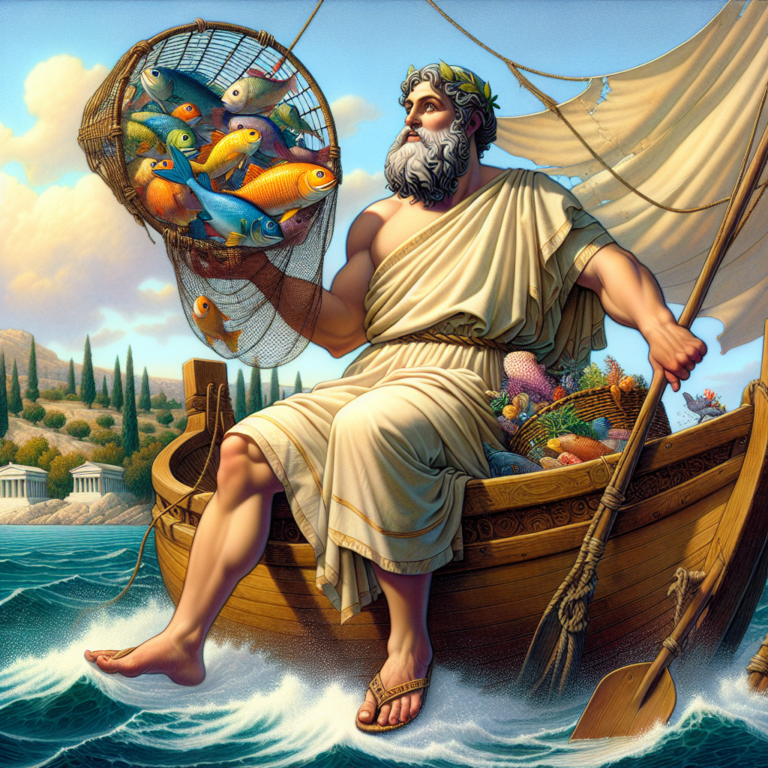
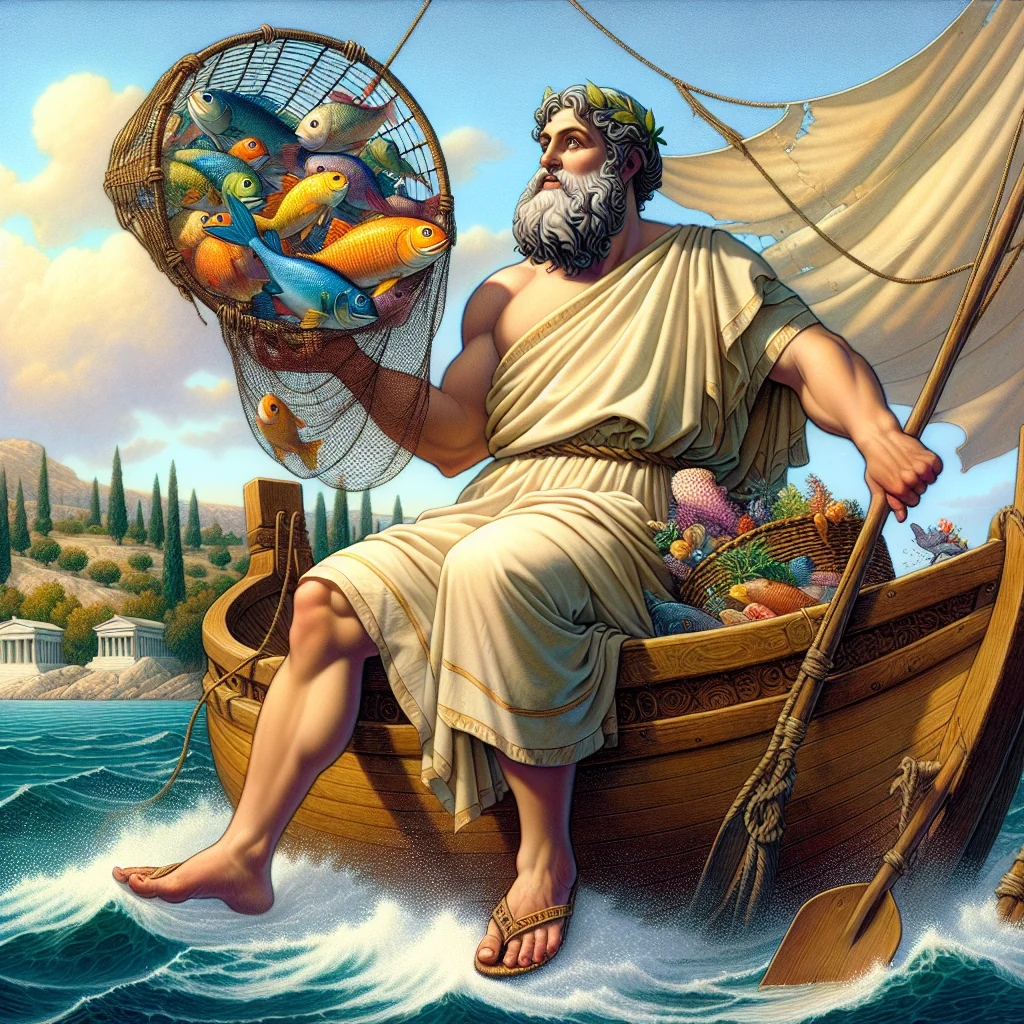
Long ago in ancient Greece, there lived a simple fisherman named Glaucus.
Every morning, Glaucus would take his fishing rod and his wicker basket down to the shore. He would cast his line into the sparkling blue water and wait patiently for the fish to bite.
Glaucus was good at fishing. He caught plenty of fish—enough to sell at the market and feed his family. It was an honest, peaceful life, and Glaucus was happy.
But one day, something strange happened.
* * *
Glaucus had caught several nice fish that morning and thrown them on the grassy bank beside him while he continued to fish. But when he glanced over at his catch, he saw something astonishing.
The fish were nibbling at the grass!
Their mouths opened and closed, taking tiny bites of the green blades growing on the bank.
And then—even more amazingly—the fish began to flop and wriggle. One by one, they flopped across the grass back toward the water and—SPLASH!—leaped back into the sea!
Glaucus dropped his fishing rod in shock.
“What kind of grass is this?” he wondered aloud, staring at the spot where his fish had nibbled.
It looked like ordinary grass—green and soft, growing in small clumps along the bank. But clearly, there was something magical about it. It had given the fish the strength to return to the water, even after they’d been caught!
Glaucus’s curiosity was naturally excited.
“I wonder,” he murmured, “what would happen if I tasted it too?”
He knew he probably shouldn’t. The grass had clearly done something strange to the fish. Who knew what it might do to a person?
But his curiosity was too strong to resist.
Glaucus knelt down, pulled up a few blades of the magical grass, and put them in his mouth.
They tasted salty and sweet at the same time, with a flavor like the ocean itself.
No sooner had he swallowed than a powerful feeling came over him—an irresistible impulse that seemed to come from the very center of his being.
The sea was calling to him.
The waves were singing his name.
He HAD to go to the water. He HAD to jump in. He HAD to—
Without even thinking about what he was doing, Glaucus ran to the edge of the shore and precipitated himself into the deep.
SPLASH!
Down, down, down he sank into the blue-green water…
And when he finally stopped sinking and opened his eyes, he found that he could breathe underwater.
Glaucus had become a sea-god.
* * *
At first, Glaucus marveled at his new form. He could swim faster than any fish. He could dive deeper than any whale. He could see in the darkness of the deep ocean and breathe as easily underwater as he once had on land.
But as the days passed, Glaucus began to notice changes.
Mussels attached themselves to his skin and wouldn’t come off.
Sea-weed wrapped around his arms and grew there like a living cloak.
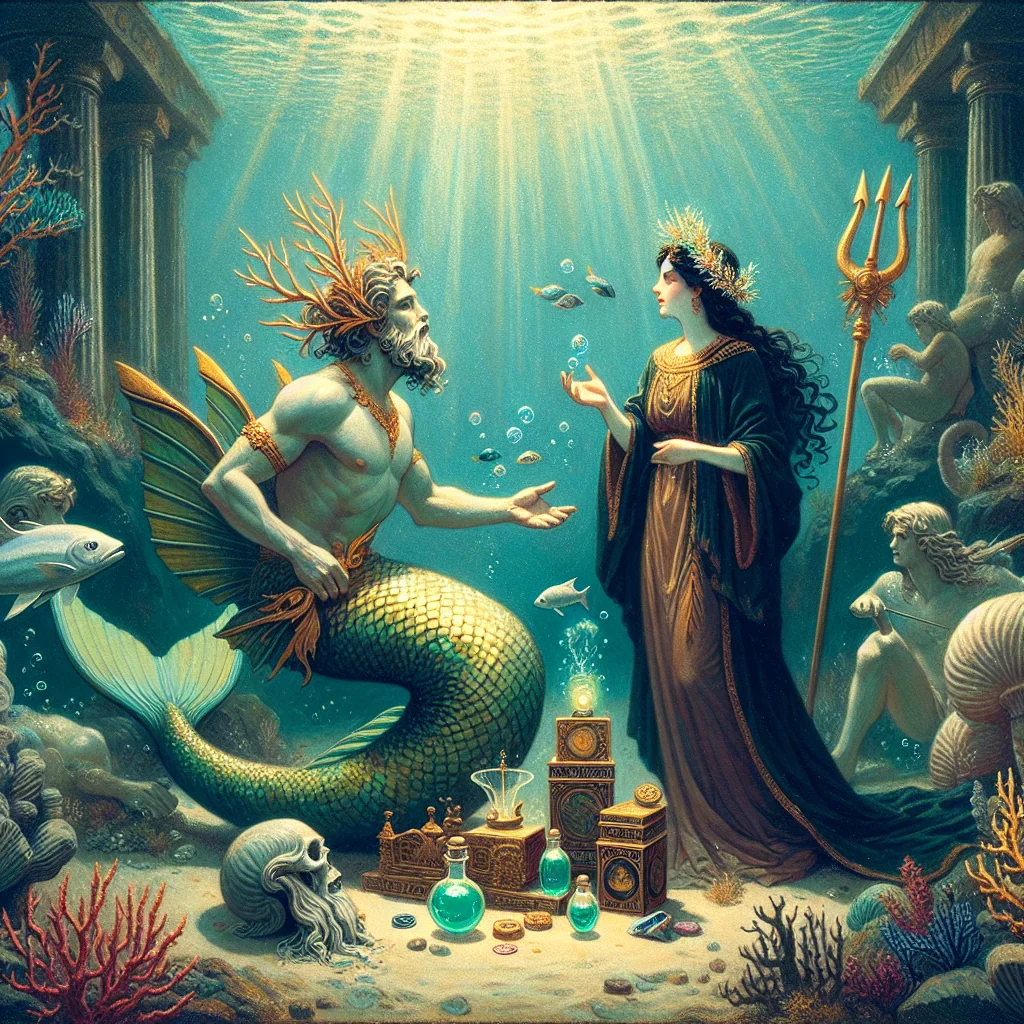
Shells stuck to his body—barnacles and limpets and tiny mollusks making their homes on him as if he were a rock or a sunken ship.
His beard grew long and wild. His hair flowed out behind him in the current, tangled with kelp and sea-grass.
And he discovered, as most sea-divinities do, that he had been gifted with prophetic power. He could see the future—and most of what he saw was terrible.
* * *
Each year, Glaucus found himself compelled to visit all the islands and coasts of Greece, accompanied by a train of marine monsters—strange, frightening creatures from the deep ocean who followed him wherever he went.
And everywhere he went, Glaucus foretold evil things.
“A storm is coming,” he would say, floating on the billows near a fishing village. “Three boats will be lost.”
“The fish will not come to these waters next season,” he would announce at another island. “You will go hungry.”
He didn’t want to say these terrible things. But the gift of prophecy wouldn’t let him stay silent. The words poured out of him whether he liked it or not.
The fishermen dreaded Glaucus’s approach. When they saw him floating on the waves—his body covered with mussels and sea-weed and shells, his beard and hair long and wild—they would cry out in fear.
“Glaucus is here! Quick, we must pray and fast to avert the misfortunes he prophesies!”
And they would kneel on the shore and pray to the other gods, begging them to prevent the evils that Glaucus had foretold.
* * *
Sometimes, late at night when the moon was full, Glaucus would float alone on the surface of the dark water, looking up at the stars.
And he would think about his old life.
His warm house on the shore.
His wife and children, whom he could never see again.
The simple pleasure of casting a fishing line and waiting for a bite.
Eating bread and cheese and olives for lunch under the shade of a tree.
Sleeping in a soft bed.
Feeling the sun warm on his face instead of the cold, dark pressure of the deep ocean.
All of that was gone now. Forever.
Because Glaucus was immortal. He would live forever as a sea-god, covered in mussels and shells, bitterly bewailing his immortality, never able to return to the life he had once loved.
“Why did I taste that grass?” Glaucus would moan, his voice echoing across the empty ocean. “Why didn’t I just wonder about it and let it be? Why did my curiosity have to be so strong?”
But the waves had no answer.
They just rolled on and on, as they always had and always would.
And Glaucus floated on the billows, forever changed, forever trapped, forever remembering the simple fisherman he used to be.
* * *
To this day, when fishermen see strange shapes floating on the waves at night, they whisper the name of Glaucus and offer a prayer:
“May we never find what we’re not meant to find. May we never taste what we’re not meant to taste. May we be content with our ordinary, mortal lives, for they are more precious than we know.”
MORAL LESSONS:
– Be careful with your curiosity—not everything is meant to be experienced
– Sometimes immortality is a curse, not a blessing
– Appreciate your ordinary life before it’s too late
– Some transformations cannot be undone
– Power and knowledge can come at too high a price
Test Your Understanding
1. What was Glaucus’s job before his transformation?
Frequently Asked Questions
What is the moral lesson of GLAUCUS.?
What age is this story appropriate for?
How long does it take to read GLAUCUS.?
What culture does this story come from?
Can I use this story for teaching?
Frequently Asked Questions
What is the story of Glaucus about?
Glaucus is an ancient Greek moral story for children ages 6-12 about a simple fisherman who discovers magical grass that brings his fish back to life. The story combines Greek mythology with important values, exploring themes of curiosity, transformation, and the consequences of chasing the unknown.
What age group is the Glaucus moral story suitable for?
The Glaucus moral story is designed for children ages 6 to 12. It uses simple, engaging language and vivid storytelling to hold younger readers’ attention while delivering meaningful life lessons in an entertaining way.
What important values does the Glaucus story teach kids?
The Glaucus story teaches children values such as curiosity, contentment, and the importance of thinking before acting. Like many ancient Greek tales, it encourages kids to reflect on whether chasing something new or magical is always worth leaving behind a happy, honest life.
📚 Recommended Books
Handpicked for readers like you
As an Amazon Associate, we earn from qualifying purchases. These recommendations are personalized based on this story's themes and your reading history.
Is Glaucus a real figure from Greek mythology?
Yes, Glaucus is a real figure from ancient Greek mythology. He was originally a mortal fisherman who ate magical sea grass and was transformed into a sea god or sea prophet. This story draws on that mythological tradition and retells it in a child-friendly, accessible way.
Why did the fish in the Glaucus story jump back into the sea?
The fish jumped back into the sea after nibbling on a patch of magical grass growing on the riverbank. The grass appeared to have supernatural properties that revived the already-caught fish, giving them the energy to flop back into the water — a mysterious event that astonished Glaucus and set the story in motion.