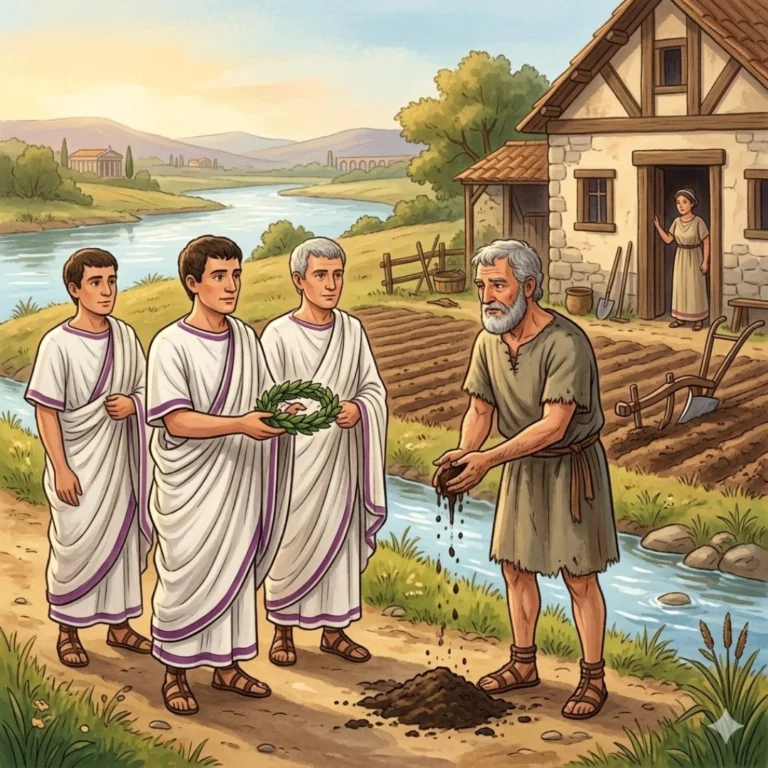
A Roman farmer is called to be dictator in the middle of ploughing his field—saves Rome—and then returns to his farm, teaching children that duty is served, not used.
In the early days of the Roman Republic, a great general named Cincinnatus had fallen out of favour with the powerful men in Rome. He had lost his estate paying his son’s debts. He farmed a small plot of land across the Tiber River with his own hands—just four acres, which he worked alone.
Rome needed him. A tribe called the Aequi had surrounded a Roman army and things were desperate.
The Senate sent messengers. They crossed the river by boat. When they arrived, Cincinnatus was ploughing. His wife Racilia was working beside him.
The messengers asked him to put on his toga. They needed to address him with the proper respect due a dictator.
He washed the soil from his hands and put on his toga.
“Rome names you dictator,” they said. “The army is trapped. They will die without you.”
Cincinnatus kissed his wife. He told her to watch the farm. He crossed the river.
In fifteen days, he assembled an army, marched through the night, surrounding the Aequi in their own camp by dawn, and forced their surrender. The Roman soldiers were freed.
Rome cheered.
His friends urged him to stay. He was dictator—the most powerful man in Rome. He could stay as long as he wanted. He could build an estate. He could make himself comfortable.
Cincinnatus resigned on the sixteenth day.
He crossed back over the river. He took off his toga. He picked up the plough.
The Romans told this story for centuries. Not as the story of a great general—but as the story of a man who understood that power is lent, not owned. You pick it up when needed. You put it down when the need is gone.
That is what duty means.
Moral of the Story
Duty means serving when you are needed—and stepping aside when the need is met. Power is lent, not owned. The truly great use it and give it back.
Learn These Words
- dictator
- in ancient Rome, a temporary leader with absolute authority during a crisis
- toga
- the formal robe worn by Roman citizens
- plough
- a farming tool used to turn over soil before planting
- resign
- to give up a position or job voluntarily
- Senate
- the governing body of ancient Rome
Test Your Understanding
1What was Cincinnatus doing when the Senate messengers arrived?
2Why did Rome need Cincinnatus?
3How many days did it take Cincinnatus to save the army?
4What did Cincinnatus do the day after the victory?
5What lesson does this story teach?
Frequently Asked Questions
Who was Cincinnatus and why is he famous?
Cincinnatus was a Roman farmer and former general who became one of history’s greatest examples of civic duty. When Rome faced a military crisis, the Senate appointed him dictator. He left his plough, defeated the enemy in just fifteen days, and then voluntarily gave up absolute power to return to his small farm across the Tiber River.
Why was Cincinnatus farming instead of leading Rome?
Cincinnatus had fallen out of favour with Rome’s powerful men and lost his estate paying off his son’s debts. He was reduced to working a tiny four-acre plot of land across the Tiber River with his own hands, alongside his wife Racilia. Despite his past as a great general, he lived humbly as a common farmer.
What does the story of Cincinnatus and the Plough teach children?
The story teaches children that true duty means serving others without seeking personal gain. Cincinnatus accepted power only when Rome needed him, used it to save his people, and gave it up immediately afterward. It shows that real greatness lies in selflessness—doing what’s needed and then stepping back without clinging to power or glory.
📚 Recommended Books
Handpicked for readers like you
As an Amazon Associate, we earn from qualifying purchases. These recommendations are personalized based on this story's themes and your reading history.
What were the Aequi and why did Rome need a dictator to fight them?
The Aequi were an ancient Italian tribe that had surrounded and trapped an entire Roman army. The situation was so desperate that the Senate invoked emergency powers and appointed Cincinnatus as dictator—a temporary role with absolute authority—because only swift, decisive leadership from a proven general could save the trapped soldiers.
Is the story of Cincinnatus and the Plough historically true?
Cincinnatus was a real historical figure from around 458 BC, and ancient Roman historians like Livy recorded his story. While some details may have been embellished over centuries of retelling, the core events—his appointment as dictator, his swift victory, and his voluntary return to farming—are accepted as rooted in genuine Roman history.