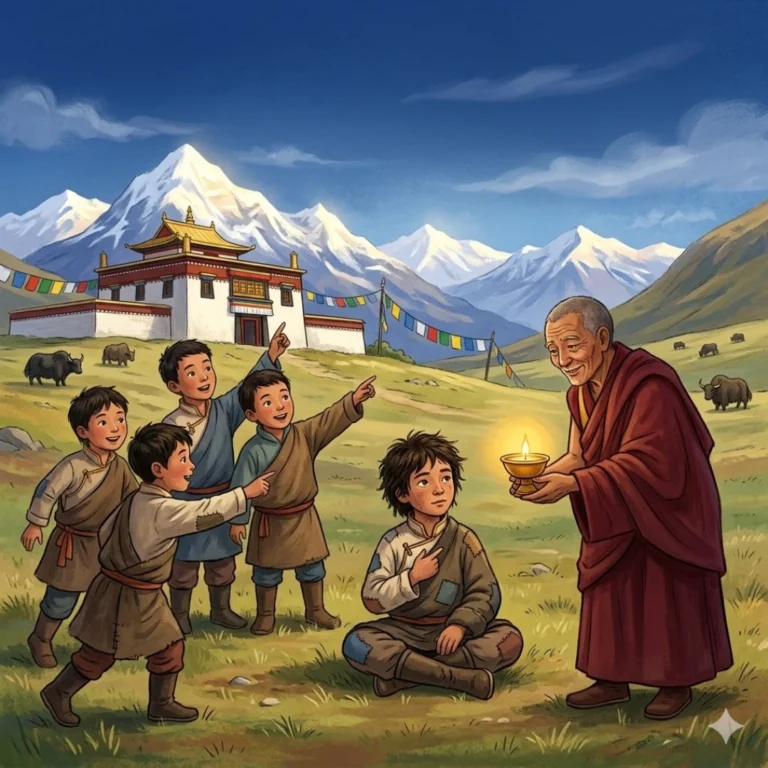
The legendary hero-king of Tibet faces his first test not with a sword but with a simple honest answer—and learns that wisdom always outshines force.
Before Gesar became the great warrior-king of Tibet, he was a small boy with wild hair and bright eyes, herding yaks on the high plateau. The other children called him Joru—the scruffy one—and no one suspected he was destined for greatness.
One day, an elderly lama called all the children of the village together. He had a question, he said, and whoever answered it correctly would receive something important.
“A river flows downhill,” said the lama. “A stone sinks in water. These are facts. But what is the most important direction in the world?”
The strong boys said: “Forward! Always forward!” They flexed their muscles.
The clever boys said: “Upward! Toward the sky and the gods!”
The daughters of wealthy families said: “Outward! Toward trade and prosperity!”
Then the lama looked at the small, scruffy boy in the back.
“Joru,” he said. “What do you say?”
Joru scratched his head. He looked at the ground. He looked at the lama.
“Inward,” he said simply. “The most important direction is inward. If you don’t know yourself, you don’t know which way forward or upward or outward should go.”
The lama was quiet for a long time.
Then he gave Joru the gift: a small butter lamp.
“A lamp lights outward,” said the lama. “But it requires a flame within. You understand this already. Remember it.”
Joru—who would become Gesar—carried that lamp his whole life. On the night before every great battle, he sat alone with it and asked himself: what am I fighting for? Is it right?
He never drew his sword for pride alone. Only for truth. And that, the storytellers say, is why he won.
Moral of the Story
Wisdom begins by looking inward. Before you act outward in the world, understand yourself—what you stand for and why.
Learn These Words
- lama
- a Buddhist monk or spiritual teacher in Tibet
- plateau
- a high flat area of land
- prosperity
- the state of being successful and having good fortune
- destiny
- the events that will happen to someone in the future, as if decided in advance
- inward
- directed toward the inside or toward yourself
Test Your Understanding
1What was the lama’s question?
2What did most of the children answer?
3What was Joru’s answer?
4What gift did the lama give Joru?
5What lesson does this story teach?
Frequently Asked Questions
Who is Gesar and why is he important in Tibetan culture?
Gesar is a legendary hero-king celebrated across Tibet, Mongolia, and the Himalayas as one of history’s greatest warrior-kings. His epic story, known as the Epic of King Gesar, is one of the world’s longest oral traditions. He is revered not just for his strength but for his wisdom, compassion, and divine destiny to protect the people.
What is Gesar’s first test about in this story?
Gesar’s first test is a wisdom challenge set by an elderly lama who asks the village children one simple question. Rather than relying on strength or cleverness, young Gesar — then known as the scruffy boy Joru — answers with honest, humble insight, revealing that true greatness comes from wisdom rather than force or ambition.
What is the moral lesson in Gesar’s First Test?
The core lesson is that wisdom always outshines brute force or worldly ambition. Even as a small, overlooked child, Gesar demonstrates that a simple, honest answer carries more power than showing off strength or intelligence. The story encourages children to value humility and clear thinking over the need to impress others.
📚 Recommended Books
Handpicked for readers like you
As an Amazon Associate, we earn from qualifying purchases. These recommendations are personalized based on this story's themes and your reading history.
Is Gesar’s First Test a good story for kids?
Yes, it’s an excellent story for children. It features a relatable young hero who starts out ordinary and overlooked, facing a challenge through honesty rather than aggression. The Tibetan setting adds rich cultural flavour, and the central message about wisdom and humility makes it ideal for sparking conversations about values with younger readers.
What does the lama’s question about direction mean in the story?
The lama’s question — ‘What is the most important direction in the world?’ — is a test of character and perspective. While other children answer with ambition (forward, upward, outward), the question is designed to reveal who thinks beyond the obvious. Gesar’s answer shows he understands a deeper truth that the others overlook in their eagerness to impress.