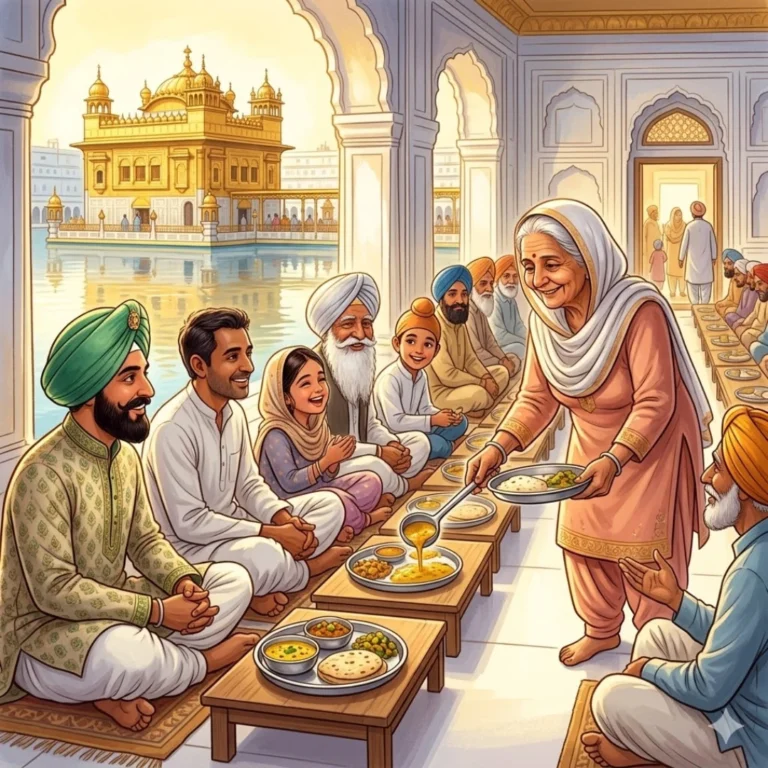
The fifth Sikh Guru builds a kitchen where beggar and king sit side by side—teaching that every human being has equal worth.
In the city of Amritsar, in the early 1600s, Guru Arjan Dev was building something.
Not just the Golden Temple, which would become the holiest place in the Sikh faith. He was also building a langar—a free kitchen—that would run every single day, feeding anyone who came, without asking any questions.
People arrived from across the Punjab. Rich merchants arrived in fine clothes. Poor farmers arrived in rags. Beggars arrived with empty hands. Brahmins from the Hindu tradition arrived.
And everyone sat in the same row.
The langar had one rule: you eat together. No one ate before anyone else. No caste, no wealth, no position mattered here. The king sat beside the sweeper. The learned man sat beside the child.
A wealthy nobleman visited one day and was told to wait in line. He was not happy. “Do you know who I am?” he said.
An old woman serving rice looked at him with kind eyes. “Yes,” she said. “You are hungry. Same as everyone else. Here, eat.”
The nobleman ate. The rice was plain but prepared with love and prayers—langar food always was. He sat beside a young farmer who was muddy from the fields.
They talked.
By the time the nobleman left, he had arranged for a water well to be dug in the farmer’s village. Not because someone asked him—because he had sat beside a person he would never otherwise have met.
Guru Arjan Dev watched this happen from across the courtyard. He wrote in his scriptures: “There is no rich and no poor before God. There is only a person who is hungry and one who has food.”
The langar at the Golden Temple still feeds tens of thousands of people every single day. The row is still the same.
Moral of the Story
Every human being has equal worth. When we eat together—truly together, as equals—we begin to see each other as we really are.
Learn These Words
- langar
- a free community kitchen in Sikhism, open to all people
- caste
- a system in some societies where people are divided into hereditary social classes
- scripture
- sacred or religious writing
- equality
- the state of being treated as equal
- nobleman
- a man of high social rank
Test Your Understanding
1What was the one rule of Guru Arjan Dev’s langar?
2What happened when the wealthy nobleman sat beside the farmer?
3What does the langar prove about caste and wealth?
4What did Guru Arjan Dev write in his scriptures?
5What lesson does this story teach?
Frequently Asked Questions
Who was Guru Arjan Dev and why did he build a free kitchen?
Guru Arjan Dev was the fifth Sikh Guru who lived in the early 1600s in Amritsar, India. He established a langar—a free community kitchen—alongside the Golden Temple to demonstrate that every person has equal worth. The kitchen served free meals daily to anyone who came, regardless of caste, wealth, or social standing.
What is a langar in the Sikh tradition?
A langar is a free communal kitchen found at Sikh gurdwaras (places of worship). Started by the Sikh Gurus, it serves meals to everyone without charge and without asking questions about identity, religion, or background. Everyone sits together in the same row and eats the same food, symbolising equality and shared humanity.
What lesson does Guru Arjan Dev’s Kitchen teach children about equality?
The story teaches children that no person is more important than another. In the langar, kings sat beside sweepers and scholars sat beside children. By removing distinctions of caste, wealth, and status at mealtime, Guru Arjan Dev showed that all human beings deserve the same dignity and respect.
📚 Recommended Books
Handpicked for readers like you
As an Amazon Associate, we earn from qualifying purchases. These recommendations are personalized based on this story's themes and your reading history.
Why did everyone have to sit in the same row at Guru Arjan Dev’s langar?
Sitting in the same row was the langar’s central rule, ensuring no one received preferential treatment. It broke down social barriers by placing rich and poor, high-caste and low-caste, side by side. This simple practice made equality something people could experience physically, not just hear about.
Is the langar tradition from this story still practised today?
Yes, the langar tradition continues at Sikh gurdwaras worldwide. The Golden Temple in Amritsar alone feeds roughly 50,000 to 100,000 people every day for free. Volunteers cook and serve the meals, and anyone—regardless of faith, nationality, or background—is welcome to sit down and eat.