For twenty years, a queen waits for her husband and outwits a hundred suitors—with patience, wit, and a weaving loom.
When Odysseus left for the Trojan War, his wife Penelope stood at the harbour with their baby son Telemachus and watched the ships disappear over the horizon.
She did not know it would be twenty years.
The years passed. The war ended. But Odysseus did not return—he was lost on the seas, tangled in the adventures that Homer would later write into song.
Back in Ithaca, powerful men began to crowd into Penelope’s palace. They said Odysseus was surely dead. They sat at her tables, ate her food, drank her wine, and each one pressed her to choose a new husband—who would of course become the new king.
There were over a hundred of them. They would not leave until she chose.
Penelope looked at them. She looked at her son. She thought of the sea.
“I will choose,” she told them, “when I have finished weaving this burial shroud for my father-in-law, Laertes. It would be wrong to marry before I have done my duty to the old man.”
They agreed. It seemed reasonable.
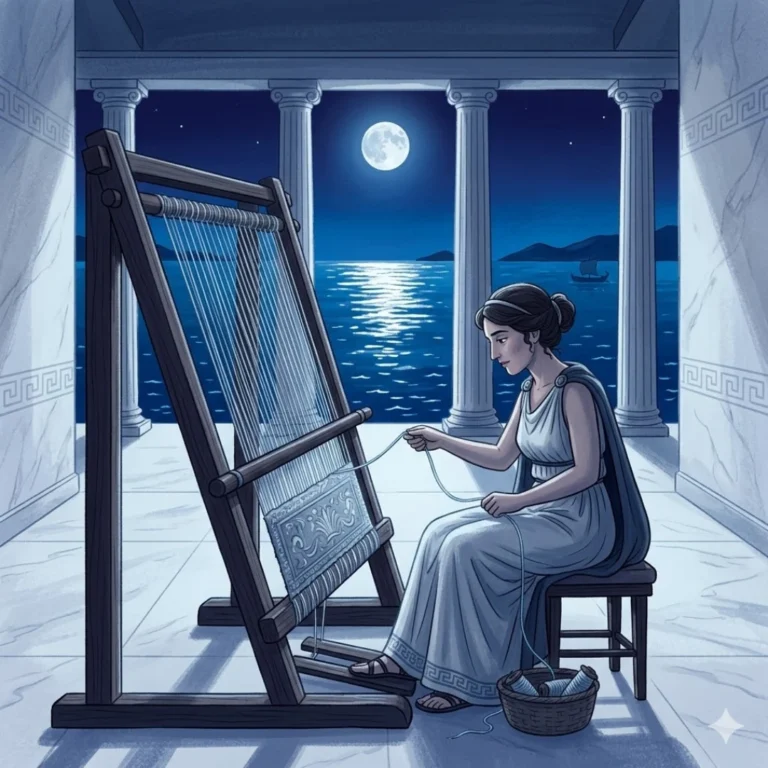
What they did not know was this: every night, by lamplight, Penelope unravelled the day’s weaving.
She did this for three years. The shroud never finished. The suitors ate and drank and waited. She kept her kingdom from their hands with a needle and a secret.
Eventually, her servants betrayed her secret. The suitors were furious.
But by then, a stranger had come to the palace. A ragged beggar who knew things—things only Odysseus would know.
Odysseus had returned.
Penelope’s faithfulness had held the kingdom together. Not with armies or threats. With wit, patience, and a length of cloth that was always almost done.
The suitors would never know—even at the end—how completely they had been outmanoeuvred by a woman with a loom.
Moral of the Story
Faithfulness and cleverness together are more powerful than force. Keeping faith with what you love, even over long years, is its own kind of heroism.
Learn These Words
- suitor
- a man who wants to marry a woman
- shroud
- a cloth used to wrap a dead body
- unravel
- to undo something that has been woven or knitted
- betray
- to reveal a secret that you were trusted to keep
- outmanoeuvre
- to cleverly gain advantage over an opponent
Test Your Understanding
1Why did the suitors come to Penelope’s palace?
2What did Penelope say she would do before choosing a husband?
3What did Penelope do each night?
4Who finally returned to Ithaca in disguise?
5What lesson does this story teach?
Frequently Asked Questions
Why did Penelope weave and unweave her loom every day?
Penelope used her weaving as a clever stalling tactic. She told the suitors she would choose a new husband only after finishing a burial shroud for her father-in-law, Laertes. Each night she secretly unravelled the day’s work by lamplight, keeping the shroud permanently unfinished and buying herself time for Odysseus to return.
How long did Penelope wait for Odysseus to come home?
Penelope waited a full twenty years for Odysseus. He left for the Trojan War when their son Telemachus was still a baby. The war itself lasted ten years, and Odysseus spent another ten years lost at sea facing legendary adventures before finally returning to Ithaca.
Who were the suitors in Penelope’s weaving story?
The suitors were over a hundred powerful men who invaded Penelope’s palace in Ithaca. They believed Odysseus was dead and each wanted to marry Penelope so they could become the new king. They refused to leave, consuming her food and wine while pressuring her to choose among them.
📚 Recommended Books
Handpicked for readers like you
As an Amazon Associate, we earn from qualifying purchases. These recommendations are personalized based on this story's themes and your reading history.
What is the moral of the story of Penelope’s weaving?
The story teaches that patience, loyalty, and clever thinking can overcome brute force and intimidation. Penelope couldn’t physically drive away a hundred suitors, but she used her intelligence and resourcefulness to outwit them for years, proving that wisdom and determination are powerful forms of strength.
Is Penelope’s weaving story suitable for kids?
Yes, Penelope’s weaving is an excellent myth for children. It highlights themes of patience, loyalty, and using your wits instead of violence. The story introduces kids to Greek mythology through a strong, resourceful female character and carries a timeless lesson about the power of intelligence and perseverance.