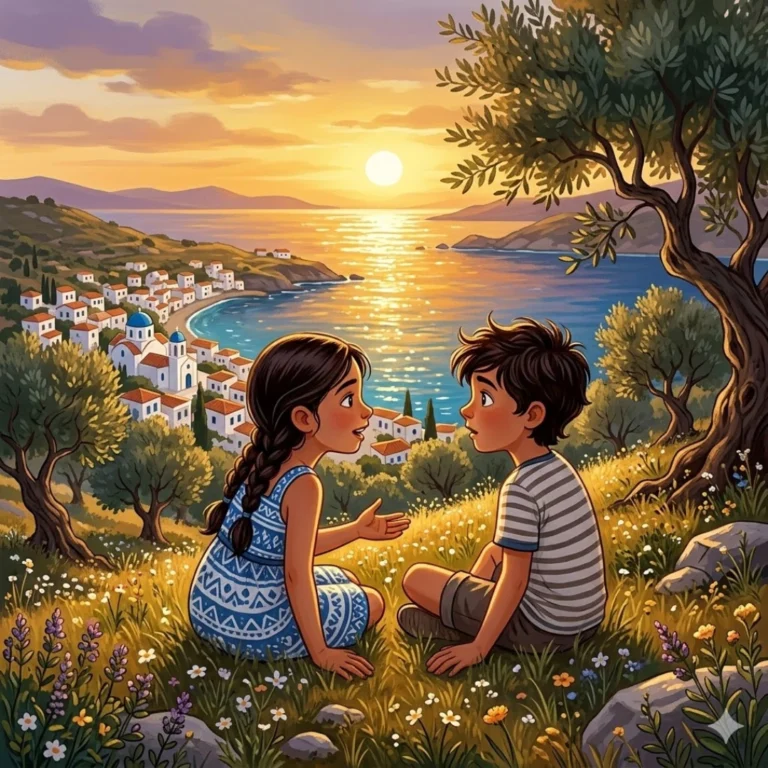
On the island of Lesbos, where the olive trees grow old enough to remember several gods and the sea on three sides says the same thing in three different languages of waves, there was a girl called Irini whose best friend had forgotten who he was.
This is the part of the story that requires explanation.
Her best friend was the son of a minor deity – not one of the famous twelve, not one who appeared in the great myths with golden eagles and lightning bolts and very bad decisions about love. He was the son of Philia, the goddess of friendship and affection, which is a quieter godhood than most, lived in the details of loyalty and the ordinary courage of staying. His name was Philos, he was ten years old on the outside and several centuries old on the inside, and he had been spending too much time on earth without remembering to be divine, which is a specific problem that minor deities are warned about and frequently ignore.
The forgetting happened gradually.
Irini had known Philos since she was eight, when he had appeared at her school one autumn and she had shared her lunch with him because he hadn’t brought one and had not known that bringing lunch was expected. Since then they had walked home together every day, argued about things that mattered and things that didn’t, and he had been consistently, reliably, inconveniently present in the way of good friends.
But over this winter he had started to change.
He forgot that Irini didn’t like the harbor road in the dark. He forgot that she was afraid of something happening to her mother since her mother had been sick last year. He forgot that she preferred to hear the whole problem before being given solutions. These were small things. They were also the things that told Irini she was known.
Without being known, she was only accompanied.
She tried to tell him. The first time, he apologized and then forgot again. The second time, he said he had been distracted. The third time, she asked him directly: “Are you all right? You seem different.”
“I am exactly as I always was,” he said, which was the answer of someone who has not looked in a mirror recently.
Irini thought about this for a week.
The problem, she decided, was that Philos had forgotten who he was. Not in the dramatic way – he still knew his name and his house and which school they attended. He had forgotten what he was for. He was the son of Philia, goddess of friendship, and he had been so busy simply existing on earth that he had stopped practicing friendship as something that required attention and intention.
This happened to gods who spent too long among humans. Her grandmother had mentioned it once, in the way that grandmothers in Greek coastal villages mention the behavior of minor deities: matter-of-factly, because they have been living alongside divine neighbors for a long time.
She found him on the hill above the village, looking at the sea in the way of someone who knows something is wrong but cannot locate what.
“Sit down,” she said.
He sat.
“I am going to tell you something true,” she said. “This is what true friends do, which I know because I have read about it, and also because you told me once, when you were more yourself.”
“I am myself.”
“Philos. You have forgotten what you are for.” She said it without accusation, because accusation would have made him defensive, and defense was not what was needed. “You are Philia’s son. Friendship is not what you practice – it is what you are. When you stop practicing it, you stop being what you are, which is what has been happening all winter.”
He was quiet for a long time. The sea below them was saying its three things in three languages of waves.
“I didn’t know I had forgotten,” he said.
“That’s the nature of forgetting.”
“What did I forget?”
“That I don’t like the harbor road in the dark. That I worry about my mother. That I want to be heard before I am helped.” She paused. “That knowing these things is the whole difference between a friend and someone who happens to be present.”
Philos looked at the sea for a while. The olive trees around them moved in the island wind with the patience of trees that have been doing this for a very long time.
“I’m sorry,” he said.
“I know.” She let this settle. “What I am telling you is not to make you feel terrible. I am telling you so that you remember. The reason I am telling you is because I would rather tell you a hard true thing than lose you to your own forgetting.”
He was quiet again, and his face went through several things, and then it changed – slightly, in a way she had not seen all winter. Something came back into his eyes that had been absent: the quality of attention that had made him extraordinary as a friend, the look of someone who was fully, carefully present.
“You walked up a hill to tell me a hard thing,” he said.
“Yes.”
“Because you are my friend.”
“Yes.”
He thought about this in the way of someone being reminded of their own nature from the outside, which is one of the things friends are for.
“I don’t like the harbor road in the dark either,” he said. “I should have remembered.”
“You will now.”
They sat on the hill until the sun came down into the Aegean and turned the water every shade of gold, and the olive trees cast long shadows across the hillside, and the island settled into evening the way it had been doing since before the gods had names for things.
Below them, the sea spoke its three languages to the shore that had always been listening.
Philia’s son was paying attention again.
This is what friendship does, when it is practiced as seriously as it deserves: it reminds us who we are, and holds us in that knowledge, even when we have forgotten to hold it ourselves.
The Moral of This Story
A true friend holds up a mirror to your soul and still chooses to stand beside you
About This Story’s Culture
This story is set on Lesbos (also known as Lesvos), a large Greek island in the Aegean Sea near the Turkish coast, famous for its olive groves, ancient history, and as the birthplace of the poet Sappho. In Greek mythology, Philia (φιλία, filía) is the concept of friendship and affection – one of the Greek words for love (alongside eros, storge, and agape) – rather than a single deity, though the story personifies it as such in the tradition of Greek mythology. The Aegean’s characteristic light and the olive groves of Lesbos are authentic to the setting. The idea of minor deities becoming confused among mortals appears in several Greek mythological traditions. The name Irini (Eirene) is an authentic Greek name meaning ‘peace.’ The story’s philosophical content reflects authentic Greek philosophical thought about the nature of friendship (φιλία), as explored extensively by Aristotle in his Nicomachean Ethics.
Key Story Elements
- Irini – a ten-year-old Greek girl whose best friend has been forgetting her in small but significant ways
- Philos – the son of Philia, goddess of friendship, who has forgotten what he is for
- The three small forgotten things: harbor road fear, mother’s illness worry, hearing before solving
- Andersen’s lyrical melancholy: the sea speaking three languages, olive trees older than god-names
- Irini’s diagnosis: not that he is bad but that he has forgotten his nature
- Walking up the hill to tell a hard true thing – friendship as the act of choosing difficulty over comfort
- Philos’s eyes changing when attention returns – the subtle physical sign of the soul remembering
Frequently Asked Questions
What is Philia in Greek mythology?
Philia is the Greek goddess of friendship and affection. Unlike the famous Olympian gods, she represents a quieter kind of divinity — the everyday loyalty, warmth, and courage involved in genuinely caring for another person. Her name is also the Greek word for the deep, platonic love found in close friendships.
What age group is the story Philia and the God Who Forgot suitable for?
The story is written for children aged 6 to 12, with a reading time of around 8 to 10 minutes. It blends Greek mythology with themes of friendship and loyalty in a gentle, accessible way, making it a great read-aloud for younger kids or an independent read for older ones.
What is the main friendship theme in this story?
The story explores what true friendship means — the quiet, ordinary courage of staying by someone’s side even when things get complicated. Through Irini and Philos, it asks what it looks like to stand by a friend who has lost their way, reflecting the deeper meaning of Philia as a concept.
📚 Recommended Books
Handpicked for readers like you
As an Amazon Associate, we earn from qualifying purchases. These recommendations are personalized based on this story's themes and your reading history.
Who is Philos in Philia and the God Who Forgot?
Philos is the ten-year-old son of Philia, the Greek goddess of friendship. Though he appears to be a regular boy, he is actually several centuries old and has spent so much time living among humans that he has gradually forgotten his divine nature — which becomes the central mystery of the story.
Where is the story of Philia and the God Who Forgot set?
The story is set on the Greek island of Lesbos, a real island in the Aegean Sea with a rich history in ancient Greek culture and poetry. The vivid island setting — with its old olive trees and surrounding sea — gives the tale an authentic mythological atmosphere while feeling warm and grounded.