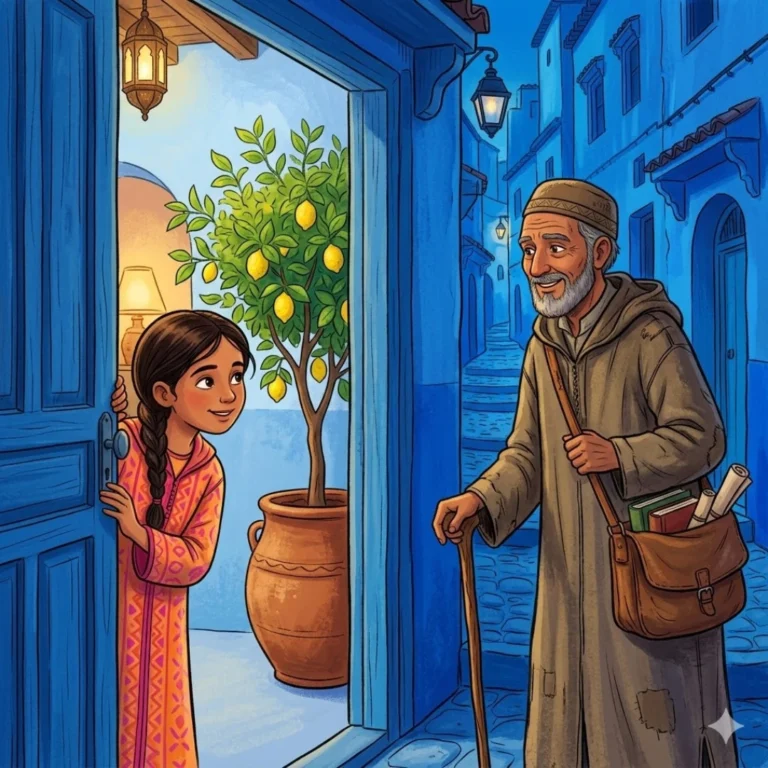
The city of Chefchaouen is painted blue.
Not one kind of blue – not the flat, decided blue of a painted wall – but every blue there is, shade layered on shade until the streets feel like walking through water, or through a sky that has come down to find out what the earth feels like, or through a place that simply decided one day that blue was the right answer to the question that the mountains were asking.
The mountains in question are the Rif, and they are considerable, and they stand around the blue city the way older siblings stand around something small and notable: protective, slightly amused, clearly fond.
A girl called Fatima lived in the blue city with her grandmother, her two aunts, and four cousins in a house that had three rooms and a courtyard where a lemon tree grew in a clay pot so large it was a mystery how it had been brought inside in the first place.
Fatima was nine years old. She kept the house clean, fed the lemon tree, helped her grandmother make m’hanncha (the serpent pastry that coiled like a beautiful idea and smelled of almonds and orange blossom) and attended school down the hill where the blue faded into the ordinary brown of the valley road.
One afternoon in October, a scholar arrived.
He was not remarkable to look at – a man of perhaps forty with dusty shoes and a notebook that had been rained on more than once and repaired with what appeared to be used envelope glue. He was, he said, traveling from Fès to the coast by the mountain roads to study the old water systems of the Rif, and he had underestimated the afternoon.
The afternoon, in October in the Rif Mountains, has a way of going dark and cold very quickly, as though it has been waiting for exactly this opportunity.
He knocked on three doors before he knocked on Fatima’s grandmother’s door.
Fatima answered. She was nine years old and she had been told certain things about strangers and she assessed the scholar with the specific calculation of someone who has been paying attention to faces for their whole life.
His shoes were very dusty. His notebook was repaired with envelope glue. He smelled of the road and mountain air and a little of mint tea, which was the smell of someone who had been traveling long enough to have accepted hospitality from other people on the way.
“One moment,” she said, and closed the door gently and went to her grandmother.
Her grandmother was making tea. She did not look up.
“Who is it?”
“A scholar. From Fès. He has been walking the mountain road all day and it’s going dark.”
Her grandmother set down the teapot. “What do you see in his face?”
Fatima thought about this. “Tired. And kind, I think. He thanked me when I said one moment, which was strange because I had closed the door on him.”
“A man who thanks the door that closes against him,” said her grandmother, “is either very patient or very good. In either case he may come in.”
Fatima opened the door. “Please,” she said. “Enter.”
Her grandmother’s hospitality was a form of art. Fatima had watched it all her life: the specific speed of tea-making that communicates urgency without fuss, the placement of the tray that says you are not an interruption, the food that appears so naturally it seems to come from the house itself rather than from work done in advance.
The scholar sat in the courtyard under the lemon tree and ate a bowl of harira soup and bread and olives, and his face changed as he ate in the way faces change when they have been tightened against cold for hours and are now warm.
“I owe you more than this can pay,” he said to Fatima’s grandmother.
“You owe us nothing,” said the grandmother. “The guest brings baraka.”
Baraka: blessing. The guest carries blessing to the house that receives them. This was not sentiment – it was practical theology, understood for a thousand years in the places where the desert road and the mountain road meet and strangers need hospitality to survive.
“What is your name?” Fatima asked the scholar, because she had been curious since the dusty shoes.
“Abdullah,” he said. “And yours?”
“Fatima.”
“Do you know why the city is painted blue?”
She had grown up with the blue and had never thought to ask why. “No.”
“Some say it was the Jewish community who first painted their homes blue, because blue represents the sky and heaven and reminds us to elevate our thoughts. Some say it keeps the mosquitoes away. Some say it was simply beautiful and once begun, could not be stopped, because beauty has a way of continuing itself when people are paying attention.” He looked at the courtyard wall, which was the deep blue of late afternoon shadow. “I think all three are probably true at once.”
“Can three different reasons be true at once?”
“Usually,” said the scholar. “Most important things have more than one reason.”
Fatima thought about this for the rest of the evening while she helped her aunt prepare dinner and the scholar sat writing in his much-repaired notebook by the light of the lamp her grandmother had lit without being asked.
In the morning he left before sunrise, because the mountain road and the coast were still ahead of him. He left a small careful drawing on the last page of his notebook – a lemon tree in a clay pot – and tore it out and placed it by the teapot.
Fatima found it when she was laying breakfast. She brought it to her grandmother.
“What do you think he was studying?” Fatima asked.
“The water systems,” said her grandmother.
“Old water systems.” Fatima looked at the drawing. “Why does someone study old water systems?”
“To understand how people brought water from the mountains to the places that needed it. To learn what the people who came before knew, so we do not have to discover it again from nothing.” Her grandmother poured tea. “Like hospitality. We know this works because a thousand years of people knew it works. The guest brings baraka. This is not a custom invented yesterday.”
Fatima pinned the lemon tree drawing on the courtyard wall.
When you looked at it in the right light, the tree in the drawing looked very much like the tree in the pot, which was exactly as it should be.
The Moral of This Story
A guest brings blessing; the door you close against a stranger closes against fortune
About This Story’s Culture
Chefchaouen (also Chaouen) is a real city in the Rif Mountains of northern Morocco, famous for its distinctive blue-painted medina (old city). The tradition of blue paint is historically connected to the Jewish community who settled there in the 15th century after fleeing the Spanish Inquisition. The concept of baraka (blessing/grace) is central to Moroccan and broader Islamic spiritual practice. Moroccan hospitality (diyafa) is a deeply ingrained cultural value – guests are expected to be welcomed with mint tea and food, regardless of circumstances. Harira is the traditional Moroccan soup of tomatoes, lentils, chickpeas, and lamb. M’hanncha (the serpent pastry) is a traditional Moroccan almond pastry coiled into a circle. The Rif Mountains water systems are of genuine historical and anthropological interest. The Arabic names Fatima (daughter of the Prophet Muhammad) and Abdullah are among the most common names in Morocco.
Key Story Elements
- Fatima – a nine-year-old girl in the blue city of Chefchaouen who assesses the scholar before opening the door
- The grandmother’s test: a man who thanks the closing door is patient or good – in either case, he may enter
- The scholar Abdullah – traveling the Rif mountain road to study ancient water systems
- Potter’s quiet domestic magic: the hospitality as art form, tea-making speed that communicates urgency without fuss
- Baraka – blessing brought by the guest as practical theology of the mountain road
- Why Chefchaouen is blue: three reasons true at once, because most important things have more than one
- The lemon tree drawing left behind – the gift of attention given to what was already there
Frequently Asked Questions
What is The Blue City and the Wandering Scholar about?
It’s a Moroccan children’s story set in the famously blue city of Chefchaouen. It follows Fatima, a nine-year-old girl living with her grandmother and cousins, and explores themes of hospitality and wisdom through an encounter with a travelling scholar. It’s written for children aged 6 to 12 and takes about 8 to 10 minutes to read.
Why is Chefchaouen called the Blue City?
Chefchaouen in Morocco is famous for its streets and buildings painted in dozens of shades of blue. The story describes it beautifully as every blue layered on every other blue, making the streets feel like walking through water or sky. The city sits in the Rif Mountains, which surround it like protective older siblings.
What age group is this Blue City story suitable for?
The story is written for children aged 6 to 12. The language is rich and imaginative but accessible, making it great for independent readers or for reading aloud together. It takes around 8 to 10 minutes to read from start to finish.
📚 Recommended Books
Handpicked for readers like you
As an Amazon Associate, we earn from qualifying purchases. These recommendations are personalized based on this story's themes and your reading history.
What tradition or culture does this story come from?
The story draws on Moroccan tradition. It features real Moroccan details like the blue streets of Chefchaouen, the Rif Mountains, and m’hanncha, a traditional Moroccan serpent-shaped pastry made with almonds and orange blossom. The central theme of hospitality is deeply rooted in Moroccan and wider North African culture.
What is the main theme of The Blue City and the Wandering Scholar?
The main theme is hospitality — a value central to Moroccan culture and many traditional stories. The story explores what it means to welcome a stranger with generosity and warmth. It’s a gentle, meaningful tale that gives children a way to think about kindness and openness toward others.