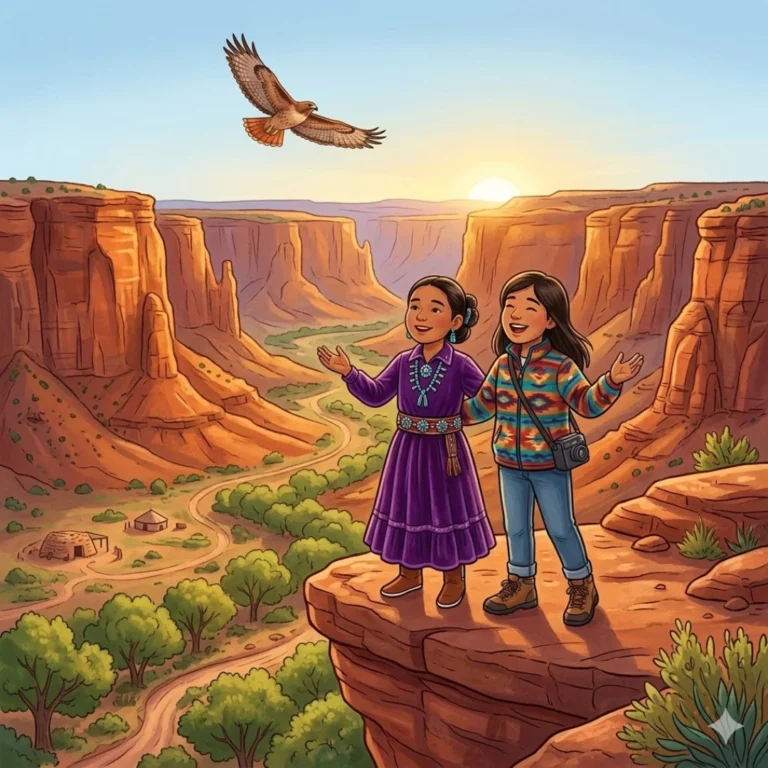
In the morning the canyon holds its light differently than anywhere else in the world.
Canyondechelly has been holding light this way for eight hundred years of Diné memory, and considerably longer before that. The sandstone walls are the color of dried blood and copper and the inside of a peach, and in the early hours they catch the new sun and throw it back changed – warmer, older, like light that has been considered by something very large before it reaches you.
A girl named Nizhoni stood at the canyon’s eastern rim before sunrise, which she had done every morning since she was old enough to do things before sunrise, which was younger than her mother was entirely comfortable with but which her grandmother had encouraged on the grounds that the canyon does not belong to daylight hours alone and a child should know the whole of where she is from.
Nizhoni was ten years old. Her name meant beauty, and she was learning what that meant.
She had thought she knew. Beauty was the canyon in the morning light. Beauty was the Navajo rug her grandmother wove – the pattern that contained a path for the spirit to travel out through the edge of the design, because a pattern with no exit traps the spirit that made it. Beauty was the sound of the kinaalda songs when a girl becomes a young woman, the singing that goes on all night and means something real is happening.
But this summer she was learning something more complicated.
Her cousin Keyah had come from the city for the summer. Keyah was twelve, knew many things about music and phones and city life, and was learning the canyon the way a visitor learns a place: collecting it, photographing it, taking small pieces of it back in pockets.
The taking was what was making Nizhoni’s chest go tight in a way she didn’t quite have words for.
Not the photographing – that was fine, photographs were fine, the light obliged and the canyon didn’t mind. But Keyah had a habit of taking: small stones, a piece of cracked clay from the ancient walls, a handful of sage, a feather she found below the cliff. Take, pocket, keep.
They walked together in the early morning of the third week. The light was doing its particular thing with the canyon walls. A red-tailed hawk rode a thermal above them in long easy circles.
“Can I tell you something?” Nizhoni asked.
“Obviously,” said Keyah, who was looking at a piece of obsidian in her palm.
“The things you take from the canyon. The stones and feathers.”
Keyah looked up. “What about them?”
Nizhoni tried to find the words. They were not easy words.
“My grandmother says hózhó means beauty and balance and rightness all at once,” she said. “And that you can only be in hózhó with a place if you give as much as you take from it. Or more.”
“I’m not taking much,” said Keyah. “Just small things.”
“I know.” Nizhoni paused. “But what are you giving?”
A long silence. The hawk described its circle above them.
“I don’t know,” said Keyah, honestly.
“That’s what my grandmother means. Not that the canyon is damaged by a pebble. But that the taking, when it’s only taking, changes something in the person who does it. You start to think the world is there for you to collect from. And then you take more, and more, and eventually you are taking things that matter because you have gotten used to taking.”
Keyah looked at the obsidian piece. It was genuinely beautiful – sharp-edged, black, with a silver vein running through it.
“What should I do with this one?”
“You could put it back where you found it. Or you could take it home and learn its story – where it came from, what made it, what it means – and that would be honoring it instead of just keeping it. Or you could leave something in exchange. Something real, that costs you something.”
Keyah was quiet for a while.
“What would you leave?”
Nizhoni thought about it. “I would sing. My grandmother taught me the walking-in-beauty song. When I sing it here, it’s a gift to the place. It doesn’t cost money but it costs practice and intention and it makes the canyon a part of me instead of just something I passed through.”
“Teach me,” said Keyah.
So Nizhoni taught her, there on the canyon rim in the early light – the walking-in-beauty song that is an old Diné prayer, the words that say beauty before me, beauty behind me, beauty above and below and all around. The words that are not only about looking but about being in the right relationship with where you are.
Keyah’s voice was uncertain at first and then less so. The canyon walls held the sound the way they held the light, considering it before returning it changed.
The hawk came lower on its thermal, passing near enough that they could see the russet of its tail.
“Does the canyon hear?” Keyah asked.
“I think things that are very old and very present hear everything,” said Nizhoni. “Even the imperfect singing. Maybe especially that.”
Keyah put the obsidian back where she had found it, in the crack between two large sandstone slabs. Then she photographed it there – beautiful in its place, correctly held by the stone that matched it.
They walked back toward the rim in the strengthening light, and Nizhoni thought about what her grandmother had told her: beauty is not a thing you own. It is a way you walk. And the walking is the gift you give the world for the gift the world gives you.
Hózhó nahasdlíí. Beauty is restored.
Beauty is restored.
Beauty is restored.
The Moral of This Story
Beauty is not in what you take from the world but in how you walk within it
About This Story’s Culture
This story draws on Navajo (Diné) cultural philosophy and is set in Canyon de Chelly (Tséyi’ in Navajo), a National Monument in northeastern Arizona that has been continuously inhabited by Navajo people for over 800 years. Hózhó is a foundational concept in Navajo philosophy encompassing beauty, balance, harmony, and right relationship with all existence – it is the central goal of the Navajo healing ceremony (Hózhóójí/Blessingway). The walking-in-beauty prayer (Hózhó Nahasdlíí) is a real Navajo prayer used in healing ceremonies and in everyday spiritual life. The detail about Navajo rugs having a spirit line (ch’ihónít’i) – an intentional break in the pattern to allow the weaver’s spirit to exit – is authentic to many traditional Navajo weavers. The story handles Navajo spiritual content with care, sharing publicly known cultural philosophy without reproducing sacred ceremonial content.
Key Story Elements
- Nizhoni (meaning ‘beauty’) – a ten-year-old Diné girl who understands the canyon with her whole self
- Keyah – the city cousin who collects the canyon without knowing what she takes from herself
- Hózhó – the Navajo concept of beauty, balance, and right relationship that cannot be translated simply
- Miyazawa’s nature communion: the canyon holding light like consideration, the hawk on the thermal
- The spirit path left open in Navajo weaving – beauty must have an exit or it traps the maker
- The walking-in-beauty song as gift to place – what costs practice and intention, not money
- The obsidian put back and photographed in place – honoring vs collecting
Frequently Asked Questions
What is the story Walking in Beauty about?
Walking in Beauty is a Navajo-inspired story about a ten-year-old girl named Nizhoni, whose name means beauty, as she learns what it truly means to respect and connect with the natural world around her. Set in the stunning Canyon de Chelly, the story explores themes of nature, tradition, and growing up within a rich cultural heritage.
What age group is Walking in Beauty suitable for?
Walking in Beauty is written for children aged 6 to 12. With an 8 to 10 minute reading time, it works well as a bedtime story or classroom read-aloud. The language is rich but accessible, making it enjoyable for young readers and a great conversation starter for parents and teachers.
What Navajo tradition or culture does this story draw from?
The story draws from Diné (Navajo) tradition, set in Canyon de Chelly, a place deeply sacred to the Navajo people for over 800 years. It reflects the Navajo concept of Hózhó — a philosophy of walking in beauty, balance, and harmony with the natural world, which sits at the heart of the story’s theme.
📚 Recommended Books
Handpicked for readers like you
As an Amazon Associate, we earn from qualifying purchases. These recommendations are personalized based on this story's themes and your reading history.
What lesson does Walking in Beauty teach kids about respect for nature?
The story teaches children that respecting nature means truly paying attention to it — observing, listening, and understanding that the world around us has wisdom of its own. Through Nizhoni’s daily sunrise ritual, young readers learn that belonging to a place means knowing it fully, not just in comfortable or convenient moments.
Why is the main character in Walking in Beauty named Nizhoni?
Nizhoni is a Navajo name meaning beauty. Her name is central to the story’s theme, as she spends the narrative learning what beauty really means — not just how something looks, but how it feels, endures, and connects us to the land and to each other. It reflects the deeper Navajo concept of living in harmony and balance.