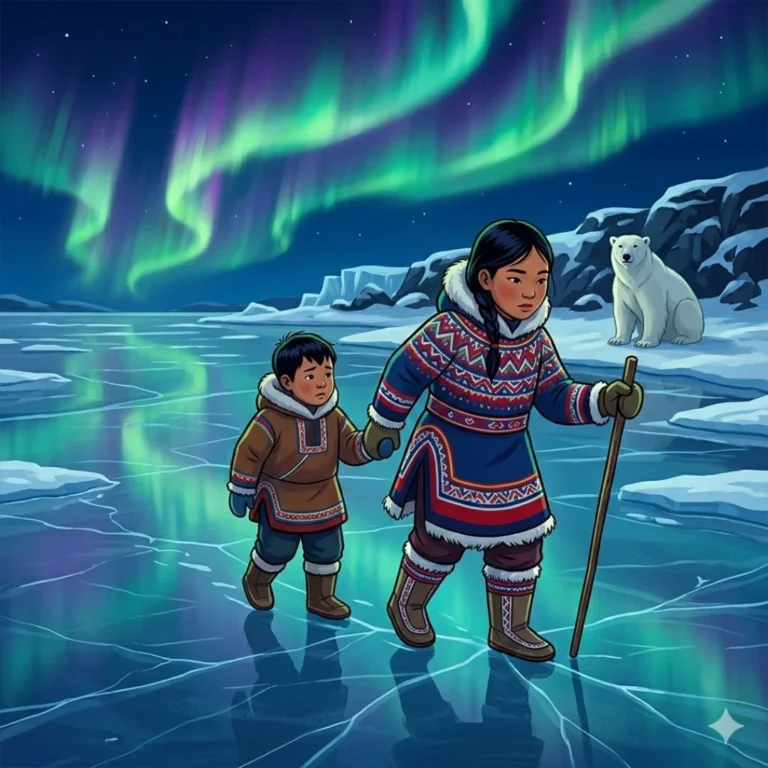
Above the Arctic Circle, in the time of the long night when the sun does not rise for weeks and the stars are so bright they cast shadows, the ice breathes.
This is not poetry. The sea ice actually moves – contracting in the cold, expanding when the light increases, cracking and shifting in the dark with sounds like rifle shots that travel miles through the frozen air. People who grow up on the ice learn to read these sounds the way others read words. A sharp crack means a new fracture. A long groan means the ice is under pressure. Silence can mean the worst thing of all.
Siku was eleven years old, and she had been reading the ice since she was old enough to listen, which in her family was very young indeed.
Her settlement of Igloolik sat on a peninsula of tundra at the edge of Foxe Basin, and the people there had lived with the Arctic for ten thousand years, and the knowledge of ten thousand years was in the names they had for ice – over forty different words for different kinds, different conditions, different dangers. Siku’s grandmother knew all forty. Siku was working on her thirty-second.
The problem began with her younger brother Nanuq, who was seven and named for the polar bear and had something of the polar bear’s personality – specifically, the part that moves toward things without fully thinking about what those things are.
Nanuq had gone onto the ice.
Not on the near ice, which was thick and well-tested and where the community went regularly. Onto the new ice that had formed east of the usual path, the ice that their mother had said specifically and clearly was not to be walked on, the ice that had only been forming for five days.
Siku had watched him go. She had been fifty feet away and she had seen where he was headed and she had shouted and he had either not heard or had made the decision to pretend not to hear, which with Nanuq was always a real possibility.
By the time she reached where he had gone, he was forty meters out on the new ice.
The new ice was, from a distance, indistinguishable from the old ice. Up close, if you knew what to look for, you could see it: the slight flex when you put your weight on it, the color a shade too dark, the absence of the rough texture that old ice develops. Five-day ice could hold the weight of a child for minutes or seconds, depending.
Siku did what every instinct in her was screaming not to do: she followed.
She went carefully, which took control she did not feel like she had. She tested each step before committing weight. She spread her arms, which distributes weight slightly better on uncertain ice. She did not run, though running was the only thing her body wanted to do.
“Nanuq,” she said, in the quietest urgent voice she could manage. “Stop walking. Stand still.”
Nanuq stopped. He had finally heard her, or the tone of what she said had reached some part of him that understood tone. He turned around and looked at her and he saw her face, and his face changed.
“Is it bad?” he said.
“Stand still,” she said again. “Don’t jump. Don’t stamp.”
“Is it -“
“Nanuq. Still.”
She reached him. She had been counting her steps and she knew they were close to the weight-to-thickness margin, and she thought about the forty words for ice and which ones applied right now – there were several that were relevant and none of them were the comfortable words.
“We are going to walk back,” she said. “Slowly. Same path we came on. Follow my feet exactly.”
“But I wanted to see the -“
“Nanuq.”
His face went still in the way that children’s faces go still when they understand something is actually serious.
“Yes,” he said.
They walked back. Forty meters of careful, measured steps, her in front, him behind, each step placed where she placed hers. She felt the ice move twice beneath her – not crack, but flex, which is the warning before the crack – and both times she moved to the next step without stopping, because stopping and panicking takes more time than moving carefully, and time mattered.
They reached the old ice. She knew they were there not by a line or a marker but by the sound of it under her feet – the solid, deep thud of thick ice rather than the slightly hollow feeling of new ice.
She stopped. She stood very still for a moment.
Behind her, Nanuq said: “Siku.”
She turned around.
A polar bear stood on the shore thirty meters away, watching them. It was enormous – the biggest she had seen this close – and it was completely still, which was not how polar bears usually stood when they were planning something. It was watching them with the specific patience of a creature that has all the time in the world and is using it thoughtfully.
They looked at each other, girl and bear, for what was probably ten seconds and felt like something much longer.
Then the bear turned and walked north along the shore, unhurried, not looking back.
“Was that Nanuq?” said her brother, meaning the spirit of the polar bear. Their people had a complicated relationship with the bear – it was prey and it was sacred and it was sometimes a warning and it was always a presence to be treated with respect.
“I don’t know,” said Siku honestly.
She told her mother that evening. All of it – where Nanuq had gone, that she had followed, the path back, the bear.
Her mother said nothing for a long time. Then: “You went on five-day ice.”
“Yes.”
“You knew it was five-day ice.”
“Yes.”
Another silence. “Did you go because you weren’t afraid?”
Siku thought about this carefully and honestly. “No. I went because he was on it and I knew how to walk it carefully and he didn’t.”
Her mother looked at her. “That is the only reason worth going.”
The ice talked that night, the way it does in the long Arctic dark – cracking and groaning and breathing in the cold – and Siku listened to it the way she had since she was small, reading the language of the place she was from, learning its newest word.
The Moral of This Story
Bravery in the dark is the only kind that counts, because anyone can be brave in the light
About This Story’s Culture
The Inuit people of the Arctic have one of the most sophisticated relationships with ice and cold environments developed by any human culture. Igloolik is a real Inuit community on an island in Nunavut, Canada, one of the most traditional Inuit communities and a center for the preservation of Inuit culture and language (Inuktitut). The famous claim about many Inuit words for snow (and ice) is well-documented – the Inuit language uses a polysynthetic structure that allows for extremely precise descriptions of ice and snow conditions, representing genuine technical knowledge crucial for survival. Nanuq (polar bear) is an important figure in Inuit spiritual life – the polar bear is both hunted for food and respected as a near-equal hunter. The story reflects authentic Inuit values of careful environmental knowledge, intergenerational learning, and reading natural signs for survival. The concept of the long night (polar night) is authentic to communities above the Arctic Circle.
Key Story Elements
- Siku – an eleven-year-old Inuit girl from Igloolik, expert ice-reader protecting her reckless brother
- The forty Inuit words for ice – the knowledge of ten thousand years encoded in language
- New ice vs old ice: the science of five-day ice, the hollow feeling underfoot, the color
- Stevenson’s practical adventure: no magic, no shortcuts, just controlled movement and technical knowledge
- Nanuq (seven years old, named for the bear) making the decision to pretend not to hear
- The polar bear on the shore: spirit or animal, watching and turning away
- Siku’s honest answer: she went not because she wasn’t afraid but because she knew how
Frequently Asked Questions
What is the story Siku and the Polar Bear’s Warning about?
Siku and the Polar Bear’s Warning is an Inuit-tradition story about an eleven-year-old girl named Siku who lives in the Arctic and knows how to read the sounds and movements of sea ice. The story explores themes of bravery, ancient knowledge, and the deep connection between Arctic people and their environment.
What age group is Siku and the Polar Bear’s Warning suitable for?
This story is written for children aged 6 to 12 and takes around 8 to 10 minutes to read. The language is vivid and engaging, making it great for independent readers or as a read-aloud with younger children who enjoy adventure and nature-based stories.
What cultural tradition does this polar bear story come from?
The story is rooted in Inuit tradition and is set in Igloolik, a real community in the Canadian Arctic. It draws on authentic Inuit knowledge, including the many words for different types of ice and the skills passed down over ten thousand years of Arctic living.
📚 Recommended Books
Handpicked for readers like you
As an Amazon Associate, we earn from qualifying purchases. These recommendations are personalized based on this story's themes and your reading history.
What moral or lesson does this story teach kids?
The central theme is bravery — specifically the quiet, everyday courage of listening carefully, trusting inherited wisdom, and acting in the face of danger. The story shows children that real bravery often means respecting nature and the knowledge of those who came before us.
Why does the ice make sounds in the Arctic setting of this story?
Sea ice constantly contracts, expands, cracks, and shifts due to temperature changes and pressure. In the story, these sounds — sharp cracks, long groans, and unsettling silence — carry important warnings. Siku has learned to read them like words, which is a real skill among people who live on Arctic sea ice.