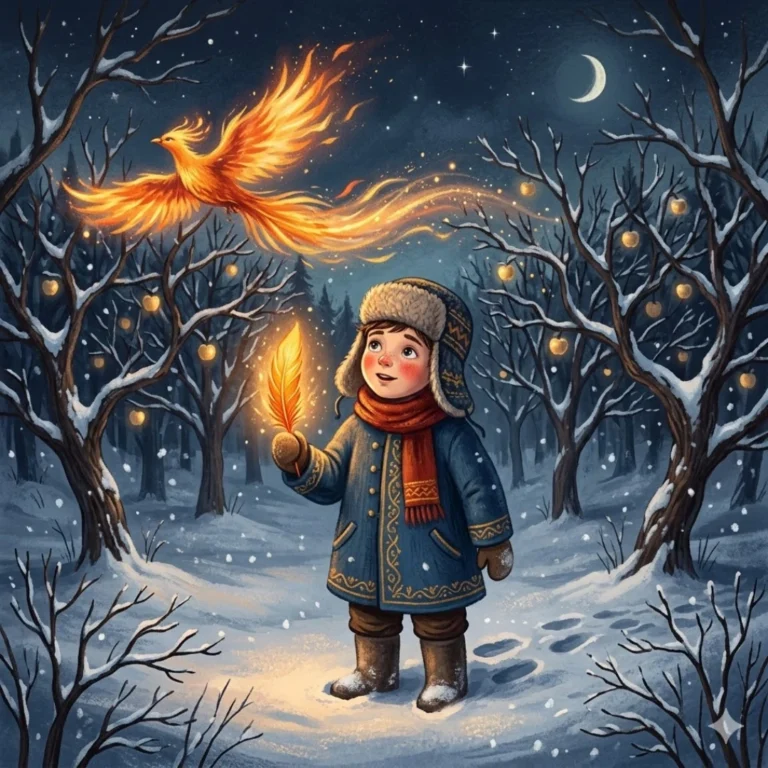
Ivan was the third son, which in Russian fairy tales is either the best or the worst thing to be, depending on the story. The third sons are usually the ones who do the impossible thing. They are also usually the ones sent to do it because nobody expects them to succeed.
He was twelve years old, and he did not feel particularly magical.
His brothers Fyodor and Alexei were older, stronger, and considerably better at everything that could be measured easily. Fyodor was a better wrestler. Alexei was a better horseman. Both of them were better at not being afraid, or at least better at hiding it, which amounted to the same thing in practice.
The trouble began with the Tsar’s orchard.
The Tsar’s golden apple trees were being robbed every night. Something came in the dark and took the apples – the golden ones, the ones that tasted of light and lasted all winter. The Tsar had posted guards, but the guards kept falling asleep at their posts, which was embarrassing. He summoned every able-bodied young man in the region and offered a reward: whoever caught the thief would have whatever they asked for.
Fyodor watched the orchard the first night and fell asleep before midnight. Alexei watched the second night and also fell asleep, and he was more annoyed about it than embarrassed, which is a character detail.
On the third night it was Ivan’s turn.
Ivan sat in the dark at the edge of the orchard and was completely, painfully awake. This was because he was scared. Fear, he had discovered, was excellent at preventing sleep. He sat with his back against the stone wall and his eyes on the apple trees and his heart doing the thing it did when something was about to happen.
At midnight, light came.
Not from lamps or torches – a different kind of light, the kind that lives inside the thing producing it rather than bouncing off it from outside. A bird the size of a falcon landed in the central apple tree, and it glowed. Its feathers were gold and orange and red like the hottest part of a fire, and in its light the whole orchard turned to orange and shadow, and the golden apples gleamed.
Ivan was so frightened he could not move. This was, in a strange way, lucky – because it meant he stayed still enough for the Firebird not to notice him immediately.
He told his legs to stand up. They did not cooperate.
He thought: someone needs you to. His father needed those apples. The Tsar needed the thief caught. His brothers had tried and this was his turn.
His legs stood up.
He ran at the Firebird – not gracefully, not skillfully, running in the stumbling way of someone whose body has overruled their fear by main force – and grabbed its tail.
The Firebird screamed, a sound like a burning forest.
It pulled free. It flew. But in Ivan’s hand, one feather remained: a single long tailfeather, glowing gold and orange, warm to the touch, impossible as a dream made solid.
The Firebird was gone.
Ivan stood in the dark orchard holding a burning feather and shaking so hard his teeth rattled.
He had not caught it. He had grabbed a feather. The golden apples were still gone.
He went to the Tsar.
The Tsar looked at the feather. He looked at Ivan. “You have the feather,” he said slowly. “But not the bird.”
“I frightened it off,” said Ivan. “The apples won’t be taken tonight. If I could get the bird itself -” He stopped. He had not planned this part.
“If you bring me the Firebird,” said the Tsar, “I will give you whatever you want. And if you go looking for it and come back empty-handed, I will throw you in the dungeon, which is where people go when they promise things they cannot deliver.”
This was not a good offer. It was the only offer.
“Yes,” said Ivan.
His brothers said he was a fool. His father said nothing, which was worse. He set out in the morning with a horse he borrowed, the feather in his coat, and the specific kind of fear that comes when you have already agreed to do something terrifying and are merely proceeding toward it.
The Firebird, he learned, lived at the edge of the world where the forests met the sea and the northern lights came down to the water. He did not know this before he left. He learned it the way you learn things on journeys: from a river spirit who wanted him to share his bread (he shared), from an old woman in a hut who wanted him to chop her firewood (he chopped), from a grey wolf who appeared from nowhere on the road and said, in the way of wolves in Russian stories: “I ate your horse. Get on my back and I will take you to the Firebird, because I owe you a horse.”
The wolf was faster than the horse would have been and better at the dark forest paths, and he carried Ivan to the edge of the world in three nights.
The Firebird’s nest was made of gold and phoenix-ash and something that smelled of summer lightning. It sat in the crown of a tree so old it had been there before the forest.
Ivan was, by this point, very tired and quite afraid and past the point where the fear helped him. He was just tired of being afraid.
He climbed the tree in the dark.
The Firebird slept with one eye open, as it always did, but it did not expect something climbing from below, and Ivan moved carefully and steadily and thought about nothing except where the next handhold was.
He caught the Firebird with both hands.
It burned. Not the destroying kind of burning – the kind that means hold on, that means keep going, that means you can bear this. He held on.
He brought it back. The grey wolf carried him, the Firebird wrapped in his coat with both hands around it, three nights through the dark forest.
The Tsar kept his word. Ivan asked for one thing: his family’s land to be their own and not under the Tsar’s thumb. The Tsar agreed, because a Firebird is worth more than a stretch of farmland and he knew it.
Ivan went home.
His father and brothers met him in the yard, and his father looked at him for a long time – at the burn marks on his hands, at the way he stood that was not quite the same as before, at something in his face that had changed in the particular way that hard things change the face of the person who survives them.
“You were afraid the whole time,” his father said. It was not a question.
“Yes,” said Ivan.
“Good,” said his father. “That’s the only kind worth telling about.”
The Moral of This Story
Courage is walking toward the thing that frightens you most, because someone needs you to
About This Story’s Culture
The Firebird (Zhar-Ptitsa) is one of the most beloved creatures in Russian and Slavic folklore, appearing in dozens of tales including those collected by Alexander Afanasyev in the 19th century. The pattern of three brothers where the third succeeds is a fundamental structure of Russian fairy tales (skazki). The grey wolf (Sivka-Burka in some variants) is another iconic figure, often serving as a magical helper. Ivan is deliberately given no special title (no Ivan Tsarevich here) to emphasize that the third-son-hero doesn’t require noble origin. The Tsar’s golden apples are a recurring element in Russian and broader Slavic fairy tales. Afanasyev’s collection, equivalent to the Brothers Grimm collection for Russia, is the source of many authentic structural elements used here.
Key Story Elements
- Ivan the third son – the unexpected hero who is completely and usefully afraid
- The Firebird in the Tsar’s golden apple orchard – authentic Russian fairy tale creature of living fire
- The single feather caught as the beginning of the quest, not its end
- Stevenson realism: Fyodor fell asleep, Alexei more annoyed than embarrassed, Ivan physically shaking
- The grey wolf who ate the horse and owes a replacement – classic Russian fairy tale logic
- Ivan climbing the tree in the dark past the point where fear was useful
- The father’s final verdict: being afraid the whole time is the only kind worth telling about
Frequently Asked Questions
What is the story of Ivan and the Firebird about?
Ivan and the Firebird is a Russian fairy tale about a young boy named Ivan, the third son, who is sent on an impossible quest to catch the magical Firebird that has been stealing golden apples from the Tsar’s orchard. It’s a story about courage, self-doubt, and proving yourself when no one believes you can succeed.
What age group is Ivan and the Firebird’s Feather suitable for?
This story is written for children aged 6 to 12 and takes about 8 to 10 minutes to read. It works well as a bedtime story or a read-aloud, and its themes of courage and believing in yourself resonate with kids across that whole age range.
What is the Firebird in Russian fairy tales?
The Firebird is a magical creature from Russian folklore, often described as a glowing, luminous bird whose feathers shine like flames. It appears in many traditional Russian fairy tales as both a prize and a source of trouble, frequently connected to quests that test a hero’s bravery and cleverness.
📚 Recommended Books
Handpicked for readers like you
As an Amazon Associate, we earn from qualifying purchases. These recommendations are personalized based on this story's themes and your reading history.
Why is being the third son important in Russian fairy tales?
In Russian folklore, the third son is a classic hero figure. He’s usually overlooked and underestimated, sent on dangerous tasks because no one expects him to succeed. But that’s exactly why he often does — he relies on wit, courage, and unexpected help rather than strength or status.
What lesson does Ivan and the Firebird teach children?
The main theme is courage — specifically, that real bravery isn’t about being fearless, it’s about acting even when you’re scared. Ivan doesn’t feel magical or special, yet he steps up anyway. The story shows kids that being underestimated doesn’t mean you can’t do extraordinary things.