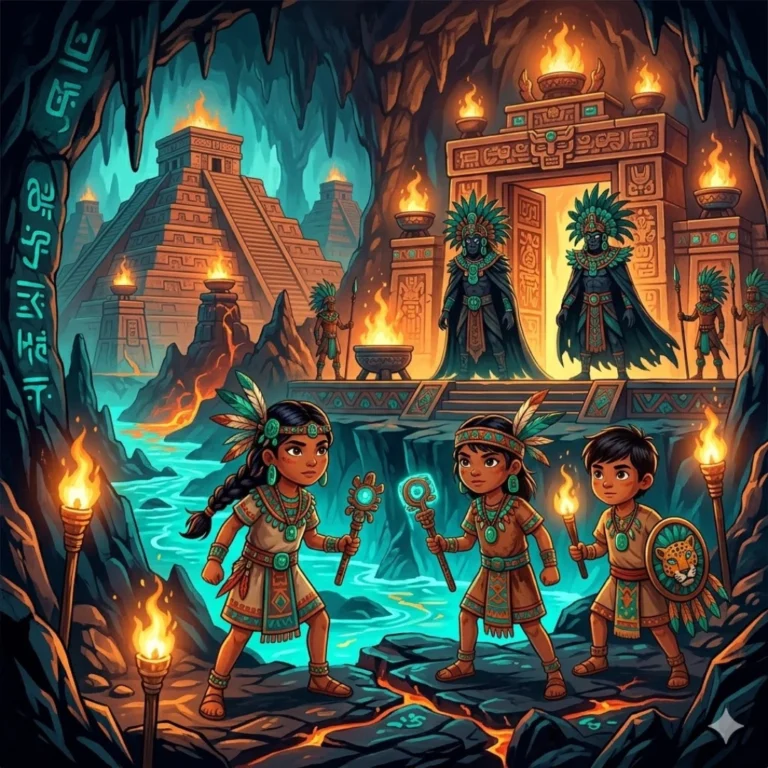
Hear now the tale of the two children who stood where no child had dared to stand, in the days when the great city of Tenochtitlan gleamed like a white flower on the face of the lake, and the smoke of copal incense drifted upward to touch the face of the sun.
Their names were Itzel and her twin brother Coatl, and they were ten years old, quick as hummingbirds and twice as bright. They lived in a village of weavers and farmers at the edge of the great milpa fields, where the corn grew tall as men and the squash blossoms opened each morning like golden trumpets calling the bees to work.
Every evening, when the light turned the color of ripe papaya, old Grandmother Xochitl would sit in the doorway of their adobe home and tell them stories—stories of the Hero Twins, of Quetzalcoatl the feathered serpent, of brave warriors who had faced darkness and returned with light.
“Grandmother,” Itzel said one such evening, pulling her woven shawl tighter as the night wind came down from the mountains, “are those stories true? Did real children ever face the lords of Xibalba?”
Grandmother Xochitl’s eyes, dark and deep as still water, grew distant. “Every story is true in the way that matters most,” she said. “Courage is always real. Fear is always real. And the choice between them—” she pressed a finger to Itzel’s heart, “—that is the realest thing of all.”
Itzel did not know then how soon she would learn exactly what her grandmother meant.
It began at the tlachtli court—the stone ball court at the edge of the village, where the older boys played ullamaliztli, the sacred rubber-ball game, driving the heavy black ball through the stone ring with their hips and knees, never their hands. The court was ancient, its stone walls carved with serpents and flowering vines, and every child in the village knew that something old and powerful lived in the shadows beneath those carvings.
Coatl loved the ball court more than anywhere on earth. He had been practicing since he could walk, rolling the solid rubber ball across the dirt, dreaming of the day he would play in a real match.
But one morning, Itzel woke to find her brother gone and his sleeping mat cold. On the mat sat his prized possession: a small jade pendant in the shape of a quetzal bird, which their father had given him before he marched away to serve the great city.
Coatl never left without that pendant. Never.
Itzel’s stomach turned to cold stone.
She ran to the ball court. The morning mist still clung to the carved stone walls, and the smell of damp earth and old copal smoke hung heavy in the air. The court was silent—too silent, the way a forest goes silent when something dangerous walks through it.
In the center of the court, where the stone ring jutted from the wall, she found a single rubber sandal. Coatl’s.
“He went down,” said a voice.
Itzel spun. Old Tezca, the court keeper, crouched in the shadow of the north wall, his white hair loose around his shoulders, his face as grey as ash. He was pointing at a crack in the stone floor—a crack that had not been there the day before, wide as two hands, breathing cold air up from below.
“Went down where?” Itzel demanded.
“Where the court leads, when the Dark Lords call a player to a match they cannot refuse,” Tezca said. “To Xibalba. To the place below places.”
Itzel stared at the crack. The cold air rising from it smelled of deep earth and something sweet and rotten, like flowers left too long in a closed room. Every story she had ever heard about Xibalba ran through her mind at once—the lords with their masks of bone, the trials of darkness and cold, the rivers of blood and pus that guarded the path, the house of knives, the house of bats.
Her knees shook. Her hands shook. Her whole body shook like a leaf in storm wind.
She took one step back. Then another.
Then she thought of Coatl. His laugh that sounded like water over stones. The way he always saved her the last piece of fried squash. The jade pendant sitting cold and alone on an empty mat.
She turned back to the crack.
“How do I get him out?” she said, and her voice shook too, but she said it.
Old Tezca looked at her for a long moment, as if measuring something. “The Dark Lords will send a challenge. They always do. And you must face it—not with strength, for they have more strength than any living child. Not with cleverness alone, for they have had a thousand years to practice their tricks. You must face it with something they have never had and cannot borrow.”
“What?” Itzel asked.
“Courage,” Tezca said. “The willingness to do what must be done, even when every part of you is screaming to run.”
He pressed something into her palm: the rubber ball from the court, still warm from some game she had not seen played. “Climb down,” he said. “And remember: the Dark Lords feed on fear. Show them yours, and you feed them. But if you act despite your fear—” he smiled, and it was a strange, ancient smile, “—that is something they have no defense against.”
Itzel tucked the ball under her arm. She sat at the edge of the crack. She looked down into the darkness, and the darkness stared back, and every part of her wanted very badly to stand up and go home and let some grown-up handle this.
She climbed down anyway.
The passage below was carved stone, smooth and cold under her fingers, lit by a faint blue light that seemed to come from the rock itself. It went down and down, twisting like the spine of a great serpent, until Itzel’s ears popped and the air grew so cold she could see her own breath like little ghosts puffing from her lips.
At the bottom, a great obsidian door stood open. Beyond it: Xibalba.
It was not what she had imagined. It was not a place of fire. It was a vast grey plain under a sky without sun or moon, lit by a cold, flat light that seemed to come from everywhere and nowhere. Strange trees grew with black leaves. Pale flowers bloomed in colors that had no name. And in the center of it all stood a ball court—exactly like the one above, but made of bone-white stone, the ring carved with grinning skulls.
And standing at the court were the Dark Lords.
There were twelve of them, tall as temple steps, draped in robes the color of midnight. Their masks were bone. Their eyes were empty black holes that somehow still managed to look amused. They were arranged in a semicircle around a small, miserable figure sitting on the court floor, hugging his knees.
“Coatl!” Itzel shouted.
Her brother’s head snapped up. “Itzel? ITZEL! No—go back, go back, you have to go back—”
“How touching,” said the tallest Dark Lord, in a voice like stone grinding on stone. “The twin has come for her twin. This is most convenient. Now we have two players for our match.”
Itzel walked forward on legs that felt made of water. Up close, the Dark Lords were even more terrible—she could feel the cold coming off them, smell the deep-earth scent that clung to their robes, hear the faint sound of something like wind through empty rooms that followed them wherever they moved.
“What are the terms?” she said, and was almost proud that her voice only cracked a little.
The Dark Lord tilted his bone mask. “A match of ullamaliztli. You and your brother, against two of my lords. If you win, you both go free. If you lose—” he gestured broadly at the grey plain, “—you stay and join our court. Forever.”
“And if we refuse?”
“Then your brother stays anyway, and you return alone. Those are our terms.”
Itzel looked at Coatl. He was shaking his head frantically, mouthing the word no. She looked at the two Dark Lords who stepped forward to play—tall and cold and radiating the kind of power that made the air around them shiver.
She walked to her brother and helped him to his feet. She felt him trembling. She was trembling too.
“Can you play?” she whispered.
“I’m scared,” he whispered back.
“Me too,” she said. “Let’s play anyway.”
The match began.
The Dark Lords were skilled beyond anything Itzel had ever seen. The rubber ball came at them with the force of a thrown stone. The court of Xibalba seemed to tilt and shift to favor the lords’ side. Twice Itzel was knocked to the ground and the cold stone burned like ice against her palms. Once Coatl nearly lost the ball through the skull-ringed stone circle on the wrong side.
But every time Itzel fell, she got up. Not because she wasn’t afraid—she was terrified, with a fear so big it felt like it lived in her bones. She got up because Coatl was there, and because it was the right thing to do, and because Old Tezca’s words rang in her memory like a struck bell: Act despite your fear—and that is something they have no defense against.
She began to notice something. The Dark Lords were fast, but they were not used to opponents who kept rising. Each time she and Coatl got up, stepped back to the line, and kept going, the lords hesitated. Just a flicker. Just a fraction of a moment. But it was there.
The Dark Lords fed on fear. And Itzel and Coatl were still afraid—but they were also still playing.
“Coatl,” Itzel said, between heaving breaths, her hip aching from a fall, her hands scraped raw, “that stone pillar—can you make the bank shot off it? The one you practice by the papaya tree?”
Coatl stared at the pillar. She saw him calculating, the way he always did when he lined up a difficult shot. “I’ve never made it in a real match,” he said.
“Neither have I,” she said. “Let’s make it now.”
Coatl looked at her. He was still afraid—she could see it in every line of him. He nodded.
The ball came off the Dark Lord’s hip with tremendous force, angled low. Coatl dove for it, caught it on his knee, sent it arcing sideways. Itzel read his motion before he made it—ten years of living side by side had taught her his body’s language better than any words—and she was already moving, twisting, dropping her shoulder, and driving the ball with every frightened, furious, determined piece of herself toward the skull-ringed stone ring.
The ball passed through.
The sound it made was like a bell struck in an empty temple—ringing and ringing and ringing, echoing off the bone-white walls of Xibalba until it seemed to fill the grey sky itself.
The Dark Lords went still.
For a long, still moment, nobody moved. The grey light of Xibalba seemed somehow brighter than it had before.
The tallest Dark Lord removed his bone mask. Beneath it was a face that was simply old—incredibly, impossibly old, and for just a moment, something in those empty eyes looked almost like respect.
“A bargain made,” he said, “is a bargain kept. Go, children of the upper world. Take your light with you.”
The obsidian door reappeared at the edge of the court. Beyond it, the carved stone passage led back up to the warmth and the living world.
Coatl grabbed Itzel’s hand and ran.
They came up through the crack in the ball court floor into dazzling morning sunlight. The mist had burned away. The corn in the milpa fields caught the light and each tassel glowed gold. Somewhere nearby, a bird was singing so extravagantly that it seemed to be competing with the sun itself.
Old Tezca was gone. But on the ground where he had sat, arranged in a careful circle, were twelve flowers—bright red, like copal flames.
Coatl sat down hard on the stone court floor, pressed his face into his hands, and shook for a solid minute. When he looked up, his eyes were wet.
“I was so scared,” he said.
“So was I,” Itzel said, sitting beside him and leaning her shoulder against his. “I’m still scared, if you want the truth. My hands won’t stop shaking.”
“Then how did you do it? Come down? Play the match?”
Itzel thought about it. She looked at the red flowers in their circle, at the gold-lit corn, at the wide, warm world that went on existing all around them.
“I don’t know how to not be scared,” she said finally. “I think that’s not how it works. I think you just—go anyway. You do the right thing even though you’re scared. Maybe especially because you’re scared.”
Coatl was quiet for a moment. Then he reached into his shirt and pulled out the jade quetzal pendant—it had found its way to him, somehow, in the way that important things sometimes do.
“Grandmother would say we have a very good story to tell her now,” he said.
Itzel laughed, and it surprised her—a real laugh, bright and sudden as the bird in the milpa field. “She would,” she agreed. “She absolutely would.”
And they walked home together through the morning light, two tired, scraped, still-slightly-trembling children who had found out something important about themselves: that being brave does not mean being unafraid. It means doing what is right, and what is necessary, even when your hands won’t stop shaking and your heart is hammering like a drum before a festival.
And sometimes—not always, but sometimes—that is enough to make the darkness step aside.
The Moral of This Story
True courage means doing what is right even when afraid
About This Story’s Culture
This story draws authentically from Mesoamerican mythology, particularly the Popol Vuh epic of the K’iche’ Maya (widely shared across Aztec cultural traditions), in which the Hero Twins Hunahpu and Xbalanque descend into Xibalba to defeat the lords of death through wit and courage. The ullamaliztli ball game (called pok-a-tok in Maya contexts) was sacred throughout Mesoamerica and played on a tlachtli court with a solid rubber ball, the goal being to drive the ball through a stone ring using only the hips, knees, and elbows. Details such as copal incense smoke, milpa corn-field agriculture, obsidian stone, jade ornaments, and the twelve lords of Xibalba are drawn directly from Aztec and broader Mesoamerican religious and daily life traditions.
Key Story Elements
- Aztec twin protagonists (Itzel and Coatl) inspired by the Hero Twins mythology
- Xibalba underworld with twelve Dark Lords as antagonists
- Sacred ball game (ullamaliztli/pok-a-tok) as the central climactic challenge
- Mesoamerican village setting with milpa fields, copal incense, and jade imagery
- Wise elder figure (Old Tezca) delivering guidance without removing the children’s agency
- Sibling bond as the emotional engine driving courage
- Fear shown honestly as the protagonist acts bravely despite trembling hands
Frequently Asked Questions
What is the story of the Brave Twins and the Dark Lords about?
The Brave Twins and the Dark Lords is an Aztec-inspired children’s story about ten-year-old twins Itzel and Coatl, who must summon extraordinary courage to face powerful dark forces. Set in the world of ancient Tenochtitlan, it weaves together themes of bravery, family, and the triumph of light over darkness.
What age group is the Brave Twins story suitable for?
This story is written for children aged 6 to 12 and takes about 8 to 10 minutes to read aloud. It’s a great choice for bedtime reading, classroom storytelling, or any time you want to share a meaningful adventure with kids who enjoy mythology and brave heroes.
Is the Brave Twins story based on real Aztec mythology?
Yes, the story draws on Aztec tradition, referencing real cultural elements like the city of Tenochtitlan, copal incense, the feathered serpent Quetzalcoatl, and the classic Hero Twins myth. While the characters Itzel and Coatl are fictional, the story is rooted in authentic Mesoamerican storytelling.
📚 Recommended Books
Handpicked for readers like you
As an Amazon Associate, we earn from qualifying purchases. These recommendations are personalized based on this story's themes and your reading history.
What moral lesson does the Brave Twins and the Dark Lords teach children?
The story’s central theme is courage and bravery — showing children that even young people can face seemingly overwhelming challenges. It encourages kids to draw strength from their heritage, trust their instincts, and support one another, especially when things feel frightening or uncertain.
Who are the Dark Lords in this children’s story?
The Dark Lords are the powerful antagonists the twin children must face in this Aztec-inspired tale. Rooted in Mesoamerican mythology, figures of darkness represent forces that test the courage and spirit of heroes. Reading the full story reveals how Itzel and Coatl confront them using wit and bravery.