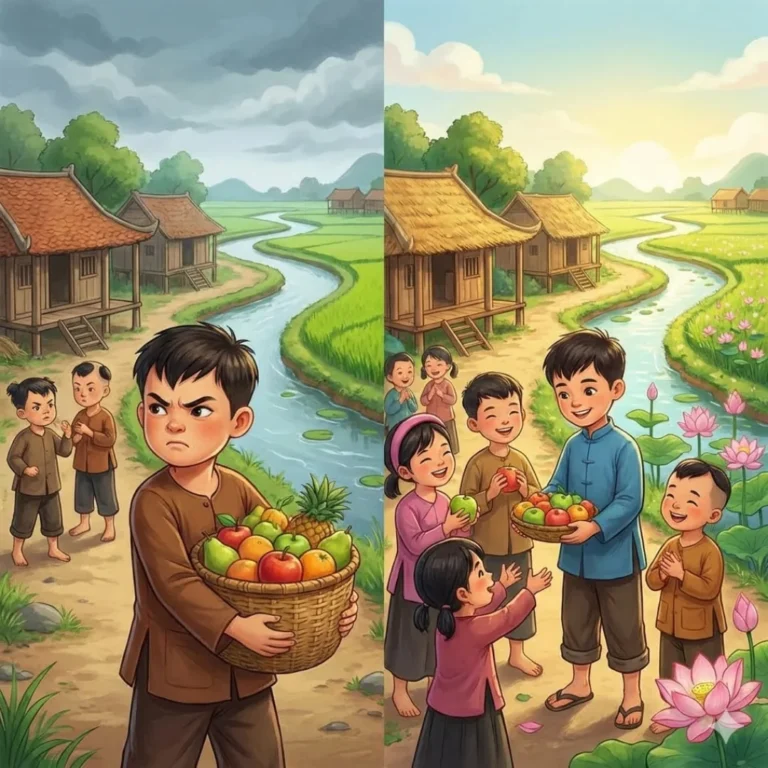
In a village on the slopes of Mount Merapi, where the morning mists rose like silver spirits and the rice terraces climbed toward heaven in emerald steps, there lived a girl named Sari. Her name meant \”essence\” or \”beautiful,\” but Sari herself did not feel beautiful at all. In fact, Sari spent most of her days thinking about all the things she did not have.\n\nSari did not have fancy batik cloth like the merchant’s daughter. She did not have sweet lapis legit cake for breakfast like the baker’s son. She did not have golden rings like the goldsmith’s children, nor fine leather shoes like the mayor’s family.\n\nWhat Sari did have was a small wooden house with a view of the volcano, a mother who wove the most intricate ikat patterns, a father who carved beautiful wooden puppets for the wayang kulit shadow plays, and a grandmother whose stories could make flowers bloom and birds sing. But Sari barely noticed these things, so busy was she looking at what others possessed.\n\nOne day, as Sari sat sulking because she had no bicycle like her friend Dewi, a strange old woman appeared at their door. She wore a kebaya of midnight blue, and her eyes sparkled like stars trapped in wells.\n\n\”I am a traveling merchant of music,\” the old woman said. \”I carry instruments that play only for those with grateful hearts. I wonder if there is anyone in this village who might hear their songs?\”\n\nSari’s father welcomed the woman inside and offered her tea and pisang goreng—fried bananas, still warm and sweet.\n\n\”I see you are generous,\” the woman said, \”though you have little.\”\n\n\”We have enough,\” Sari’s mother said softly, \”and what is enough is plenty when shared.\”\n\nSari rolled her eyes at her mother’s words. How could her mother say they had enough when clearly they had so little compared to others?\n\nThe old woman unpacked an instrument from her bag. It looked like a miniature gamelan—the traditional orchestra of bronze percussion instruments that Sari had seen played at temple ceremonies. But this gamelan was no bigger than a jewelry box, with tiny gongs and metallophones that gleamed like captured moonlight.\n\n\”This,\” the old woman said, \”is a Gamelan of Grateful Hearts. Each time you speak aloud something you are thankful for, one instrument will play. When all the instruments play together in harmony, you will receive a gift beyond measure.\”\n\nSari’s heart leaped. A gift! Perhaps something valuable, something that would make her as rich as the merchant’s daughter!\n\n\”I’ll do it!\” Sari said quickly, reaching for the miniature gamelan.\n\nThe old woman held it back. \”Are you certain? For this gamelan shows the truth of what is in your heart. It cannot be deceived by empty words.\”\n\n\”I’m certain,\” Sari insisted.\n\nThe old woman handed her the gamelan box. \”Very well. But remember—true gratitude is not about getting something. It is about recognizing what you already have.\”\n\nThen, like morning mist burned away by the sun, the old woman vanished.\n\nSari immediately held up the gamelan box and said, \”I’m thankful for… um… I’m thankful that I might get a gift!\”\n\nThe gamelan remained silent.\n\nShe tried again. \”I’m thankful for… for not being sick today?\”\n\nStill, not a single gong chimed.\n\nSari frowned. This was harder than she thought. She racked her brain for things to be grateful for, but everything she thought of seemed so ordinary, so common, so not worth mentioning.\n\nDays passed. Sari carried the gamelan box everywhere, trying phrase after phrase, but no music played. She grew frustrated and eventually shoved the box under her sleeping mat, convinced it was broken or that the old woman had tricked her.\n\nThen, one morning, Sari woke with a terrible fever. Her body ached, her head throbbed, and she felt as though she were burning from the inside out. Her mother placed cool cloths on her forehead and made her jamu—herbal medicine from turmeric and ginger. Her father carved a small wooden bird to entertain her. Her grandmother sat beside her bed and told stories of the rice goddess Dewi Sri.\n\nFor three days, Sari was too ill to complain about what she didn’t have. For three days, she could only focus on the gentle hands that cared for her, the cool water that soothed her throat, the soft voices that kept fear at bay.\n\nOn the fourth day, the fever broke. Sari opened her eyes to see sunlight streaming through the window, and suddenly the world looked different. The simple wooden walls of her house seemed warm and welcoming. The sound of her mother’s loom was like gentle music. The smell of her grandmother’s cooking made her stomach rumble with hunger—what a wonderful feeling!\n\nWithout thinking, Sari whispered, \”I’m so grateful to feel better.\”\n\nFrom under her sleeping mat came a single, clear note—like a bronze gong struck by a soft mallet.\n\nSari gasped and pulled out the gamelan box. One tiny instrument glowed softly.\n\nShe looked around her room with new eyes. \”I’m grateful for my mother’s care,\” she said, and another instrument began to play—a gentle, rippling melody.\n\n\”I’m grateful for my father’s kindness.\” Another instrument joined the song.\n\n\”I’m grateful for Grandmother’s stories.\” The music grew richer.\n\nAs Sari recovered her strength, she found that gratitude began to flow more easily, like water from a spring. She was grateful for the morning light that painted the volcano pink and gold. Grateful for the rice porridge that gave her strength. Grateful for the birds whose songs welcomed each day. Grateful for the roof that kept out the rain. Grateful for the woven mat she slept on. Grateful for the sound of her parents’ voices in the evening.\n\nEach expression of gratitude brought another instrument to life in the miniature gamelan, and the music grew more beautiful, more complex, more enchanting.\n\nBut Sari noticed something else changing too. The more she looked for things to be grateful for, the more beauty she saw in her life. The simple wooden house seemed cozy now, not shabby. Her mother’s handwoven clothes seemed like works of art, not poor substitutes for store-bought cloth. Her father’s carved puppets seemed like treasures, not reminders of their humble status.\n\nOne evening, as the sun set over Mount Merapi in a blaze of orange and purple, Sari helped her mother in the garden. They were planting peanuts between the rows of cassava, their hands dark with rich earth.\n\n\”Ibu,\” Sari said softly, using the respectful term for mother, \”I’m grateful for this garden, even though it’s small.\”\n\nHer mother smiled. \”A small garden can feed a family just as surely as a large one, if tended with love.\”\n\n\”And I’m grateful for your weaving,\” Sari continued, \”even though the cloth is simple. The patterns you make are more beautiful than any I’ve seen in the market.\”\n\nHer mother’s eyes filled with tears. \”Sari, my child, you’ve become so different these past weeks. What has changed?\”\n\nSari told her about the gamelan box and how it had taught her to see the blessings she’d always overlooked.\n\nThat night, Sari sat with her entire family—her parents, her grandmother, and her little brother whom she’d always found annoying. She looked at each of them in the lamplight and felt her heart swell with love.\n\n\”I’m grateful,\” she said, \”for this family. We may not be rich in money, but we are rich in love, in creativity, in care for each other. I’m grateful for every single day I get to spend with you.\”\n\nThe gamelan box blazed with light. Every single instrument played at once—the gongs, the metallophones, the drums—all in perfect harmony. The music was so beautiful that neighbors came running to see where such enchanting sounds could be coming from. It was like the music of heaven itself, like the songs the gods play in their palaces above the mountains.\n\nThe light from the gamelan grew brighter and brighter until Sari had to close her eyes. When she opened them again, the old woman stood there, smiling.\n\n\”You have done it,\” she said. \”All the instruments play in harmony. You have learned true gratitude. Now you may have your gift.\”\n\nSari waited for gold, jewels, or some magical treasure to appear.\n\nInstead, the old woman touched Sari’s heart, and Sari felt a warmth spread through her entire body.\n\n\”What… what is the gift?\” Sari asked, confused.\n\n\”The gift,\” the old woman said, \”is the ability to always see the blessings in your life. Most people are blind to their riches, always looking at what they lack. But you now have eyes that see truly. You will never be poor again, for you know how to count your blessings.\”\n\n\”But—\” Sari started to protest, thinking of all the material things she’d hoped for.\n\nThe old woman laughed, a sound like bells in the wind. \”You think this is a small gift? Let me show you.\”\n\nShe waved her hand, and suddenly Sari could see inside the hearts of people throughout the village. She saw the merchant’s daughter, surrounded by beautiful things but lonely and afraid no one liked her for herself. She saw the baker’s son, full of sweet foods but bitter with resentment toward his demanding father. She saw the goldsmith’s children, adorned with jewelry but empty inside, always wanting more and more.\n\nThen she saw her own life—simple, modest, but full of love, creativity, purpose, and joy. And she understood. She had been rich all along. She’d just been too blind to see it.\n\n\”Thank you,\” Sari whispered, and she meant it from the depths of her soul.\n\nThe old woman smiled and faded away, but the miniature gamelan remained, softly playing its harmonious song.\n\nFrom that day forward, Sari became known throughout the region as the girl with the grateful heart. People noticed that she always smiled, always found something beautiful to appreciate, always had a kind word about her circumstances. They marveled that someone with so little could be so happy.\n\nBut Sari knew the truth. She didn’t have little. She had everything that mattered.\n\nYears later, when Sari had children of her own, she would place the gamelan box in their hands and tell them its story.\n\n\”Count your blessings,\” she would say, \”and be thankful. Not because it might bring you gifts, but because gratitude itself is the greatest gift. It opens your eyes to the riches you already possess. It turns what you have into more than enough. It transforms ordinary days into extraordinary blessings.\”\n\nAnd her children would learn, as she had learned, that the music of a grateful heart is the most beautiful music in all the world.\n\nOn the slopes of Mount Merapi, in a simple wooden house with a view of the volcano, that music plays still—in the loom that weaves love into cloth, in the tools that carve wonder from wood, in the voices that tell stories, in the hands that plant gardens, in the hearts that choose gratitude over complaint.\n\nAnd sometimes, on quiet evenings when the mist rises like silver spirits and the rice terraces glow in the sunset, you can hear it—the gamelan of grateful hearts, playing its eternal song of thanksgiving for those wise enough to listen.
Moral of the Story
Count your blessings and be thankful
Frequently Asked Questions
What is the moral lesson of The Gamelan of Grateful Hearts – An Indonesian Gratitude Story for Kids?
What age is this story appropriate for?
How long does it take to read The Gamelan of Grateful Hearts – An Indonesian Gratitude Story for Kids?
What culture does this story come from?
Can I use this story for teaching?
Frequently Asked Questions
What is The Gamelan of Grateful Hearts about?
The Gamelan of Grateful Hearts is a story about a young girl named Sari who lives on the slopes of Mount Merapi in Indonesia. Despite having a loving family and a beautiful home, she focuses only on what she lacks. The story teaches children about gratitude and appreciating what they already have through a magical encounter with a traveling music merchant.
What is a gamelan and why is it important in this story?
A gamelan is a traditional Indonesian musical ensemble made up of percussion instruments like gongs, metallophones, and drums. In this story, the gamelan serves as a magical instrument that only plays for those with grateful hearts, making it a powerful symbol for the story’s central lesson about thankfulness and appreciating life’s blessings.
What lesson does The Gamelan of Grateful Hearts teach kids?
The story teaches children that true happiness comes from gratitude, not from comparing yourself to others or wanting what you don’t have. Sari learns to notice and value the wonderful things already in her life — her family’s talents, their home, and their love — rather than focusing on material possessions others own.
📚 Recommended Books
Handpicked for readers like you
As an Amazon Associate, we earn from qualifying purchases. These recommendations are personalized based on this story's themes and your reading history.
Is The Gamelan of Grateful Hearts suitable for young children?
Yes, this story is ideal for children aged 5 to 10. It uses vivid, imaginative storytelling set in Indonesian culture, with relatable characters and a clear moral message about gratitude. The gentle fantasy elements, like a magical instrument and a mysterious merchant, make it engaging while keeping the lesson easy to understand.
What Indonesian cultural elements are featured in The Gamelan of Grateful Hearts?
The story is rich with Indonesian culture, including references to Mount Merapi, batik and ikat weaving, lapis legit cake, wayang kulit shadow puppets, and the kebaya traditional garment. These authentic details give children a window into Javanese culture while grounding the gratitude story in a vivid and meaningful setting.