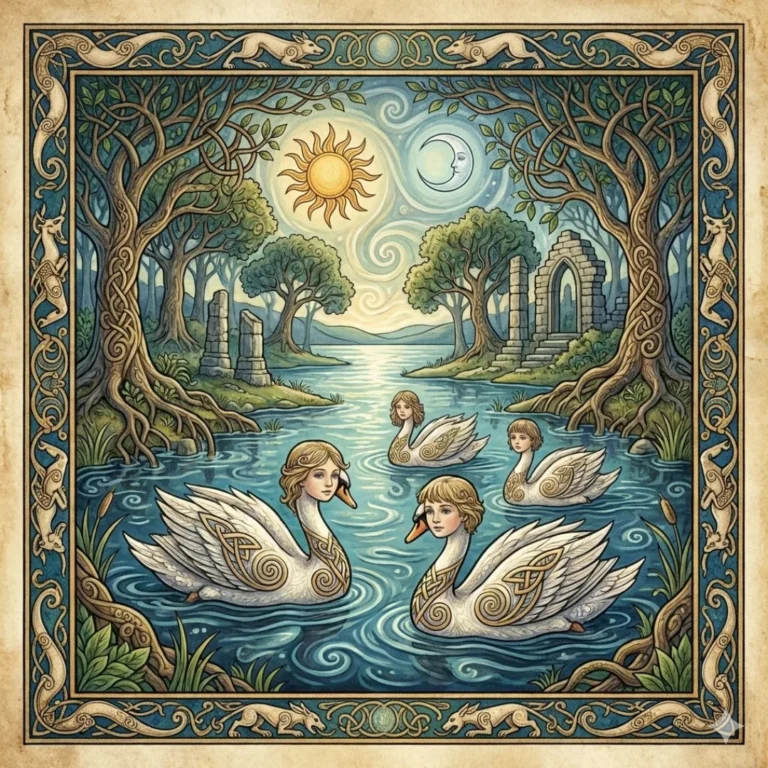
In the emerald hills of ancient Ireland, where morning mist clings to the valleys like a soft grey cloak and the standing stones remember secrets older than memory itself, there lived a girl named Brighid. She was named after the goddess of wisdom, fire, and poetry, though she did not feel particularly wise herself.
Brighid lived in a roundhouse with a roof of golden thatch, where smoke from the central fire drifted up through the roof hole like prayers ascending to the sky. Her grandmother was a druid, one of the wise women who kept the old knowledge alive through story and song, through careful observation of the stars and seasons, through understanding the language of herbs and trees.
Now, you must understand that Brighid was clever – quick-witted and sharp as a thorn. She could recite all the genealogies of the great heroes, could name every star in the night sky, could tell you which herbs would soothe a fever and which would bring sleep. She had studied hard, learning everything her grandmother taught her, memorizing poems and laws and ancient wisdom.
But there was something Brighid wanted more than anything else in the world. She wanted to be truly wise, not just knowledgeable. She wanted to understand the deep mysteries that her grandmother spoke of in hushed tones, the kind of wisdom that couldn’t be learned from books or recitations, but had to be earned through experience.
One autumn morning, when the hawthorn trees were heavy with red berries and the air smelled of woodsmoke and approaching rain, Brighid’s grandmother called her to the fireside.
‘My dear child,’ said the old woman, her eyes bright as a bird’s, ‘you have learned much, but you have learned it all here, in safety, by our warm fire. True wisdom, however, comes from walking out into the world with open eyes and an open heart. Are you ready for such a journey?’
Brighid’s heart leaped like a salmon in a stream. ‘Yes, Grandmother! I am ready!’
The old druid smiled, though there was a touch of sadness in it. ‘Then I will give you a task. Journey to the sacred grove at the heart of the forest, where the oldest oak tree in all of Ireland grows. Beneath that oak, you will find the Stone of Wisdom. Place your hand upon it, and it will ask you three questions. Only when you answer all three truthfully will you gain the wisdom you seek.’
‘Three questions?’ Brighid said confidently. ‘I have studied for years, Grandmother. I can answer any question about our history, our laws, our herbs and stars and—’
‘Perhaps,’ her grandmother interrupted gently. ‘Or perhaps not. The Stone does not ask the questions you expect, child. It asks the questions you need.’
So Brighid set out the very next morning, her cloak wrapped tight against the autumn chill, her leather bag carrying bread and cheese and a flask of clear water from the sacred well. The journey to the heart of the forest would take three days, and she walked with a light step, confident in her knowledge and ability.
The first day of walking was easy enough. The path was clear, the weather fair, and Brighid sang songs as she walked, feeling very much like the hero of her own story. But as afternoon shadows grew long, she came upon a sight that made her stop.
An old woman sat by the roadside, weeping. Her cloak was threadbare, her face lined with care and age, and beside her lay a walking stick, broken in two pieces.
‘Why do you weep, grandmother?’ Brighid asked, using the term of respect for any elder.
‘My stick is broken,’ the old woman said, ‘and I cannot walk without it. I was traveling to my daughter’s house for the winter, but now I cannot continue, and night is coming.’
Brighid felt a tug of sympathy, but she also felt the pull of her quest. If she stopped to help, she might not reach the sacred grove in time. And surely this old woman would be fine – someone else would come along to help her.
But something in Brighid’s heart whispered that this was not right. So she sat down beside the old woman and, using her knowledge of trees and her small knife, she fashioned a new walking stick from a fallen ash branch, strong and smooth and just the right height.
‘There,’ she said, helping the old woman to her feet. ‘This will serve you well.’
The old woman’s eyes gleamed strangely in the fading light. ‘You have a kind heart, child. Remember this: knowledge tells you what you can do, but wisdom tells you what you should do.’
Then the old woman walked away into the forest, moving much more spryly than Brighid would have expected, and was soon lost in the gathering dusk.
The second day, Brighid walked deeper into the forest, where the trees grew so thick that the sky was only a distant promise glimpsed through green. At midday, she came to a stream that rushed fast and cold over black rocks. The stepping stones that should have crossed it were visible, but they were slippery with moss and spray.
As Brighid prepared to cross, she heard a small voice: ‘Help! Help!’
Looking around, she saw a tiny bird, its wing tangled in a bramble bush beside the stream. The poor creature struggled and chirped in distress.
Again, Brighid felt torn. She was making good time, and if she stopped to help the bird, she might lose precious daylight. Besides, it was just a bird – surely it would free itself eventually?
But she remembered the old woman’s words: wisdom tells you what you should do. Carefully, she untangled the bird, smoothing its ruffled feathers and checking that its wing was not broken. The bird sang a bright note of thanks and flew away into the canopy.
As it flew, it seemed to call back to her, and though Brighid did not speak the language of birds, she heard in her heart: ‘You have a gentle touch, child. Remember this: knowledge gives you power, but wisdom gives you compassion.’
On the third day, Brighid finally reached the heart of the forest. And there it stood – the oldest oak in all of Ireland, so massive that ten people holding hands could not encircle its trunk, its branches reaching up like the arms of the earth itself, embracing the sky. Beneath it, half-buried in moss and fallen leaves, lay a stone carved with spirals and ancient symbols that seemed to shift and shimmer in the dappled light.
Brighid knelt and placed her hand upon the Stone of Wisdom. It was warm, as if it held the heat of every summer sun that had shone upon it, and it seemed to pulse like a heartbeat.
Then a voice spoke, though whether it came from the stone, the tree, or from somewhere deep inside her own heart, Brighid could not say:
‘First question: What is the difference between knowledge and wisdom?’
Brighid opened her mouth to recite one of the definitions she had memorized, but the words died on her lips. Instead, she thought of the old woman and the bird, of the choices she had made on her journey.
‘Knowledge is what you learn from others,’ she said slowly, ‘from books and teachers and study. It tells you what things are and how they work. But wisdom… wisdom is what you learn from living, from choosing, from experience. Knowledge tells you what you can do, but wisdom tells you what you should do.’
The stone pulsed warmly beneath her hand. ‘Second question: Where does true wisdom come from?’
Again, Brighid paused. She thought of all the hours she had spent memorizing poems and laws, and she thought of the three days she had spent walking, helping, choosing.
‘True wisdom doesn’t come from memorizing facts or reciting old words,’ she said. ‘It comes from walking through the world with open eyes and an open heart. It comes from making choices, even difficult ones. It comes from kindness and compassion and from learning from every experience.’
The stone grew warmer still. ‘Third and final question: Are you wise?’
This was the hardest question of all. Brighid’s first impulse was to say yes – she had answered the first two questions correctly, hadn’t she? But then she understood. True wisdom would recognize that wisdom is not a destination but a journey.
‘No,’ she said honestly. ‘I am not wise. Not yet. I am learning to be wise. Every day, every choice, every kindness, every mistake – they all teach me. I will spend my whole life learning wisdom, and even then, I will have more to learn. Wisdom is not something you achieve and keep like a prize. It is something you earn again and again, with every sunrise.’
For a long moment, there was silence. Then the stone beneath her hand seemed to sing, a note so pure and clear that it resonated in her bones, in her blood, in her very soul. And Brighid understood.
She understood that wisdom was not a magical gift that would suddenly make her know everything. It was a way of walking through the world – with humility, with compassion, with willingness to learn from every moment. It was choosing to help the old woman even when it was inconvenient. It was showing gentleness to a small bird. It was admitting when you didn’t know something. It was understanding that knowledge and wisdom, while related, were as different as a map and a journey.
When she opened her eyes, the sun was setting through the oak’s ancient branches, painting the world in gold and amber. And there, standing beneath the tree, was the old woman from the road and, perched on her shoulder, the small bird from the stream.
But now Brighid could see them clearly for what they truly were – spirits of the forest, guardians of the sacred grove, wearing the shapes they chose to test those who sought wisdom.
‘You have learned well, child,’ said the woman, who was no longer old but ageless, her eyes holding the depth of centuries. ‘True wisdom comes from learning and experience, not from books alone. Carry this lesson with you always.’
Brighid returned to her grandmother’s roundhouse, and though she looked no different on the outside, something within her had changed. She continued to study, yes, but now she also listened more than she spoke. She observed the world around her with new attention. She made her choices with care, asking not just “what do I know?” but “what should I do?”
Years passed, and Brighid became a druid like her grandmother, known throughout the land not for reciting facts, but for her wisdom. When people came to her with troubles, she would help them find their own answers. When students asked her questions, she would often respond with stories rather than facts, knowing that wisdom learned through experience lasts longer than wisdom heard in words.
And sometimes, on quiet evenings by the fire, she would tell the story of her journey to the sacred grove, of the three questions and the lessons learned along the way. And she would always end by saying:
‘True wisdom comes from learning and experience. Knowledge can be taught, but wisdom must be earned, one choice at a time, one kindness at a time, one honest moment at a time.’
And in the emerald hills of Ireland, where the standing stones still remember the old secrets and the morning mist still clings to the valleys, they say that story is still being told, passed from grandmother to grandchild, a reminder that wisdom is not about knowing all the answers, but about asking the right questions and learning from every moment of our lives.
Frequently Asked Questions
What is the moral lesson of Brighid and the Three Questions – A Celtic Wisdom Story for Kids?
What age is this story appropriate for?
How long does it take to read Brighid and the Three Questions – A Celtic Wisdom Story for Kids?
What culture does this story come from?
Can I use this story for teaching?
Frequently Asked Questions
What is the story of Brighid and the Three Questions about?
Brighid and the Three Questions is a Celtic moral story set in ancient Ireland about a clever girl named after the goddess of wisdom. Despite memorizing vast knowledge, Brighid discovers there is something more important than book learning. The story explores themes of true wisdom, humility, and the difference between knowing facts and understanding life.
What age group is Brighid and the Three Questions suitable for?
This story is ideal for children aged 6 to 12, though its moral lessons resonate with readers of all ages. The rich Celtic setting and relatable main character make it engaging for kids, while parents and teachers will appreciate the deeper wisdom themes woven throughout the narrative.
What moral lesson does Brighid and the Three Questions teach?
The story teaches that true wisdom goes beyond memorizing facts or reciting knowledge. Brighid learns that real understanding comes from curiosity, listening, and knowing the right questions to ask. It encourages children to value thoughtful questioning over simply having all the answers.
📚 Recommended Books
Handpicked for readers like you
As an Amazon Associate, we earn from qualifying purchases. These recommendations are personalized based on this story's themes and your reading history.
Is Brighid and the Three Questions based on Celtic mythology?
Yes, the story draws inspiration from Celtic mythology and ancient Irish tradition. The character Brighid is named after the beloved Irish goddess of wisdom, fire, and poetry. The setting features druids, roundhouses, and standing stones, giving the tale an authentic Celtic folklore atmosphere rooted in real cultural heritage.
Who is the goddess Brighid in Irish mythology?
In Irish mythology, Brighid is a powerful goddess associated with wisdom, poetry, healing, and fire. She is one of the most beloved Celtic deities, celebrated during the festival of Imbolc. In the story, the young girl Brighid shares her name but must grow into the qualities the goddess represents.