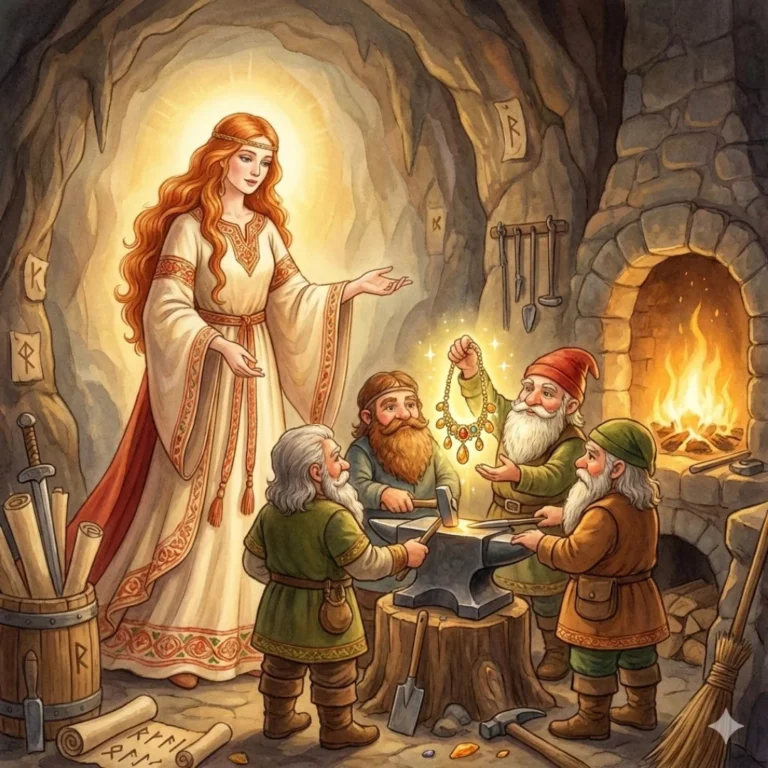
One misty morning, she wandered into the ancient forest where the pine trees whispered secrets and the streams sang silver songs. Deep in a cave carved from blue-black stone, she heard the ring of hammers on metal—tap, tap, tap.
Inside the cave, four dwarf brothers worked at their forge. The fire glowed orange and red, casting dancing shadows on the walls. And there on the anvil lay the most beautiful thing Freya had ever seen: a necklace called Brisingamen.
The necklace blazed with an inner light, as if it held captured stars. Gold threads woven together like rivers of sunlight, studded with gems that sparkled like frost on a winter morning. Each link was perfect, each jewel caught the firelight and threw it back in rainbows.
“Oh!” Freya gasped, her hand reaching toward it. “I must have this necklace! I’ll give you anything—gold, silver, treasures from my hall!”
The eldest dwarf, Dvalinn, looked up from his work. His beard was long and gray as storm clouds. “We don’t need gold, goddess. We make it ourselves.”
“Then what do you want?” Freya asked, unable to take her eyes from the glowing necklace.
The four brothers looked at each other. “Four days and four nights,” said Alfrik, the second brother. “One day and night with each of us.”
Freya’s heart squeezed tight. Four days and nights away from her beautiful hall in Asgard? Away from her duties as goddess? Away from everything she loved? The price seemed so high.
But the necklace called to her like a song. “Yes,” she whispered. “I agree.”
For four days and four nights, Freya stayed with the dwarves in their dark cave. She helped them work the forge, learned their ancient songs, listened to stories of deep earth and hidden gems. Each brother taught her something: Dvalinn showed her patience, Alfrik shared wisdom, Berling taught her humility, and Grer revealed secrets of the stone.
When the fourth night ended and dawn broke over the mountains, the brothers fastened the Brisingamen around Freya’s neck. It was even more beautiful than she remembered—warm against her skin, glowing with soft light.
But as Freya walked home through the forest, she felt different. The necklace was heavy. Not heavy on her neck, but heavy in her heart. She had paid such a high price—four days and nights she would never get back. Days when duties went undone, when others might have needed her help.
Back in her hall, she looked at herself in the still water of her silver bowl. Yes, the necklace made her more beautiful. But had it been worth the cost?
That night, as stars appeared over the northern mountains, Freya understood something important. Beautiful things always cost something. The dwarf brothers had spent years learning their craft. The necklace itself was made from materials pulled from deep earth with hard work. Even her own beauty—she realized—was a gift that came with the duty to use it wisely.
From that day forward, whenever Freya looked at her necklace, she remembered: everything beautiful requires sacrifice. But we must choose wisely what we’re willing to pay. Some prices are too high. Some bargains leave us poorer, even when we get what we wanted.
The Brisingamen still glows around Freya’s neck, shining like the northern lights. And those who see it remember her lesson: desire what is beautiful, yes—but always count the cost before you pay.
Moral of the Story
Beautiful things require sacrifice, but we must choose wisely what we’re willing to pay
Frequently Asked Questions
What is the moral lesson of Freya’s Necklace?
What age is this story appropriate for?
How long does it take to read Freya’s Necklace?
What culture does this story come from?
Can I use this story for teaching?
Frequently Asked Questions
What is the story of Freya’s necklace about?
Freya’s necklace is a Norse mythology story about Freya, the goddess of love and beauty, who discovers a breathtaking magical necklace called Brisingamen crafted by four dwarf brothers in a forest cave. The story explores themes of desire, the lengths we go to get what we want, and the consequences of our choices.
What is Brisingamen in Norse mythology?
Brisingamen is Freya’s legendary necklace in Norse mythology. Crafted by four dwarf brothers, it was said to glow with an inner light like captured stars, with gold threads woven like rivers of sunlight and jewels that sparkled like frost. It became one of the most prized treasures in all the Norse myths.
Is Freya’s necklace story suitable for kids?
Yes, this retelling of Freya’s necklace is written as a children’s story with gentle, imaginative language. It uses the Norse myth as a foundation to teach young readers meaningful moral lessons, making it both entertaining and educational for kids who enjoy mythology and adventure tales.
📚 Recommended Books
Handpicked for readers like you
As an Amazon Associate, we earn from qualifying purchases. These recommendations are personalized based on this story's themes and your reading history.
Who is Freya in Norse mythology?
Freya is the Norse goddess of love and beauty. She is one of the most well-known figures in Norse mythology, often depicted with golden hair and magical abilities. She lives in the far northern lands among mountains and fjords, and her famous necklace Brisingamen is central to many stories about her.
What moral lesson does Freya’s necklace teach children?
Freya’s necklace story teaches children about the dangers of wanting something so desperately that you sacrifice your values to get it. It encourages kids to think about whether the price of something is truly worth paying, and to consider the difference between wanting something and genuinely needing it.