

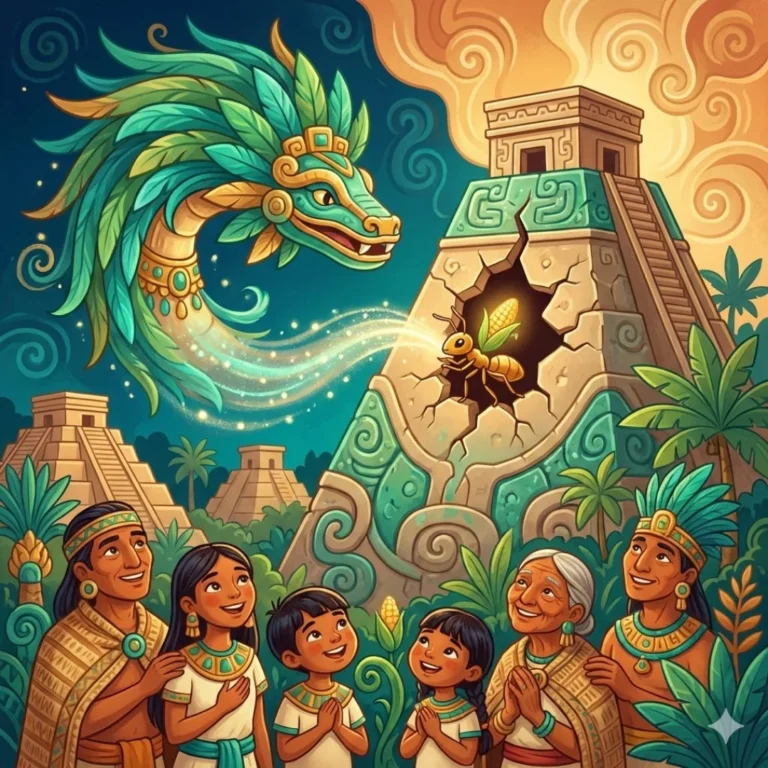
One morning, Quetzalcoatl glided through a village and noticed something terrible. The children sat quietly—too quietly. Their bellies were empty, and their mothers had nothing to cook. The men returned from hunting with weary faces and empty hands.
“Why do my people suffer so?” Quetzalcoatl asked an old woman sitting outside her home.
The woman looked up at the magnificent god. “Great Feathered Serpent, we survive on roots and wild berries, but they are not enough. We grow weak. Our children cry from hunger. We have searched everywhere for better food, but we find nothing.”
Quetzalcoatl’s heart ached. What good was his power if his people starved? He spread his feathered wings and flew high above the earth, searching for something—anything—that could feed the humans he cherished.
As he soared over mountains and valleys, his sharp eyes spotted something curious. A line of red ants marched in and out of a crack in a massive mountain. And each ant that emerged carried a single golden kernel of something Quetzalcoatl had never seen before.
He swooped down and landed beside the ants. “Little friends, what is that you carry?”
The ants paused. One brave ant stepped forward. “This is maize, Great One. It grows inside the mountain, where the gods hid it long ago. It is the most delicious and nourishing food in all the world. One kernel can grow into a tall plant that feeds many.”
“Will you share it with me?” Quetzalcoatl asked. “My people are starving.”
The ant shook her tiny head sadly. “We would if we could, but the mountain is sealed tight. Only creatures as small as we are can squeeze through the cracks. Even you, powerful as you are, cannot break through solid stone.”
Now, another god might have given up. Another god might have said, “Too bad for the humans—at least I tried.” But Quetzalcoatl was different. He didn’t think about himself first. He thought about the children with empty bellies and the mothers with nothing to cook.
“If I cannot enter as a god,” Quetzalcoatl announced, “then I shall enter as an ant.”
The ants gasped. “But Great Feathered Serpent, you are magnificent! Why would you make yourself so small and ordinary?”
Quetzalcoatl smiled gently. “Because sometimes, helping others means becoming less so they can become more.”
With a shimmer of magic, the beautiful god transformed. His shining feathers vanished. His graceful serpent body shrank and shrank until he was no bigger than the red ants beside him. He had six tiny legs, two waving antennae, and a body as small as a grain of sand.
“Show me the way,” said Quetzalcoatl in his tiny ant voice.
The ants led him through the narrow crack in the mountain. It was dark inside, and the passage was so tight that Quetzalcoatl’s little ant body barely fit. He squeezed and pushed, crawled and climbed. The journey was hard—far harder than flying through the clouds had ever been.
Finally, they emerged into a vast cavern inside the mountain. Quetzalcoatl’s ant eyes grew wide with wonder. Golden maize grew everywhere—tall stalks heavy with ears of corn, each kernel glowing like a tiny sun.
“Help me carry as much as we can,” Quetzalcoatl called to his ant friends.
All day and all night, Quetzalcoatl worked. Trip after trip, he carried kernels through the narrow passage. His tiny ant legs grew tired. His back ached. But each time he thought about stopping, he remembered the hungry children, and he kept going.
When morning came, Quetzalcoatl transformed back into his glorious form. He gathered all the kernels he’d carried and flew to the villages, distributing the golden maize to every family.
“Plant these in the earth,” he told the people. “Water them with care. When they grow, you will never be hungry again. And remember—this gift came because someone was willing to become small to serve you.”
The people planted the maize, and it grew tall and strong, just as Quetzalcoatl promised. From that day forward, they always had enough to eat. And whenever they ground the corn to make tortillas, they remembered the Feathered Serpent who loved them so much that he gave up his greatness to crawl like an ant through the dark.
Years later, children would ask their grandparents, “Why did Quetzalcoatl become an ant? He was a powerful god!”
And the grandparents would smile and say, “Because true leaders don’t ask others to do what they won’t do themselves. They serve first, and they lead by example. That is the way of the Feathered Serpent, and that is the way we should live too.”
And so the people of the valley learned that the greatest power isn’t in being strong or mighty—it’s in being willing to help others, no matter what it costs you.
Moral of the Story
True leadership means serving others, even at great personal cost. The greatest power isn’t in being strong or mighty—it’s in being willing to help others, no matter what it costs you.
Frequently Asked Questions
What is the moral lesson of Quetzalcoatl and the Gift of Maize?
What age is this story appropriate for?
How long does it take to read Quetzalcoatl and the Gift of Maize?
What culture does this story come from?
Can I use this story for teaching?
Frequently Asked Questions
What is the story of Quetzalcoatl and the gift of maize about?
This story tells how Quetzalcoatl, the Feathered Serpent god of Aztec mythology, discovered maize and brought it to his people who were suffering from hunger. It’s a children’s retelling of the ancient legend explaining how corn became a staple food, highlighting themes of compassion, courage, and caring for others.
Who is Quetzalcoatl in Aztec mythology?
Quetzalcoatl is one of the most important Aztec gods, known as the Feathered Serpent. He was covered in brilliant green feathers and had the body of a serpent. Unlike many gods, he was believed to walk among humans and care deeply about their well-being, making him a beloved figure in ancient Mesoamerican culture.
Why did Quetzalcoatl give maize to humans?
Quetzalcoatl gave maize to humans because his people were starving. Villagers survived only on roots and wild berries, which weren’t enough to sustain them. Seeing hungry children and suffering families deeply troubled him, so he used his divine power to find and share maize, giving people a nourishing and reliable food source.
📚 Recommended Books
Handpicked for readers like you
As an Amazon Associate, we earn from qualifying purchases. These recommendations are personalized based on this story's themes and your reading history.
Is the Quetzalcoatl maize legend suitable for kids?
Yes, this retelling of the Quetzalcoatl and maize legend is written specifically for children. It uses simple, engaging language and focuses on positive values like kindness and helping others. It’s a great way to introduce kids to Aztec mythology and world cultures while sharing an entertaining and meaningful moral story.
What moral lesson does the Quetzalcoatl and maize story teach children?
The story teaches children the value of compassion and taking action when others are in need. Quetzalcoatl didn’t ignore his people’s suffering — he used his gifts and courage to find a solution. The tale encourages kids to care about their communities and shows that true power means helping others, not just looking after yourself.
