A Buddhist bedtime story about compassion, retold for ages 6-12.
There is an old bedtime story that grandmothers in Sri Lanka still whisper to sleepy children, and it always starts the same way: with a question nobody wants to answer. Tonight, it’s your turn to try answering it too.
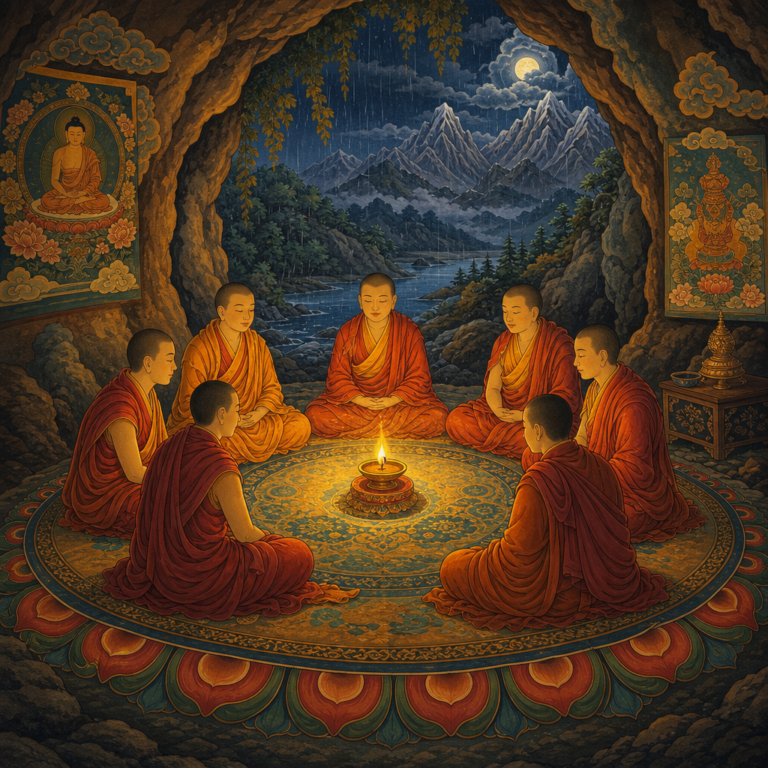
Deep in a jungle thick with fig trees and singing cicadas, there was a cave where seven monks lived. They spent their days meditating on a stone floor cool as river water, breathing in the smell of beeswax candles and rain-soaked leaves. At night, moonlight poured through the cave mouth like spilled milk, and you could hear owls calling from tree to tree, as if passing secrets along.
The head monk, Nandiya, had a quiet, steady voice, the kind that made people listen even when he barely spoke above a whisper. Beside him sat his brother Tissa, who had become a monk on the very same day as Nandiya, and his dearest friend Sona, who could always make him laugh even during silent meditation, which got them both in trouble more than once. There was also Vappa, who argued with Nandiya about nearly everything — even which way to sweep the cave floor. Old Uttara was so wrinkled and slow that everyone whispered he might not see another rainy season. Young Deva coughed through the night, sick with a fever that never fully broke. And then there was Piya, who dropped every bowl he touched and fell asleep mid-chant, but who always shared his rice with the birds.
One evening, three bandits crept into the jungle looking for a hiding place from the king’s soldiers. They found the cave — and the monks already inside it.
“This is perfect,” growled their leader, a scarred man named Kalu, “except for one small problem.”
“We will tell no one you were here,” Nandiya said calmly, stepping forward. “We keep our promises. That is our way.”
Kalu narrowed his eyes. “Words are cheap, monk. I need something stronger than a promise.” He drew his knife slowly, letting torchlight slide along the blade. “One of you dies tonight. As a warning. So the rest of you remember what happens if you talk.”
The cave went silent except for Deva’s shallow breathing and the drip of water somewhere in the dark.
“Take me,” Tissa said suddenly, gripping his brother’s sleeve. “I would rather it be me than watch you choose.”
“No,” Nandiya answered, his voice cracking just slightly. “Let me think.”
All night, Nandiya sat with his eyes closed, and the other monks watched him, terrified of what he might decide. Should it be Vappa, who annoyed him constantly? Should it be Uttara, who was old anyway? Should it be Deva, who was already so sick? Should it be clumsy, sleepy Piya, who broke every bowl he ever held?
This is exactly the kind of impossible question that makes kids ages 6-12 go quiet when they hear it, because there is no easy answer — and Nandiya knew it too.
When dawn light finally crept pink and gold across the cave stones, Nandiya rose and walked to Kalu.
“I cannot choose,” he said.
Kalu laughed, cold and sharp. “Then I will choose for you.”
“Wait.” Nandiya held up a hand, and something in his stillness made even Kalu pause. “Let me explain why. My love for my brother is not one grain heavier than my love for my friend. My love for the monk who argues with me is not one grain lighter than my love for the monk who cannot stay awake. The old monk, the sick monk, the clumsy monk — I hold each of them in my heart exactly the same, with no more and no less than I hold myself. That is what our teacher, the Buddha, called metta, loving-kindness that leaves no one out. I have searched all night, and I cannot find even a thread of difference between them. So I cannot choose. There is nothing to choose from.”
The cave was silent again, but this silence felt different — full instead of empty, like the pause right before rain.
Kalu stared at Nandiya for a long moment. Something in his scarred face softened, the way frost melts when the sun finally reaches it. He lowered his knife.
“No one dies here tonight,” he said quietly.
By morning, two of the bandits had asked to stay in the cave and learn to meditate beside the monks. Kalu himself sat cross-legged on the stone floor, watching dust drift through the first light like tiny golden fish swimming through the air. The third bandit walked back toward his village, promising he would never steal again.
📚 Recommended Books
Handpicked for readers like you
As an Amazon Associate, we earn from qualifying purchases. These recommendations are personalized based on this story's themes and your reading history.
And somewhere far above the jungle canopy, the stars kept their old habit of watching quietly, the way they always do when someone finally answers a question that seemed impossible — not with cleverness, but with a heart wide enough to hold everyone in it at once.
Moral of the Story
Compassion