What the Snow Lion Knew
Not frozen — silent. The water hadn't turned to ice. It had simply… stopped. Like a story cut off in the middle of a sentence. Every morning, the children would run to the stone basin at the village center, only to find it empty and dry as old bone. (This is the kind of tale that grandmothers tell as a bedtime story, tucking the littlest ones under yak-wool blankets while the wind howls outside.) Every morning, they found nothing.
The elders said the Nāga — the great water serpent who slept beneath the mountain spring — had been offended. Someone had thrown a stone into her sacred pool. Someone had disturbed her sleep.
No one knew who.
But the water was gone, and the barley fields were turning brown at the edges, and the smell of dust was everywhere — sharp and wrong, where there should have been the clean cold scent of snowmelt.
Dorje was ten years old and small for his age, with wind-chapped cheeks and eyes the color of dark tea. He hadn't thrown the stone. He knew who had — his little sister Pema, who hadn't understood, who had only been playing. He'd watched her do it and said nothing, too afraid of her crying if he told her off.
Now the whole village was suffering for his silence.
On the seventh night, Dorje couldn't sleep. He lay beneath his blankets listening to the wind moan through the prayer flags outside — that low, singing sound — and he made up his mind.
He would climb to the high cave above the village, where the monks said the Green Tara sometimes came to rest, and he would ask for her help.
—
He left before dawn, when the stars were still scattered like butter lamp flames across the dark sky. The mountain path was steep and rocky, and by the time the sun crept over the eastern peaks, his legs ached and his breath came out in white clouds.
That was when he heard it.
A sound that wasn't wind. Low and rough, like gravel rolling underwater.
Dorje froze. His heart thumped so hard he felt it in his ears. Slowly, he turned.
There, wedged between two boulders, was the most magnificent and terrifying creature he had ever seen.
A snow lion.
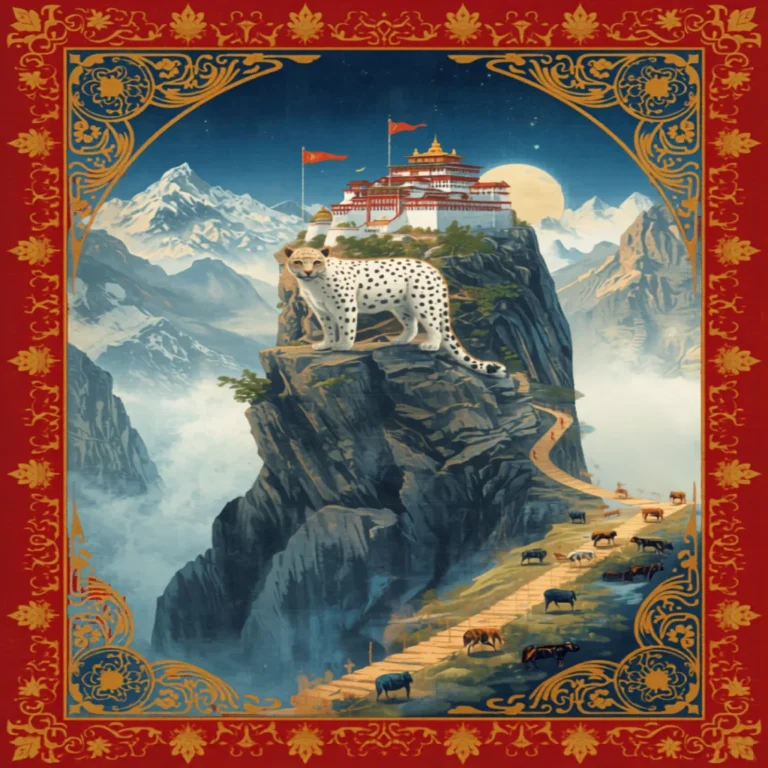
It was enormous — as big as a horse, covered in fur so white it almost glowed, with a mane the color of turquoise water. In all the old stories, snow lions were fearless, the guardians of the sacred peaks, strong enough to carry the weight of mountains on their backs.
This one was whimpering.
Its great front paw was caught between the rocks, twisted at a painful angle. Its golden eyes, when they found Dorje's, were wet with pain.
Every part of Dorje wanted to run.
He took one step back. Then stopped.
the lion made the sound again — that low, gravelly moan — and its eyes didn't leave his face.
Dorje's hands were shaking. He had never been so scared in his life. But he thought of Pema, who had thrown the stone without understanding. He thought about how sometimes you do something that hurts others without meaning to. And he thought: this creature didn't mean to get stuck either.
He took a breath of mountain air — so sharp and clean it almost burned his throat — and he walked toward the snow lion.
"Okay," he whispered. "I'm going to help you. Please don't eat me."
The snow lion blinked.
Dorje wedged himself against the boulder, braced his feet, and pushed with everything he had. The rock was rough under his palms. His arms screamed. He pushed again — harder — until something shifted, just enough.
The snow lion pulled its paw free with a grunt.
For one terrible moment, they stared at each other. The lion was so close that Dorje could smell it — warm fur, cold stone, something faintly like pine resin. He could see the rise and fall of its huge chest.
Then the snow lion lowered its great head and pressed its forehead — gently, so gently — against Dorje's cheek.
It was like being touched by a warm cloud.
Then it stepped back and spoke, because in the time between stars and sunrise, such things are possible.
"Why did you help me?" it rumbled. "You were afraid."
"I was," Dorje said honestly. "I still am, a bit. But you needed help."
The lion was quiet for a moment. Then: "What do you seek on this mountain, small one?"
"I'm going to find the Green Tara," Dorje said. "Our spring has gone dry. The Nāga who guards it was offended by a stone thrown in her pool. I need to ask for help to fix things."
The lion looked up the mountain, toward the high cave. "The Tara will not restore the spring for you," it said. "She doesn't work that way. But I know what the Nāga needs to hear."
"What?"
"The truth," said the snow lion. "Go to the pool. Say what really happened. No blame, no hiding. Just the truth, spoken aloud, and an apology that comes from the heart."
Dorje thought of Pema. He thought of his own silence, which was its own kind of lie.
"Both truths?" he asked quietly.
The lion met his eyes. "Both truths."
—
The journey back down was faster than the journey up. The sun was high and bright by the time Dorje reached the village, and the sky above the peaks was the deep blue of a lapis stone — the color used in the old painted thangkas that hung in the monastery.
The whole village had gathered around the dry basin, worried and tired.
Dorje pushed through to the front. "I need to say something," he announced. His voice only wobbled a little.
He told them everything. He told them about Pema, who hadn't understood, who had only been playing. And he told them about himself — that he had seen, and stayed quiet, and let the silence grow into something heavy and wrong.
Pema began to cry. He took her hand.
"We're sorry," Dorje said to the empty pool. "We're sorry for the disturbance. We didn't understand. We do now."
For a moment, nothing happened.
Then — a gurgling sound, like a laugh buried deep underground.
The water came back slowly, threading up through the stone like something shy, then faster, until it was spilling over the basin's edge and splashing cold and bright onto the dusty ground. It smelled like snow and deep earth and something sweet that Dorje couldn't quite name.
The village erupted in shouts and laughter. Children — the kind of kids this story was made for, ages 6-12, the ones full of big questions and brave hearts — splashed their faces and cupped cold handfuls to their mouths, laughing.
Dorje felt Pema squeeze his hand.
"Are you angry at me?" she asked, her voice very small.
He looked down at her wet, worried face. "No," he said. "I should have spoken sooner. That was my part of it."
She leaned her head against his arm, and he felt something loosen in his chest — something that had been knotted up for seven whole days.
That evening, as the butter lamps were lit in the monastery windows and their small amber flames glowed soft against the dusk, Dorje looked up at the high white peaks. Just for a moment, he thought he saw something moving up there — enormous and white and bright as new snow, leaping easily from rock to rock.
Then the prayer flags snapped in the wind, and it was gone.
He smiled, and went home for dinner.
📚 Recommended Books
Handpicked for readers like you
As an Amazon Associate, we earn from qualifying purchases. These recommendations are personalized based on this story's themes and your reading history.