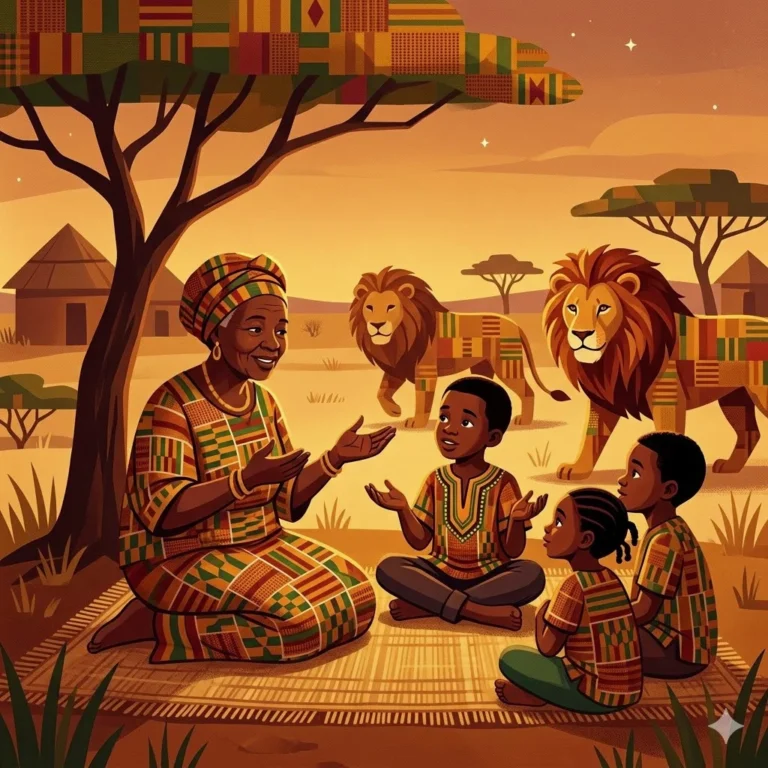
The Boy Who Walked With Lions
—
In a village nestled between two great hills in West Africa, there lived a boy named Kofi. He was small for his age, with quick eyes the colour of river mud and feet that never seemed to stop moving. The village sat near the edge of a vast grassland where the tall, golden grass hissed in the wind like whispered secrets, and the red earth smelled of rain even when the sky was cloudless and blue.
The village had one great problem: a pride of lions had taken to prowling the edges of the fields at night. The farmers' goats disappeared. The cattle refused to leave their pens. And every morning, the elders would sit beneath the ancient acacia tree, its twisted branches spread wide like an old man's arms, and they would argue.
"We must send hunters," said one.
"We have no hunters left since the drought took our strongest men north," said another.
"Then we wait," said a third.
And so they waited. And the goats kept disappearing.
Kofi listened from behind the great gnarled roots of the acacia tree. He pressed his back against the rough bark, feeling it scratch through his thin shirt, and he thought very hard.
That evening, he went to see old Nana Adwoa, the keeper of stories. She lived in a round hut that smelled of dried herbs and woodsmoke, and her walls were hung with calabashes and carved wooden masks that seemed, in the firelight, to breathe.
"Nana," said Kofi, crouching at her feet on the cool clay floor, "how did our ancestors stop the lions?"
Nana Adwoa did not look up from her weaving. Her fingers moved like birds through the coloured threads. "They did not stop them," she said.
Kofi frowned. "Then what did they do?"
"They *spoke* to them." She finally looked up, her eyes like two dark, deep pools. "Not with words, child. With understanding. A lion does not enter a village because it is evil. It enters because it is *hungry*."
Kofi sat with that thought for a long time. The fire crackled and popped between them. An owl called somewhere in the dark outside.
"Where have the antelope gone this season?" he asked slowly.
Nana Adwoa smiled. Just barely. But she smiled.
—
The next morning, Kofi went to the edge of the grassland alone. His mother would have forbidden it — so he did not tell her. The grass came up to his chest, whispering and swaying around him, and the ground felt warm beneath his bare feet even in the early cool of dawn. He could smell the sharp, wild scent of something large nearby. His heart hammered like a talking drum.
He did not run.
He walked forward slowly, the way Nana Adwoa had taught him to approach a frightened dog — low, calm, hands open.
At the edge of a clearing, three lions lay in the long grass. One lifted its great tawny head and fixed Kofi with amber eyes. The morning light caught the mane and turned it to fire.
Kofi stopped. He breathed. His legs wanted very badly to run.
"I see you," he said quietly. "And I know why you have come."
The lion did not move.
"The antelope have gone east, to the river mouth where the rains brought new grass. You have been following old paths. But the world has changed." He swallowed. "If you go east along the dry riverbed, past the split fig tree, you will find them."
For a long moment, the savanna was utterly silent. Even the grass stopped its whispering.
Then the lion stood, stretched — a long, slow arc of muscle and golden fur — and turned its gaze east. The two others rose as well. And without a sound, they walked into the grass and disappeared.
—
The goats were never taken again.
The elders could not explain it. They inspected the lion tracks, they argued under the acacia tree, they debated charms and offerings. Only Nana Adwoa said nothing. She simply handed Kofi an extra piece of flatbread that evening and went back to her weaving.
Kofi's mother noticed the flatbread. She narrowed her eyes at him across the fire, where the woodsmoke curled upward and the smell of roasted groundnuts filled the warm air.
"What did you do?" she asked.
"I listened," said Kofi. "And then I walked toward something frightening instead of away from it."
His mother was quiet for a moment. The fire hissed softly.
"Was it very frightening?" she asked.
"Very," said Kofi honestly. "My legs were terrible."
She laughed at that — a real, full laugh — and pulled him close so he could feel the warmth of her through his shirt and hear her heartbeat slow down.
"Your grandfather," she said at last, "used to say that courage is not the absence of shaking. It is walking forward *while* you shake."
Kofi leaned his head against her shoulder and watched the embers glow like a hundred small suns in the dark.
📚 Recommended Books
Handpicked for readers like you
As an Amazon Associate, we earn from qualifying purchases. These recommendations are personalized based on this story's themes and your reading history.
Outside, the savanna breathed its warm, grassy breath, and somewhere very far east, along a dry riverbed past a split fig tree, a pride of lions found exactly what they were looking for.