

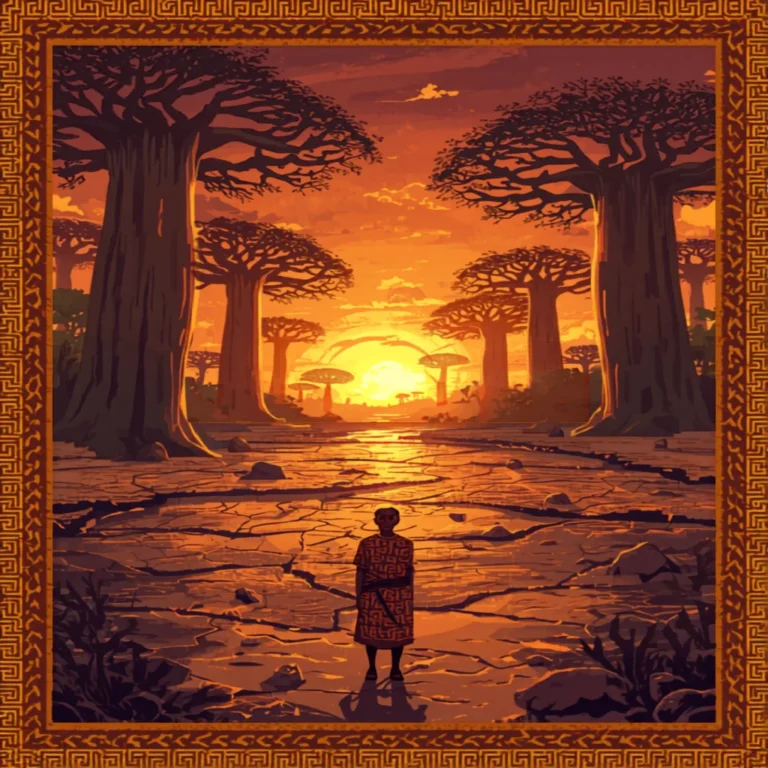
The Girl Who Carried the Rain
—
It hadn't rained in forty days.
The river that ran past the village of Mkweli had become a thin, whispering trickle. The maize plants were brown and bent. The cattle stood very still under the acacia trees, because standing still uses less water than moving around, and cattle understand this better than most.
Zuri pressed her cheek against the Great Baobab — the oldest tree in the village, whose trunk was so wide it would take ten children to hug it. The bark was warm and rough beneath her cheek, like the back of an old, wise hand.
"The tree is sleeping," said a voice.
Zuri turned. Sitting on a low branch above her was a honey badger, its black-and-white fur impossibly neat, its small dark eyes full of something that looked almost like a strong opinion.
"Honey badgers don't talk," said Zuri.
"Honey badgers don't talk to people who aren't paying attention," said the honey badger. "My name is Kivuli. I know where the Rain Keeper lives."
—
Zuri's grandmother, Bibi, had told her about the Rain Keeper long ago.
"She lives at the top of the Hill of Three Winds," Bibi had said, stirring her ugali over the fire, the thick white porridge filling the whole hut with its warm, starchy smell. "She holds the clouds in a clay pot. When she tips it, it rains. When she doesn't —" Bibi had looked out at the cracked, pale ground. "Well. We all know what happens."
"Can someone ask her to tip it?" Zuri had said.
Bibi had looked at her very carefully then, the way grandmothers do when they're deciding whether you're old enough to hear the rest. "Someone could try," she said.
—
So Zuri followed Kivuli across the savanna, which was golden and hot and smelled of warm grass and smoke from somewhere far away. The sun sat on her shoulders like a heavy orange stone.
They hadn't gone very far when Zuri heard a sound — small and trembling — coming from beneath a thornbush.
A lion cub. One tiny paw caught in a tangle of dried roots. Its amber eyes were full of the kind of desperate hope that says *please* without making a single word out of it.
Kivuli trotted straight past. "The Hill is still very far," he called back.
"I know," said Zuri.
She knelt down slowly. The cub went very still. Carefully, quietly, Zuri worked at the roots with her fingers — one twist, then another, then the small paw came free. The cub looked at her once, astonished, then bounded away into the golden grass.
"You know," said Kivuli, watching it go, "the Rain Keeper is going to ask you who you are."
"She's going to ask my name?" said Zuri.
"Not exactly," said Kivuli.
This was the most puzzling thing Zuri had ever heard. She thought about it all the way to the Hill.
—
The Hill of Three Winds was exactly that — tall and round, with three winds arriving from different directions and arguing with each other constantly. Zuri could feel all three at once: one warm, one cool, and one that simply couldn't make up its mind.
Near the bottom of the hill sat a very old woman on a very small stool. She had one eye that looked at you, and one eye looking at something far away and far more interesting.
"I want to pass," said Zuri. "I want to speak to the Rain Keeper."
The old woman smiled. "Answer me this: what is stronger — a river or a stone?"
Zuri chewed her lip. "A stone," she said slowly, "is stronger for one day. But a river is stronger in the end, because it doesn't give up." She paused. "I think. I'm not entirely certain."
The old woman tilted her head. "Most people give me a very certain answer. Most people are wrong. You may pass."
—
The top of the hill smelled like rain. Not the dry, dusty smell *before* rain, but the real, deep, alive smell of it — clean and dark and full of something wonderful.
The Rain Keeper was younger than Zuri had imagined. She sat cross-legged on the red earth, a clay pot cradled in her lap like something precious, her dress the exact colour of storm clouds.
"I have been watching you," she said, without looking up. "I have one question."
Zuri's heart knocked about quite loudly in her chest.
"Why should your village have rain?"
Zuri opened her mouth. She had been preparing something Wise to say. Something Impressive. But standing there, with three winds pulling at her braids and the clay pot just sitting there, she found she didn't want to say the clever thing.
"Because my bibi stands in the heat all day making food for everyone who is hungry, even people who haven't always been kind to her," she said. "And because the children are thirsty. And because when old Mr. Daudi's goat had babies last spring, four different neighbours came running to help — and nobody had asked them. They just… came."
She stopped.
"That's all," she said quietly.
The Rain Keeper looked at her for a long, still moment.
Then she tipped the pot.
—
The rain arrived the way rain does when it has been thinking about it for forty days — all at once, enormous and joyful, bouncing off the red earth in huge splashing drops that smelled of everything good.
Zuri walked home in it, completely soaked, laughing so hard her stomach hurt.
Kivuli trotted beside her. His black-and-white fur was plastered flat to his small round body, and he looked extremely dignified about this.
"You knew what to say," he said.
"I didn't say anything clever," said Zuri.
"No," said Kivuli, and there was warmth in his voice, even if honey badgers don't technically smile. "That's how you knew what to say."
When they reached the Great Baobab, Kivuli slipped into the roots of the tree and vanished, quiet as a thought.
The river filled. The maize grew tall.
And Bibi made extra ugali that night, with no particular reason, except that some nights simply feel like That Kind of Night.
📚 Recommended Books
Handpicked for readers like you
As an Amazon Associate, we earn from qualifying purchases. These recommendations are personalized based on this story's themes and your reading history.
